NLN NEX (Nursing Entrance Exam) · 2026 Edition
NLN NEX Study Guide — 2026 Edition
Edition noteNew for 2026: written to the NLN's Jan 2026 NEX blueprint (the PAX replacement) — 145 scored items, 3 × 60 min
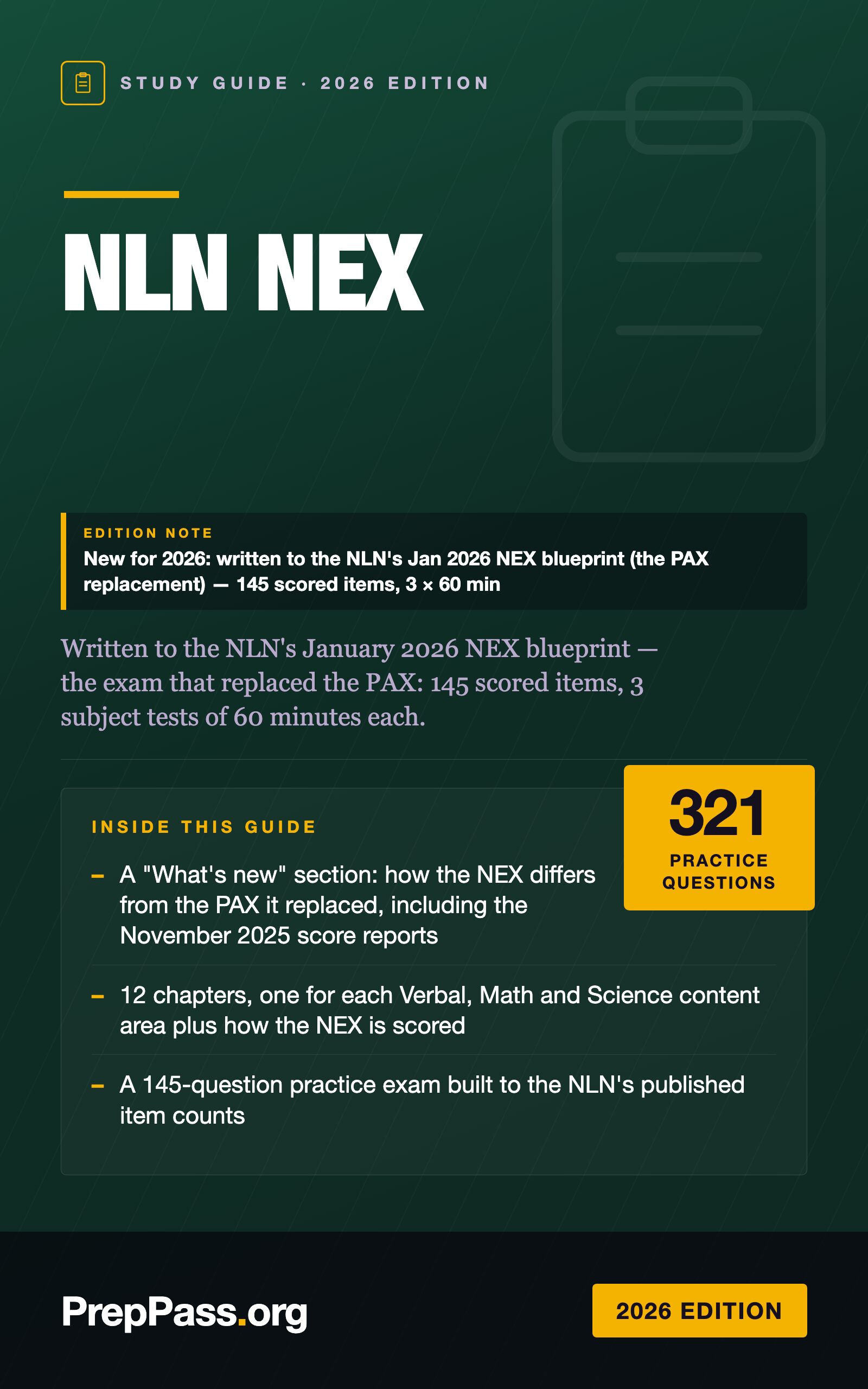
Written to the NLN's January 2026 NEX blueprint — the exam that replaced the PAX: 145 scored items, 3 subject tests of 60 minutes each. 321 original questions and a 145-question practice exam.
- 321 original NLN NEX practice questions, each with a worked explanation, in one PDF + EPUB you keep
PDF + EPUB · English · 260 pages · $24.99 one-time
This book is written in English.
Instant download after payment — no account needed, no subscription.
14-day money-back guarantee: not satisfied for any reason? Email support@preppass.org within 14 days of purchase for a full refund. Refund policy
Look inside the book
Three real pages, rendered straight from the PDF you download — a reference page, a teaching page, and a worked question, always in that order. Nothing here was redrawn to look better.
- Quick referenceChapter 8 — Biology (Science) · PDF page 125
A page you can turn back to: the numbers, deadlines or terms gathered in one place.
- How it's taughtChapter 1 — How the NEX Works: Format, Timing and Scores · PDF page 18
An explanation page: the material taught in prose, in the order the exam tests it.
- A question, workedChapter 11 — Chemistry (Science) · PDF page 166
A practice question with its answer and the reasoning behind it — not just a key.
About the NEX exam
Applicants to RN or LPN/VN nursing programs whose school requires the NLN Nursing Entrance Exam. This book teaches all eleven NEX content areas and ends with a full-length practice exam weighted like the NLN blueprint. It is independent of the NLN, offers no online practice, and cannot predict any program's admission requirement.
Outline changes: The NEX replaced the NLN PAX, which the NLN listed as available through May 31, 2024: each section now has 60 minutes instead of 40, physics was dropped, and math was reorganized into four content areas. Since November 1, 2025, scores are reported against separate RN and LPN/VN reference groups.
| Awarding body | National League for Nursing (NLN) |
|---|---|
| Questions | 145 scored items (Verbal 50, Math 40, Science 55) plus 18 unscored pilot items (8, 5, 5) |
| Time limit | 60 minutes for each of the three subject tests; all three must be completed to produce a score report |
| Passing rule | The NLN does not establish a "passing" or "failing" mark on this exam; each nursing program decides what level of performance it accepts |
| Fees | NLN pricing sheet effective March 1, 2026: $59.00 for the on-campus NEX, $80.00 for the virtual NEX; no refunds; $30 rescheduling fee |
| Delivery | Computer-based, multiple choice with four options, in one live-proctored session at an approved institutional testing center or virtually with active monitoring (Proctor360) |
| Retakes | 30 days between testing unless a school has communicated a different frequency; the NLN does not limit attempts, but schools may |
| Content outline | NEX Blueprint (Nursing Entrance Exam: NEX — Technical Guide: Blueprint, Norms and Reports), Technical brief last updated January 26, 2026 — effective February 11, 2024 |
| Domains and weights |
|
Questions buyers ask
- How many questions are on the NEX and how long is it?
- The NEX has 145 scored questions — 50 Verbal, 40 Math and 55 Science — plus 18 unscored pilot items. Each of the three subject tests is timed at 60 minutes, and all three must be completed to receive a score report.
- What score do I need to pass the NEX?
- There is no NLN passing score: the NLN states that it does not establish a passing or failing mark on this exam. Each nursing program sets its own requirement, so ask your program which score and which reference group it uses.
- What content areas does the NEX cover, and how are they weighted?
- Verbal: Word Knowledge 17% and Reading Comprehension 17%. Math: Numbers and Operations 8%, Measurement 10%, Algebra 5%, Data and Information 5%. Science: Biology 14%, Human Anatomy 8%, Human Physiology 8%, Chemistry 3%, Health 6%. The NLN notes that the percentages may not total exactly 100 because of rounding.
- What changed on the NEX in 2026?
- The blueprint did not change: the NLN's technical brief, last updated January 26, 2026, keeps 145 scored items. Scores reported since November 1, 2025 use separate RN and LPN/VN reference groups. The larger change came earlier, when the NEX, released February 11, 2024, replaced the PAX.
- Who can take the NEX?
- The NLN does not publish a list of eligibility requirements. You register through an NLN testing account linked to your institution, and accommodation requests must come from the institution, so start with the nursing program you are applying to.
- How much does the NEX cost, and can I retake it?
- The NLN's pricing sheet effective March 1, 2026 lists $59.00 on campus and $80.00 virtual; purchases are not refundable. The NLN requires 30 days between attempts unless your school sets a different frequency, and it does not limit the number of attempts.
- How is this study guide organized?
- It has one chapter for each of the NLN's eleven content areas, each ending with a quiz, plus a chapter on scoring and a 145-question practice exam weighted like the blueprint — 321 questions in all, each explained, for $24.99.
- Is the NEX the same as the NLN PAX?
- No. The NEX replaced the PAX, which the NLN listed as available through May 31, 2024. The NEX gives 60 minutes per section instead of 40, has 50 scored Verbal items instead of 60, and no longer tests physics.
- Is a study guide enough for the NLN NEX (Nursing Entrance Exam), or do I need a course?
- A book is exam review: it does not replace any education, training or experience National League for Nursing (NLN) requires before you may sit the exam, so check those requirements first. For the exam content itself, this 260-page guide teaches the material chapter by chapter with 321 practice questions and explanations inside. A prep course adds live instruction and a set schedule; whether you need one beyond any required education is your call.
- Does the NLN NEX (Nursing Entrance Exam) study guide come as a PDF?
- Yes — NLN NEX Study Guide — 2026 Edition downloads as PDF and EPUB, 260 pages. The download link is emailed the moment payment clears and does not expire.
- How much does the NLN NEX (Nursing Entrance Exam) study guide cost?
- $24.99, once. There is no subscription and no account to create; the PDF and EPUB files are yours to keep.
- Can I read part of the NLN NEX (Nursing Entrance Exam) study guide before buying?
- Yes. A full chapter is free to read on this page — not a summary of one, the chapter itself.
- Is this the official NLN NEX (Nursing Entrance Exam) study guide?
- No. This is an independent study guide and is not affiliated with or endorsed by the exam's awarding body. It is written from NLN Nursing Entrance Exam (NEX) Technical Guide: Blueprint, Norms and Reports (updated January 26, 2026) and NLN testing pages, read September 2026. Always confirm current requirements with the body that issues your licence.
What's included — and what isn't
Included
- A "What's new" section: how the NEX differs from the PAX it replaced, including the November 2025 score reports
- 12 chapters, one for each Verbal, Math and Science content area plus how the NEX is scored
- A 145-question practice exam built to the NLN's published item counts
- 321 original questions, each with a worked explanation citing its source
- A numbers card and study plans for the weeks before test day
- PDF + EPUB you keep
Not included
- No printed copy is shipped — this is a file you download and can print yourself
- No video course, instructor, tutoring or online question bank comes with the book — everything is in the file
- Not your exam registration or the testing centre's fee, which you still pay to the official body
Contents
See 27 sections and the page each one starts on
- Chapter 1 — How the NEX Works: Format, Timing and Scoresp. 10
- Chapter 2 — Word Knowledge (Verbal)p. 24
- Chapter 3 — Reading Comprehension (Verbal)p. 49
- Chapter 4 — Numbers and Operations (Math)p. 67
- Chapter 5 — Measurement (Math)p. 82
- Chapter 6 — Algebra (Math)p. 95
- Chapter 7 — Data and Information (Math)p. 105
- Answer key & explanationsp. 113
- Chapter 8 — Biology (Science)p. 115
- Chapter 9 — Human Anatomy (Science)p. 133
- Chapter 10 — Human Physiology (Science)p. 147
- Chapter 11 — Chemistry (Science)p. 160
- Chapter 12 — Health (Science)p. 168
- Section 1 — Word Knowledge (25 questions)p. 180
- Section 2 — Reading Comprehension (25 questions)p. 188
- Section 3 — Numbers and Operations (12 questions)p. 199
- Section 4 — Measurement (14 questions)p. 203
- Section 5 — Algebra (7 questions)p. 207
- Section 6 — Data and Information (7 questions)p. 209
- Section 7 — Biology (20 questions)p. 212
- Section 8 — Human Anatomy (11 questions)p. 218
- Section 9 — Human Physiology (11 questions)p. 222
- Section 10 — Chemistry (5 questions)p. 225
- Section 11 — Health (8 questions)p. 227
- Appendix A — The exam at a glance, in one tablep. 230
- Appendix B — Terms the NEX expects you to know preciselyp. 234
- Appendix D — Study plansp. 239
Taken from the PDF you download, with the page each one starts on — not typed here.
Read a chapter free, in full
One complete chapter, exactly as it ships in the eBook. Scroll the window to read it right here; no download, no email.
Read chapter 1 here, without leaving the page
Most candidates open a study guide and go straight to the math. That is a mistake on this exam, for one reason: the NEX is not scored the way school tests are scored. There is no passing mark, your result is reported as a comparison with other applicants, and the comparison group depends on the kind of program you are applying to. If you understand that before you study, you will study differently — and you will read your score report correctly the day you get it.
This chapter covers what the NEX is, how a test form is put together, how time works, how the NLN turns right answers into the numbers your school sees, and what happens around test day. Everything here comes from the NLN's own documents, dated in the Sources list.
1.1 Three subject tests, one sitting
The NEX is "a battery of three computer-based subject tests administered in a single testing session under live proctoring"[1]. The three subject tests are Verbal, Math and Science. You take all three in one session, either in person at an approved institutional testing center or virtually with active monitoring[1].
Every item is multiple choice with four response options[1]. There are no fill-in-the-blank items, no essays and no drag-and-drop items described anywhere in the NLN's technical brief.
The NLN states four general objectives for the exam. The first is to measure "foundational academic competencies in verbal, mathematics, and science knowledge and skills"; the third is to give nursing programs data "as one measure to guide admission decisions"[1]. Notice the phrase one measure. Your NEX result is one input to an admission decision, alongside whatever else your program weighs.
What each subject test contains
| Subject test | Content areas (scored items) | Scored | Unscored |
|---|---|---|---|
| Verbal | Word Knowledge (25), Reading Comprehension (25) | 50 | 8 |
| Math | Numbers and Operations (12), Measurement (14), Algebra (7), Data and Information (7) | 40 | 5 |
| Science | Biology (20), Human Anatomy (11), Human Physiology (11), Chemistry (5), Health (8) | 55 | 5 |
| Total | 145 | 18 |
Every figure in that table is from the NLN's blueprint[1]. Two facts stand out. Science is the largest subject test, at 38% of the scored total[1]. And inside Science, Biology alone is 20 items — more than Anatomy or Physiology, and four times Chemistry[1].
The NLN also describes the level. The Verbal test "measures skill levels typically expected of high school or first-year college students"[1]. Math content "is drawn from material typically taught from Grade 8 through Grade 10 Algebra I"[1]. Science "is primarily at the high school level, with some material reflecting introductory college coursework (100–200 level)"[1].
1.2 Time: sixty minutes per subject test
"Each subject test is timed at 60 minutes, and all tests must be completed to produce a score report"[1]. Three subject tests at 60 minutes each is three hours of testing time.
The pace that matters is per item, and it differs by subject because the item counts differ. Counting scored and unscored items together, because you cannot skip the unscored ones:
| Subject test | Items you will see | Minutes | Average time per item |
|---|---|---|---|
| Verbal | 58 (50 + 8) | 60 | about 62 seconds |
| Math | 45 (40 + 5) | 60 | 80 seconds |
| Science | 60 (55 + 5) | 60 | 60 seconds |
Two practical consequences follow.
Math is the least rushed subject test on paper and the most rushed in practice. Eighty seconds sounds generous until a two-step word problem with a unit conversion eats three minutes. The way to protect your time is to know the conversions and formulas in Chapters 4 through 7 so well that you never derive one during the test.
Verbal time is dominated by reading. Reading Comprehension uses passages — the NLN says the section "includes five scored passages and one unscored (pilot) passage"[1] — and every passage has to be read before its questions can be answered. Word Knowledge items are short. Bank time on Word Knowledge and spend it on the passages.
The NLN's virtual-testing guide warns that "There are no restroom breaks allowed during the majority of the exams"[2]. Plan for three hours of sitting.
1.3 How your test form is built
The NEX "is delivered as a Linear-On-The-Fly Test (LOFT) which creates unique comparable forms that meet the blueprint specifications and pre-defined test statistical parameters"[1]. In plain terms: the computer assembles a form for you from the NLN's item bank, following the blueprint. The person next to you gets a different set of questions covering the same content areas in the same numbers.
Two things follow from LOFT that are worth knowing.
- You cannot "learn the test" from someone who took it. Their form was not yours. What transfers is the blueprint — which content areas, how many items each — and that is exactly what this book is organized around.
- The blueprint is the only reliable guide to emphasis. If a friend says "mine was all chemistry", they are remembering vividly, not counting. Chemistry is 5 scored items[1].
The PAX was delivered differently. The NLN's own comparison lists the PAX as a "Modified Random Parallel approach" and the NEX as "Modified Linear on the Fly"[3]. The NLN also says that on the NEX "Each item is now assigned a difficulty level"[3].
1.4 Scored items and pilot items
Each subject test contains operational (scored) items and pilot (unscored) items, and "Only operational items contribute to examinee scores"[1]. The counts: 8 unscored Verbal items, 5 unscored Math items and 5 unscored Science items[1]. In Verbal, the brief breaks this down as 3 unscored Word Knowledge items and 5 unscored Reading Comprehension items[1].
The NLN does not say that pilot items are marked on screen, and nothing in its documents suggests you can identify one. Treat every item as if it counts. An item that feels strange may simply be hard.
1.5 How the NLN scores the NEX
Step 1 — right or wrong, no penalty for guessing
"Items are scored as correct or incorrect, with no penalty for guessing; unanswered items are counted as incorrect"[1]. This single sentence settles the most common test-day question. Never leave an item blank. A blank is scored exactly like a wrong answer, and a guess has a one-in-four chance of being right before you eliminate anything.
Step 2 — percent correct for each subject test
For each subject test your report gives a Percent Correct — "the number answered correctly divided by the number of questions"[1] — based "only on scored questions (pilot test questions are not counted)"[1]. If you answer 34 of the 40 scored Math items correctly, your Math percent correct is 34 ÷ 40 = 85%.
Step 3 — percentile rank against a national group
Percent correct is then compared with a national reference group. "Percentile Rank shows how an examinee's score compares to the norming group. It tells the percentage of students who scored the same as or lower than the examinee"[1].
This is the number candidates misread most often. A percentile rank is not a percentage of questions answered correctly. An introductory statistics text puts it exactly: "To score in the 90 th percentile of an exam does not mean, necessarily, that you received 90% on a test. It means that 90% of test scores are the same or less than your score"[4]. A Science percent correct of 70% could correspond to a percentile rank well above or well below 70, depending on how everyone else did.
Step 4 — the composite score
The composite "ranges from 0 - 300. It is the sum of the three subject test percentile ranks and is computed for RN and LPN/VN norming groups separately"[1]. Because it adds three percentile ranks, each of which runs up to 99, the composite has a ceiling near 300.
Worked example (from the NLN's own sample report). An LPN/VN applicant's percentile ranks are Verbal 30, Math 99 and Science 22. "The LPN/VN composite score is: 30 + 99 + 22 = 151"[1]. Notice what that example teaches: one very strong subject test can carry a composite, and one very weak one can sink it. A balanced profile and a lopsided one can reach the same composite.
Worked example (yours). Suppose your RN-group percentile ranks are Verbal 64, Math 58 and Science 47. Your RN composite is 64 + 58 + 47 = 169. You cannot compute that composite from percent-correct scores, and you cannot turn it back into a percent correct.
Step 5 — the two reference groups
Since November 1, 2025, the NEX Student Score Report presents percentile ranks against "two national reference groups (RN and LPN/VN) derived from 2024 operational testing"[1]. The NLN found that "Registered Nurse (RN) and Licensed Practical/Vocational Nurse (LPN/VN) applicants represent distinct subpopulations"[1].
The practical effect is spelled out in the brief: "An RN examinee will need to achieve a higher raw score than an LPN/VN examinee would in order to meet the same percentile rank"[1]. The same answer sheet produces a lower percentile rank when it is compared with RN applicants than when it is compared with LPN/VN applicants.
For orientation only, the brief reports that "the 50th percentile corresponds to a composite score of 145 for RN applicants and 143 for LPN/VN applicants"[1]. The NLN adds that its table of such values "should not be interpreted as an NLN-recommended standard or decision threshold"[1]. Treat those numbers as a description of the 2024 group, not as a target.
If you tested before November 1, 2025, you "may receive both the Historical NEX Student Score Report, which uses a single reference group, and the NEX Student Score Report, which uses two reference groups"[1].
The Coaching Report
Besides the score report, the NLN produces a Coaching Report "to review a single examinee's raw (% correct) and comparative scores for each subject test and the associated content areas and cognitive dimensions"[1]. If you are retesting, this is the report to study: it shows which content areas pulled you down, and each content area in it matches a chapter in this book.
1.6 There is no passing score
"The NLN does not establish a 'passing' or 'failing' mark on this exam, nor is it involved in any benchmark settings that an institution might conduct"[1]. The NLN's student FAQ says the same thing in candidate language: "The NLN does not set the cut score for passing or failing. Please check with your institution"[5].
So there are only two questions worth asking about your target score, and only your program can answer them:
- Which number does the program look at — the composite, a subject test percentile rank, or percent correct?
- Which reference group does it use — RN or LPN/VN — and what minimum, if any, has it set?
Anyone who tells you "you need a 70 to pass the NEX" is describing one program's rule, or guessing. Ask the admissions office of the program you are applying to, in writing if you can.
1.7 Registering, paying, testing and retesting
Registering. You create an account on the NLN's testing site, entering "your name, email address, password, and institution"[6]. You then buy the exam in the NLN store, choosing the onsite or virtual version.
Fees. The NLN's pricing sheet dated January 17, 2024 lists the NEX at $52.50 for administration on campus[7] and $68.50 for virtual administration[7]. That sheet is the most recent NLN price list we found; confirm the price in the store when you buy. Your school may add its own proctoring charge.
No refunds. "The NLN has a NO REFUND policy. Once a purchase is made, it is final"[8]. Check with your program which version — onsite or virtual — it accepts before you pay.
Rescheduling. A $30 fee applies to rescheduling onsite exams[9]. For virtual exams, rescheduling must be done at least 24 hours in advance or a $30 fee applies[10].
Virtual testing. Virtual sessions run through Proctor360[10]. The only items allowed at your desk are a basic four-function calculator, a dry-erase board no larger than 8.5" × 11", a dry-erase marker and an eraser[2]. Smart watches are not allowed[2]. You also need a mobile device with a camera, plus its charger[10]. Keep your computer plugged in: "If your device powers off due to low battery, you will be required to purchase a new exam and start over"[10].
Results. "Scores are available on My Dashboard immediately after the exam"[11], and "The NLN keeps scores on file for three years"[5]. To send scores to a different school, the NLN directs you to its Student Duplicate Score Report[5].
Retesting. "We require 30 days between testing unless a school has communicated a different preferred testing frequency with Assessment Services"[5]. The NLN "does not limit the number of testing attempts", but it adds that "some institutions have limitations in their testing frequency"[5]. Your program's retake rule is the one that binds you.
Accommodations. "All ADA Accommodation Requests must come directly from the institution"[5]. Start with your school's disability services office, early.
The NLN's own practice material. The NLN sells NEX prep study materials[7], and its practice exams are "untimed, available for 90 days, and can be taken as many times as you like"[12]. This book does not reproduce or paraphrase any of that material.
Sources cited in this excerpt
- Nursing Entrance Exam: NEX — Technical Guide: Blueprint, Norms and Reports (last updated January 26, 2026). National League for Nursing, 2026-01-26. https://www.nln.org/docs/default-source/assessment-services/nex_technical-brief_2025_v2-final.pdf?sfvrsn=cbf6c58d_1
- Test Candidate's Guide: Taking NLN Exams Online with Proctor360 (2026-03). National League for Nursing, 2026-03. https://www.nln.org/docs/default-source/assessment-services/proctor360-guide-2026-03.pdf?sfvrsn=9e10eb53_1
- Product Update: PAX to NEX (one-page comparison). National League for Nursing, 2023. https://www.nln.org/docs/default-source/uploadedfiles/testing-services/pax-to-nex-one-pager-(1).pdf?sfvrsn=4674cbaa_3
- Introductory Statistics 2e, section 2.3 Measures of the Location of the Data. OpenStax, Rice University (openly licensed, peer-reviewed textbook), 2026-09-24. https://openstax.org/books/introductory-statistics-2e/pages/2-3-measures-of-the-location-of-the-data
- Student Resources — NLN Assessment Services web page (retrieved 2026-09-24). National League for Nursing, 2026-09-24. https://www.nln.org/education/assessment-services/student-resources
- How to Create Your Account — NLN Assessment Services web page (retrieved 2026-09-24). National League for Nursing, 2026-09-24. https://www.nln.org/education/assessment-services/student-resources/how-to-create-your-account
- NLN Assessment Services Pricing Sheet (dated 01.17.2024). National League for Nursing, 2024-01-17. https://www.nln.org/docs/default-source/uploadedfiles/testing-services/01.17.2024-nln-assessment-services-pricing-sheet.pdf?sfvrsn=e16c671d_3
- Student Refund Policy — NLN Assessment Services web page (retrieved 2026-09-24). National League for Nursing, 2026-09-24. https://www.nln.org/education/assessment-services/student-resources/student-refund-policy
- Onsite Exams — NLN Assessment Services web page (retrieved 2026-09-24). National League for Nursing, 2026-09-24. https://www.nln.org/education/assessment-services/student-resources/onsite-exams
- Virtual Exams — NLN Assessment Services web page (retrieved 2026-09-24). National League for Nursing, 2026-09-24. https://www.nln.org/education/assessment-services/student-resources/virtual-exams
- How to Access Your Results — NLN Assessment Services web page (retrieved 2026-09-24). National League for Nursing, 2026-09-24. https://www.nln.org/education/assessment-services/student-resources/how-to-access-your-results
- Prep and Practice Materials — NLN Assessment Services web page (retrieved 2026-09-24). National League for Nursing, 2026-09-24. https://www.nln.org/prep-and-practice-materials-new
Before you buy
- How do I get it?
- Pay, and the download appears on this page straight away. The links are also emailed to you. No account is required.
- What if it isn't for me?
- Email us within 14 days for a full refund, no questions asked.
- Is there online practice for this exam too?
- No. PrepPass has no online question bank for this exam; the book is self-contained. Its chapter quizzes and full-length practice exam, each question with a worked explanation, are all in the PDF and EPUB.
- Can I read it on my phone?
- Yes — the EPUB is for phones and e-readers, the PDF is for printing and tabbing. You get both.
The details
Written to the NLN's January 2026 NEX blueprint — the exam that replaced the PAX: 145 scored items, 3 subject tests of 60 minutes each. 321 original questions and a 145-question practice exam.
- Format: PDF + EPUB download · 260 pages
- 321 practice questions in the book, with a full answer key
- $24.99 one-time — no subscription
- 14-day money-back guarantee · refund policy
- Cross-referenced against: NLN Nursing Entrance Exam (NEX) Technical Guide: Blueprint, Norms and Reports (updated January 26, 2026) and NLN testing pages, read September 2026
- Verified from the official source(NLN Nursing Entrance Exam (NEX) Technical Guide: Blueprint, Norms and Reports (updated January 26, 2026) and NLN testing pages, read September 2026)
- Instant download, yours for life
What the book gives you
PrepPass has no online question bank for this exam, so the $24.99 book is complete in itself: the material taught in order, a quiz closing each chapter and a full-length practice exam, in a file you own.
- Systematic teaching — every exam section explained chapter by chapter, start to finish, not just questions
- Print it & tab it — a paper-ready PDF you can highlight, mark up, and bring to your study table
- Study anywhere, offline — EPUB on your phone or e-reader; no wifi, no browser tabs
- Everything in one place — the chapters and the practice questions in one file
- Yours for life — one-time $24.99, instant download, no subscription
And it's risk-free: 14-day money-back guarantee — not satisfied? Email us for a full refund, no questions asked. See the refund policy.
14-day money-back guarantee · full refund, no questions asked.
One-time purchase, lifetime access to the download. The eBook is the full NLN NEX (Nursing Entrance Exam) study guide in PDF and EPUB. Educational summary, not professional or legal advice — always confirm the current rules with the official source.