PANCE — Physician Assistant National Certifying Examination (NCCPA) · 2026 Edition
PANCE Study Guide — 2026 Edition
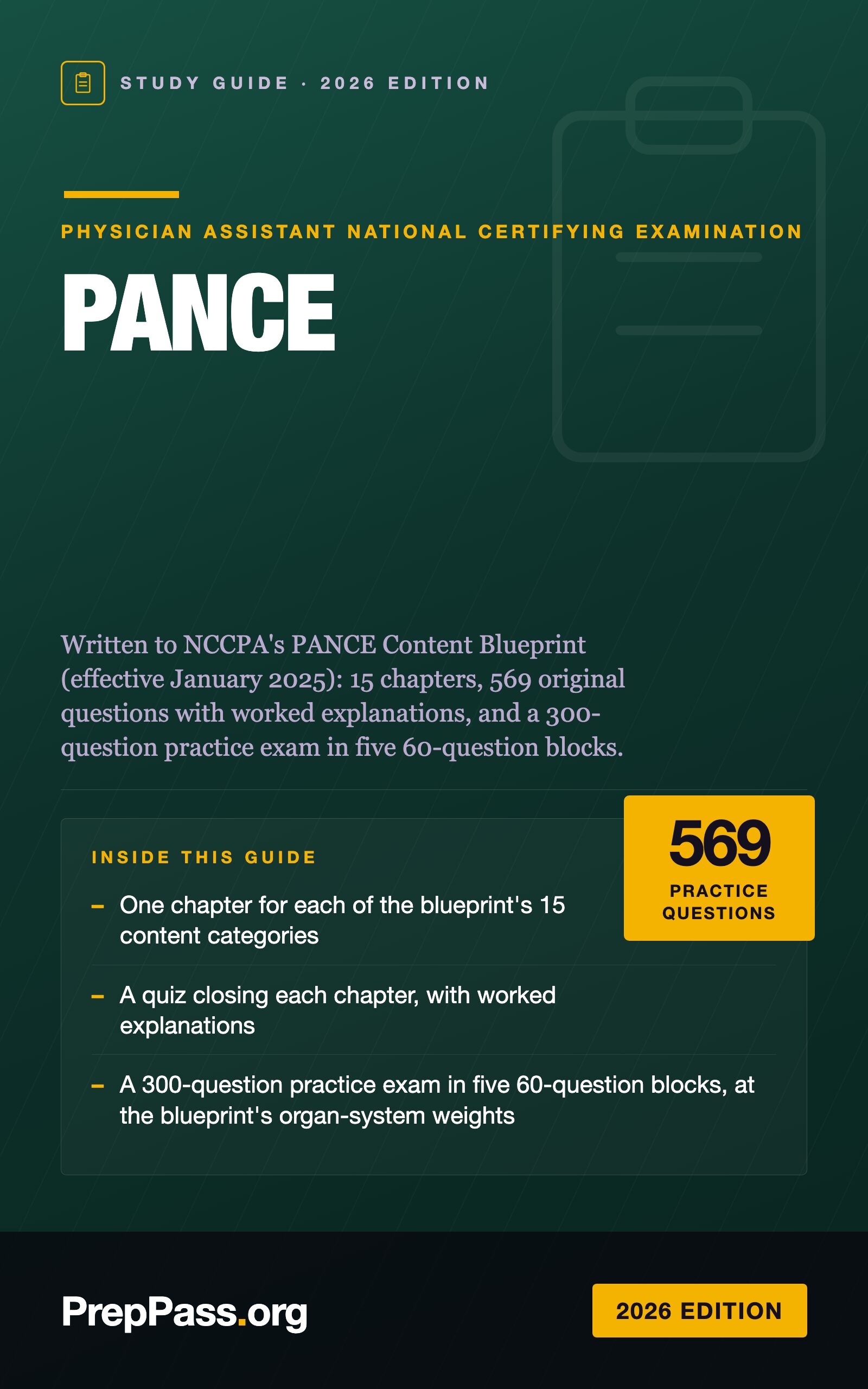
Written to NCCPA's PANCE Content Blueprint (effective January 2025): 15 chapters, 569 original questions with worked explanations, and a 300-question practice exam in five 60-question blocks.
- 569 original PANCE practice questions, each with a worked explanation, in one PDF + EPUB you keep
PDF + EPUB · English · 427 pages · $24.99 one-time
This book is written in English.
Instant download after payment — no account needed, no subscription.
14-day money-back guarantee: not satisfied for any reason? Email support@preppass.org within 14 days of purchase for a full refund. Refund policy
Try 10 questions first — free
Answer all 10, then see every answer explained — with the section of this guide that teaches it. About 5 minutes, no sign-up.
Start 10 free questionsLook inside the book
Three real pages, rendered straight from the PDF you download — a reference page, a teaching page, and a worked question, always in that order. Nothing here was redrawn to look better.
- Quick referenceChapter 5. Gastrointestinal and Nutritional Disorders Biliary disorders · PDF page 87
A page you can turn back to: the numbers, deadlines or terms gathered in one place.
- How it's taughtChapter 15. Professional Practice · PDF page 349
An explanation page: the material taught in prose, in the order the exam tests it.
- A question, workedChapter 2. Dermatologic System Psoriasis · PDF page 41
A practice question with its answer and the reasoning behind it — not just a key.
About the exam itself
| Administering body | National Commission on Certification of Physician Assistants (NCCPA) — exam delivered by Pearson VUE |
|---|---|
| Questions | 300 questions |
| Time limit | 300 minutes |
| Passing score | Scaled score of 350 on a 200–800 scale |
| Fees |
|
| Languages offered | Not published by NCCPA What we read and found nothing in: NCCPA — Become Certified (About PANCE) |
Questions buyers ask
- Which outline is the PANCE — Physician Assistant National Certifying Examination (NCCPA) exam based on?
- PANCE Content Blueprint, in force from January 2025. Check National Commission on Certification of Physician Assistants (NCCPA) for the current outline before you book.
- Is a study guide enough for the PANCE — Physician Assistant National Certifying Examination (NCCPA) exam, or do I need a course?
- Check eligibility first — per National Commission on Certification of Physician Assistants (NCCPA): you must graduate from an entry-level physician assistant program accredited by ARC-PA (the Accreditation Review Commission on Education for the Physician Assistant). A book does not replace those requirements. For the exam content itself, this 427-page guide teaches the material chapter by chapter with 569 practice questions and explanations inside, and 118 more practice questions are free on PrepPass. A prep course adds live instruction and a set schedule; whether you need one beyond any required education is your call.
- What is the cheapest way to prepare for the PANCE — Physician Assistant National Certifying Examination (NCCPA) exam?
- Start with what costs nothing: 118 practice questions on PrepPass, with explanations and no signup. If you want it taught in one file you keep, the full study guide is $24.99 once. No subscription on any of them.
- What happens if I fail the PANCE — Physician Assistant National Certifying Examination (NCCPA) exam?
- You can retake it under National Commission on Certification of Physician Assistants (NCCPA)'s rule: you may take PANCE only once in any 90-day period and no more than three times in a calendar year. Graduates who have never been certified get six years after graduation and six attempts, and lose eligibility when either runs out, whichever comes first. Confirm the current policy with National Commission on Certification of Physician Assistants (NCCPA) before you book.
- Who administers the Physician Assistant National Certifying Examination (PANCE)?
- National Commission on Certification of Physician Assistants (NCCPA) — exam delivered by Pearson VUE. The current PANCE content blueprint took effect in January 2025. By organ system: Cardiovascular 11%, Dermatologic 4%, Endocrine 6%, Eyes, Ears, Nose and Throat 6%, Gastrointestinal/Nutrition 8%, Genitourinary 4%, Hematologic 5%, Infectious Diseases 7%, Musculoskeletal 8%, Neurologic 7%, Psychiatry/Behavioral Science 7%, Pulmonary 9%, Renal 5%, Reproductive 7%, Professional Practice 6%. NCCPA notes the exact allocations may vary slightly between exams.
- How many questions are on the Physician Assistant National Certifying Examination (PANCE)?
- 300 questions. Five blocks of 60 multiple-choice questions. NCCPA includes unscored pretest items that cannot be told apart from scored ones, but does not say how many.
- How long is the Physician Assistant National Certifying Examination (PANCE)?
- 300 minutes. 60 minutes for each of the five blocks. The appointment lasts 6 hours: NCCPA adds a total of 45 minutes for breaks between blocks and 15 minutes for a tutorial, and candidates manage their own break time.
- What is the passing score for the Physician Assistant National Certifying Examination (PANCE)?
- Scaled score of 350 on a 200–800 scale. NCCPA sets the passing standard with the modified Angoff method. Because scores are scaled, the number of correct answers needed to pass varies from one examinee to another.
- How much does the Physician Assistant National Certifying Examination (PANCE) cost?
- $550 — PANCE application (NCCPA, per attempt)
- What languages is the Physician Assistant National Certifying Examination (PANCE) offered in?
- Not published by NCCPA. None of NCCPA's PANCE pages, blueprint, policies or test-day guide states which languages the exam is offered in.
- Does the PANCE — Physician Assistant National Certifying Examination (NCCPA) study guide come as a PDF?
- Yes — PANCE Study Guide — 2026 Edition downloads as PDF and EPUB, 427 pages. The download link is emailed the moment payment clears and does not expire.
- How much does the PANCE — Physician Assistant National Certifying Examination (NCCPA) study guide cost?
- $24.99, once. There is no subscription and no account to create; the PDF and EPUB files are yours to keep.
- Are there free PANCE — Physician Assistant National Certifying Examination (NCCPA) practice questions?
- Yes — 118 of them, free to use with no signup and an explanation on every one. They are separate from this study guide, which is what you are buying here.
- Can I read part of the PANCE — Physician Assistant National Certifying Examination (NCCPA) study guide before buying?
- Yes. A full chapter is free to read on this page — not a summary of one, the chapter itself.
- Is this the official PANCE — Physician Assistant National Certifying Examination (NCCPA) study guide?
- No. This is an independent study guide and is not affiliated with or endorsed by the exam's awarding body. It is written from NCCPA's PANCE Content Blueprint (effective January 2025), Become Certified page and Exam Development & Scoring page. Always confirm current requirements with the body that issues your licence.
What's included — and what isn't
Included
- One chapter for each of the blueprint's 15 content categories
- A quiz closing each chapter, with worked explanations
- A 300-question practice exam in five 60-question blocks, at the blueprint's organ-system weights
- 569 original questions, each explained and cited to its source
- High-yield drug tables and a key-numbers quick reference
- PDF + EPUB you keep
Not included
- No printed copy is shipped — this is a file you download and can print yourself
- No video course, instructor or tutoring comes with the book — the free videos on the site are separate
- Not your exam registration or the testing centre's fee, which you still pay to the official body
Contents
See 18 sections and the page each one starts on
- Chapter 1. Cardiovascular Systemp. 7
- Chapter 2. Dermatologic System Psoriasisp. 29
- Chapter 3. Endocrine System Diabetes mellitusp. 45
- Chapter 4. Eyes, Ears, Nose, and Throat Eyesp. 57
- Answer key & explanationsp. 76
- Chapter 5. Gastrointestinal and Nutritional Disorders Biliary disordersp. 80
- Chapter 6. Genitourinary System Benign prostatic hyperplasiap. 102
- Chapter 7. Hematologic System Autoimmune disordersp. 113
- Chapter 8. Infectious Diseases Bacterial diseasesp. 124
- Chapter 9. Musculoskeletal System Chest/rib disordersp. 143
- Chapter 10. Neurologic System Cerebrovascular disordersp. 161
- Chapter 11. Psychiatry/Behavioral Science Depressive disordersp. 180
- Chapter 12. Pulmonary System Acute respiratory distress syndromep. 194
- Chapter 13. Renal System Acute kidney injuryp. 210
- Chapter 14. Reproductive System Early pregnancy disordersp. 222
- Chapter 15. Professional Practicep. 242
- Appendix A — High-Yield Drug Tablesp. 379
- Appendix B — Key Numbers Quick Referencep. 386
Taken from the PDF you download, with the page each one starts on — not typed here.
Read a chapter free, in full
One complete chapter, exactly as it ships in the eBook. Scroll the window to read it right here; no download, no email.
Read chapter 1 here, without leaving the page
Cardiovascular disease is the single largest content domain on the PANCE, and it rewards pattern recognition: the ECG that separates STEMI from NSTEMI, the medication list that marks guideline-directed heart failure therapy, the rhythm strip that says "do not give an AV nodal blocker." This chapter moves through the blueprint in order — cardiomyopathy, dysrhythmias, congenital disease, coronary disease, heart failure, hypertension, hypotension, lipids, shock, inflammatory conditions, valvular disorders, and vascular disease — pausing longest where the exam tests hardest: acute coronary syndromes, heart failure pharmacology, and atrial fibrillation.
Cardiomyopathy
Cardiomyopathy is disease of the heart muscle itself, classified by phenotype. Dilated cardiomyopathy presents with ventricular dilation and systolic dysfunction — a failing pump, the classic low ejection fraction picture that progresses to the heart failure syndromes covered later in this chapter. Hypertrophic cardiomyopathy is asymmetric septal thickening that obstructs outflow; it is the most common cause of sudden cardiac death in young athletes and produces a harsh systolic murmur that gets louder with Valsalva (less preload, more obstruction) and softer with squatting. Restrictive cardiomyopathy is stiff, noncompliant ventricles with preserved wall thickness — diastolic filling fails while systolic function looks deceptively normal; amyloidosis is the prototype. Stress (Takotsubo) cardiomyopathy follows an emotional or physical trigger, balloons the left ventricular apex, mimics an acute MI with chest pain and troponin elevation, but shows clean coronaries on angiography — and it usually recovers.
Conduction disorders and dysrhythmias
Atrial fibrillation dominates this section on every exam. The atria quiver instead of contracting, the AV node is bombarded with impulses, and the ventricular response is irregularly irregular — usually rapid. The absent atrial kick predisposes to thrombus, especially in the left atrial appendage, which is why stroke prevention drives management. Diagnosis is by ECG: absent P waves, fibrillatory f waves, irregularly irregular R-R intervals[1]. The pulse is irregularly irregular with loss of a waves in the jugular venous pulse[1].
Rate control comes first for every patient with atrial fibrillation: the target is typically under 100 beats per minute at rest, to control symptoms and prevent tachycardia-induced cardiomyopathy[1]. Beta-blockers such as metoprolol and esmolol are preferred when excess catecholamines are suspected; nondihydropyridine calcium channel blockers such as verapamil and diltiazem are also effective; digoxin is the least effective but may be preferred if heart failure is present[1].
The lethal trap is atrial fibrillation with Wolff-Parkinson-White syndrome. When the QRS is wide, an accessory pathway is conducting — and AV node blockers must not be used: they "may increase frequency of conduction via the bypass tract, possibly causing ventricular fibrillation," and in AF with a wide QRS suggesting WPW, "use of atrioventricular node-blocking medications may be fatal"[1].
Rhythm control — synchronized cardioversion or antiarrhythmics — is indicated when heart failure or hemodynamic compromise is directly attributable to new-onset atrial fibrillation, to improve cardiac output[1]. Cardioversion at 200 joules biphasic converts about 90% of patients[1]. But timing matters: if atrial fibrillation has been present more than 48 hours, give an oral anticoagulant for more than 3 weeks before cardioversion (or rule out thrombus with transesophageal echo first), and continue anticoagulation for at least 4 weeks after[1]. Conversion never eliminates the need for chronic anticoagulation in patients who meet criteria for it[1].
Long-term anticoagulation decisions run on the CHA2DS2-VASc score: class I recommendation for nonvalvular atrial fibrillation with scores of 2 or more in males and 3 or more in females[1]. Two groups get warfarin specifically, not a direct oral anticoagulant: mechanical heart valves and moderate-to-severe rheumatic mitral stenosis (both class I)[1]. Everyone else eligible gets warfarin, apixaban, dabigatran, edoxaban, or rivaroxaban — with the non–vitamin K agents preferred — and warfarin's target INR is 2.0 to 3.0[1]. Aspirin monotherapy is not recommended for stroke prevention[1].
Atrial flutter is the sawtooth cousin — regular atrial activity around 300 per minute with variable conduction. Atrial tachycardia, junctional rhythms, and premature contractions fill out the supraventricular list. Below the AV node, the stakes rise: ventricular tachycardia is wide, fast, and regular; ventricular fibrillation is chaotic and pulseless — defibrillate immediately. Torsades de pointes is polymorphic VT twisting around the baseline in the setting of QT prolongation — give magnesium, stop the offending drug. Sick sinus syndrome is sinus node failure with alternating bradycardia and tachycardia; symptomatic bradycardia gets a pacemaker. AV block is graded: first-degree (prolonged PR), second-degree Mobitz I (Wenckebach — progressive PR lengthening then a dropped beat) and Mobitz II (dropped beats without warning, usually infranodal — pace it), and third-degree (complete dissociation — pace it). Bundle branch blocks widen the QRS; a new left bundle branch block in chest pain was historically treated as a STEMI equivalent but is not one in isolation[2].
Congenital heart disease
Shunts are the organizing principle: left-to-right shunts (VSD, ASD, PDA, atrioventricular septal defects) flood the pulmonary circulation; right-to-left shunts (Tetralogy of Fallot, transposition of the great vessels) send deoxygenated blood to the body — cyanosis. The exam loves a few signatures. Ventricular septal defect is the most common congenital lesion: a harsh holosystolic murmur at the left sternal border. Atrial septal defect gives a fixed split S2 and often presents in adulthood. Patent ductus arteriosus is the continuous "machinery" murmur, kept open by prostaglandin E — indomethacin closes it; it is the lesion of premature infants. Coarctation of the aorta: upper-extremity hypertension with weak femoral pulses and brachial-femoral delay; rib notching on chest film in older patients. Tetralogy of Fallot is the most common cyanotic lesion surviving to childhood — four features (VSD, overriding aorta, pulmonic stenosis, right ventricular hypertrophy), boot-shaped heart, and tet spells relieved by squatting (increases systemic vascular resistance, reducing right-to-left shunt). Transposition of the great vessels: the aorta arises from the right ventricle and the pulmonary artery from the left — incompatible with life unless a shunt (PDA, ASD, VSD) mixes blood; prostaglandin E keeps the ductus open as a bridge. Patent foramen ovale is usually incidental but implicated in paradoxical embolism and cryptogenic stroke.
Coronary artery disease and acute coronary syndromes
Acute coronary syndromes — unstable angina, NSTEMI, and STEMI — "all involve acute coronary ischemia and are distinguished based on symptoms, ECG findings, and cardiac troponin levels"[2]. The distinction drives everything, because prognosis and treatment vary.
Unstable angina is "transient myocardial ischemia with reduced coronary blood flow, in the absence myocardial necrosis (circulating cardiac troponin < 99th percentile)"[2]. Its symptom signatures: rest angina prolonged beyond 20 minutes, new-onset severe angina, or angina distinctly more frequent, severe, prolonged, or lower-threshold than before[2]. NSTEMI is "myocardial necrosis (evidenced by circulating cardiac troponin levels ≥ 99th percentile) without acute ST-segment elevation that meets criteria for STEMI"[2] — typically subendocardial, with ST depression or T-wave inversion rather than elevation. STEMI is "myocardial necrosis with ECG changes showing ST-segment elevation that is not quickly reversed by nitroglycerin"[2] — transmural, the one that needs the cath lab now.
Diagnosis runs on two rails simultaneously. The ECG "is the most important test and should be performed as soon as possible (within 10 minutes of presentation to medical care, whether in or out of the hospital)"[2]. STEMI shows "ST-segment elevation ≥ 1 mm in 2 or more contiguous leads subtending the damaged area"[2]; NSTEMI shows "horizontal or downsloping ST depression," T-wave inversion, or transient ST elevation[2]. Troponin is the tiebreaker: "an abnormal cTn level, using an appropriate cutoff, is the primary distinguishing factor between unstable angina and myocardial infarction"[2]. Draw high-sensitivity troponin on presentation and again 1 to 2 hours later[2] — but never let a normal early troponin delay care: "angiography and treatment in patients with STEMI, or unstable patients with a NSTE-ACS, should not be delayed because of an initially normal troponin level"[2].
Treatment is reperfusion plus antithrombotics. "For STEMI, do emergency PCI when door to balloon-inflation time is < 90 minutes (120 minutes accounting for hospital to hospital transfers); do fibrinolysis if such timely PCI is not available"[2]. Fibrinolytics "benefit patients with STEMI but may increase risk for those with NSTEMI," so they are for STEMI only when primary PCI is not immediately available[2]. Prehospital, EMS gives "chewed aspirin (160 to 325 mg)" plus nitrates and triage to a PCI-capable center[2]. Post-MI, secondary prevention continues antiplatelets, beta-blockers, ACE inhibitors, and statins.
Stable angina is the predictable exertional cousin — relieved by rest and nitroglycerin, worked up initially with exercise stress testing when the resting ECG is normal. Atherosclerosis is the underlying pathology across all of it: plaque disruption with thrombosis is the most common cause of ACS[2].
Heart failure
Heart failure is the clinical syndrome of the heart failing to meet metabolic demands — low output, elevated filling pressures, or both. Ejection fraction phenotyping determines therapy: reduced (HFrEF), mildly reduced, and preserved (HFpEF).
Four medication classes improve survival in HFrEF and form guideline-directed medical therapy: "Beta-blockers; Angiotensin receptor/neprilysin inhibitors (ARNIs) (or angiotensin converting enzyme [ACE] inhibitors or Angiotensin II receptor blockers [ARBs]); Sodium-glucose cotransporter-2 inhibitors (SGLT2i); Mineralocorticoid receptor antagonists"[3].
Beta-blockers are "a mainstay of treatment" in HFrEF "unless otherwise contraindicated (by asthma, second-degree or third-degree atrioventricular block, or previous significant intolerance)"[3] — carvedilol, metoprolol succinate, bisoprolol. In HFpEF, "beta-blockers are not generally recommended," though they can be used for rate control in atrial fibrillation or hypertension with coronary disease[3].
Sacubitril/valsartan (ARNI) "reduces all-cause mortality and should be considered in all patients with HFrEF" and "is preferred over an ACE inhibitor or ARB if tolerated"[3]. The switch has a rule: "ACE inhibitors should be discontinued 36 hours before initiation of sacubitril/valsartan. Patients previously taking an ARB can simply switch to sacubitril/valsartan without a washout period"[3] — and "combined ACE inhibitor plus ARNI therapy is absolutely contraindicated" because of angioedema risk[3].
ACE inhibitors: "all patients with HFrEF should be given oral ACE inhibitors unless contraindicated"[3]. Contraindications are bilateral renal artery stenosis (or stenosis in a solitary kidney), creatinine above 2.8 mg/dL, and prior ACE-inhibitor angioedema[3]. Two counseling points the exam tests: a creatinine rise of 20 to 30% after starting is expected from efferent arteriole vasodilation and "is not a reason to stop the medication" (monitor, slow titration, reduce diuretic, avoid NSAIDs)[3]; and the dry cough from bradykinin accumulation — "if cough limits use, an ARB is a reasonable alternative"[3]. Both ACE inhibitors and ARBs are contraindicated in pregnancy[3].
Mineralocorticoid receptor antagonists (spironolactone, eplerenone) are recommended for symptomatic HFrEF, NYHA class II to IV[3]. Spironolactone 25 to 50 mg daily is typical; eplerenone avoids the gynecomastia[3]. Because hyperkalemia is the danger, "serum potassium and creatinine should be checked every 1 to 2 weeks for the first 4 to 6 weeks and after dose changes" — lower the dose if potassium is 5.0 to 5.5, stop it above 5.5, with creatinine above 2.5, or with ECG changes of hyperkalemia[3].
SGLT2 inhibitors dapagliflozin and empagliflozin "reduce cardiovascular mortality and hospitalization in patients with HFrEF who are symptomatic (New York Heart Association Class II to IV)" and "therapy is recommended for all HFrEF patients with symptoms"[3].
Digoxin "has no proven survival benefit but... may help control symptoms and reduce the likelihood of hospitalization in patients with HFrEF," and it doubles as rate control in atrial fibrillation with either HFrEF or HFpEF[3]. Dosing is 0.125 mg daily with normal renal function (or three times weekly with renal dysfunction)[3]. Toxicity signs to memorize: "bidirectional ventricular tachycardia, nonparoxysmal junctional tachycardia in the presence of atrial fibrillation, and hyperkalemia are serious signs of digitalis toxicity" — and hypokalemia or hypomagnesemia from diuretics lets toxicity strike at lower levels, so monitor electrolytes[3].
Diuretics relieve congestion: "loop diuretics should be used initially for control of volume overload," with furosemide 40 mg equal to bumetanide 1 mg equal to torsemide 20 mg[3]. Ivabradine fits symptomatic HFrEF in normal sinus rhythm with heart rate above 70 despite maximal therapy[3]. Hydralazine plus isosorbide dinitrate suits HFrEF patients intolerant of ACE inhibitors or ARBs — and in patients of African ancestry added to standard therapy it "may reduce mortality and hospitalization"[3]. Positive inotropes other than digoxin increase mortality risk and are reserved for cardiogenic shock or bridge/palliation[3].
Sources cited in this excerpt
- Atrial Fibrillation. Merck Manual Professional Edition. https://www.merckmanuals.com/professional/cardiovascular-disorders/arrhythmias-and-conduction-disorders/atrial-fibrillation
- Overview of Acute Coronary Syndromes (ACS). Merck Manual Professional Edition. https://www.merckmanuals.com/professional/cardiovascular-disorders/coronary-artery-disease/overview-of-acute-coronary-syndromes-acs
- Medications for Heart Failure. Merck Manual Professional Edition. https://www.merckmanuals.com/professional/cardiovascular-disorders/heart-failure/medications-for-heart-failure
Before you buy
- How do I get it?
- Pay, and the download appears on this page straight away. The links are also emailed to you. No account is required.
- What if it isn't for me?
- Email us within 14 days for a full refund, no questions asked.
- Is the free practice going away?
- No. Every practice question, the timed mock and the free chapters on this site stay free. This book is the studying half, not a gate around the free half.
- Can I read it on my phone?
- Yes — the EPUB is for phones and e-readers, the PDF is for printing and tabbing. You get both.
The details
Written to NCCPA's PANCE Content Blueprint (effective January 2025): 15 chapters, 569 original questions with worked explanations, and a 300-question practice exam in five 60-question blocks.
- Format: PDF + EPUB download · 427 pages
- 569 practice questions in the book, with a full answer key
- 118 free practice questions for this exam on PrepPass, included at no cost
- $24.99 one-time — no subscription
- 14-day money-back guarantee · refund policy
- Cross-referenced against: NCCPA's PANCE Content Blueprint (effective January 2025), Become Certified page and Exam Development & Scoring page
- Last updated: September 2026
- Verified from the official source(NCCPA's PANCE Content Blueprint (effective January 2025), Become Certified page and Exam Development & Scoring page)
- 118 free practice questions
- Instant download, yours for life
Why buy the book when the practice is free?
Our practice questions and timed mock stay free — nothing on the site moves behind this book. The $24.99 book is the studying half: the material itself, taught in order, in a file you own.
- Systematic teaching — every exam section explained chapter by chapter, start to finish, not just questions
- Print it & tab it — a paper-ready PDF you can highlight, mark up, and bring to your study table
- Study anywhere, offline — EPUB on your phone or e-reader; no wifi, no browser tabs
- Everything in one place — the chapters and the practice questions in one file
- Yours for life — one-time $24.99, instant download, no subscription
And it's risk-free: 14-day money-back guarantee — not satisfied? Email us for a full refund, no questions asked. See the refund policy.
14-day money-back guarantee · full refund, no questions asked.
One-time purchase, lifetime access to the download. The eBook is the full PANCE — Physician Assistant National Certifying Examination (NCCPA) study guide in PDF and EPUB. Educational summary, not professional or legal advice — always confirm the current rules with the official source. Last updated: September 2026.