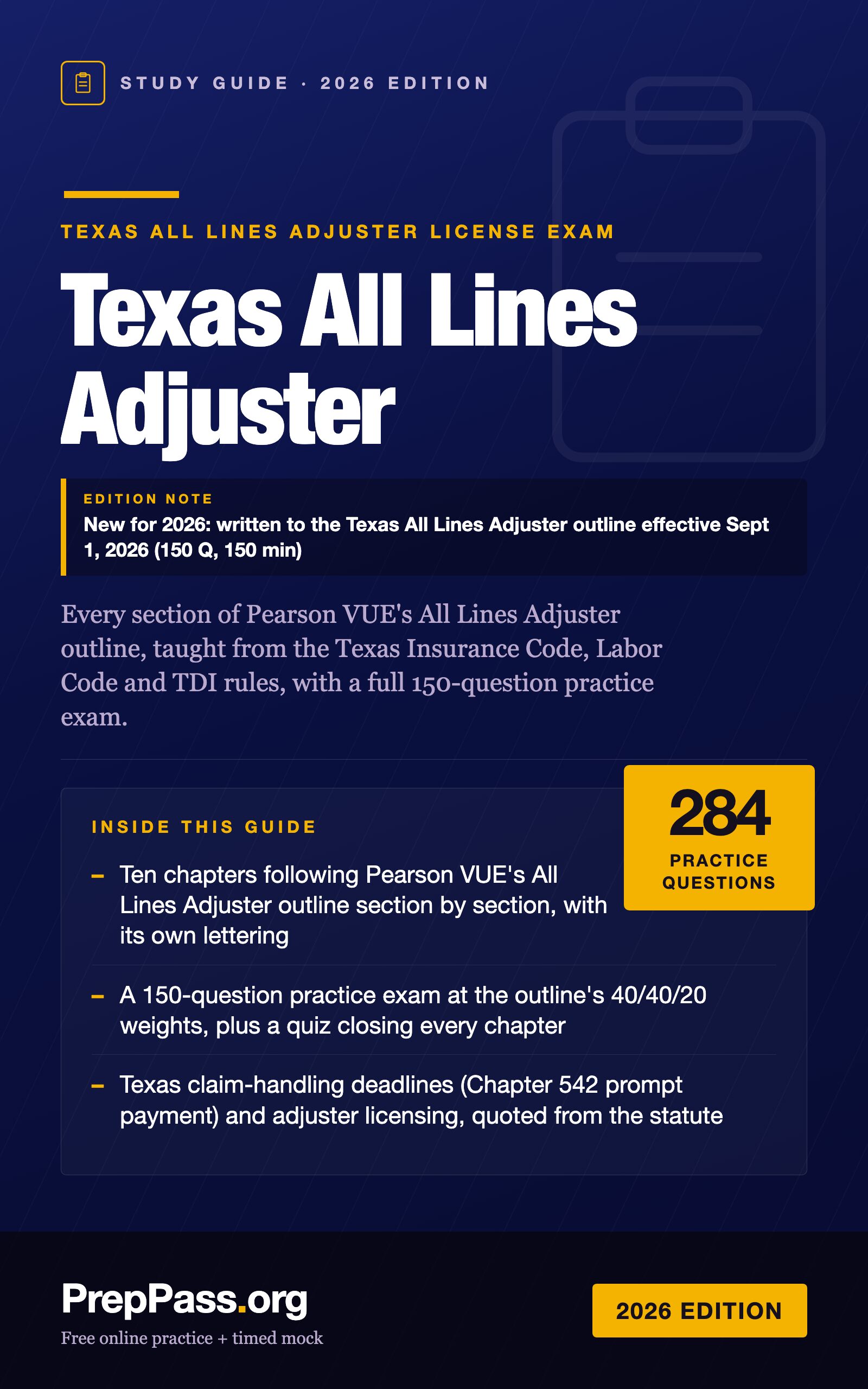
Texas All Lines Adjuster License Exam · 2026 Edition
Texas All Lines Adjuster Study Guide — 2026 Edition
Edition noteNew for 2026: written to the Texas All Lines Adjuster outline effective Sept 1, 2026 (150 Q, 150 min)
Every section of Pearson VUE's All Lines Adjuster outline, taught from the Texas Insurance Code, Labor Code and TDI rules, with a full 150-question practice exam.
- 284 original Texas All Lines Adjuster practice questions, each with a worked explanation, in one PDF + EPUB you keep
PDF + EPUB · English · 226 pages · $24.99 one-time
This book is written in English.
Instant download after payment — no account needed, no subscription.
14-day money-back guarantee: not satisfied for any reason? Email support@preppass.org within 14 days of purchase for a full refund. Refund policy
Try 10 questions first — free
Answer all 10, then see every answer explained — with the section of this guide that teaches it. About 5 minutes, no sign-up.
Start 10 free questionsLook inside the book
Three real pages, rendered straight from the PDF you download — a reference page, a teaching page, and a worked question, always in that order. Nothing here was redrawn to look better.
- Quick referenceChapter 1 — The Standard Fire Policy, Dwelling and Homeowners Coverage · PDF page 15
A page you can turn back to: the numbers, deadlines or terms gathered in one place.
- How it's taughtChapter 8 — Texas Adjuster Licensing and the Commissioner · PDF page 115
An explanation page: the material taught in prose, in the order the exam tests it.
- A question, workedChapter 5 — Risk, Value and the Measure of a Loss · PDF page 72
A practice question with its answer and the reasoning behind it — not just a key.
About the exam itself
| Administering body | Texas Department of Insurance (TDI) — exam delivered by Pearson VUE |
|---|---|
| Questions | 150 questions |
| Time limit | 150 minutes |
| Passing score | Scaled score of 70 on a 0–100 scale |
| Fees |
|
| Languages offered | English · Spanish |
Questions buyers ask
- What has changed on the Texas All Lines Adjuster License Exam?
- New for 2026: written to the Texas All Lines Adjuster outline effective Sept 1, 2026 (150 Q, 150 min).
- Which outline is the Texas All Lines Adjuster License Exam based on?
- Texas Insurance Supplement – Examination Content Outlines (#124401, 9/2026), All Lines Adjuster Content Outline, in force from 2026-09-01. Check Texas Department of Insurance (TDI) for the current outline before you book.
- Is a study guide enough for the Texas All Lines Adjuster License Exam, or do I need a course?
- Check eligibility first — per Texas Department of Insurance (TDI): pass the exam before applying, complete a fingerprint background check, and submit your application within one year of passing or you will need to retake the exam. The Texas designated home state adjuster license, which uses the same InsTX-ALAdj16 exam, is only for residents of states that do not license adjusters. A book does not replace those requirements. For the exam content itself, this 226-page guide teaches the material chapter by chapter with 284 practice questions and explanations inside, and 100 more practice questions are free on PrepPass. A prep course adds live instruction and a set schedule; whether you need one beyond any required education is your call.
- What is the cheapest way to prepare for the Texas All Lines Adjuster License Exam?
- Start with what costs nothing: 100 practice questions on PrepPass, with explanations and no signup. If you want it taught in one file you keep, the full study guide is $24.99 once. No subscription on any of them.
- What happens if I fail the Texas All Lines Adjuster License Exam?
- You can retake it under Texas Department of Insurance (TDI)'s rule: a candidate who fails can schedule a new exam within one day, and there is no limit on the number of attempts at the same exam. The $49 exam fee is paid at each reservation. Confirm the current policy with Texas Department of Insurance (TDI) before you book.
- Who administers the Texas Adjuster – All Lines License Examination (InsTX-ALAdj16)?
- Texas Department of Insurance (TDI) — exam delivered by Pearson VUE. TDI licenses adjusters and set the passing score with Pearson VUE, which delivers the exam by reservation at its test centers; walk-in exams are not available. Content outline effective September 1, 2026: General Property and Casualty Insurance Product Knowledge Pertinent to Adjusters 40%, Insurance Terms and Related Concepts 40%, Texas Statutes and Rules Pertinent to Property and Casualty Adjusting 20%. Pearson VUE publishes no list of changes from the previous outline. The same exam (InsTX-ALAdj16) is used for TDI's designated home state adjuster license, which only residents of states that do not license adjusters may hold.
- How many questions are on the Texas Adjuster – All Lines License Examination (InsTX-ALAdj16)?
- 150 questions. The outline heading reads "150 scoreable questions" and lists no pretest questions; the candidate handbook says that when no pretest number is listed, the exam has none.
- How long is the Texas Adjuster – All Lines License Examination (InsTX-ALAdj16)?
- 150 minutes. 150 minutes is the time allotted in the handbook's exam table, for both the English and the Spanish exam.
- What is the passing score for the Texas Adjuster – All Lines License Examination (InsTX-ALAdj16)?
- Scaled score of 70 on a 0–100 scale. Raw scores are converted to a scaled score from 0 to 100. The handbook states that the reported scaled score is neither the number nor the percentage of questions answered correctly; a score below 70 shows how close the candidate came to passing.
- How much does the Texas Adjuster – All Lines License Examination (InsTX-ALAdj16) cost?
- $49 — Examination fee (English or Spanish), paid when reserving (Pearson VUE, per attempt); $50 — License application fee (Texas Department of Insurance, one-time). The handbook gives the $50 application fee per license type. TDI's designated home state page states the same $49 exam fee and $50 application fee.
- What languages is the Texas Adjuster – All Lines License Examination (InsTX-ALAdj16) offered in?
- English · Spanish. The English exam is InsTX-ALAdj16 and the Spanish exam is InsTX-ALAdj36; both allow 150 minutes and cost $49.
- Does the Texas All Lines Adjuster License Exam study guide come as a PDF?
- Yes — Texas All Lines Adjuster Study Guide — 2026 Edition downloads as PDF and EPUB, 226 pages. The download link is emailed the moment payment clears and does not expire.
- How much does the Texas All Lines Adjuster License Exam study guide cost?
- $24.99, once. There is no subscription and no account to create; the PDF and EPUB files are yours to keep.
- Are there free Texas All Lines Adjuster License Exam practice questions?
- Yes — 100 of them, free to use with no signup and an explanation on every one. They are separate from this study guide, which is what you are buying here.
- Can I read part of the Texas All Lines Adjuster License Exam study guide before buying?
- Yes. A full chapter is free to read on this page — not a summary of one, the chapter itself.
- Is this the official Texas All Lines Adjuster License Exam study guide?
- No. This is an independent study guide and is not affiliated with or endorsed by the exam's awarding body. It is written from Pearson VUE Texas candidate handbook (#124400) and content outline (#124401, effective September 1, 2026), the Texas Insurance and Labor Codes and TDI's adjuster pages, read September 2026. Always confirm current requirements with the body that issues your licence.
Free Texas All Lines Adjuster License Exam practice questions and study chapters →
What's included — and what isn't
Included
- Ten chapters following Pearson VUE's All Lines Adjuster outline section by section, with its own lettering
- A 150-question practice exam at the outline's 40/40/20 weights, plus a quiz closing every chapter
- Texas claim-handling deadlines (Chapter 542 prompt payment) and adjuster licensing, quoted from the statute
- Texas workers' compensation, with the benefit caps for injuries from October 1, 2026
- A master table of Texas deadlines and dollar figures, and a terms appendix
- 284 original questions, each with a worked explanation citing its source
- PDF + EPUB you keep
Not included
- No printed copy is shipped — this is a file you download and can print yourself
- No video course, instructor or tutoring comes with the book — the free videos on the site are separate
- Not your exam registration or the testing centre's fee, which you still pay to the official body
Contents
See 15 sections and the page each one starts on
- Chapter 1 — The Standard Fire Policy, Dwelling and Homeowners Coveragep. 10
- Chapter 2 — Auto Liability: Personal and Commercialp. 30
- Chapter 3 — Commercial Lines: Property, Package, Boiler and Machinery, BOP, Cargo and Crimep. 43
- Chapter 4 — Inland Marine, Ocean Marine, Additional Coverages, Bonds and Professional Liabilityp. 55
- Chapter 5 — Risk, Value and the Measure of a Lossp. 70
- Chapter 6 — Policy Provisions and Contract Lawp. 85
- Chapter 7 — Liability, Negligence and Legal Causep. 101
- Chapter 8 — Texas Adjuster Licensing and the Commissionerp. 113
- Chapter 9 — Texas Claim- Handling Law and Adjuster Conductp. 129
- Chapter 10 — Texas Workers’ Compensationp. 144
- Part II — Insurance Terms and Related Concepts (60 questions)p. 173
- Practice exam answer key & explanationsp. 193
- Appendix A — The exam at a glance Item What the sources publishp. 211
- Appendix B — Terms the exam expects you to use preciselyp. 212
- Appendix C — Master table of Texas deadlines and dollar figuresp. 216
Taken from the PDF you download, with the page each one starts on — not typed here.
Read a chapter free, in full
One complete chapter, exactly as it ships in the eBook. Scroll the window to read it right here; no download, no email.
Read chapter 9 here, without leaving the page
We didn't give you the easy intro — the free chapter opens on one of the hardest-working parts of the book, so you can judge the teaching where the exam gets difficult.
This is the chapter that governs an adjuster's working day in Texas. The Insurance Code sets deadlines measured in days and business days, lists practices that are unfair as a matter of law, and attaches a price — 18 percent interest plus attorney's fees — to missing a deadline. The exam tests the numbers and the lists; the job tests whether you can apply them to a file.
III.C.1 Functions of an adjuster
An adjuster "investigates or adjusts losses on behalf of an insurer" or "supervises the handling of claims"[1]. In practice the functions follow the claim's life: acknowledge the claim and request what is needed; investigate the facts (inspection, statements, documents, experts); determine coverage by reading the policy; evaluate the amount of the loss; communicate a decision with the reasons; negotiate and settle; and, where someone else caused the loss, preserve subrogation. Chapter 8 lists who is exempt from licensing — technical experts, clerical staff, agents processing undisputed losses on their own policies[1]. The dividing line is negotiation and judgment on disputed claims.
III.B.1.a Claims methods and practices — the prompt-payment law (Chapter 542, Subchapter B)
Scope
Subchapter B applies to first-party claims — a claim made by an insured, policyholder or named beneficiary that "must be paid by the insurer directly to the insured or beneficiary"[2]. It applies to nearly every kind of insurer, including "an eligible surplus lines insurer"[2], but not to "(1) workers' compensation insurance; (2) mortgage guaranty insurance; (3) title insurance; (4) fidelity, surety, or guaranty bonds; (5) marine insurance"[2]. It "shall be liberally construed to promote the prompt payment of insurance claims"[2].
Two definitions start every clock. Notice of claim is "any written notification provided by a claimant to an insurer that reasonably apprises the insurer of the facts relating to the claim"[2]. Business day is "a day other than a Saturday, Sunday, or holiday recognized by this state"[2].
The four deadlines
| Step | Deadline | Source |
|---|---|---|
| 1. Acknowledge, begin investigating, request all items the insurer then reasonably believes it needs | Not later than the 15th day after notice of claim (30th business day for an eligible surplus lines insurer) | [2] |
| 2. Accept or reject in writing | Not later than the 15th business day after receiving all items, statements and forms required to secure final proof of loss | [2] |
| 2a. Suspected arson | Not later than the 30th day after receiving all items | [2] |
| 2b. Needs more time | Tell the claimant the reasons within the same period, then accept or reject not later than the 45th day after that notice | [2] |
| 3. Pay | Not later than the 5th business day after notifying the claimant it will pay (or after the claimant performs a required act); 20th business day for an eligible surplus lines insurer | [2] |
| 4. Outside limit | Delay beyond the period set by other statutes or, if none, more than 60 days after receiving all items triggers statutory damages | [2] |
Details the exam likes:
- The first deadline is 15 days; the decision deadline is 15 business days. Read the question for the word "business."
- If the acknowledgment is not in writing, the insurer "shall make a record of the date, manner, and content of the acknowledgment"[2].
- The insurer may make additional requests later "if during the investigation of the claim the additional requests are necessary"[2] — but not as a device to restart the clock.
- A rejection "must state the reasons for the rejection"[2].
- "In the event of a weather-related catastrophe or major natural disaster, as defined by the commissioner, the claim-handling deadlines imposed under this subchapter are extended for an additional 15 days"[2].
Worked example. Notice of a hail claim arrives Monday, March 2. By March 17 (15 days) the insurer acknowledges it, assigns an adjuster and requests photos, the contractor's estimate and a signed proof of loss. The insured delivers the last item on Thursday, April 9. The insurer must accept or reject in writing within 15 business days — by Thursday, April 30, if there are no state holidays. It accepts on April 28; payment is due within five business days, by Tuesday, May 5.
What a violation costs
An insurer that is liable for a claim and does not comply with the subchapter must pay, in addition to the claim, "interest on the amount of the claim at the rate of 18 percent a year as damages, together with reasonable and necessary attorney's fees"[2]. In actions governed by Chapter 542A, a different rate applies instead: simple interest at the Finance Code judgment rate plus five percent[2]. These remedies "are in addition to any other remedy or procedure provided by law or at common law"[2].
Liability claims: telling the insured about settlements (Subchapter D)
On a casualty (liability) policy, the insurer must tell its own insured what it is doing with claims against him: "Not later than the 10th day after the date an initial offer to settle a claim against a named insured ... is made, the insurer shall notify the insured in writing of the offer"[2], and "Not later than the 30th day after the date a claim against a named insured ... is settled, the insurer shall notify the insured in writing of the settlement"[2]. The subchapter does not apply to a policy "that requires the insured's consent to settle a claim against the insured"[2], to bonds or to marine insurance.
III.B.1 Unfair claim settlement practices (Chapter 542, Subchapter A; 28 TAC §§21.201–21.205; Chapter 541)
The statutory list
Section 542.003 lists acts that are unfair claim settlement practices, including "knowingly misrepresenting to a claimant pertinent facts or policy provisions relating to coverage at issue"[2], failing to acknowledge pertinent communications with reasonable promptness, failing to adopt reasonable standards for prompt investigation, "not attempting in good faith to effect a prompt, fair, and equitable settlement of a claim submitted in which liability has become reasonably clear"[2], and compelling a policyholder to sue by offering substantially less than the amount ultimately recovered.
Tax returns. An insurer may not require a claimant to produce federal income tax returns as a condition of settlement unless "(1) the claimant is ordered to produce the tax returns by a court; or (2) the claim involves: (A) a fire loss; or (B) a loss of profits or income"[2]. A violation is also "a deceptive trade practice" under the Business & Commerce Code[2].
The rule: 28 TAC §21.203
TDI's "Unfair Claims Settlement Practices Rules"[3] expand the list to nineteen items, and the minimum standard of performance for all insurers is to comply with §21.203[4]. The items an adjuster meets every day:
- (1) Misrepresenting to claimants "pertinent facts or policy provisions relating to coverages at issue"[5].
- (2) Failing to acknowledge pertinent communications with reasonable promptness — "An acknowledgment within 15 business days is presumed to be reasonably prompt"[5].
- (3) "failing to adopt and implement reasonable standards for prompt investigation of claims"[5].
- (4) Not attempting in good faith to settle when liability is reasonably clear.
- (5) "compelling policyholders to institute suits to recover amounts due under its policies by offering substantially less than the amounts ultimately recovered"[5].
- (7) Failing to provide claim forms promptly when the insurer requires them[5].
- (8) Not settling a clear claim under one coverage "in order to influence settlement under other portions of the policy coverage"[5].
- (9) "failing to promptly provide to a policyholder a reasonable explanation of the basis in the insurance policy in relation to the facts or applicable law for denial of a claim or for the offer of a compromise settlement"[5].
- (10) Failing to affirm or deny coverage within a reasonable time — where a timely reservation of rights letter "is deemed compliance"[5].
- (11) Delaying a first-party payment "on the basis that other coverage may be available or third parties are responsible"[5].
- (13) "undertaking to enforce a full and final release from a policyholder when, in fact, only a partial payment has been made"[5].
- (15) "refusing to pay claims without conducting a reasonable investigation based upon all available information"[5].
- (16) "failing to respond promptly to a request by a claimant for personal contact about or review of the claim"[5].
- (17) On the Texas personal auto policy, the claimant who can recover from either or both insurers "is entitled to choose under which coverage and in what order payment is to be made"[5].
- (19) Requiring federal income tax returns except by court order or for fire or loss-of-income claims[5].
Chapter 541 makes the same core practices actionable as unfair or deceptive acts, including "refusing to pay a claim without conducting a reasonable investigation with respect to the claim"[6] and enforcing "a full and final release of a claim from a policyholder when only a partial payment has been made, unless the payment is a compromise settlement of a doubtful or disputed claim"[6]. When the department finds from complaints that an insurer needs closer supervision, it may require periodic reports of claims filed, denied, settled and litigated[7].
III.B.1.b Misrepresentation
TDI's rule defines misrepresentation as "any untrue statement of a material fact; (2) any omission to state a material fact necessary to make the statements made (considered in the light of the circumstances under which they are made) not misleading"[8], the making of a statement "in such manner or order as to mislead a reasonably prudent person to a false conclusion of a material fact," and "any material misstatement of law"[8]. Section 541.061 makes each of these an unfair or deceptive act when it misrepresents an insurance policy, including "making a statement in a manner that would mislead a reasonably prudent person to a false conclusion of a material fact"[6] and "(4) making a material misstatement of law"[6].
Worked example. A policyholder asks whether her policy covers a burst pipe. The adjuster says, truthfully, that "water damage from floods is excluded" and stops there, knowing the policy does cover sudden discharge from plumbing. Every word was true, but the omission of a material fact necessary to make the statement not misleading is itself a misrepresentation under the rule.
III.B.1.c Defamation
It is an unfair or deceptive act to make or circulate a statement that "(1) is false, maliciously critical of, or derogatory to the financial condition of an insurer; and (2) is calculated to injure a person engaged in the business of insurance"[6]. The rule reaches "any oral or written statement, including a statement in any pamphlet, circular, article, or literature"[6]. An adjuster who tells a claimant that a competitor "is about to go broke, so settle with us" commits defamation of an insurer.
III.C.2 Prohibited conduct — contractors as adjusters
The outline cites §4102.163, the public-adjuster conflict rule: "A contractor may not act as a public adjuster or advertise to adjust claims for any property for which the contractor is providing or may provide contracting services, regardless of whether the contractor" holds a public adjuster license[9] or "is authorized to act on behalf of the insured under a power of attorney or other agreement"[9]. A licensed public adjuster also "may not accept a fee, commission, or other valuable consideration ... in exchange for the referral" of an insured to a contractor, attorney, appraiser, umpire or salvage company[9].
Chapter 4101 imposes the same wall on company-side adjusters: a licensed adjuster "may not adjust a loss related to roofing damage on behalf of an insurer if the adjuster is a roofing contractor or otherwise provides roofing services or roofing products for compensation"[1], and a roofing contractor may not act as an adjuster on property it is or may be roofing[1]. The principle is the same on both sides: the person who values the loss may not be the person paid to repair it.
Sources cited in this excerpt
- Texas Insurance Code Chapter 4101, Insurance Adjusters. Texas Legislature, Current text as served 2026-09-25. https://tcss.legis.texas.gov/resources/IN/htm/IN.4101.htm
- Texas Insurance Code Chapter 542, Processing and Settlement of Claims. Texas Legislature, Current text as served 2026-09-25. https://tcss.legis.texas.gov/resources/IN/htm/IN.542.htm
- 28 Tex. Admin. Code § 21.201, Title (as reproduced by LII). Texas Department of Insurance / Cornell LII, read 2026-09-25. https://www.law.cornell.edu/regulations/texas/28-Tex-Admin-Code-SS-21-201
- 28 Tex. Admin. Code § 21.205, Minimum Standard of Performance (as reproduced by LII). Texas Department of Insurance / Cornell LII, read 2026-09-25. https://www.law.cornell.edu/regulations/texas/28-Tex-Admin-Code-SS-21-205
- 28 Tex. Admin. Code § 21.203, Unfair Claim Settlement Practices (as reproduced by LII). Texas Department of Insurance / Cornell LII, read 2026-09-25. https://www.law.cornell.edu/regulations/texas/28-Tex-Admin-Code-SS-21-203
- Texas Insurance Code Chapter 541, Unfair Methods of Competition and Unfair or Deceptive Acts or Practices. Texas Legislature, Current text as served 2026-09-25. https://tcss.legis.texas.gov/resources/IN/htm/IN.541.htm
- 28 Tex. Admin. Code § 21.204, Insurer Reports (as reproduced by LII). Texas Department of Insurance / Cornell LII, read 2026-09-25. https://www.law.cornell.edu/regulations/texas/28-Tex-Admin-Code-SS-21-204
- 28 Tex. Admin. Code § 21.4, Misrepresentation Defined (as reproduced by LII). Texas Department of Insurance / Cornell LII, read 2026-09-25. https://www.law.cornell.edu/regulations/texas/28-Tex-Admin-Code-SS-21-4
- Texas Insurance Code Chapter 4102, Public Insurance Adjusters. Texas Legislature, Current text as served 2026-09-25. https://tcss.legis.texas.gov/resources/IN/htm/IN.4102.htm
Before you buy
- How do I get it?
- Pay, and the download appears on this page straight away. The links are also emailed to you. No account is required.
- What if it isn't for me?
- Email us within 14 days for a full refund, no questions asked.
- Is the free practice going away?
- No. Every practice question, the timed mock and the free chapters on this site stay free. This book is the studying half, not a gate around the free half.
- Can I read it on my phone?
- Yes — the EPUB is for phones and e-readers, the PDF is for printing and tabbing. You get both.
The details
Every section of Pearson VUE's All Lines Adjuster outline, taught from the Texas Insurance Code, Labor Code and TDI rules, with a full 150-question practice exam.
- Format: PDF + EPUB download · 226 pages
- 284 practice questions in the book, with a full answer key
- 100 free practice questions for this exam on PrepPass, included at no cost
- $24.99 one-time — no subscription
- 14-day money-back guarantee · refund policy
- Cross-referenced against: Pearson VUE Texas candidate handbook (#124400) and content outline (#124401, effective September 1, 2026), the Texas Insurance and Labor Codes and TDI's adjuster pages, read September 2026
- Verified from the official source(Pearson VUE Texas candidate handbook (#124400) and content outline (#124401, effective September 1, 2026), the Texas Insurance and Labor Codes and TDI's adjuster pages, read September 2026)
- 100 free practice questions
- Instant download, yours for life
An adjuster pre-license course runs $100–$400. This book teaches the same exam — same rules, verified to current standards — for a one-time $24.99 you keep for life.
Why buy the book when the practice is free?
Our practice questions and timed mock stay free — nothing on the site moves behind this book. The $24.99 book is the studying half: the material itself, taught in order, in a file you own.
- Systematic teaching — every exam section explained chapter by chapter, start to finish, not just questions
- Print it & tab it — a paper-ready PDF you can highlight, mark up, and bring to your study table
- Study anywhere, offline — EPUB on your phone or e-reader; no wifi, no browser tabs
- Everything in one place — the chapters and the practice questions in one file
- Yours for life — one-time $24.99, instant download, no subscription
And it's risk-free: 14-day money-back guarantee — not satisfied? Email us for a full refund, no questions asked. See the refund policy.
14-day money-back guarantee · full refund, no questions asked.
One-time purchase, lifetime access to the download. The eBook is the full Texas All Lines Adjuster License Exam study guide in PDF and EPUB. Educational summary, not professional or legal advice — always confirm the current rules with the official source.