CPA Exam — Auditing and Attestation (AUD) Practice Test
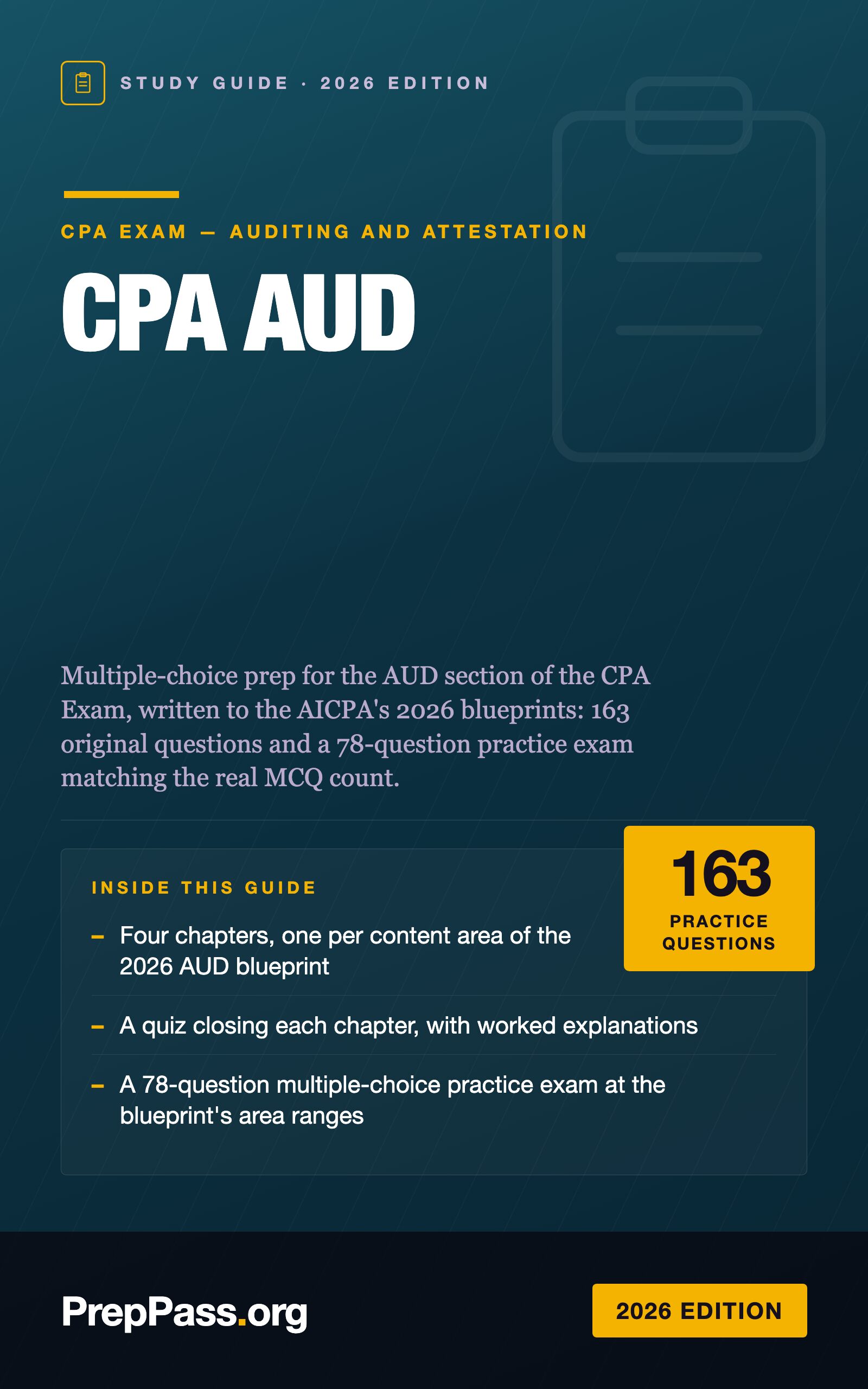
Practice stays free. The full CPA Exam — Auditing and Attestation (AUD) study guide is the material itself, taught start to finish — a downloadable PDF + EPUB you keep.
| Administering body | American Institute of Certified Public Accountants (AICPA) — exam delivered by Prometric |
|---|---|
| Questions | 78 questions Source: AICPA — Uniform CPA Examination Blueprints (effective January 2026, PDF) |
| Time limit | 240 minutes Source: AICPA — Uniform CPA Examination Blueprints (effective January 2026, PDF) |
| Passing score | Scaled score of 75 on a 0–99 scale Source: AICPA & CIMA — Learn more about CPA Exam scoring and pass rates |
| Fees | Not published by Boards of Accountancy / NASBA What we read and found nothing in: NASBA — CPA Exam Candidate Guide (07162026, PDF) |
| Languages offered | English |
Frequently asked questions
How many CPA Exam — Auditing and Attestation (AUD) practice questions are here?+
A full bank of original CPA Exam — Auditing and Attestation (AUD) practice questions across the official content areas, weighted like the real exam, with explanations. Free, no signup.
What is the CPA Exam — Auditing and Attestation (AUD) exam like?+
A multiple-choice exam, 240 minutes. Practice by topic here, then take the full timed mock exam to gauge readiness.
Are these the real exam questions?+
No. Every question is 100% original, written from public primary sources with explanations. We never copy real exam questions or paid prep material.
Can I study in Chinese or Spanish?+
PrepPass practice is in English, 中文 and Español. The official exam is in English — switch the question language to English any time to rehearse the exact terminology you'll see on test day.
Is there a study guide for the CPA Exam — Auditing and Attestation (AUD)?+
Yes. PrepPass sells CPA AUD Study Guide — 2026 Edition, a PDF + EPUB download, $24.99 one-time; the practice on this page stays free without it. See the study guide →
Sample practice questions
A few real questions from this free bank, with full explanations. Use the practice tool above for the whole set.
- 1. Ethics, Professional Responsibilities and General Principles
Maria, a staff auditor on the engagement team for the audit of Crane Co., a nonissuer, inherits Crane shares worth $900, an amount immaterial to her. She obtains the right to sell the shares on March 3. Under the AICPA Code of Professional Conduct, what must happen for her independence not to be impaired?
- a.She tells the engagement partner about the shares and keeps them, since they are immaterial
- b.She transfers the shares to her spouse before the auditor's report is issued
- c.She keeps the shares until the auditor's report is released and then sells them
- d.She disposes of the shares within 30 days after she obtains the right to dispose of them
Answer: d
Explanation: The Unsolicited Financial Interests interpretation (ET 1.240.020) accepts an inherited interest only if the covered member disposes of it as soon as practicable and no later than 30 days after gaining knowledge of it and the right to dispose of it. Materiality does not matter for a direct financial interest: ET 1.240.010 says any direct interest held during the period of the professional engagement impairs independence, so telling the partner does not cure it. A spouse is immediate family, whose interests are treated as the covered member's own, and holding the shares until the report is released keeps a direct interest during the engagement period.
- 2. Ethics, Professional Responsibilities and General Principles
Under the Department of Labor's interpretive bulletin on the independence of accountants who audit employee benefit plans, which circumstance would make the accountant not independent for the plan's audit?
- a.A member of the accounting firm maintains the plan's financial records
- b.A former sponsor employee now at the firm has fully cut ties and is off the plan audit
- c.An actuary associated with the firm provides actuarial services to the plan
- d.The firm is separately engaged by the plan sponsor for other professional work
Answer: a
Explanation: The DOL bulletin (29 CFR 2509.2022-01, which the AICPA blueprint cites under its former number 2509.75-9) states in paragraph (b)(3) that an accountant is not independent if the accountant or a member of the firm maintains financial records for the plan. Paragraph (c)(1) says an accountant does not lose independence solely because the firm is engaged by the plan sponsor or because an associated actuary serves the plan. Paragraph (b)(2) exempts a former employee of the plan or sponsor who has completely disassociated and does not audit periods of his or her employment.
- 3. Ethics, Professional Responsibilities and General Principles
Under PCAOB AS 1305, by when must the auditor of an issuer communicate in writing to management and the audit committee all significant deficiencies and material weaknesses identified in an audit of the financial statements?
- a.Before the auditor's report is issued
- b.Within 45 days after the report release date
- c.Only at the next audit committee meeting after year-end
- d.No later than 60 days after the report release date
Answer: a
Explanation: AS 1305.04 requires written communication of all significant deficiencies and material weaknesses to management and the audit committee, and states that it should be made before the auditor's report on the financial statements is issued. The 60-day window comes from AU-C 265, which governs nonissuer audits. The other timings do not appear in AS 1305.
- 4. Assessing Risk and Developing a Planned Response
In an audit of a nonissuer, no specific risks of material misstatement due to fraud have been identified. Which procedure does AU-C 240 still require in order to address the risk of management override of controls?
- a.Confirming every related party balance with the counterparty
- b.Testing the appropriateness of journal entries and other adjustments
- c.Obtaining a separate representation letter from the board
- d.Observing a surprise count of all petty cash funds
Answer: b
Explanation: AU-C 240.32 requires, apart from any specific fraud risks, procedures to test journal entries and other adjustments, to review accounting estimates for bias (including a retrospective review), and to evaluate the business rationale of significant unusual transactions. Confirming related party balances and counting petty cash may be useful in some audits but are not required responses to override. A separate board representation letter is not required by AU-C 240.
- 5. Assessing Risk and Developing a Planned Response
Certain controls that do not address a significant risk were tested in a prior audit and have not changed. AU-C 330 allows the auditor of a nonissuer to use that prior-year evidence if
- a.management states in writing that none of the controls has changed during the year
- b.the controls were tested in the immediately preceding audit and in no other period
- c.continuing relevance is established and each is tested at least every third audit
- d.the controls are automated and the general IT controls were tested in any earlier year
Answer: c
Explanation: AU-C 330.14 requires the auditor to establish the continuing relevance of prior evidence through inquiry combined with observation or inspection. If nothing has changed, the controls must be tested at least once in every third audit, with some controls tested each year so that all testing does not fall in a single year. Automation and management's written statements do not replace these steps.
- 6. Assessing Risk and Developing a Planned Response
An entity expended $2.4 million of federal awards, all under a single federal program that is not research and development. The program's terms do not require a financial statement audit. Under 2 CFR 200.501, which audit may the entity elect?
- a.A review of its schedule of federal expenditures
- b.No audit, because only one program is involved
- c.A program-specific audit
- d.An agreed-upon procedures engagement instead
Answer: c
Explanation: 2 CFR 200.501(c) allows a program-specific audit under 200.507 when the entity expends federal awards under only one program (excluding research and development) and the program's rules do not require a financial statement audit. Because expenditures exceed $1,000,000, an audit of some kind is still required. Agreed-upon procedures and reviews are not audits under subpart F.
- 7. Performing Further Procedures and Obtaining Evidence
The auditor of a nonissuer tests 80 purchase approvals and finds 4 without approval. The tolerable rate of deviation is 4%. What is the most appropriate conclusion?
- a.The 5% sample rate exceeds the tolerable rate, so planned reliance on the control is not supported
- b.The deviations can be disregarded if management corrects the four transactions afterward
- c.The sample rate equals the 4% tolerable rate, so the control can be relied on as planned
- d.The control is effective, because 76 of the 80 approvals tested were properly performed
Answer: a
Explanation: The sample deviation rate is 4 / 80 = 5%, which PCAOB AS 2315.41 treats as the best estimate of the population rate. Because it already exceeds the 4% tolerable rate, the sample does not support the planned reliance, and AU-C 330.17 requires the auditor to consider additional tests of controls or more substantive procedures. Correcting the transactions afterward does not change how the control operated during the period.
- 8. Performing Further Procedures and Obtaining Evidence
In an audit of a nonissuer, how is the letter of inquiry to the entity's external legal counsel handled under AU-C 501?
- a.The auditor prepares and sends it, and counsel replies to management, who forwards it
- b.The auditor drafts it, and management delivers it to counsel in person with the file
- c.Management prepares it; the auditor sends it and counsel replies to the auditor
- d.Management prepares and sends it, and passes counsel's reply on to the auditor
Answer: c
Explanation: AU-C 501.19 requires the auditor to seek direct communication with external counsel through a letter of inquiry prepared by management and sent by the auditor, asking counsel to respond directly to the auditor. Management prepares the letter because the client is asking its own lawyer to communicate. Routing the reply through management, or having management send the letter, breaks the direct line to the auditor that the standard requires.
- 9. Performing Further Procedures and Obtaining Evidence
Management of a nonissuer refuses to sign a representation letter acknowledging its responsibility for preparing and fairly presenting the financial statements. Under AU-C 580, the auditor should
- a.accept an oral acknowledgment from management instead
- b.express an unmodified opinion with an other-matter paragraph
- c.express a qualified opinion because of the scope limitation
- d.disclaim an opinion or withdraw from the engagement
Answer: d
Explanation: AU-C 580.25 requires the auditor to disclaim an opinion or withdraw if management does not provide the representations about its responsibilities required by paragraphs .10-.11. A qualified opinion is not enough because this refusal affects the whole audit. An other-matter paragraph and oral acknowledgments do not replace required written representations, since .21 calls for them in a letter addressed to the auditor.
- 10. Forming Conclusions and Reporting
In an integrated audit of an issuer, the auditor identifies a material weakness in internal control over financial reporting, and there is no restriction on the scope of the engagement. Under PCAOB AS 2201, what opinion on internal control must the auditor express?
- a.A qualified opinion
- b.A disclaimer of opinion
- c.An unqualified opinion with an explanatory paragraph
- d.An adverse opinion
Answer: d
Explanation: AS 2201.90 states that if one or more material weaknesses exist, the auditor must express an adverse opinion on the company's internal control over financial reporting, unless there is a restriction on the scope of the engagement. AS 2201 does not provide for a qualified opinion on internal control. A disclaimer is for scope restrictions. Paragraph .92 requires the auditor to also consider the effect on the opinion on the financial statements.