National Home Inspector Exam (NHIE) Practice Test
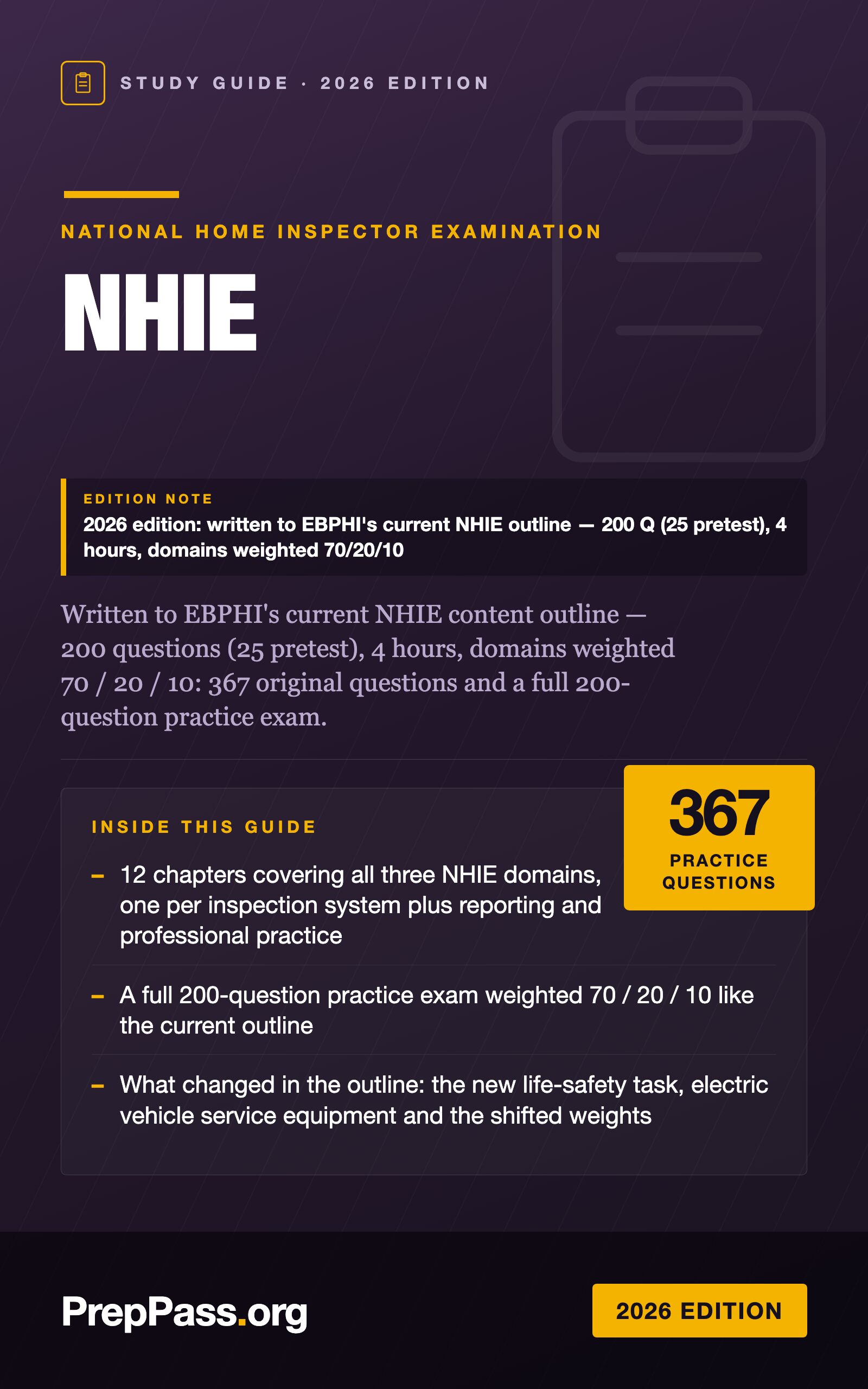
Practice stays free. The full National Home Inspector Examination (NHIE) study guide is the material itself, taught start to finish — a downloadable PDF + EPUB you keep.
Frequently asked questions
How many National Home Inspector Exam (NHIE) practice questions are here?+
A full bank of original National Home Inspector Exam (NHIE) practice questions across the official content areas, weighted like the real exam, with explanations. Free, no signup.
What is the National Home Inspector Exam (NHIE) exam like?+
About 200 questions, 240 minutes. Practice by topic here, then take the full timed mock exam to gauge readiness.
Are these the real exam questions?+
No. Every question is 100% original, written from public primary sources with explanations. We never copy real exam questions or paid prep material.
Can I study in Chinese or Spanish?+
PrepPass practice is in English, 中文 and Español. The official exam is in English — switch the question language to English any time to rehearse the exact terminology you'll see on test day.
Is there a study guide for the National Home Inspector Exam (NHIE)?+
Yes. PrepPass sells NHIE Study Guide — 2026 Edition, a PDF + EPUB download, $19.99 one-time; the practice on this page stays free without it. See the study guide →
Sample practice questions
A few real questions from this free bank, with full explanations. Use the practice tool above for the whole set.
- 1. Property & Building Inspection
On a sloped asphalt-shingle roof, what is the primary purpose of the metal or plastic drip edge installed along the eaves and rakes?
- a.To hold the shingles down during high winds
- b.To provide attic ventilation at the roof edge
- c.To direct runoff into the gutter and keep water from wicking back onto the fascia and sheathing
- d.To increase the roof's fire resistance rating
Answer: c
Explanation: A drip edge extends water past the fascia so runoff falls into the gutter rather than wicking behind it and rotting the sheathing and fascia. It is a moisture-management detail, not a structural, ventilation, or fire component.
- 2. Property & Building Inspection
In a home's electrical panel, why is it a defect to find two circuit conductors (a 'double tap') under a single breaker terminal not rated for two wires?
- a.The terminal may not clamp both wires securely, causing loose connections, arcing, and overheating
- b.It doubles the available amperage on the circuit
- c.It is required by code for kitchen circuits
- d.It improves grounding of the panel
Answer: a
Explanation: Most breakers are listed for a single conductor; forcing two under one lug can leave one wire loose, producing high-resistance connections that arc and overheat. Double taps are only acceptable on breakers specifically listed for two conductors.
- 3. Property & Building Inspection
An inspector finds no anti-tip bracket on a freestanding kitchen range. Why is this reported as a safety concern?
- a.The bracket is required for electrical grounding
- b.The range can tip forward if weight is applied to an open oven door, risking injury and burns
- c.It prevents gas leaks at the supply line
- d.The range will not heat evenly without it
Answer: b
Explanation: An anti-tip bracket anchors the rear of the range so it cannot tip forward when a child stands or leans on the open oven door. Missing brackets are a common, easily corrected safety defect.
- 4. Property & Building Inspection
In a vented attic, what problem is most directly caused by inadequate balance between soffit (intake) and ridge (exhaust) ventilation?
- a.Increased water pressure at fixtures
- b.Higher risk of electrical short circuits in the panel
- c.Moisture buildup and heat accumulation leading to condensation, mold, and premature shingle aging
- d.Excessive foundation settlement
Answer: c
Explanation: Balanced intake at the soffits and exhaust at the ridge lets air wash the underside of the roof, carrying away heat and moisture. Without it, condensation and heat build up, promoting mold, rot, and shortened shingle life.
- 5. Property & Building Inspection
On a forced-air furnace, why is a cracked heat exchanger considered a serious safety defect?
- a.It can allow combustion gases, including carbon monoxide, to mix with the conditioned air distributed through the home
- b.It reduces the airflow through the ducts only
- c.It only affects the furnace's energy efficiency
- d.It causes the blower motor to overheat
Answer: a
Explanation: The heat exchanger separates combustion gases from the breathing air moved by the blower. A crack can leak carbon monoxide into the supply air, so a suspected cracked exchanger warrants immediate evaluation and shutdown.
- 6. Property & Building Inspection
What does the presence of efflorescence (a white crystalline deposit) on a basement foundation wall indicate to an inspector?
- a.The concrete is losing structural strength rapidly
- b.There is an electrical fault behind the wall
- c.Water has been moving through the masonry, leaving mineral salts as it evaporates
- d.The wall was recently painted
Answer: c
Explanation: Efflorescence is mineral salt left behind as water passes through masonry and evaporates at the surface. It is evidence of past or present moisture intrusion and should prompt a look at grading, drainage, and waterproofing.
- 7. Property & Building Inspection
In a crawlspace with exposed soil, why does an inspector recommend a vapor barrier (ground cover) over the earth?
- a.To provide additional structural support to the floor joists
- b.To serve as a walking surface for future repairs
- c.To reduce moisture migrating from the soil into the crawlspace, limiting wood decay and mold
- d.To improve the crawlspace's fire rating
Answer: c
Explanation: Bare soil continuously releases moisture into the crawlspace, feeding mold and rot in the wood structure above. A vapor barrier over the ground greatly reduces this moisture load and protects the framing and insulation.
- 8. Analysis of Findings & Reporting
A well-written home inspection report finding should generally include which combination of elements?
- a.The names of past owners of the property
- b.A guaranteed repair cost estimate for every item
- c.The location and description of the defect, its implication, and a recommended action
- d.Only the inspector's personal opinion of the seller
Answer: c
Explanation: Clear findings state what was observed and where, why it matters (the implication), and what the client should do next. This structure lets clients understand and act on the issue without the inspector guaranteeing costs or making unrelated claims.
- 9. Analysis of Findings & Reporting
Why should an inspection report distinguish between a 'deficiency' and an item that is simply near the end of its service life?
- a.Because service life has no bearing on a home purchase
- b.So the client can prioritize actual defects versus planning for eventual, expected replacement
- c.Because near-end-of-life items never need to be reported
- d.So the inspector can avoid inspecting older components
Answer: b
Explanation: A deficiency is something not performing as intended, while an aging component may still function but warrant future budgeting. Distinguishing them helps clients separate urgent repairs from planned capital expenses.
- 10. Professional Responsibilities
Under a typical home inspector Standard of Practice, which of the following best describes the nature of a general home inspection?
- a.A guarantee or warranty that no problems will arise after purchase
- b.A code-compliance audit that certifies the home meets all current building codes
- c.A visual, non-invasive examination of readily accessible systems and components to identify observed defects
- d.A destructive investigation that includes opening walls and dismantling equipment
Answer: c
Explanation: Standards of Practice define a home inspection as a visual, non-invasive survey of accessible systems, reporting defects observed at the time. It is not a code inspection, a warranty, or a destructive investigation, and reports should reflect those limits.