Journeyman Electrician (NEC) Practice Test
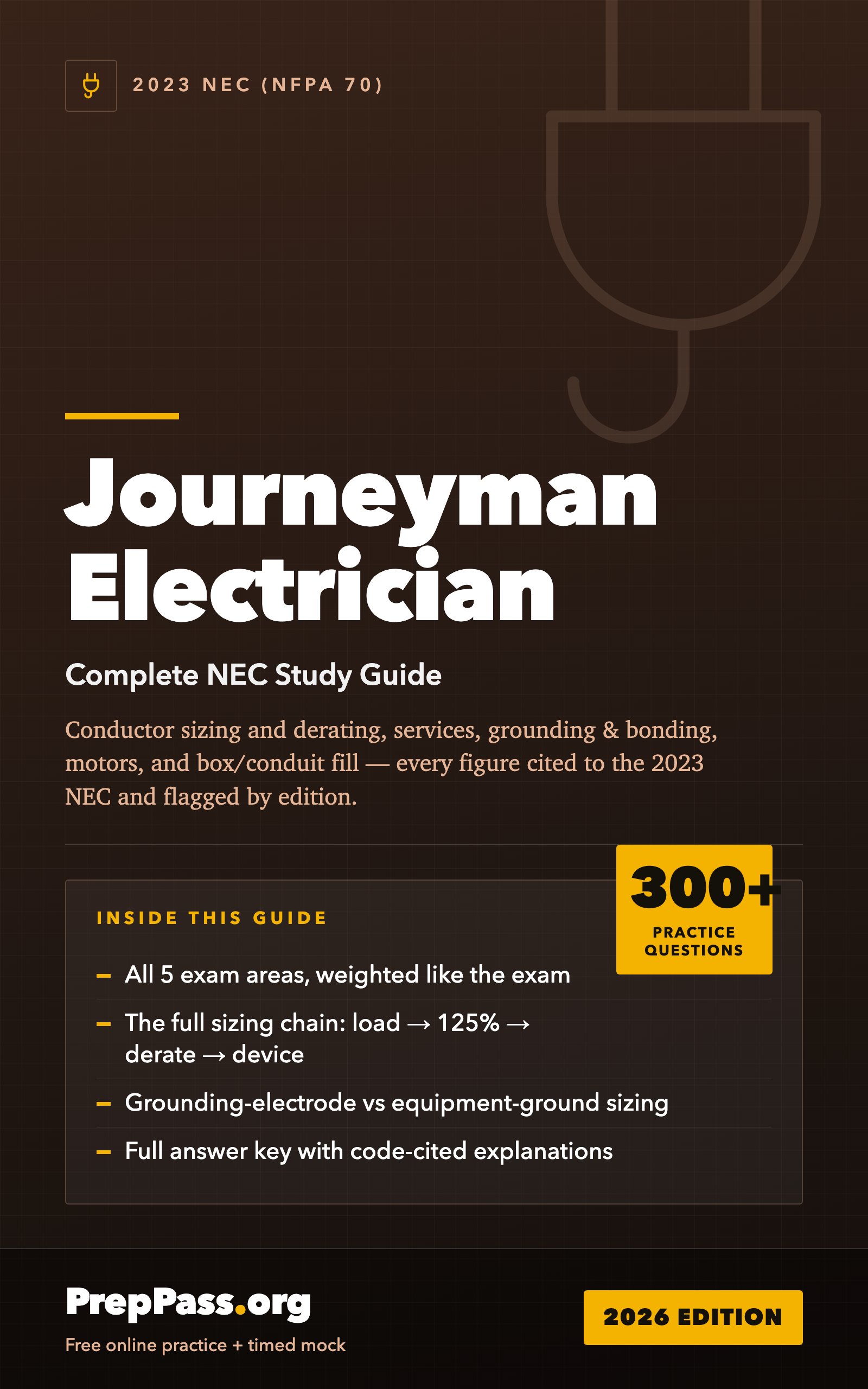
Practice stays free. The full Journeyman Electrician (NEC) study guide is the material itself, taught start to finish — a downloadable PDF + EPUB you keep.
Frequently asked questions
How many Journeyman Electrician (NEC) practice questions are here?+
A full bank of original Journeyman Electrician (NEC) practice questions across the official content areas, weighted like the real exam, with explanations. Free, no signup.
What is the Journeyman Electrician (NEC) exam like?+
About 161 questions, 240 minutes, and you need 70% to pass. Practice by topic here, then take the full timed mock exam to gauge readiness.
Are these the real exam questions?+
No. Every question is 100% original, written from public primary sources with explanations. We never copy real exam questions or paid prep material.
Can I study in Chinese or Spanish?+
PrepPass practice is in English, 中文 and Español. The official exam is in English — switch the question language to English any time to rehearse the exact terminology you'll see on test day.
Sample practice questions
A few real questions from this free bank, with full explanations. Use the practice tool above for the whole set.
- 1. Branch Circuits & Feeders
A 208-volt, single-phase branch circuit supplies a continuous load of 24 amperes. What is the minimum standard overcurrent device rating permitted?
- a.30 amperes
- b.25 amperes
- c.24 amperes
- d.40 amperes
Answer: a
Explanation: An overcurrent device supplying a continuous load must be rated at not less than 125 percent of that load: 24 A x 1.25 = 30 A, which is a standard rating in 240.6(A). The 24 A and 25 A choices ignore or under-apply the 125 percent factor, and 40 A jumps past the next standard size above the calculated value.
Source: 2023 NEC §210.20(A)
- 2. Services, Grounding & Bonding
A service is supplied by two parallel sets of 250 kcmil copper conductors per phase. What is the minimum size copper grounding electrode conductor?
- a.4 AWG
- b.2 AWG
- c.1/0 AWG
- d.3/0 AWG
Answer: c
Explanation: With parallel conductors the equivalent area is the sum of the areas in one phase: 2 x 250 kcmil = 500 kcmil, which falls in the over 350 through 600 kcmil row and requires 1/0 copper. Using 2 AWG treats a single 250 kcmil conductor as the whole service, and 3/0 corresponds to services above 1,100 kcmil.
Source: 2023 NEC Table 250.66
- 3. Wiring Methods & Materials
A short raceway nipple no longer than 24 inches connects two enclosures. What fill percentage is permitted?
- a.31 percent
- b.40 percent
- c.53 percent
- d.60 percent
Answer: d
Explanation: Notes to Chapter 9, Table 1 permit a nipple not exceeding 24 inches in length to be filled to 60 percent of its total cross-sectional area, because heat buildup and pulling friction are both minimal over such a short run. The 40, 53 and 31 percent values are the normal fills for three or more, one, and two conductors respectively.
Source: 2023 NEC Chapter 9, Table 1, Note 4
- 4. Motors & Equipment
A continuous-duty motor over 1 horsepower has no marked service factor and no marked temperature rise. What is the maximum overload device rating as a percentage of nameplate full-load current?
- a.140 percent
- b.125 percent
- c.115 percent
- d.175 percent
Answer: c
Explanation: Motors that carry neither a service factor of 1.15 or greater nor a marked temperature rise of 40 degrees C or less are limited to 115 percent of nameplate current, because there is less thermal margin available. The 125 percent value applies to the better-rated motors, 140 percent is the permitted increase when the motor will not start, and 175 percent is a fuse sizing percentage.
Source: 2023 NEC §430.32(A)(1)
- 5. Branch Circuits & Feeders
A dwelling has a single household electric clothes dryer with a nameplate rating of 4.5 kilowatts. What value must be used for the dryer load in the service calculation?
- a.4,500 volt-amperes
- b.4,000 volt-amperes
- c.5,000 volt-amperes
- d.3,600 volt-amperes
Answer: c
Explanation: The load for a household electric clothes dryer is 5,000 volt-amperes or the nameplate rating, whichever is larger, so a 4,500-volt-ampere nameplate is calculated at the 5,000-volt-ampere floor. Using the nameplate 4,500 value violates the minimum, and the other figures apply factors that do not belong here.
Source: 2023 NEC §220.54
- 6. Theory & Safety
As defined in Article 100, ampacity is best described as which of the following?
- a.The maximum current a conductor can carry continuously under the conditions of use without exceeding its temperature rating
- b.The current that will instantly melt the conductor
- c.The rated current of the overcurrent device protecting the conductor, taken directly from the marking on the breaker or fuse without regard to installation conditions
- d.The current at which voltage drop reaches 3 percent
Answer: a
Explanation: Article 100 defines ampacity as the maximum current, in amperes, that a conductor can carry continuously under the conditions of use without exceeding its temperature rating. It is a property of the conductor and its environment, not the rating of the protective device ahead of it.
Source: 2023 NEC Art. 100
- 7. Branch Circuits & Feeders
A 480-volt three-phase feeder carries 30 amperes 300 feet on 4 AWG copper (41,740 circular mils). Using K = 12.9, what is the approximate voltage drop?
- a.4.8 volts
- b.9.6 volts
- c.5.6 volts
- d.2.8 volts
Answer: a
Explanation: Three-phase VD = (1.732 x K x I x L) / CM = (1.732 x 12.9 x 30 x 300) / 41,740, about 4.8 V. Using 2 instead of 1.732 gives the 5.6-V answer. See NEC Chapter 9, Table 8.
- 8. Services, Grounding & Bonding
A service uses two parallel sets of 600 kcmil copper conductors per phase. Using the 12.5 percent rule, what is the minimum copper main bonding jumper?
- a.2/0 AWG
- b.4/0 AWG
- c.3/0 AWG
- d.250 kcmil
Answer: c
Explanation: Where copper service conductors exceed 1,100 kcmil, the main bonding jumper must be at least 12.5 percent of that area: 2 x 600 = 1,200 kcmil, and 1,200 x 0.125 = 150 kcmil. 2/0 (133.1 kcmil) is too small; 3/0 (167.8 kcmil) qualifies. See NEC 250.28(D)(2).
- 9. Wiring Methods & Materials
A 15-ampere, 125-volt receptacle is installed in a damp location such as under a roofed open porch. What cover is required?
- a.A cover that is weatherproof when no attachment plug is inserted
- b.A cover that is weatherproof whether or not a plug is inserted
- c.No cover is required in a damp location
- d.A standard indoor wall plate
Answer: a
Explanation: In damp locations a receptacle needs an enclosure weatherproof when a plug is not inserted; the stricter in-use cover, weatherproof with a plug inserted, is required in wet locations. See NEC 406.9(A).
- 10. Wiring Methods & Materials
Type NM cable entering a single-gang nonmetallic box that has no cable clamps must be secured within what distance of the box?
- a.24 inches
- b.8 inches
- c.3 feet
- d.4 and 1/2 feet
Answer: b
Explanation: Where a single-gang nonmetallic box without internal clamps is used, the NM cable must be secured within 8 inches of the box. See NEC 314.17(C) Exception and 334.30(A).
Own the complete Journeyman Electrician (NEC) guide — PDF + EPUB, $14.99 →