Study guide · 2026 Edition
Journeyman Electrician — Complete NEC Study Guide (2026)
PrepPass's independent 2026 study guide for the Journeyman Electrician exam is 58 pages including 55 practice questions with a full answer key, PDF + EPUB, $14.99 one-time; it is not affiliated with the exam provider. The book does not include PrepPass's separate online timed mock for this exam (80 questions, 240 minutes).
- Length
- 58 pages
- Practice questions in the book
- 55
- PrepPass online timed mock
- 80 questions · 240 min
- File last updated
- October 2026
- Delivery
- PDF + EPUB · English · instant download
Please read before you buy: This is an independent study guide, not affiliated with or endorsed by the NFPA.
Read the rest of this notice
Electrical exams are administered on the NEC (NFPA 70) edition your jurisdiction has adopted — 2017, 2020, or 2023, sometimes with state amendments. Every figure here is written to the 2023 NEC and flagged where an edition changed it; always confirm your jurisdiction's adopted edition and any local amendments before relying on a number.
What is in the Journeyman Electrician (NEC) study guide?
Conductor sizing and derating, services, grounding & bonding, motors, and box/conduit fill — every figure cited to the 2023 NEC and flagged by edition.
Exam facts, who it suits and what changed
Look inside the book
Three real pages, rendered straight from the PDF you download — a reference page, a teaching page, and a worked question, always in that order. Nothing here was redrawn to look better.
- Quick referenceChapter 2 — Services, Grounding and Bonding, Panelboards and Transformers · PDF page 18
A page you can turn back to: the numbers, deadlines or terms gathered in one place.
- How it's taughtAnswer Key & Explanations · PDF page 56
An explanation page: the material taught in prose, in the order the exam tests it.
- A question, workedChapter 2 — Services, Grounding and Bonding, Panelboards and Transformers · PDF page 19
A practice question with its answer and the reasoning behind it — not just a key.
Exam inside two weeks?
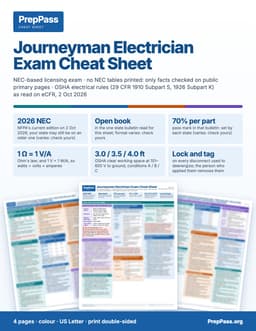
This guide is the teaching, read over weeks. If your exam is inside two weeks, the printable colour cheat sheet is the other product: the figures the exam turns on, laid out by section.
See the Journeyman Electrician cheat sheet PDF — $9.99 →
4 pages · US Letter · printable PDF · yours to keep
What's included — and what isn't
Included
- All 5 exam areas (branch circuits, services/grounding, wiring methods, motors/HVAC, theory/safety), weighted like the exam
- The full sizing chain taught step-by-step: load → 125% → temperature column → derate → device
Not included
- No printed copy is shipped — this is a file you download and can print yourself
- No video course, instructor or tutoring comes with the book — the free videos on the site are separate
Everything included, and everything that isn't
Included
- 55 practice questions with a full answer key and code-cited explanations
- Grounding-electrode vs equipment-grounding conductor sizing, made clear
- Every figure written to the 2023 NEC and flagged by edition
- PDF (print & tab it) + EPUB (phone / e-reader)
Not included
- Not your exam registration or the testing centre's fee, which you still pay to the official body
Contents
See 6 sections and the page each one starts on
- Chapter 1 — Branch Circuits, Feeders, Conductor Sizing and Overcurrent Protectionp. 9
- Chapter 2 — Services, Grounding and Bonding, Panelboards and Transformersp. 15
- Chapter 3 — Raceways, Boxes, Cables and Underground Installationsp. 21
- Chapter 4 — Motors, HVAC Equipment, Luminaires and Power Sourcesp. 26
- Chapter 5 — Electrical Theory, Working Space and Job-Site Safetyp. 31
- Answer Key & Explanationsp. 50
Taken from the PDF you download, with the page each one starts on — not typed here.
Read a chapter free, in full
One complete chapter, exactly as it ships in the eBook. Scroll the window to read it right here; no download, no email.
Read chapter 1 here, without leaving the page
The free chapter is the exam's calculation core — the full conductor sizing chain, load to device — so you can judge the teaching where the exam is won or lost.
Almost every question in this chapter comes down to the same chain of reasoning: find the load, apply the continuous-load multiplier, pick a conductor from the ampacity table, adjust it for heat, then choose an overcurrent device. Master that sequence and you will answer branch-circuit, feeder, and voltage-drop questions with the same handful of moves. Learn the chain, not a hundred separate facts.
Loads, continuous loads, and the 125 percent rule
A continuous load is one whose maximum current is expected to continue for three hours or more (2023 NEC Art. 100). That describes most commercial lighting, sign circuits, and electric heat. The rule that flows from it is the single most-tested idea on the exam: both the conductor and the overcurrent device must be sized for the noncontinuous load plus 125 percent of the continuous load. Standard breakers and the terminations they land on are not tested to carry their full rating indefinitely, so the code builds in a 25 percent cushion on the part of the load that never lets up.
The multiplier applies only to the continuous portion. Noncontinuous load is added in at 100 percent. So a mixed circuit is: noncontinuous amps + (1.25 × continuous amps). Conductor minimum ampacity uses this rule (2023 NEC §210.19(A) for branch circuits, §215.2(A)(1) for feeders), and the overcurrent device minimum uses the same rule (§210.20(A) for branch circuits, §215.3 for feeders).
Once you have the calculated minimum device size, you round up to a standard rating. The standard ampere ratings in 2023 NEC §240.6(A) are 15, 20, 25, 30, 35, 40, 45, 50, 60, 70, 80, 90, 100, 110, 125, 150, 175, 200, and up. A value like 55 amperes is not a standard rating and does not exist as a breaker — a favorite trap.
Reading the ampacity table and respecting termination temperature
Table 310.16 gives the allowable ampacity of insulated conductors in a raceway, cable, or earth at a 30 °C ambient with not more than three current-carrying conductors. The column you finish in is set by the temperature rating of the terminations, not by the insulation printed on the wire. A 90 °C THHN conductor that lands on a 75 °C lug is limited to the 75 °C column. The higher column may still be used as the starting point for derating — this split (finish at the termination column, start derating from the insulation column) is the most misunderstood idea in all of conductor sizing.
Two termination limits control most jobs (2023 NEC §110.14(C)(1)):
- Circuits 100 A or less, or using 14 AWG through 1 AWG, are limited to the 60 °C ampacities unless the equipment is listed for higher.
- Circuits over 100 A, or using conductors larger than 1 AWG, are limited to the 75 °C ampacities unless listed for higher.
Two more rules protect small conductors and let you round devices up:
- Small-conductor protection (§240.4(D)): regardless of table ampacity, overcurrent protection is limited to 15 A for 14 AWG, 20 A for 12 AWG, and 30 A for 10 AWG copper. This overrides the table for these three sizes.
- Next higher standard device (§240.4(B)): where a conductor's ampacity does not land on a standard rating, you may protect it with the next higher standard device — but only up to 800 A.
Type NM cable ampacity is always taken from the 60 °C column even though its conductors are rated 90 °C (§334.80). Single-phase dwelling services and main power feeders may be sized from the reduced conductor table in §310.12 rather than Table 310.16.
Derating: ambient temperature and more than three conductors
Two independent penalties can stack on the same run, and when both apply you multiply them together against the ampacity read from the column that matches the conductor's insulation (not its termination):
- Ambient correction (§310.15(B)) handles hot attics, boiler rooms, and rooftops. For a 90 °C conductor the factor is 0.91 at 36–40 °C and 0.82 at 46–50 °C (read the actual factor from the table for the actual ambient).
- Conductor bundling adjustment (§310.15(C)(1)) handles the heat bundled conductors impose on each other: 80% for 4–6 current-carrying conductors, 70% for 7–9, 50% for 10–20, 45% for 21–30.
Start from the insulation column (§310.14(A)(1); the "lowest value applies" rule that reconciles this with the 75 °C terminations is §110.14(C)): a THHN conductor derates from the 90 °C value even when its terminations are 75 °C. After multiplying, the result must still be checked against the termination-temperature limit and the small-conductor protection rule. Two counting rules keep the "number of current-carrying conductors" honest: a neutral that carries only the unbalanced current of a wye system is not counted, but a neutral on a circuit whose major portion of load is nonlinear (electric-discharge lighting, electronics) is counted (§310.15(E)); equipment grounding and bonding conductors are never counted (§310.15(F)).
Voltage drop
Voltage drop is not an enforceable requirement for most branch circuits — the NEC states recommended maximums in informational notes, not mandatory rules. But it is heavily tested, because it is the one place the exam makes you work with conductor resistance directly. The standard method uses the constant K (about 12.9 for copper, 21.2 for aluminum) and the conductor's circular-mil area from Chapter 9, Table 8.
- Single-phase: VD = (2 × K × I × L) ÷ circular mils, where L is the one-way length in feet.
- Three-phase: VD = (1.732 × K × I × L) ÷ circular mils.
- Solving for size: circular mils = (2 × K × I × L) ÷ allowable VD, then pick the next larger conductor from the table.
The widely applied design target is 3% on a branch circuit and 5% total from the service to the farthest outlet.
Dwelling branch-circuit requirements
Residential questions test a small set of memorized numbers rather than calculations, and they appear on every exam:
- Receptacle spacing (§210.52(A)(1)): no point along the floor line of any wall space may be more than 6 feet from a receptacle (so a 6-foot cord always reaches).
- Small-appliance circuits (§210.11(C)(1)): at least two 20-A small-appliance branch circuits serve the kitchen, pantry, breakfast room, and dining room receptacles.
- Laundry and bathroom (§210.11(C)(2), (3)): a dedicated 20-A circuit for laundry receptacles and another 20-A circuit for bathroom receptacles.
- GFCI near sinks (§210.8(A)): receptacles within 6 feet of the outside edge of a sink require GFCI protection (the 2020 and 2023 editions expanded GFCI coverage — confirm your edition).
- AFCI coverage (§210.12(A)): arc-fault protection for 120-V, 15- and 20-A circuits supplying outlets in most habitable rooms, including kitchens and laundry areas.
- Multiwire branch circuits (§210.4(B)): all ungrounded conductors must be disconnected simultaneously at the point where the circuit originates.
Key numbers & facts — Chapter 1 (2023 NEC; confirm your adopted edition) - Continuous load = maximum current for 3 hours or more — Art. 100 - Sizing rule (conductor and device): noncontinuous + 125% × continuous — §210.19(A), §210.20(A), §215.2(A)(1), §215.3 - Standard device ratings: 15, 20, 25, 30, 35, 40, 45, 50, 60, 70, 80, 90, 100, 110… — §240.6(A); 55 A is NOT standard - Next higher standard device allowed up to 800 A — §240.4(B) - Small-conductor protection: 14 AWG → 15 A, 12 AWG → 20 A, 10 AWG → 30 A (copper) — §240.4(D) - Termination limits: ≤100 A or 14–1 AWG → 60 °C; >100 A or larger than 1 AWG → 75 °C — §110.14(C)(1) - Table 310.16 basis: 30 °C ambient, ≤3 current-carrying conductors - NM cable uses the 60 °C column — §334.80 - Bundling adjustment: 4–6 → 80%, 7–9 → 70%, 10–20 → 50%, 21–30 → 45% — §310.15(C)(1) - Voltage drop: single-phase 2·K·I·L / CM; three-phase 1.732·K·I·L / CM; K ≈ 12.9 Cu / 21.2 Al; targets 3% branch, 5% total - Dwelling: receptacle within 6 ft; two 20-A small-appliance circuits; 20-A laundry and bath; GFCI within 6 ft of a sink
Worked example — the full sizing chain
A 240-volt, single-phase electric heater draws 40 amperes and runs continuously. It is wired with copper THWN to 75 °C terminations, in a raceway with no more than three conductors at 30 °C. Size the conductor and the branch-circuit breaker.
- Continuous load, so apply 125%: 40 A × 1.25 = 50 A minimum for both the conductor ampacity and the device.
- Conductor: in the 75 °C column of Table 310.16, 8 AWG copper is 50 A — exactly meets the 50 A minimum. (6 AWG at 65 A would also work but is oversized for the minimum asked.)
- Device: 50 A is itself a standard rating (§240.6(A)), so the breaker is 50 A. No rounding needed.
- Check small-conductor rule: 8 AWG is above the 14/12/10 AWG limits, so §240.4(D) does not cap it. Done: 8 AWG Cu on a 50 A breaker.
Notice the order never changes: multiply the continuous load, read the termination column, then land on a standard device.
Named exam traps
- "55-ampere breaker." There is no 55 A standard rating. If your calculation lands between standards, round up to the next one in §240.6(A) (subject to the §240.4(B) 800 A ceiling). Watch also for 90 A looking "close enough" when the answer is a real standard size.
- Wrong column. THHN is a 90 °C wire, but if it lands on a 75 °C lug you size from the 75 °C column. The 90 °C column is only the starting point for derating, never the finish for a termination.
- Applying 125% to the whole load. The multiplier hits only the continuous part. On a mixed circuit, add the noncontinuous load at 100%.
- Forgetting small-conductor protection. Even if a derated 12 AWG "calculates" to 25 A, §240.4(D) still caps its breaker at 20 A.
- Counting the wrong conductors when derating. Don't count a wye neutral that carries only unbalanced current, and never count the EGC — but do count the neutral when the load is majority nonlinear.
- Voltage-drop length. Use the one-way run length L in the formula; the factor of 2 (single-phase) already accounts for the return conductor.
Questions buyers ask
How do I get it?
Pay, and the download appears on this page straight away. The links are also emailed to you. No account is required.
What if it isn't for me?
Email us within 14 days for a full refund, no questions asked.
Is the free practice going away?
No. Every practice question, the timed mock and the free chapters on this site stay free. This book is the studying half, not a gate around the free half.
More questions (9)
Can I read it on my phone?
Yes — the EPUB is for phones and e-readers, the PDF is for printing and tabbing. You get both.
Is a study guide enough for the Journeyman Electrician (NEC) exam, or do I need a course?
A book is exam review: it does not replace any education, training or experience your licensing body requires before you may sit the exam, so check those requirements first. For the exam content itself, this 58-page guide teaches the material chapter by chapter with 55 practice questions and explanations inside, and 311 more practice questions are free on PrepPass. A prep course adds live instruction and a set schedule; whether you need one beyond any required education is your call.
What is the cheapest way to prepare for the Journeyman Electrician (NEC) exam?
Start with what costs nothing: 311 practice questions on PrepPass, with explanations and no signup. If you want it taught in one file you keep, the full study guide is $14.99 once; the printable cheat sheet for the last days is $9.99. No subscription on any of them.
Does the Journeyman Electrician (NEC) study guide come as a PDF?
Yes — Journeyman Electrician — Complete NEC Study Guide (2026) downloads as PDF and EPUB, 58 pages. The download link is emailed the moment payment clears and does not expire.
How much does the Journeyman Electrician (NEC) study guide cost?
$14.99, once. There is no subscription and no account to create; the PDF and EPUB files are yours to keep.
Are there free Journeyman Electrician (NEC) practice questions?
Yes — 311 of them, free to use with no signup and an explanation on every one. They are separate from this study guide, which is what you are buying here. The same free, no-account system also has practice modes (adaptive, new questions, spaced review of misses, weak-topic focus, saved, my mistakes); a timed mock exam (80 questions, 240 minutes) with a score report by topic; a 10-question readiness check (about 5 minutes); 5 study chapters. None of it needs this study guide.
Can I read part of the Journeyman Electrician (NEC) study guide before buying?
Yes. A full chapter is free to read on this page — not a summary of one, the chapter itself.
What is the difference between the Journeyman Electrician (NEC) study guide and the cheat sheet?
The study guide ($14.99) teaches the material chapter by chapter and is meant to be read over weeks. The cheat sheet ($9.99, 4 pages) drops the teaching and keeps the figures: every number on the exam grouped by value so the confusable ones sit together, each reference page paired with a recall page that blanks the answers, and four routes by days left — 14, 7, 3, or tonight. They are separate purchases; neither replaces the other.
Is this the official Journeyman Electrician (NEC) study guide?
No. This is an independent study guide and is not affiliated with or endorsed by the exam's awarding body. It is written from 2023 NEC (NFPA 70) — independently source-checked. Always confirm current requirements with the body that issues your licence.
Why buy the book when the practice is free?
Our practice questions and timed mock stay free — nothing on the site moves behind this book. The $14.99 book is the studying half: the material itself, taught in order, in a file you own.
- Systematic teaching — every exam section explained chapter by chapter, start to finish, not just questions
- Print it & tab it — a paper-ready PDF you can highlight, mark up, and bring to your study table
- Study anywhere, offline — EPUB on your phone or e-reader; no wifi, no browser tabs
- Everything in one place — the chapters and the practice questions in one file
- Yours for life — one-time $14.99, instant download, no subscription
The details
- Verified from the official source(2023 NEC (NFPA 70) — independently source-checked)
- 311 free practice questions
A journeyman electrician exam prep course runs $150–$600. This book teaches the same exam — same rules, verified to current standards — for a one-time $14.99 you keep for life.
Also free on PrepPass for Journeyman Electrician (NEC)
Beside this guide, PrepPass has a free study system for the same exam. It needs no account, and buying the guide does not unlock or change it: 311 practice questions with explanations; practice modes (adaptive, new questions, spaced review of misses, weak-topic focus, saved, my mistakes); a timed mock exam (80 questions, 240 minutes) with a score report by topic; a 10-question readiness check (about 5 minutes); 5 study chapters.
Progress is saved in your browser; a free account keeps it across devices. The readiness gauge reflects your own practice, not a prediction of the real exam result. How the practice works
One-time purchase, lifetime access to the download. The eBook is the full Journeyman Electrician (NEC) study guide in PDF and EPUB. Educational summary, not professional or legal advice — always confirm the current rules with the official source. Last updated: October 2026.