PTCB Pharmacy Technician (PTCE) pass rate & how retakes work
Yes. PTCB publishes a pass rate for the CPhT credential — 69% for 2025 — on its own Credentials by the Numbers page, alongside the 49,253 PTCE exams it administered that year.
Last checked 2026-09-22 · Source: PTCB — Become a Certified Pharmacy Technician (CPhT) · Full sourced exam facts
Free practice before you sit the exam
Retakes cost time and, often, another exam fee. Practice real questions until you consistently clear the standard you need. PrepPass has 400+ free PTCB Pharmacy Technician (PTCE) practice questions with answer explanations and a full timed mock exam — no signup required.
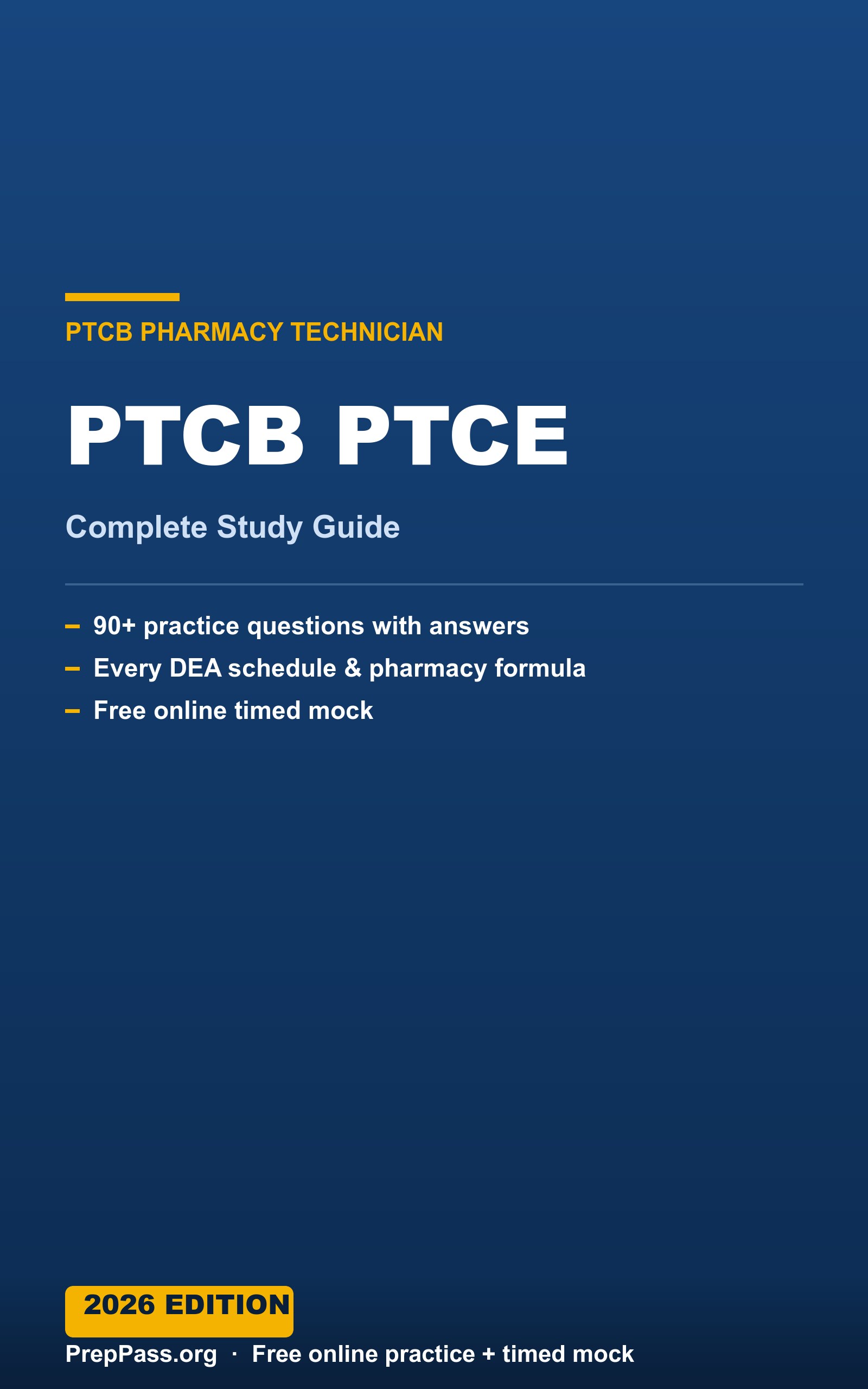
In the PTCB Pharmacy Technician (PTCE) guide: A named-traps list and a self-check closing each of the 4 domains, with 34 key-numbers boxes and 45 worked calculations through the book. Practice here stays free.
Is there a published PTCB Pharmacy Technician (PTCE) pass rate?
Yes. PTCB (Pharmacy Technician Certification Board) publishes it. These are its own figures for calendar year 2025:
| Candidate group | Volume | Pass rate |
|---|---|---|
| Certified Pharmacy Technician (CPhT) — the credential the PTCE leads to | 49,253 PTCEs administered in 2025 | 69% |
| Certified Compounded Sterile Preparation Technician (CSPT), for comparison | not stated | 83% |
Source: PTCB — Credentials by the Numbers (2025 pass rates) →
PTCB labels this only "2025 Pass Rate". It does not say whether the 69% is first-attempt candidates or every attempt, and it does not break the two apart — so we will not tell you it is a first-time rate, because PTCB has not said that it is. Treat it as the overall figure for the year and nothing more precise than that.
PTCB Pharmacy Technician (PTCE) facts
How many times can you retake the PTCB Pharmacy Technician (PTCE) exam?
There is generally no fixed lifetime cap. Here is how retakes work:
- If you don't pass, you can retake the exam. Each attempt generally requires registering (and paying any exam fee) again.
- The exam authority sets the retake policy, including any required waiting period between attempts. Confirm the exact wait on the official site before you rebook.
- You can prepare between attempts with free practice — PrepPass has 400+ free PTCB Pharmacy Technician (PTCE) practice questions with explanations.
Want the full picture of the difficulty and the content areas?
See how hard the PTCB Pharmacy Technician (PTCE) exam is →Frequently asked questions
What is the PTCB Pharmacy Technician (PTCE) pass rate?+
PTCB (Pharmacy Technician Certification Board) publishes it. For calendar year 2025: Certified Pharmacy Technician (CPhT) — the credential the PTCE leads to: 69% (49,253 PTCEs administered in 2025); Certified Compounded Sterile Preparation Technician (CSPT), for comparison: 83%. Source: PTCB — Credentials by the Numbers (2025 pass rates). PTCB labels this only "2025 Pass Rate". It does not say whether the 69% is first-attempt candidates or every attempt, and it does not break the two apart — so we will not tell you it is a first-time rate, because PTCB has not said that it is. Treat it as the overall figure for the year and nothing more precise than that.
What score do you need to pass the PTCB Pharmacy Technician (PTCE) exam?+
The published passing standard is scaled score of 1,400 on a 1,000–1,600 scale. That is the authority's figure, not ours, and it is a passing SCORE — the bar you personally have to clear — not a pass RATE. Confirm it on Pharmacy Technician Certification Board (PTCB) before you rely on it.
What happens if you fail the PTCB Pharmacy Technician (PTCE) exam?+
You can retake it. The authority may require a waiting period between attempts, so check the official page for the current rule. Between attempts, you can keep working through practice questions until you consistently clear the standard you need.
Scoring and retake rules — confirm on the official authority:
Pharmacy Technician Certification Board (PTCB) →PTCB — Credentials by the Numbers (2025 pass rates) →PTCB — Pharmacy Technician Certification Exam (PTCE) Content Outline →Last updated: September 2026 · sources above last read by hand that month