Series 24 — General Securities Principal Practice Test
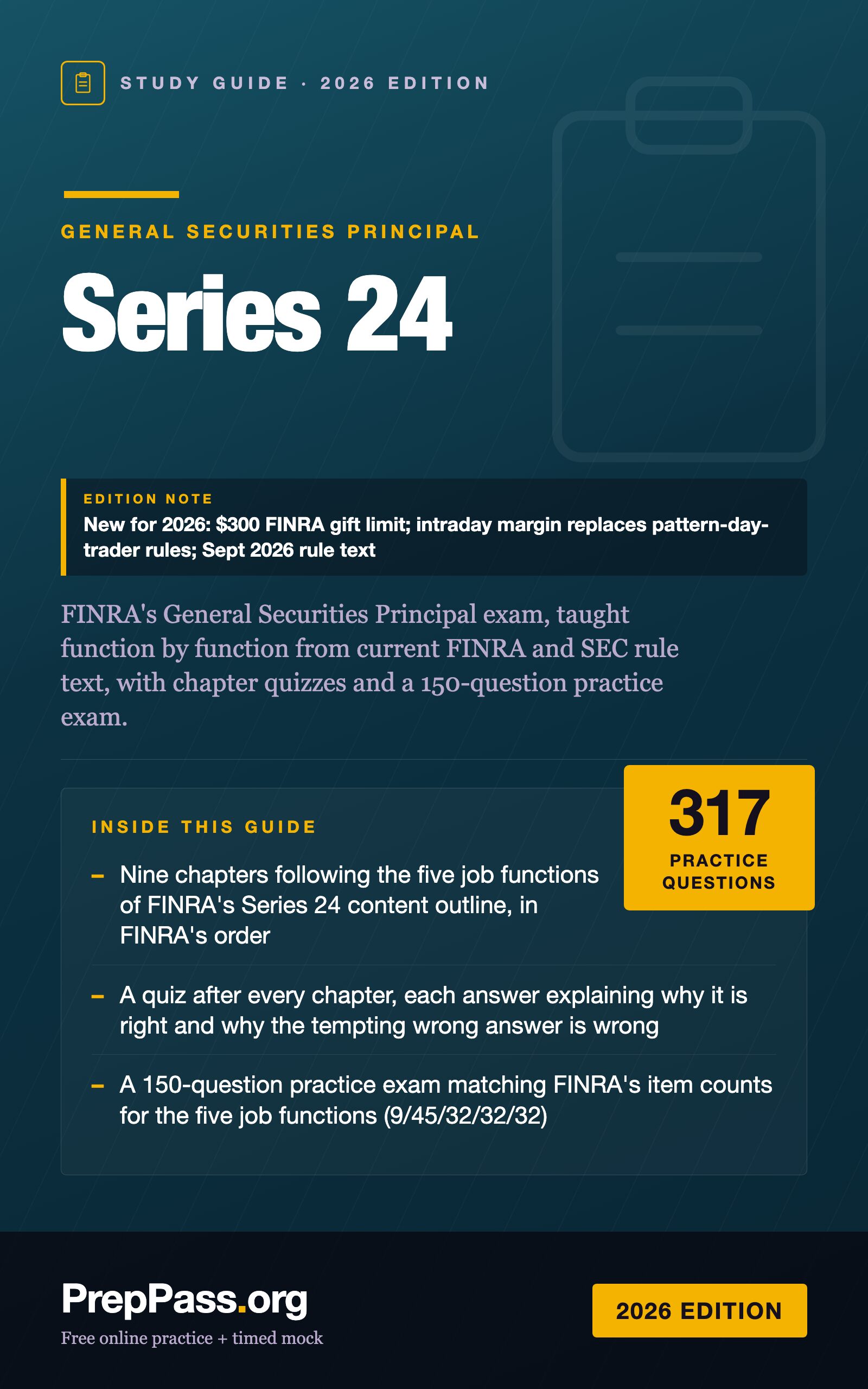
Practice stays free. The full Series 24 — General Securities Principal study guide is the material itself, taught start to finish — a downloadable PDF + EPUB you keep.
Frequently asked questions
How many Series 24 — General Securities Principal practice questions are here?+
A full bank of original Series 24 — General Securities Principal practice questions across the official content areas, weighted like the real exam, with explanations. Free, no signup.
What is the Series 24 — General Securities Principal exam like?+
About 150 questions, 225 minutes, and you need 70% to pass. Practice by topic here, then take the full timed mock exam to gauge readiness.
Are these the real exam questions?+
No. Every question is 100% original, written from public primary sources with explanations. We never copy real exam questions or paid prep material.
Can I study in Chinese or Spanish?+
PrepPass practice is in English, 中文 and Español. The official exam is in English — switch the question language to English any time to rehearse the exact terminology you'll see on test day.
Is there a study guide for the Series 24 — General Securities Principal?+
Yes. PrepPass sells Series 24 Study Guide — 2026 Edition, a PDF + EPUB download, $24.99 one-time; the practice on this page stays free without it. See the study guide →
Sample practice questions
A few real questions from this free bank, with full explanations. Use the practice tool above for the whole set.
- 1. General Broker-Dealer Activities
Under FINRA Rule 3110, a broker-dealer's supervisory system must, at a minimum, include:
- a.A guarantee that no rule violations will ever occur
- b.Approval of the firm's business plan by the SEC
- c.Written procedures and qualified principals to carry them out
- d.Daily approval of every trade by the firm's CEO
Answer: c
Explanation: Rule 3110 requires a supervisory system reasonably designed to achieve compliance, including written supervisory procedures (WSPs) and designated, appropriately registered principals. A system cannot guarantee zero violations, and there is no requirement for CEO approval of every trade or SEC approval of the business plan.
- 2. Customer-Related Activities
Most disputes between a customer and a member firm are resolved through:
- a.Binding mediation by the Federal Reserve
- b.FINRA arbitration
- c.A hearing before the SEC commissioners
- d.A jury trial in federal district court
Answer: b
Explanation: Customer agreements typically require that disputes be resolved through FINRA's arbitration forum, with mediation available. This provides a faster, industry-specific process rather than court litigation.
- 3. Registration & Personnel Management
A branch manager with 10 years as a Series 7 representative is named acting principal on March 1 but has not passed the Series 24. What is the last day she may act as a principal without passing?
- a.August 31, six months later
- b.March 31, 30 days later
- c.There is no deadline while she studies
- d.About June 29
Answer: d
Explanation: FINRA Rule 1210.04 permits a qualified registered representative to function as a principal for 120 calendar days before passing the principal exam. Counting 120 calendar days from March 1 lands on about June 29.
- 4. General Broker-Dealer Activities
Who must a member designate under FINRA Rule 3130?
- a.An independent director
- b.A FINRA liaison in each branch
- c.One or more chief compliance officers
- d.An outside auditor
Answer: c
Explanation: Rule 3130 requires each member to designate and identify one or more principals as chief compliance officer and to have its CEO certify annually that it has processes to establish, maintain, review, test and modify compliance and supervisory procedures.
- 5. General Broker-Dealer Activities
A member's networking agreement with a bank must allow whom to access the bank premises where the member operates?
- a.Only the bank's auditors
- b.Only the member's customers
- c.Its supervisors, the SEC and FINRA
- d.The state banking regulator only
Answer: c
Explanation: Rule 3160 requires the written networking agreement to permit supervisory personnel of the member and representatives of the SEC and FINRA to access the financial institution's premises where the member conducts broker-dealer services.
- 6. Customer-Related Activities
A firm's AML program must designate an individual responsible for day-to-day operations. To whom must that person be identified?
- a.The firm's clearing bank
- b.The state securities regulator
- c.FINRA
- d.The SEC's Division of Enforcement
Answer: c
Explanation: FINRA Rule 3310(d) requires each member to designate and identify to FINRA the individual or individuals responsible for implementing and monitoring the day-to-day operations and internal controls of its AML program.
- 7. Customer-Related Activities
Under Reg BI, what must a firm's policies do about material limitations on the products it offers, such as a proprietary-only shelf?
- a.Obtain FINRA approval of the product list
- b.Eliminate the limitations
- c.Nothing, if the products are registered
- d.Disclose them and prevent resulting harm
Answer: d
Explanation: Reg BI's conflict of interest obligation requires firms to identify and disclose material limitations on the securities that may be recommended and any associated conflicts, and to prevent those limitations from causing recommendations that put the firm's interest ahead of the customer's.
- 8. Trading & Market Making
Which order handling practice does FINRA Rule 5290 target?
- a.Combining orders for the same security
- b.Splitting orders to earn more
- c.Executing orders as riskless principal
- d.Routing orders to exchanges
Answer: b
Explanation: Rule 5290 prohibits conduct that splits an order into multiple smaller orders, or an execution into smaller executions for reporting, primarily to maximize amounts received by the member or associated person.
- 9. Trading & Market Making
A POD order is accepted from an institutional customer. What must the member have before accepting it?
- a.A margin agreement
- b.FINRA approval of the order
- c.The customer's trusted contact
- d.The customer's agent and account details
Answer: d
Explanation: FINRA Rule 11860 requires a member accepting a POD or COD order to have received, before or when accepting it, the name and address of the customer's agent and the customer's account number with that agent, among other requirements.
- 10. Investment Banking & Research
How long must a member keep the records it relies on to determine an account's eligibility for new issues?
- a.At least one year after the representation
- b.At least six years after account opening
- c.Until the account is closed
- d.Three years after the last sale
Answer: d
Explanation: FINRA Rule 5130 requires members to keep all records and information about an account's eligibility to purchase new issues for at least three years following the member's last sale of a new issue to that account.