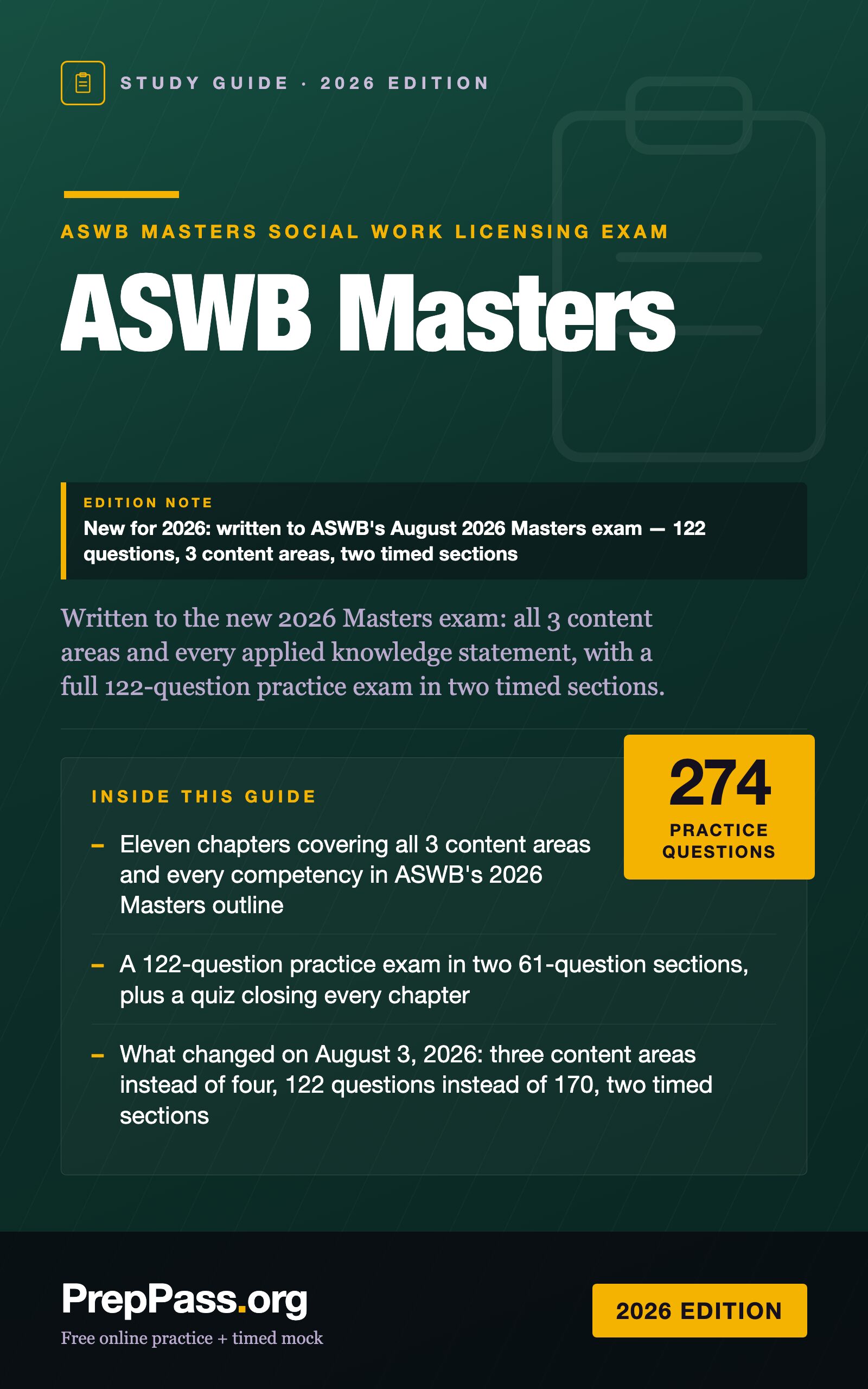
ASWB Masters Social Work Licensing Exam · Edición 2026
ASWB Masters Study Guide — 2026 Edition
Nota de ediciónNew for 2026: written to ASWB's August 2026 Masters exam — 122 questions, 3 content areas, two timed sections
Written to the new 2026 Masters exam: all 3 content areas and every applied knowledge statement, with a full 122-question practice exam in two timed sections.
- 274 preguntas originales de práctica del examen ASWB Masters, cada una con explicación razonada, en un PDF + EPUB que conservas
PDF + EPUB · en inglés · 247 páginas · $24.99 pago único
Este libro está escrito en inglés — el PDF y el EPUB que descargas están en inglés.
Descarga inmediata tras el pago — sin cuenta y sin suscripción.
Garantía de devolución de 14 días: ¿no te convence por cualquier motivo? Escribe a support@preppass.org en los 14 días siguientes a la compra y te devolvemos el importe completo. Política de reembolso
Prueba primero 10 preguntas — gratis
Responde las 10, y al terminar verás cada respuesta explicada — con la sección de esta guía que la enseña. Unos 5 minutos, sin registro.
Empezar 10 preguntas gratisMira dentro del libro
Tres páginas reales, renderizadas directamente del PDF que descargas — una página de referencia, una de explicación y una pregunta resuelta, siempre en ese orden. Nada se rediseñó para verse mejor.
- Referencia rápidaChapter 1 — Ethical Principles and Responsibilities (Competency IA) · Página 22 del PDF
Una página a la que puedes volver: cifras, plazos o términos reunidos en un solo lugar.
- Cómo se enseñaSection 1 — answer key & explanations · Página 202 del PDF
Una página de explicación: el material enseñado en prosa, en el orden en que lo evalúa el examen.
- Una pregunta resueltaChapter 2 — Ethical Service Delivery (Competency IB) · Página 40 del PDF
Una pregunta de práctica con su respuesta y el razonamiento detrás — no solo la clave.
Sobre el examen en sí
| Organismo administrador | Association of Social Work Boards (ASWB) — examen administrado por Pearson Fuente: ASWB — Examination Guidebook, Social Work Licensing Exams (08/2026 edition, PDF) |
|---|---|
| Preguntas | 122 preguntas (110 calificadas, 12 de prueba sin calificar) Fuente: ASWB — Examination Guidebook, Social Work Licensing Exams (08/2026 edition, PDF) |
| Tiempo límite | 240 minutos Fuente: ASWB — Examination Guidebook, Social Work Licensing Exams (08/2026 edition, PDF) |
| Puntuación para aprobar | No publicado por ASWB Lo que leímos y donde no aparece: ASWB — Examination Guidebook, Social Work Licensing Exams (08/2026 edition, PDF) |
| Tarifas |
Fuente: ASWB — Examination Guidebook, Social Work Licensing Exams (08/2026 edition, PDF) |
| Idiomas disponibles | No publicado por ASWB Lo que leímos y donde no aparece: ASWB — Examination Guidebook, Social Work Licensing Exams (08/2026 edition, PDF) |
Preguntas de práctica y capítulos gratis de ASWB Masters Social Work Licensing Exam →
Qué incluye — y qué no
Incluido
- Eleven chapters covering all 3 content areas and every competency in ASWB's 2026 Masters outline
- A 122-question practice exam in two 61-question sections, plus a quiz closing every chapter
- What changed on August 3, 2026: three content areas instead of four, 122 questions instead of 170, two timed sections
- Ethics taught from the NASW Code of Ethics, cited by section
- Key numbers and named traps at the end of every chapter, and a one-page decision guide
- 274 original questions, each with a worked explanation citing its source
- PDF + EPUB you keep
No incluido
- No se envía copia impresa — es un archivo que descargas y puedes imprimir tú
- El libro no incluye curso en vídeo, instructor ni tutorías — los vídeos gratis del sitio van aparte
- No incluye tu inscripción al examen ni la tasa del centro, que sigues pagando al organismo oficial
Contenido
Ver 19 secciones y la página en la que empieza cada una
- Chapter 1 — Ethical Principles and Responsibilities (Competency IA)p. 11
- Chapter 2 — Ethical Service Delivery (Competency IB)p. 30
- Chapter 3 — Diversity and Social Justice (Competency IC)p. 48
- Chapter 4 — Assessment Concepts I: Human Development, Behavior and Relationships (Competency IIA)p. 62
- Chapter 5 — Assessment Concepts II: Trauma, Abuse, Mental Health, Substance Use and Environment (Competency IIA)p. 79
- Chapter 6 — Assessment Methods and Techniques (Competency IIB)p. 96
- Chapter 7 — Assessment Practices and Planning (Competency IIC)p. 110
- Chapter 8 — Practice Concepts (Competency IIIA)p. 125
- Chapter 9 — Intervention Methods and Techniques (Competency IIIB)p. 137
- Chapter 10 — Practice Evaluation and Research (Competency IIIC)p. 154
- Chapter 11 — Supervision and Administration (Competency IIID)p. 167
- Section 1 Section 2 Totalp. 180
- Section 1 — 61 questions (2 hours)p. 181
- Section 1 — answer key & explanationsp. 195
- Section 2 — 61 questions (2 hours)p. 205
- Section 2 — answer key & explanationsp. 220
- Appendix A — The exam at a glancep. 230
- Appendix B — Terms the exam expects you to use preciselyp. 233
- Appendix C — One-page decision guidep. 236
Tomado del PDF que descargas, con la página en la que empieza cada uno — no escrito a mano aquí.
Lee un capítulo completo gratis
Un capítulo completo, tal como viene en el eBook. Desplázate en la ventana para leerlo aquí; sin descargas ni correo.
Lee el capítulo 2 aquí, sin salir de la página
No te dimos la introducción fácil — el capítulo gratis abre en una de las partes más exigentes del libro, para que juzgues la enseñanza donde el examen se pone difícil.
Competency IB moves from principles to the daily decisions that put them into practice: where the professional boundary sits, how far self-determination reaches, when the law requires a report, what goes in the record, how policy shapes service, how to act ethically around death and dying, what supervisors and managers owe, how to bill honestly, how technology changes each of these, and how to end a professional relationship well. On the 2026 Masters outline these topics sit inside content area I, Values and Ethics (35%).[1]
Professional boundaries in the social worker–client relationship
A boundary is the line between the professional relationship and every other kind of relationship. The ASWB outline lists the pressures on it: power differences, influence, privilege, conflicts of interest, self-disclosure and dual relationships.[1]
Dual and multiple relationships. The NASW Code does not forbid every overlapping relationship; it forbids those "in which there is a risk of exploitation or potential harm to the client." When a dual relationship is unavoidable — a rural social worker whose client is also the town's only pharmacist, for instance — the social worker "should take steps to protect clients" and is responsible for "setting clear, appropriate, and culturally sensitive boundaries."[2] The burden always sits with the social worker, never the client.
Conflicts of interest. Social workers inform clients when a real or potential conflict arises and resolve it in a way "that makes the clients' interests primary."[2] When services go to people who have a relationship with each other — a couple, a family — the social worker clarifies "which individuals will be considered clients" and what obligations are owed to each.[2]
Sexual relationships. With current clients the prohibition is absolute — "under no circumstances," whether the contact is "consensual or forced," and including "inappropriate sexual communications through the use of technology."[2] With former clients the Code says social workers "should not engage in sexual activities or sexual contact … because of the potential for harm," and places the full burden of showing no exploitation on the social worker who claims an exception.[2] Social workers also do not provide clinical services to former sexual partners.[2] Terminating services in order to pursue a relationship is expressly prohibited.[2]
Physical contact. Not banned outright, but social workers avoid contact "when there is a possibility of psychological harm to the client as a result of the contact (such as cradling or caressing clients)."[2]
Gifts, bartering and fees. Fees should be "fair, reasonable, and commensurate with the services performed," considering the client's ability to pay.[2] Bartering is permitted "only in very limited circumstances" — an accepted local practice, essential for services, negotiated without coercion, at the client's initiative and with informed consent.[2] A social worker may not charge a private fee to a client who is entitled to the same service through the social worker's agency.[2] Referral fees are prohibited when the referring social worker provided no service.[2]
Self-disclosure. Self-disclosure is a tool, not a relationship. The test is whether it serves the client's goals. A social worker who shares personal struggles because it feels good to be understood has crossed the line; a brief, purposeful disclosure that models hope may not. On the exam, answers that shift the focus to the social worker are almost always wrong.
Technology and boundaries. Social workers "avoid communication with clients using technology … for personal or non-work-related purposes"[2] and avoid "accepting requests from or engaging in personal relationships with clients on social networking sites."[2] A friend request from a client is declined, and the reason is discussed in the next session as a boundary conversation, not ignored.
Protecting and enhancing client self-determination
"Social workers respect and promote the right of clients to self-determination and assist clients in their efforts to identify and clarify their goals."[2] The outline's examples — medication, medical treatment, counseling, placement, the right to refuse services — show where the exam tests it: clients who want to leave the hospital against advice, older adults who refuse a nursing-home move, adults who return to an abusive partner.
The limit is narrow and specific: self-determination may be limited when "clients' actions or potential actions pose a serious, foreseeable, and imminent risk to themselves or others."[2] A choice that the social worker thinks is unwise is not, by itself, that kind of risk.
When a client lacks capacity, the social worker acts "to safeguard the interests and rights of those clients"[2] and seeks permission from an appropriate third party while still informing the client at their level of understanding.[2]
Exam pattern: If a competent adult makes a lawful but risky choice, the best answer supports the client's decision and reduces risk (education, safety planning, keeping the door open). If the choice creates imminent danger, protection comes first.
Mandatory reporting: abuse, threats of harm, impaired professionals, duty to warn
Child abuse and neglect
The federal Child Abuse Prevention and Treatment Act (CAPTA) requires every state to have provisions requiring certain individuals to report known or suspected child abuse and neglect.[3] Social workers are named as mandated reporters in most states.[3] The reporting standard is not proof: "Typically, a report must be made when the reporter, in their official capacity, suspects or has reason to believe that a child has been abused or neglected."[3]
What this means on the exam:
- Report, don't investigate. The social worker's job is to report reasonable suspicion to child protective services or law enforcement as state law directs — not to interview the alleged perpetrator, gather evidence, or wait for certainty.
- Report even if the client objects. The Code tells clients at the outset that legal obligations can supersede loyalty — its own example is a legal duty to report child abuse.[2]
- Tell the client when feasible that a report is being made, unless doing so would endanger the child.[2]
- Make sure the report is made. Informing a supervisor is good practice, but the exam expects the mandated reporter to ensure the report itself reaches the authority state law names.
- States vary. Who reports, how fast, and to whom are set by state law; the exam tests the principle, not a single state's statute.
Older and dependent adults
An "older adult" in CDC's elder abuse definition is someone aged 60 or older, and the abuse "occurs at the hands of a caregiver or other trusted person."[4] Forms include physical, sexual, emotional or psychological abuse, neglect ("the failure to meet an older adult's basic needs"),[4] and financial abuse ("the illegal, unauthorized, or improper use of money, benefits, property, or assets").[4] The National Institute on Aging advises reporting suspected abuse to an authority and notes that the person reporting "do[es] not personally need to prove that abuse is occurring; professionals will investigate."[5] Adult protective services is the usual recipient. As with child abuse, which professionals are mandated reporters is set by state law.
Threats of harm to others: duty to warn and protect
The foundational case is Tarasoff v. Regents of the University of California (1976). The California Supreme Court held that when a therapist determines, or should determine, "that his patient presents a serious danger of violence to another, he incurs an obligation to use reasonable care to protect the intended victim."[6] The court said discharging that duty may call for warning the intended victim or others likely to tell the victim, notifying the police, "or to take whatever other steps are reasonably necessary."[6] Its most quoted line: "The protective privilege ends where the public peril begins."[6]
Today, states differ. NCSL reports that "most states have laws that either require or permit mental health professionals to disclose information about patients who may become violent," and the triggering threat is defined differently from state to state — learn your own state's rule.[7] HIPAA permits disclosure, consistent with law and ethics, to prevent a serious and imminent threat, including to "the target of the threat."[8] The Code's own exception covers disclosure "necessary to prevent serious, foreseeable, and imminent harm to a client or others."[2]
The sequence the exam rewards: assess the threat (specific person? plan? means? history? intent?), consult if time allows, take protective action proportionate to the risk, disclose only what is necessary, tell the client when feasible, and document.
Impaired and unethical professionals
The Code asks social workers to discuss concerns directly with an impaired, incompetent or unethical colleague when feasible and productive, and to use formal channels — employer, licensing board, NASW, other professional bodies — if the colleague does not act.[9] State practice acts may add their own reporting rules for misconduct; the exam will not expect you to know any one state's version.
Legal and ethical issues regarding documentation
Records serve the client first. The Code's documentation standards:
- Documentation must be "accurate and reflects the services provided."[10]
- Records must be "sufficient and timely … to facilitate the delivery of services and to ensure continuity of services provided to clients in the future."[10]
- Documentation "should protect clients' privacy to the extent that is possible and appropriate and should include only information that is directly relevant to the delivery of services."[10]
- Records are kept after termination "for the number of years required by relevant laws, agency policies, and contracts."[10]
Two exam traps: (1) altering a record after the fact — errors are corrected by a dated, signed addendum, never by rewriting or deleting; (2) writing for the wrong audience — speculative or judgmental language that is not relevant to service delivery does not belong in the record, and derogatory language about clients is prohibited in any communication.[2]
Impact of governmental policies on service delivery
Law and policy define who is eligible, what is funded and how long services last. The Code asks social workers to "be aware of the impact of the political arena on practice" and to "advocate for changes in policy and legislation to improve social conditions."[11] Administrators advocate "within and outside their agencies for adequate resources to meet clients' needs,"[10] and when resources are scarce, allocation should be "nondiscriminatory and based on appropriate and consistently applied principles."[10] On the exam, a policy that harms clients calls for advocacy through legitimate channels, not quiet noncompliance.
Legal and ethical issues related to death and dying
Advance directives. Under the federal Patient Self-Determination Act rules, Medicare- and Medicaid-participating providers must give adult patients written information about their rights under state law to accept or refuse treatment "and the right to formulate, at the individual's option, advance directives."[12] The two most common directives are the living will, which tells doctors how a person wants to be treated if they cannot make their own decisions,[13] and the durable power of attorney for health care, which names a health care proxy to make decisions if the person cannot communicate.[13]
Palliative care versus hospice. Palliative care focuses on "improving quality of life for people with serious illnesses and their care partners," is available at any age, and "can be provided along with curative treatment."[14] Hospice is for a person with a terminal illness whose doctor believes they have "six months or less to live if the illness runs its natural course," and in hospice "attempts to cure the person's illness are stopped."[14] The Medicare hospice regulation uses the same prognosis: "a life expectancy of 6 months or less if the terminal illness runs its normal course."[15]
The social worker's role. Social workers help clients understand options, document their wishes, communicate with family and the team, and have their decisions respected. Laws on medical aid in dying exist in some jurisdictions and not others; the social worker's ethical task is to know the law where they practice, respect the client's self-determination within it, avoid imposing personal beliefs, and seek consultation when their own values conflict.[16]
Sources cited in this excerpt
- ASWB Examination Guidebook (08/2026 edition, for exams administered beginning August 3, 2026). Association of Social Work Boards, 2026-08. https://www.aswb.org/wp-content/uploads/2026/05/2026-Social-Work-Licensing-Exam-Guidebook-5.4.2026.pdf
- NASW Code of Ethics, Standard 1: Social Workers' Ethical Responsibilities to Clients. National Association of Social Workers, 2021 revision; read 2026-09-25. https://www.socialworkers.org/About/Ethics/Code-of-Ethics/Code-of-Ethics-English/Social-Workers-Ethical-Responsibilities-to-Clients
- Mandatory Reporting of Child Abuse and Neglect (State Statutes series). Child Welfare Information Gateway (U.S. Children's Bureau), read 2026-09-25. https://artifacts.childwelfare.gov/public/documents/mandatory-reporting-abuse-neglect.pdf?VersionId=hBmqKpTL4fH1g96myykMFNR046sQNdbu
- About Abuse of Older Persons. Centers for Disease Control and Prevention, read 2026-09-25. https://www.cdc.gov/elder-abuse/about/index.html
- Elder Abuse. National Institute on Aging, read 2026-09-25. https://www.nia.nih.gov/health/elder-abuse/elder-abuse
- Tarasoff v. Regents of University of California, 17 Cal.3d 425 (1976) - SCOCAL, Stanford Law School. Supreme Court of California (via Stanford Law School SCOCAL), 1976-07-01; read 2026-09-25. https://scocal.stanford.edu/opinion/tarasoff-v-regents-university-california-30278
- Mental Health Professionals' Duty to Warn (updated March 16, 2022). National Conference of State Legislatures, 2022-03-16; read 2026-09-25. https://www.ncsl.org/health/mental-health-professionals-duty-to-warn
- 45 CFR § 164.512 Uses and disclosures for which an authorization or opportunity to agree or object is not required. (eCFR, current text). Electronic Code of Federal Regulations (U.S. Government Publishing Office / Office of the Federal Register), current as of 2026-09-25. https://www.ecfr.gov/api/renderer/v1/content/enhanced/current/title-45?part=164§ion=164.512
- NASW Code of Ethics, Standard 2: Ethical Responsibilities to Colleagues. National Association of Social Workers, 2021 revision; read 2026-09-25. https://www.socialworkers.org/About/Ethics/Code-of-Ethics/Code-of-Ethics-English/Social-Workers-Ethical-Responsibilities-to-Colleagues
- NASW Code of Ethics, Standard 3: Ethical Responsibilities in Practice Settings. National Association of Social Workers, 2021 revision; read 2026-09-25. https://www.socialworkers.org/About/Ethics/Code-of-Ethics/Code-of-Ethics-English/Social-Workers-Ethical-Responsibilities-in-Practice-Settings
- NASW Code of Ethics, Standard 6: Ethical Responsibilities to the Broader Society. National Association of Social Workers, 2021 revision; read 2026-09-25. https://www.socialworkers.org/About/Ethics/Code-of-Ethics/Code-of-Ethics-English/Social-Workers-Ethical-Responsibilities-to-the-Broader-Society
- 42 CFR § 489.102 Requirements for providers. (eCFR, current text). Electronic Code of Federal Regulations (U.S. Government Publishing Office / Office of the Federal Register), current as of 2026-09-25. https://www.ecfr.gov/api/renderer/v1/content/enhanced/current/title-42?part=489§ion=489.102
- Advance Care Planning: Advance Directives for Health Care. National Institute on Aging, read 2026-09-25. https://www.nia.nih.gov/health/advance-care-planning/advance-care-planning-advance-directives-health-care
- What Are Palliative Care and Hospice Care? National Institute on Aging, read 2026-09-25. https://www.nia.nih.gov/health/hospice-and-palliative-care/what-are-palliative-care-and-hospice-care
- 42 CFR § 418.22 Certification of terminal illness. (eCFR, current text). Electronic Code of Federal Regulations (U.S. Government Publishing Office / Office of the Federal Register), current as of 2026-09-25. https://www.ecfr.gov/api/renderer/v1/content/enhanced/current/title-42?part=418§ion=418.22
- NASW Code of Ethics: Preamble, Purpose, Ethical Principles. National Association of Social Workers, 2021 revision; read 2026-09-25. https://www.socialworkers.org/About/Ethics/Code-of-Ethics/Code-of-Ethics-English
Antes de comprar
- ¿Cómo lo recibo?
- Paga y la descarga aparece en esta página al instante. Los enlaces también se te envían por correo. No hace falta cuenta.
- ¿Y si no es para mí?
- Escríbenos dentro de 14 días para un reembolso total, sin preguntas.
- ¿Va a desaparecer la práctica gratis?
- No. Todas las preguntas, el simulacro cronometrado y los capítulos gratis del sitio siguen gratis. Este libro es la mitad de estudio, no una valla alrededor de lo gratuito.
- ¿Puedo leerlo en el móvil?
- Sí — el EPUB es para móviles y e-readers, el PDF para imprimir y marcar. Recibes ambos.
Los detalles
Written to the new 2026 Masters exam: all 3 content areas and every applied knowledge statement, with a full 122-question practice exam in two timed sections.
- Format: PDF + EPUB download · 247 pages
- 274 practice questions in the book, with a full answer key
- 100 free practice questions for this exam on PrepPass, included at no cost
- $24.99 one-time — no subscription
- 14-day money-back guarantee · refund policy
- Cross-referenced against: ASWB Examination Guidebook (08/2026 edition) Masters content outline and ASWB's exam pages, the NASW Code of Ethics and federal regulations (eCFR), read September 2026
- Verificado con la fuente oficial(ASWB Examination Guidebook (08/2026 edition) Masters content outline and ASWB's exam pages, the NASW Code of Ethics and federal regulations (eCFR), read September 2026)
- 100 preguntas de práctica gratis
- Descarga instantánea, tuyo de por vida
¿Por qué comprar el libro si la práctica es gratis?
Nuestras preguntas de práctica y el simulacro cronometrado siguen gratis: nada del sitio se esconde tras este libro. El libro de $24.99 es la mitad de estudio: el material en sí, explicado en orden, en un archivo tuyo.
- Enseñanza sistemática — cada sección del examen explicada capítulo a capítulo, de principio a fin, no solo preguntas
- Imprímelo y márcalo — un PDF listo para papel que puedes resaltar, anotar y llevar a tu mesa de estudio
- Estudia en cualquier lugar, sin conexión — EPUB en tu teléfono o e-reader; sin wifi, sin pestañas
- Todo en un solo lugar — los capítulos y las preguntas de práctica en un archivo
- Tuyo de por vida — pago único de $24.99, descarga instantánea, sin suscripción
Y sin riesgo: Garantía de reembolso de 14 días — ¿no te convence? Escríbenos para un reembolso total, sin preguntas. Consulta la política de reembolso.
Garantía de reembolso de 14 días · reembolso total, sin preguntas.
Compra única, acceso de por vida a la descarga. El eBook es la guía completa de ASWB Masters Social Work Licensing Exam en PDF y EPUB. Resumen educativo, no asesoría profesional ni legal — confirma siempre las reglas vigentes con la fuente oficial.