CSLB · Law & Business · 2026 Edition
The complete, current CSLB study guide
Nota de ediciónWritten to 2026 California law, incl. the July 2026 penalty ranges and CSLB's January 1, 2027 workers'-comp deadline.
All 7 exam sections in full, written to the current 2026 California law — the numbers the outdated prep books still get wrong.
- Las 7 secciones del examen en un PDF + EPUB que conservas
- 170 preguntas de práctica escritas para el libro — ninguna está en el banco gratuito de este sitio
- Una hoja de cifras y plazos clave en cada uno de los 7 capítulos
PDF + EPUB · en inglés · 400 páginas · $24.99 pago único
Descarga inmediata tras el pago — sin cuenta y sin suscripción.
Garantía de devolución de 14 días: ¿no te convence por cualquier motivo? Escribe a support@preppass.org en los 14 días siguientes a la compra y te devolvemos el importe completo. Política de reembolso
Lee primero un capítulo de muestra gratis
¿Ya la compraste? Recupera tu compra
¿Preparas ambos? Hay precio de pareja
- CSLB Law & Business — Complete Study Guide (2026)$24.99
- CSLB Law & Business — Cheat Sheet (2026)$9.99
Compra ambos: $27.99 — ahorras $6.99 frente a comprarlos por separado
Por separado $34.98 · 19% de descuento · Un pago, los dos productos.
¿Ya compraste CSLB Law & Business? No compres el paquete — lo incluye y pagarías dos veces por él. Consigue CSLB Law & Business por separado por $24.99. CSLB Law & Business · Qué incluye →
¿Lo combinas con otro examen de oficio?
Prueba primero 10 preguntas — gratis
Responde las 10, y al terminar verás cada respuesta explicada — con la sección de esta guía que la enseña. Unos 5 minutos, sin registro.
Empezar 10 preguntas gratisMira dentro del libro
Tres páginas reales, renderizadas directamente del PDF que descargas — una página de referencia, una de explicación y una pregunta resuelta, siempre en ese orden. Nada se rediseñó para verse mejor.
- Referencia rápidaChapter 3 — Employment Requirements · Página 131 del PDF
Una página a la que puedes volver: cifras, plazos o términos reunidos en un solo lugar.
- Cómo se enseñaChapter 3 — Employment Requirements · Página 118 del PDF
Una página de explicación: el material enseñado en prosa, en el orden en que lo evalúa el examen.
- Una pregunta resueltaPart II — Section Drills · Página 319 del PDF
Una pregunta de práctica con su respuesta y el razonamiento detrás — no solo la clave.
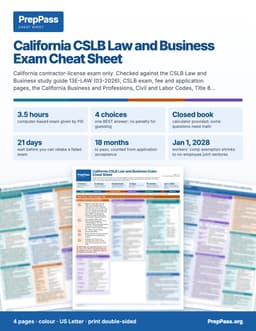
¿Examen en menos de dos semanas?
Esta guía es la enseñanza, para leer durante semanas. Si tu examen es en menos de dos semanas, la hoja de referencia a color imprimible es el otro producto: las cifras clave, por secciones.
4 páginas · US Letter · PDF imprimible · tuyo para siempre
Qué incluye — y qué no
Incluido
- All 7 exam sections, weighted like the real exam
- Written to current 2026 California law
- 170 practice questions: a 115-question timed practice exam (answers at the back) + 55 section drills, all explained
- “Key numbers & deadlines” cram sheets per chapter
- Worked California examples + named exam traps
- PDF (print & tab it) + EPUB (phone / e-reader)
No incluido
- No se envía copia impresa — es un archivo que descargas y puedes imprimir tú
- El libro no incluye curso en vídeo, instructor ni tutorías — los vídeos gratis del sitio van aparte
- No incluye tu inscripción al examen ni la tasa del centro, que sigues pagando al organismo oficial
Contenido
Ver 9 secciones y la página en la que empieza cada una
- Chapter 1 — Business Organization and Licensingp. 7
- Chapter 2 — Business Financesp. 54
- Chapter 3 — Employment Requirementsp. 93
- Chapter 4 — Insurance and Liensp. 137
- Chapter 5 — Contract Requirements and Executionp. 188
- Chapter 6 — Public Worksp. 244
- Chapter 7 — Safetyp. 278
- Part II — Section Drillsp. 316
- Part III — Timed Practice Exam (115 Questions)p. 343
Tomado del PDF que descargas, con la página en la que empieza cada uno — no escrito a mano aquí.
Lee un capítulo completo gratis
The core of the opening chapter, up to its Additional Topics — the same fact-checked text as the eBook, written to current 2026 California law. It stays free whether or not you buy.
Read chapter 1 here, without leaving the page
Introduction
Everything else in California contractor law starts here. Before a bond matters, before a contract binds anyone, before a lien can be filed, one question has to be answered: is this person legally a contractor, and are they licensed to do the work? Section 1 is where the exam builds that foundation, and roughly one question in eight comes from it.
The material is mostly memorization, which makes it some of the most reliable points on the test — if you learn the current numbers. That is the catch. More figures changed in this section recently than in almost any other, and the changes run directly against what older study guides (and stale memory) say. The minimum job size that triggers a license is now $1,000, not the $500 that appears everywhere in outdated material. The contractor's bond is $25,000, not $15,000. License fees were rewritten effective January 1, 2026. A candidate who studies the right values here banks easy points; one who trusts old numbers loses them.
This chapter walks through what legally counts as a contractor and who must be licensed, then the license classifications and the limits they impose, the qualifying individual who stands behind every license, the bonds and liability insurance the license law requires, the choice of business structure, and finally the advertising and consumer-notice rules that tie licensing back to the public. Wherever a dollar figure or deadline appears, it reflects law in force today.
Learning objectives
After working through this chapter you should be able to:
- State the legal definition of a "contractor" and explain why it reaches specialty trades, subcontractors, and hourly workers, not just "general contractors" (B&P §§7025–7026).
- Explain that contracting without a required license is a misdemeanor (B&P §7028), and — separately — that an unlicensed contractor generally cannot sue to collect and may have to refund money already paid, the civil rule of B&P §7031(a)/(b).
- Apply the minor-work exemption — no license needed when the whole job is under $1,000 in combined labor and materials — and know you cannot split a larger job to fit under it (B&P §7048).
- Distinguish the license classifications: Class A (general engineering), Class B (general building), B-2 (residential remodeling), and C specialty trades, including the "two unrelated trades" rule for a B (B&P §§7055–7059).
- Explain how a Class B may self-perform trades on a qualifying multi-trade project, and how a specialty contractor handles other-trade work — subcontract it, or keep it "incidental and supplemental" (B&P §§7057, 7059).
- Describe the role of the qualifying individual (sole owner, RMO, or RME), the §7068.1 direct-supervision-and-control duty that applies to every qualifier, and the specific RME test — a bona fide employee actively engaged at least 32 hours per week or 80% of the business's operating hours (B&P §7068(c)).
- Distinguish the license-law bonds — $25,000 contractor's license bond (§7071.6), $25,000 qualifier's bond when required (§7071.9), $100,000 LLC worker bond (§7071.6.5), and the disciplinary bond when triggered (§7071.8) — from the LLC's $1M–$5M liability insurance (§7071.19), which is insurance, not a bond.
- Compare the business structures — sole proprietor, partnership, corporation, LLC — and know the license is issued to the entity.
- Apply the current advertising rules and the mandatory CSLB consumer notice (B&P §§7027.1, 7027.2, 7030, 7030.5).
Part A — Who is a contractor, and who must be licensed
What legally counts as a "contractor"
The starting definition is deliberately broad. Under California law a contractor is anyone who, for others, builds, alters, repairs, adds to, or improves a building, road, or other structure — or who submits a bid to do so (B&P §§7025, 7026). The breadth is the point. It does not matter whether you are paid a lump sum, an hourly rate, or through a markup on materials; it does not matter whether you call yourself a "general contractor," a "handyman," or a "specialty trade." If the work improves real property and it is done for someone else, you are acting as a contractor, and you generally need a license.
Two misconceptions trip candidates here. The first is that only "general contractors" are contractors — in fact specialty trades and subcontractors are equally covered. The second is that being paid by the hour rather than by the project automatically takes you outside the definition — the method of payment alone does not decide status. But note the flip side: a bona fide employee who receives wages as sole compensation, does not customarily run an independently established business, and does not control the manner of performance is exempt under B&P §7053. So the real question is not hourly-vs-lump-sum; it is whether the person is a genuine wage employee or an independent operator holding themselves out as a contractor.
Why does this matter so much? Because almost every other rule on the exam — licensing, bonds, contracts, liens — only switches on once a person is legally a "contractor." Get the definition wrong and you will mislabel handymen, maintenance workers, and material suppliers all the way through the test.
California example. A homeowner in Bakersfield hires a worker at $45 an hour to reframe and re-tile a bathroom. The worker advertises his own remodeling services, supplies his own tools and helpers, sets his own methods, and works for many homeowners — he insists he is "just labor, paid hourly, not a contractor." On these facts the hourly rate does not save him: he is an independently established operator repairing and improving a structure for another, so he is acting as a contractor and needs the appropriate license. Change the facts — a genuine wage employee of a licensed contractor, directed and controlled, not holding out on his own — and §7053 would exempt that same bathroom work.
The license requirement and unlicensed contracting as a misdemeanor
The core consumer-protection rule of the entire license law is short: you must hold a valid CSLB license before you contract for, bid on, or perform work that requires one. Contracting without that license is a misdemeanor (B&P §7028), and penalties escalate for repeat offenses and for unlicensed work performed in a declared disaster area.
The civil consequence is even more powerful than the criminal one, and the exam leans on it — and it lives in a different statute from the crime. Under B&P §7031(a) an unlicensed contractor generally cannot bring or maintain any action to collect payment for the work — no matter how well the job was done or how clearly the customer agreed to pay. Worse, under §7031(b) a customer can sue to recover money already paid to an unlicensed contractor (disgorgement). Keep the citations straight: §7028 is the criminal misdemeanor statute; §7031 is the civil no-suit/refund statute — a distinction the exam tests. So the two ideas to hold together are: unlicensed contracting is a crime, and it forfeits the right to be paid.
Do not fall for the two traps. It is not true that an unlicensed contractor can still sue "as long as the work was good" — generally they cannot. And a first offense is not merely a fine with no criminal label; it is classified as a misdemeanor.
California example. An unlicensed operator completes a $28,000 deck-and-patio project in Riverside. The homeowner refuses to pay. When the operator sues, the court dismisses the claim: §7031(a) bars an unlicensed contractor from maintaining an action to collect for work requiring a license — and under §7031(b) the homeowner may even be able to recover amounts already paid.
The minor-work exemption — the $1,000 threshold
Not every small job requires a license. A license is not required where the total contract price for labor and materials combined is less than $1,000, provided all of §7048's conditions are met: the work is genuinely casual or minor, it does not require a building permit, the person does not employ others to perform or assist with the work, and the person does not hold themselves out as a contractor (B&P §7048(a),(c)).
Three details decide the exam questions. First, the threshold is measured on the whole project, labor plus materials — not labor alone. Second, you cannot split one larger job into several sub-$1,000 contracts to dodge the requirement; a $3,000 job is a $3,000 job even if written as three papers. Third — and this is the single most important number in the section — the current figure is $1,000, raised from the old $500 that still appears throughout stale study material.
That change is recent and worth pinning down. AB 2622 (Stats. 2024, Ch. 240) raised the threshold from $500 to $1,000 effective January 1, 2025, and AB 1170 (Stats. 2025, Ch. 67) re-enacted §7048 at $1,000 effective January 1, 2026. Any source citing "$500" is out of date. This same $1,000 figure also controls when an unlicensed person may advertise (Part F), so it is worth memorizing once and using twice.
California example. A homeowner wants a single fence-repair job done for $950 total — labor and materials combined. Because the whole job is under $1,000 and the work is minor, no license is required, so long as the worker does not advertise or present themselves as licensed. Bump the same job to $1,050, or discover it is really one phase of a larger $3,000 project, and a license is required.
Part B — License classifications and their limits
The classifications: A, B, B-2, and C specialty
CSLB does not issue one all-purpose license; it issues licenses by classification, and you may only contract for and perform work within the classifications you hold (B&P §§7055–7059; Cal. Code Regs. tit. 16, §§830–834).
- Class A — General Engineering. Fixed works requiring specialized engineering knowledge: roads, bridges, dams, pipelines, and utilities (§7056).
- Class B — General Building. A general building contractor's projects require the use of at least two unrelated building trades or crafts — and framing or carpentry may not be counted toward those two (§7057). A Class B may still take a standalone framing or carpentry project on its own, and on a qualifying multi-trade project the B may contract for and self-perform the work. The B must hold the specialty classification or subcontract only for fire protection (C-16) and well drilling (C-57), which §7057 expressly carves out.
- B-2 — Residential Remodeling. A newer classification tailored to residential remodel work, sitting between the general building license and single-trade specialties.
- Class C — Specialty. Single-trade licenses, each limited to its own craft — for example C-10 electrical, C-36 plumbing, C-20 HVAC (§7058). A specialty contractor works within its trade, not across trades.
The high-yield idea, and a frequent exam target, is the two-unrelated-trades rule for a B license, paired with the fact that C classes are single-trade. A Class B general building license does not license you to take just any single-trade job, and a specialty contractor cannot wander outside its trade simply because the other work happens to be on the same project.
California example. A developer needs a highway on-ramp built — grading, paving, drainage. That is Class A general engineering work, not general building. Separately, a company holding only a C-36 plumbing license cannot self-perform the electrical rough-in on a remodel just because its crew is already on site; electrical is a different trade requiring a C-10.
Working outside your classification and subletting work
Two different rules govern out-of-class work, and the exam rewards keeping them apart.
A Class B general building contractor may contract for and self-perform all the work on a project that genuinely requires two or more unrelated building trades (framing and carpentry don't count toward the two). On that qualifying multi-trade job the B does not have to hold the C-10, C-36, and so on for each trade, and does not have to subcontract them — self-performing the electrical, plumbing, and other trades on a real multi-trade building project is exactly what the general-building license authorizes (§7057). The B does have to hold the specialty or subcontract for fire protection (C-16) and well drilling (C-57), which §7057 singles out. Where the B's authority runs out is the standalone single-specialty job: a B taking a prime contract for only electrical, or only plumbing, must hold that C classification or subcontract it, and a single-specialty subcontract generally requires the specialty license outright.
A specialty (Class C) contractor faces the narrower rule in B&P §7059 and Cal. Code Regs. tit. 16, §831: it stays within its own trade and may take on other-trade work only when that work is incidental and supplemental — that is, essential to accomplish the work of its own classification — performed with its own employees or through a licensed subcontractor. That allowance is narrow; it does not authorize a large volume of unrelated-trade work dressed up as incidental.
California example. A Class B general building contractor building a custom home that requires framing, electrical, plumbing, HVAC, and roofing may self-perform the electrical rough-in itself — a genuine multi-trade home is precisely the project the Class B license covers, so this does not violate §7059. Subcontracting the electrical to a licensed C-10 is equally fine; the choice is the contractor's. What the same B could not do is take a job that is only an electrical service upgrade — a standalone single-specialty prime — without holding the C-10 or subcontracting it. Separately, a C-36 plumbing contractor may open and patch drywall to reach the pipes (incidental and supplemental under §831) but may not rewire the house.
Part C — Qualifying the license: the exam and the qualifying individual
Every license must stand behind a real, examined person. That person is the qualifying individual, and understanding the role — plus the anti-sham rules around it — is a reliable source of exam points.
To obtain a license, the qualifying individual must pass the trade and law examinations and must be responsible for supervising the licensee's construction operations (B&P §§7065, 7068; Cal. Code Regs. tit. 16, §823). Depending on the entity, the qualifier can be:
- a sole owner who qualifies their own license;
- a Responsible Managing Officer (RMO) — an officer of a corporation;
- a Responsible Managing Employee (RME) — a bona fide employee; or
- a qualifying partner or manager, depending on the entity form.
The crucial modern rule is that a qualifier cannot be a "paper" name who merely lends a license number. An RME in particular must be a bona fide employee actively engaged in the business — roughly at least 32 hours per week, or 80% of the business's total operating hours, whichever is less (B&P §§7068, 7068.1). This standard was clarified by AB 830 (Stats. 2021, Ch. 376), effective January 1, 2022, and it remains current. A qualifier also cannot freely qualify multiple firms at once except in narrow ownership situations.
The two misconceptions to bury: that a qualifier can lend their license number without real involvement (they cannot), and that one person can qualify many unrelated companies simultaneously (they generally cannot). The "actively engaged / bona fide employee" standard is a classic trap answer.
California example. A newly formed corporation pays an experienced license holder a small monthly fee to list him as its RME, though he never sets foot on a job and works elsewhere full time. This is an unlawful "paper" qualifier: an RME must be a bona fide employee actively engaged at least 32 hours a week or 80% of the firm's operating hours. The arrangement exposes both parties to discipline.
Part D — Bonds and insurance in the license law
Bond amounts are prime memorization items, and the exam tests whether candidates can keep several different bonds straight — each with a different amount and trigger — and can tell a bond from liability insurance. Learn them as a set: the contractor's license bond, the qualifier's bond (when required), the LLC worker bond, and the disciplinary bond (triggered by discipline; covered later in this chapter). The LLC's liability insurance is a separate thing — insurance, not a bond — covered at the end of this part.
The contractor's license bond — $25,000
Every active license must maintain a contractor's license bond, currently $25,000, filed with CSLB (B&P §7071.6). Understand what it is and is not. The bond protects certain consumers, employees, and subcontractors from specified violations of the license law — it is not liability insurance, and it is not a fund the contractor can draw on. When the surety pays a valid claim, the contractor must reimburse the surety. That three-party structure (principal, surety, and the protected public) is the difference between a bond and insurance, and it is tested.
The amount changed recently: SB 607 (Stats. 2021, Ch. 367) raised it from $15,000 to $25,000, effective January 1, 2023. Any material listing "$15,000" is outdated.
California example. A licensed contractor commits a license-law violation that harms a homeowner, who collects $10,000 from the contractor's license bond. That payout is not a benefit to the contractor — the surety now looks to the contractor to repay the $10,000, and the contractor must restore the bond to keep the license active.
The bond of the qualifying individual — $25,000
A separate bond of the qualifying individual, currently $25,000, is required unless the qualifier is the proprietor, a general partner, or owns at least 10% of the voting stock (RMO) or membership interest (LLC) (B&P §7071.9). In other words, a non-owner or small-stake RMO/RME triggers the bond, while a qualifier who owns 10% or more is exempt — the tested line is the 10% ownership stake, not "majority" ownership. The logic: a qualifier with little ownership has less at risk in the firm's compliance, so the law demands an additional bond. This figure also rose in step with the license bond under SB 607 (from a legacy $12,500) and is in addition to, not a replacement for, the contractor's license bond.
Two traps: not every license needs the qualifier's bond — it is triggered only in the specified RMO/ownership situations — and when required, it does not substitute for the main license bond.
LLC bonds and insurance — $100,000 worker bond and $1M liability
A limited liability company applying for a contractor license carries extra requirements beyond the standard license bond (B&P §§7071.6.5, 7071.19). It must file a separate $100,000 LLC employee/worker bond, which protects the LLC's workers for unpaid wages and fringe benefits — not consumers. And it must carry liability insurance of at least $1,000,000 — this is insurance, not a bond. The coverage scales by the number of persons listed on the LLC's personnel of record, not by members: $1,000,000 for five or fewer persons, plus $100,000 for each additional person, capped at $5,000,000 (§7071.19). These exist because the LLC form limits the members' personal liability, so the state requires additional financial protection for workers and the public.
The distinct figures matter: the $100,000 worker bond is not the $25,000 license bond, and an LLC needs both. And the $100,000 bond protects the LLC's own workers, not its customers.
California example. A four-member LLC applies for a Class B license. Beyond the $25,000 license bond every licensee posts, it must file the $100,000 LLC worker bond and carry at least $1,000,000 in liability insurance — with five or fewer persons on its personnel of record, $1M is the floor; add $100,000 for each additional person, up to a $5M cap. If it later fails to pay wages, its workers can claim against that $100,000 bond.
Part E — Company organization: choosing a business structure
Sole proprietor, partnership, corporation, LLC
A contracting business can be organized as a sole proprietorship, a general or limited partnership, a corporation, or an LLC, and the choice drives personal liability, taxation, and how the license is qualified (B&P §§7065, 7071.6.5).
- A sole proprietor has unlimited personal liability for business debts but the simplest taxes and setup.
- Partnerships spread ownership but, for general partners, also spread personal liability.
- Corporations and LLCs limit owners' personal liability, but cost more to form, owe annual state minimum taxes/fees, and — for LLCs — trigger the extra CSLB worker bond and liability insurance covered in Part D.
The rule the exam most wants here: the license is issued to the specific entity, not to a person floating between entities. So a sole proprietor who incorporates cannot simply carry the old license into the corporation — changing entity form generally requires a new or reissued license. Do not assume a license moves freely between a sole proprietorship and a corporation, and do not assume an LLC and a corporation have identical CSLB requirements; the LLC has extra bond and insurance obligations.
California example. A successful sole proprietor in San Jose incorporates to limit personal liability. He assumes his existing license simply follows him. It does not — the license belonged to the sole proprietorship (the individual), so the new corporation must obtain its own license, with its own qualifier on record.
License application and renewal fees
CSLB charges statutory fees to apply for and renew a license, and these were updated by SB 861 (Stats. 2025, Ch. 592), effective January 1, 2026 (B&P §7137). Two things trip candidates here. First, the application fee and the later initial-license fee are separate charges. Second, renewal fees depend on whether the licensee is an individual owner or an entity (partnership, corporation, LLC, or joint venture) — they are not one universal number.
| Transaction | Individual owner | Entity (partnership / corp / LLC / JV) |
|---|---|---|
| Original application (single classification) | $450 (cap $563) | $450 (cap $563) |
| Initial license fee | $200 (cap $250) | $350 (cap $438) |
| Active-license renewal | $450 (cap $563) | $700 (cap $875) |
| Inactive-license renewal | $300 (cap $375) | $500 (cap $625) |
| Delinquency (late renewal) | +50% of the renewal fee | +50% of the renewal fee |
Active licenses renew on a two-year cycle, not annually. Older study material quotes lower — and universal — amounts; use the current figures and mind the individual-vs-entity split. Traps: renewal is biennial, not annual; the $450/$300 figures are the individual-owner amounts (entities pay $700 active / $500 inactive); and the application fee is not the initial-license fee.
Part F — Advertising and subcontracting; the consumer notice
Advertising rules and unlicensed-advertising limits
Advertising is where licensing meets the public, and the rules are specific (B&P §§7027.1, 7027.2, 7030.5; Cal. Code Regs. tit. 16, §861). A licensed contractor must include their license number in all advertising — business cards, truck signage, websites, and printed and online ads alike. Leaving the number off, or advertising for work outside your classification, is a violation.
An unlicensed person faces a tighter rule. They may advertise only for work that does not require a license — that is, minor jobs under the current $1,000 threshold — and any such ad must clearly state that the advertiser is not a licensed contractor. (The unlicensed-advertising ceiling in §7027.2 tracks the §7048 minor-work figure, so it moved from $500 to $1,000 along with it.) The two traps: the license number is not optional on small ads or vehicle signage, and an unlicensed person cannot advertise freely just because each job stays small — they must also disclose that they are unlicensed.
California example. A licensed contractor runs a Facebook ad for kitchen remodels but omits his license number — a violation, even online. Separately, an unlicensed handyman advertises "small repairs, under $1,000": to be lawful, every such ad must state plainly that he is not a licensed contractor, and he must keep each job genuinely under the threshold.
The required consumer notice
Finally, §7030 requires a CSLB consumer notice — but in two different tracks (B&P §7030). Under §7030(a), a 10-point-type statement directing the consumer to the Contractors State License Board (with CSLB's mailing address) must appear in all written prime contracts EXCEPT home-improvement and service-and-repair contracts. Under §7030(b), those excepted forms — home-improvement and service-and-repair contracts — instead carry a different, longer 12-point-type statement (how to check a license, complaint deadlines, the risks of hiring an unlicensed contractor, and CSLB's website and phone number). Neither statement provides the contractor's bond information — that is a common misconception.
The notice is a mandated element, not optional boilerplate, and a verbal assurance of licensure does not satisfy it. As for consequence, §7030(c) makes failure to comply cause for disciplinary action — the statute does not itself say the contract becomes unenforceable. This notice is the bridge from Section 1 (licensing) into Section 5 (contracts), where the same §7030 disclosure reappears.
That's the core of Chapter 1 of 7. The rest of it, the other 6 chapters in full, the per-chapter cheat sheets & 170 practice questions are in the $24.99 eBook — PDF + EPUB, yours forever.
Antes de comprar
- ¿Cómo lo recibo?
- Paga y la descarga aparece en esta página al instante. Los enlaces también se te envían por correo. No hace falta cuenta.
- ¿Y si no es para mí?
- Escríbenos dentro de 14 días para un reembolso total, sin preguntas.
- ¿Va a desaparecer la práctica gratis?
- No. Todas las preguntas, el simulacro cronometrado y los capítulos gratis del sitio siguen gratis. Este libro es la mitad de estudio, no una valla alrededor de lo gratuito.
- ¿Puedo leerlo en el móvil?
- Sí — el EPUB es para móviles y e-readers, el PDF para imprimir y marcar. Recibes ambos.
The details
Un CSLB exam prep course cuesta $200–$800. Este libro enseña el mismo examen — las mismas reglas, verificadas a los estándares actuales — por un pago único de $24.99 que conservas de por vida.
“having all the California law stuff in one place instead of searching around online”
Resultados individuales, compartidos con permiso. No es una tasa de aprobación.
Most CSLB books are quietly out of date
Get one number wrong on exam day and it costs you a retake — plus weeks you can't legally work. Every figure in this guide was checked against the live statute on leginfo, not copied from an older book.
Wait — isn't it free online?
Part of it is. The core of all 7 chapters — every rule, the conditions it turns on, the contrasts the exam tests — is free at the online study guide, with no payment and no email, and so is every practice question. Each chapter then continues past that point, and that is what the $24.99 eBookis: the exemption and discipline catalogs, §7031 by the numbers, the SB 800 timelines, and each chapter's key numbers & deadlines sheet — as a clean PDF you can print and tab and an EPUB for your phone, offline, yours for good.
- The rest of every chapter — roughly two-thirds of the book is only here
- Offline & print-ready — print it, tab it, study with no wifi
- All 7 sections organized in one place, to study start-to-finish
- Yours to keep — one-time purchase, no subscription
And it's risk-free: 14-day money-back guarantee — not satisfied? Email us for a full refund, no questions asked. See the refund policy.
14-day money-back guarantee · full refund, no questions asked.
One-time purchase, lifetime access to the download. The eBook is the full CSLB Law & Business study guide in PDF and EPUB. Educational summary, not legal advice — always confirm the current law with the official source (leginfo / CSLB). Last updated: September 2026.