EPA Section 608 Certification · Edición 2026
EPA 608 Universal Study Guide (2026) — Core + Type I/II/III, with the 2027 A2L update
Nota de ediciónFrom January 1, 2027, certifiers accept only the revised 608 question bank (A2L/A3 refrigerants); this book covers it.
Updated September 2026 for the current 40 CFR §82.156 evacuation table and the revised question bank (A2L/A3: R-32, R-454B, R-1234yf)
- Los 7 capítulos — Core, la normativa, las tres secciones de Tipo, la recuperación y los nuevos refrigerantes inflamables con el banco de preguntas revisado — cada uno cerrando con trampas nombradas y una autoevaluación o práctica, en un PDF + EPUB que conservas
- 24 ejemplos resueltos que recorren la decisión real — qué nivel de vacío necesita el equipo, recuperar o regenerar, bajo qué Tipo cae
- Nueve apéndices, entre ellos una hoja de una página con cada cifra que este examen convierte en pregunta y una lista de los pares que suele confundir
$14.99pago único · descarga de por vida · sin suscripción
PDF + EPUB · en inglés · 165 páginas · $14.99 pago único
Este libro está escrito en inglés — el PDF y el EPUB que descargas están en inglés.
Descarga inmediata tras el pago — sin cuenta y sin suscripción.
Garantía de devolución de 14 días: ¿no te convence por cualquier motivo? Escribe a support@preppass.org en los 14 días siguientes a la compra y te devolvemos el importe completo. Es una descarga, así que no hay nada que devolver por correo. Política de reembolso
Léelo antes de comprar: Independent study guide; not affiliated with or endorsed by EPA or any certifying organization.
Leer el resto de este aviso
Regulatory figures checked against the eCFR (current September 22, 2026).
Datos del examen verificados por última vez con fuentes oficiales: septiembre de 2026.
Prueba primero 10 preguntas — gratis
Responde las 10, y al terminar verás cada respuesta explicada — con la sección de esta guía que la enseña. Unos 5 minutos, sin registro.
Empezar 10 preguntas gratisMira dentro del libro
Tres páginas reales, renderizadas directamente del PDF que descargas — una página de referencia, una de explicación y una pregunta resuelta, siempre en ese orden. Nada se rediseñó para verse mejor.
- Referencia rápidaPart I — Cylinder and DOT detail · Página 39 del PDF
Una página a la que puedes volver: cifras, plazos o términos reunidos en un solo lugar.
- Cómo se enseñaPart III — Answer Key & Explanations · Página 143 del PDF
Una página de explicación: el material enseñado en prosa, en el orden en que lo evalúa el examen.
- Una pregunta resueltaPart II — Practice Questions · Página 98 del PDF
Una pregunta de práctica con su respuesta y el razonamiento detrás — no solo la clave.
¿Preparas ambos? Hay precio de pareja
- EPA 608 Universal Study Guide (2026) — Core + Type I/II/III, with the 2027 A2L update$14.99
- EPA Section 608 Certification — Cheat Sheet (2026)$9.99
Compra ambos: $17.99 — ahorras $6.99 frente a comprarlos por separado
Por separado $24.98 · 27% de descuento · Un pago, los dos productos.
¿Ya compraste EPA Section 608 Certification? No compres el paquete — lo incluye y pagarías dos veces por él. Consigue EPA Section 608 Certification por separado por $14.99. EPA Section 608 Certification · Qué incluye →
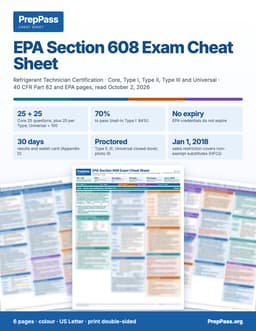
¿Examen en menos de dos semanas?
Esta guía es la enseñanza, para leer durante semanas. Si tu examen es en menos de dos semanas, la hoja de referencia a color imprimible es el otro producto: las cifras clave, por secciones.
6 páginas · US Letter · PDF imprimible · tuyo para siempre
Sobre el examen en sí
| Organismo administrador | United States Environmental Protection Agency (EPA) — rule-setting only — examen administrado por EPA-approved certifying organizations; there is no single national test vendor Fuente: US EPA — Section 608 Technician Certification Requirements |
|---|---|
| Preguntas | 50–100 preguntas Fuente: 40 CFR Part 82, Subpart F — Recycling and Emissions Reduction (incl. § 82.161 and Appendix D), eCFR |
| Tiempo límite | No publicado por US EPA Lo que leímos y donde no aparece: 40 CFR Part 82, Subpart F — Recycling and Emissions Reduction (incl. § 82.161 and Appendix D), eCFR |
| Puntuación para aprobar | 70% Fuente: 40 CFR Part 82, Subpart F — Recycling and Emissions Reduction (incl. § 82.161 and Appendix D), eCFR |
| Tarifas | No publicado por US EPA Lo que leímos y donde no aparece: 40 CFR Part 82, Subpart F — Recycling and Emissions Reduction (incl. § 82.161 and Appendix D), eCFR |
| Idiomas disponibles | No publicado por US EPA Lo que leímos y donde no aparece: 40 CFR Part 82, Subpart F — Recycling and Emissions Reduction (incl. § 82.161 and Appendix D), eCFR |
Preguntas de práctica y capítulos gratis de EPA Section 608 Certification →
How this book compares
EPA lists what each Section 608 test covers for free. This book teaches Core and Types I, II and III with a Universal practice exam; ESCO Institute sells a short preparatory manual.
| Resource | Price | What you get | Choose it if |
|---|---|---|---|
| This bookEPA 608 Universal Study Guide (2026) — Core + Type I/II/III, with the 2027 A2L updatePrepPass | $14.99 | Downloadable Universal study guide for Section 608
| Choose this book if you want each section taught with its regulations cited and a Universal practice exam scored by section. |
| From the exam bodySection 608 Technician Certification test topics (opens the publisher's page in a new tab)U.S. Environmental Protection Agency | Free (web page) | EPA's description of the Core, Type 1, Type 2 and Type 3 tests | Read it in any case to see what each test covers. |
| AlternativeEPA Section 608 Certification Exam Preparatory Manual, 9th Edition (opens the publisher's page in a new tab)ESCO Institute | $34.99 at HD Supply | Printed preparatory manual (retailer listing)
| Choose ESCO's manual if you want a short printed booklet. |
This book
EPA 608 Universal Study Guide (2026) — Core + Type I/II/III, with the 2027 A2L update
PrepPass
- Price
- $14.99
- What you get
Downloadable Universal study guide for Section 608
- 170 practice questions with explanations
- 165 pages, PDF + EPUB
- Choose it if
- Choose this book if you want each section taught with its regulations cited and a Universal practice exam scored by section.
From the exam body
Section 608 Technician Certification test topics (opens the publisher's page in a new tab)
U.S. Environmental Protection Agency
- Price
- Free (web page)
- What you get
EPA's description of the Core, Type 1, Type 2 and Type 3 tests
- Choose it if
- Read it in any case to see what each test covers.
Alternative
ESCO Institute
- Price
- $34.99 at HD Supply
- What you get
Printed preparatory manual (retailer listing)
- 28 pages
- Choose it if
- Choose ESCO's manual if you want a short printed booklet.
Other resources' prices and contents are as listed on each publisher's or seller's own page, checked September 24, 2026. Prices change; confirm on the linked page before you buy. This book's price and contents come from our own catalog.
Sources (2)
- https://www.epa.gov/section608/test-topics — read September 24, 2026
- https://hdsupplysolutions.com/p/esco-institute-epa-section-608-cert-exam-prep-p117508 — read September 24, 2026
Qué incluye — y qué no
Incluido
- 7 chapters: Core, Regulations, Type I, Type II, Type III, Recovery, and A2L/A3 refrigerants with the 2027 question bank
- A 100-question Universal practice exam — 25 per section, scored per section
- 60 section practice questions plus a 10-question A2L drill
- Explanations with 40 CFR citations, and §82.156 Table 1 as it reads today (pressure classes by psia at 104°F)
- Appendix B "The numbers" cram page, plus nine appendices in all
- PDF (print & tab it) + EPUB (phone / e-reader)
No incluido
- No se envía copia impresa — es un archivo que descargas y puedes imprimir tú
- El libro no incluye curso en vídeo, instructor ni tutorías — los vídeos gratis del sitio van aparte
- No incluye tu inscripción al examen ni la tasa del centro, que sigues pagando al organismo oficial
Contenido
Ver 21 secciones y la página en la que empieza cada una
- Part I — The pressure–temperature relationshipp. 16
- Part I — Cylinder and DOT detailp. 33
- Part I — Small appliance vs. motor‑vehicle A/C (the Section 609 line)p. 48
- Part I — Components you will meet on the examp. 60
- Part I — Standing tests, water boxes, and putting it togetherp. 71
- Part I — Evacuation and dehydration (a different job from recovery)p. 81
- Part II — Practice Questionsp. 98
- Part III — Universal Practice Exam (100 questions)p. 117
- Section 1 — Core (Q1–Q25)p. 117
- Section 2 — Type I (small appliances) (Q26–Q50)p. 122
- Section 3 — Type II (medium-, high- and very‑high‑pressure) (Q51–Q75)p. 127
- Section 4 — Type III (low‑pressure) (Q76–Q100)p. 132
- Part III — Answer Key & Explanationsp. 137
- Appendix A — Common refrigerant referencep. 148
- Appendix C — Glossaryp. 153
- Appendix D — Exam‑day strategyp. 155
- Appendix E — Frequently confused pairsp. 157
- Appendix F — A one‑week study planp. 159
- Appendix G — 40 must‑know facts (rapid fire)p. 160
- Appendix H — Official sources and further readingp. 162
- Appendix I — Frequently asked questionsp. 164
Tomado del PDF que descargas, con la página en la que empieza cada uno — no escrito a mano aquí.
Lee un capítulo completo gratis
Un capítulo completo, tal como viene en el eBook. Desplázate en la ventana para leerlo aquí; sin descargas ni correo.
Lee el capítulo 4 aquí, sin salir de la página
No te dimos la introducción fácil — el capítulo gratis abre en una de las partes más exigentes del libro, para que juzgues la enseñanza donde el examen se pone difícil.
EPA Section 608 Study Guide · Type II Section (25 questions)
Introduction
Type II certification covers medium-, high- and very‑high‑pressure appliances — from residential split systems and heat pumps to supermarket refrigeration racks and R‑134a chillers. This is the certification most field HVAC/R technicians rely on daily, because most everyday air‑conditioning and commercial refrigeration work is Type II.
The heart of this chapter is a table of evacuation vacuum levels that depend on the pressure class of the refrigerant, the appliance size (the 200‑pound split), and the age of your recovery equipment. Those numbers are among the most heavily tested figures on the entire certification. Learn them until they are automatic.
Learning objectives
After working through this chapter you should be able to:
- Define medium-, high- and very‑high‑pressure appliances the way 40 CFR §82.152 does (saturation pressure at 104°F) and place common refrigerants in each class.
- Recall the required evacuation levels (in inches of mercury vacuum) from §82.156 Table 1, by pressure class, by the 200‑pound size split, and by equipment age.
- Choose an appropriate leak‑detection method and pressurize a system safely.
- Apply efficient recovery techniques — liquid before vapor, managing non‑condensables, low‑loss fittings, and the 80% fill limit.
Part A — Pressure classes defined
40 CFR §82.152 sorts appliances by one measurement: the refrigerant's liquid‑phase saturation pressure at 104°F. Many study guides describe the classes by boiling point instead; the regulation does not, and the pressure class is what picks the row of the evacuation table.
| Class (§82.152) | Saturation pressure at 104°F | Examples the CFR names | Certification |
|---|---|---|---|
| Low‑pressure | below 45 psia | R‑11, R‑123, R‑113, R‑245fa | Type III |
| Medium‑pressure | 45 to 170 psia | R‑114, R‑124, R‑12, R‑134a, R‑500 | Type II |
| High‑pressure | 170 to 355 psia | R‑22, R‑407A, R‑407C, R‑410A, R‑502 | Type II |
| Very‑high‑pressure | above 355 psia, or critical temperature below 104°F | R‑13, R‑23, R‑503, R‑508A, R‑508B | Type II |
Two refrigerants you meet every week are placed by the numbers rather than by name:
- R‑404A is not on the CFR's example list, but a standard R‑404A pressure‑temperature chart reads about 250 psig (roughly 265 psia) at 104°F, inside the high‑pressure band. A supermarket rack on R‑404A is a high‑pressure appliance, in the same row as R‑22 and R‑410A.
- R‑134a is often called "high‑pressure" in older material, but it sits at about 147 psia at 104°F (NIST), which makes it medium‑pressure, alongside R‑12. For comparison, R‑22 is about 222 psia (NIST).
Type II is required to service, maintain, repair, or dispose of all three of the medium-, high-, and very‑high‑pressure classes — except for small appliances (Type I) and motor‑vehicle air conditioners (which fall under Section 609) (40 CFR §82.161). If a question describes a rooftop AC unit, a heat pump, a supermarket rack or an R‑134a chiller, think Type II.
Part B — Evacuation levels: 40 CFR §82.156, Table 1
Before opening an appliance for maintenance, service, repair or disposal, you must recover the refrigerant to the level in §82.156 Table 1 (small appliances, MVACs and MVAC‑like appliances have their own rules). The level turns on three things: the pressure class, the full charge (under 200 lb, or 200 lb and more), and the date your recovery equipment was made (before, or on/after, November 15, 1993). As read on the eCFR (current September 22, 2026):
| Appliance (or isolated component) | Equipment made before Nov 15, 1993 | Equipment made on/after Nov 15, 1993 |
|---|---|---|
| Very‑high‑pressure | 0 in Hg | 0 in Hg |
| High‑pressure, under 200 lb (R‑22, R‑410A, R‑404A, R‑407C) | 0 in Hg | 0 in Hg |
| High‑pressure, 200 lb or more | 4 in Hg | 10 in Hg |
| Medium‑pressure, under 200 lb (R‑12, R‑134a, R‑500) | 4 in Hg | 10 in Hg |
| Medium‑pressure, 200 lb or more | 4 in Hg | 15 in Hg |
| Low‑pressure (Type III, Chapter 5) | 25 mm Hg absolute | 25 mm Hg absolute |
(in Hg = inches of mercury vacuum, relative to standard atmospheric pressure of 29.9 in Hg.)
Almost every exam question assumes post‑1993 equipment, so the right‑hand column is the one to own. Two rules sit beside the table:
- Not a major repair? If the work does not remove a compressor, condenser, evaporator or auxiliary heat‑exchange coil, or leave an opening of more than 4 square inches of flow area uncovered for more than 15 minutes (§82.152, "major"), and the appliance will not be evacuated to atmosphere afterward, a medium-, high- or very‑high‑pressure appliance only has to reach 0 psig before it is opened (§82.156(a)(1)(i)).
- Leaks make the level unattainable? Isolate leaking from non‑leaking parts, take the non‑leaking parts to the Table 1 level, and take the leaking part as low as you can without substantially contaminating the refrigerant — never above 0 psig (§82.156(a)(2)).
Why other guides disagree. Many study guides still print a table organized by refrigerant name — "HCFC‑22" and "other high‑pressure" — that files R‑410A, R‑404A and R‑407C under "other" at 10/15 in Hg. That was the pre‑2017 table. Since EPA's November 2016 rule took effect on January 1, 2017, the CFR table is organized by pressure class. R‑410A, R‑404A and R‑407C sit in the high‑pressure row with R‑22 (0/10); the deeper 10/15 row belongs to medium‑pressure refrigerants such as R‑12 and R‑134a. If a practice test tells you a 300‑lb R‑404A rack needs 15 in Hg, it is teaching the wrong row.
Part C — Leak detection methods
Finding leaks quickly protects the charge, the equipment, and the atmosphere. Know the common methods and their strengths:
- Electronic leak detector — highly sensitive; pinpoints small leaks by sensing refrigerant near a joint. The go‑to for finding a small leak.
- Soap‑bubble solution — brushed on a suspect fitting, it reveals larger leaks as growing bubbles.
- Fluorescent dye — added to the system, it shows leak points under ultraviolet light after the unit runs.
- Ultrasonic detector — "hears" the hiss of escaping gas.
To pressurize a system for leak testing, use dry nitrogen — sometimes with a trace of refrigerant so an electronic detector can sense it — but never oxygen or compressed air (explosion hazard with refrigerant oil). And always leak‑test and repair before recharging: charging a leaking system simply vents refrigerant and wastes money.
Part D — Recovery techniques for high‑pressure systems
Recovering a high‑pressure system efficiently means managing both liquid and vapor:
- Recover liquid before vapor on large charges. Pull liquid first through the liquid‑line port to move the bulk quickly, then switch to vapor recovery to bring the remaining gas down to the required vacuum. This greatly shortens the job.
- Purge non‑condensables. Gases such as air raise head pressure and slow recovery, so purge them and avoid drawing air into the system.
- Minimize losses. Keep hoses short and use low‑loss fittings to cut the refrigerant released when you connect and disconnect.
- Respect the 80% fill limit. Watch the recovery cylinder weight and never exceed 80% fill.
- Manage temperature. If the appliance is very cold or the ambient is low, recovery slows; warming the appliance slightly or cooling the recovery cylinder can speed the transfer.
Part E — Memorizing the evacuation table
The Part B table is the single densest set of numbers on the certification, so here is a way to hold it in your head instead of memorizing cells cold. One sentence carries it: the lower the pressure class, the deeper the vacuum. Then three steps:
- High‑pressure (R‑22, R‑410A, R‑404A, R‑407C) is the shallow row. Under 200 lb: 0 in Hg. 200 lb and up: 10 in Hg.
- Medium‑pressure (R‑12, R‑134a, R‑500) is one step deeper. Under 200 lb: 10 in Hg. 200 lb and up: 15 in Hg.
- Very‑high‑pressure is 0 in Hg at any size, and low‑pressure is deepest of all (25 mm Hg absolute). With pre‑1993 equipment, nothing but a low‑pressure appliance ever needs more than 4 in Hg.
So the ladder from shallow to deep is: very‑high and small high‑pressure (0) → large high‑pressure and small medium‑pressure (10) → large medium‑pressure (15) → low‑pressure (25 mm Hg absolute). The 200‑lb line is the hinge; the pressure class picks the row.
Worked example — the large R‑404A rack. A supermarket condensing unit holds 300 lb of R‑404A and you are opening it for a compressor change with a 2019 recovery machine. To what vacuum must you evacuate? Reasoning: R‑404A reads about 250 psig (roughly 265 psia) at 104°F, inside the 170–355 psia band, so it is high‑pressure — the same row as R‑22 and R‑410A. 300 lb ≥ 200 lb and the machine is post‑1993, so Table 1 gives 10 in Hg. Guides that file R‑404A as "other high‑pressure" answer 15 in Hg; 15 is the medium‑pressure figure. Answer: 10 in Hg. (40 CFR §82.152; §82.156 Table 1.)
Part F — Leak detection and repair depth
You cannot fix what you cannot find, and Type II leans on leak‑detection judgment beyond the method list in Part C:
- Standing pressure/temperature. A system that has lost pressure since the last visit is leaking; comparing the saturation pressure to the ambient‑temperature saturation of the refrigerant tells you whether the charge is low or the system is under vacuum (drawing air).
- Match the method to the leak. The electronic detector pinpoints the small leak at a joint or flare; bubbles confirm a larger, accessible one; UV dye — circulated, run, then scanned with a UV lamp — catches the intermittent or hidden leak that only opens under running conditions; ultrasonic hears the hiss in a plant too noisy for anything else.
- Nitrogen pressure test. To confirm a repair or find a leak in an empty system, pressurize with dry nitrogen (optionally a trace of refrigerant so an electronic detector can sense it) and watch for pressure decay — never oxygen or compressed air.
Always repair before recharging. Charging a system that still leaks just meters expensive refrigerant into the atmosphere.
Part G — Retrofits and non‑condensables
- Retrofitting to a new refrigerant. As R‑22 supply tightens, systems get retrofitted to an approved substitute. The rules: the substitute must be SNAP‑approved for that end use, you usually must change the lubricant (mineral oil for CFC/HCFC vs. POE/polyol‑ester for many HFCs), you recover the old charge (never mix), and you relabel the system for the new refrigerant. Never just "top off" R‑22 with a different refrigerant — that creates an unreclaimable mixed charge.
- Non‑condensables. Air and other non‑condensable gases collect in the condenser, raise head pressure, and slow both cooling and recovery. Purge them and keep air out of the system in the first place (evacuate with a vacuum pump and hold a standing vacuum before charging a repaired system).
Worked example — retrofit compliance. A customer wants you to convert an old R‑22 rooftop unit to a lower‑cost refrigerant. List the compliance steps. Reasoning / Answer: (1) choose a refrigerant SNAP‑approved for that end use; (2) recover the R‑22 into a dedicated cylinder (do not vent, do not mix); (3) change the lubricant if the new refrigerant requires POE oil; (4) evacuate and leak‑check with nitrogen; (5) charge the new refrigerant — as a liquid if it is a zeotropic blend; (6) relabel the unit. (40 CFR Part 82, Subparts F & G.)
Part H — Charging a high‑pressure system correctly
After a repair you must put the right amount of refrigerant back — an undercharge or overcharge wrecks efficiency and can damage the compressor. Type II tests the concepts, not deep calculations:
- Weigh‑in (charge by weight). The most accurate method: recover/evacuate the system, then weigh in the exact factory charge listed on the nameplate using a scale. Best when the full charge is known and the system is empty.
- Superheat method. Superheat is how many degrees the vapor is above its saturation temperature at the suction line. On fixed‑orifice/capillary systems you charge to a target superheat — too little superheat risks liquid flooding back to the compressor; too much means the system is undercharged.
- Subcooling method. Subcooling is how many degrees the liquid is below its saturation temperature at the liquid line. On TXV (thermostatic expansion valve) systems you charge to a target subcooling; low subcooling usually means undercharge, high subcooling overcharge.
- Charge zeotropic blends as a liquid. Because R‑404A, R‑407C, and R‑410A glide and can fractionate, add them to the system as liquid (throttled so you don't slug the compressor) — never as vapor from the cylinder, which would shift the blend's composition.
Charging safety: never charge into a system you have not leak‑tested and evacuated; never use the cylinder pressure alone to judge the charge; and keep the recovery/charging cylinder on a scale.
Antes de comprar
- ¿Cómo lo recibo?
- Paga y la descarga aparece en esta página al instante. Los enlaces también se te envían por correo. No hace falta cuenta.
- ¿Y si no es para mí?
- Escríbenos dentro de 14 días para un reembolso total, sin preguntas.
- ¿Va a desaparecer la práctica gratis?
- No. Todas las preguntas, el simulacro cronometrado y los capítulos gratis del sitio siguen gratis. Este libro es la mitad de estudio, no una valla alrededor de lo gratuito.
- ¿Puedo leerlo en el móvil?
- Sí — el EPUB es para móviles y e-readers, el PDF para imprimir y marcar. Recibes ambos.
Los detalles
Updated September 2026 for the current 40 CFR §82.156 evacuation table and the revised question bank (A2L/A3: R-32, R-454B, R-1234yf)
- Format: PDF + EPUB download · 165 pages
- 170 practice questions in the book, with a full answer key
- 240 free practice questions for this exam on PrepPass, included at no cost
- $14.99 one-time — no subscription
- 14-day money-back guarantee · refund policy
- Cross-referenced against: EPA Clean Air Act §608 / 40 CFR Part 82 Subpart F
- Last updated: September 2026
- Verificado con la fuente oficial(EPA Clean Air Act §608 / 40 CFR Part 82 Subpart F)
- 240 preguntas de práctica gratis
- Descarga instantánea, tuyo de por vida
Un EPA 608 certification course cuesta $50–$200. Este libro enseña el mismo examen — las mismas reglas, verificadas a los estándares actuales — por un pago único de $14.99 que conservas de por vida.
¿Por qué comprar el libro si la práctica es gratis?
Nuestras preguntas de práctica y el simulacro cronometrado siguen gratis: nada del sitio se esconde tras este libro. El libro de $14.99 es la mitad de estudio: el material en sí, explicado en orden, en un archivo tuyo.
- Enseñanza sistemática — cada sección del examen explicada capítulo a capítulo, de principio a fin, no solo preguntas
- Imprímelo y márcalo — un PDF listo para papel que puedes resaltar, anotar y llevar a tu mesa de estudio
- Estudia en cualquier lugar, sin conexión — EPUB en tu teléfono o e-reader; sin wifi, sin pestañas
- Todo en un solo lugar — los capítulos y las preguntas de práctica en un archivo
- Tuyo de por vida — pago único de $14.99, descarga instantánea, sin suscripción
Y sin riesgo: Garantía de reembolso de 14 días — ¿no te convence? Escríbenos para un reembolso total, sin preguntas. Consulta la política de reembolso.
Garantía de reembolso de 14 días · reembolso total, sin preguntas.
Compra única, acceso de por vida a la descarga. El eBook es la guía completa de EPA Section 608 Certification en PDF y EPUB. Resumen educativo, no asesoría profesional ni legal — confirma siempre las reglas vigentes con la fuente oficial. Última actualización: September 2026.