NYC Food Protection Certificate · Edición 2026
NYC Food Protection Certificate — Complete Study Guide (2026)
The NYC DOHMH Food Protection Course exam every NYC food-service supervisor must pass — taught to the NYC Health Code (Article 81), including the NYC-specific temperatures the FDA Food Code doesn't use.
- 55 preguntas de práctica dentro del libro, con clave de respuestas completa
- 47 páginas de enseñanza, capítulo a capítulo — no un volcado de preguntas
- Contrastado con NYC Health Code Article 81 / NYC DOHMH Food Protection Course
Examen final tras el curso en línea gratuito: $24 por intento, que se paga a NYC DOHMH / Health Academy. Repetir el examen vuelve a costarlo. Esta guía: $14.99, pago único.
$14.99pago único · descarga de por vida · sin suscripción
PDF + EPUB · en inglés · 47 páginas · $14.99 pago único
Este libro está escrito en inglés — el PDF y el EPUB que descargas están en inglés.
Descarga inmediata tras el pago — sin cuenta y sin suscripción.
Garantía de devolución de 14 días: ¿no te convence por cualquier motivo? Escribe a support@preppass.org en los 14 días siguientes a la compra y te devolvemos el importe completo. Es una descarga, así que no hay nada que devolver por correo. Política de reembolso
Datos del examen verificados por última vez con fuentes oficiales: septiembre de 2026.
Prueba primero 10 preguntas — gratis
Responde las 10, y al terminar verás cada respuesta explicada — con la sección de esta guía que la enseña. Unos 5 minutos, sin registro.
Empezar 10 preguntas gratisMira dentro del libro
Tres páginas reales, renderizadas directamente del PDF que descargas — una página de referencia, una de explicación y una pregunta resuelta, siempre en ese orden. Nada se rediseñó para verse mejor.
- Referencia rápidaPágina 10 del PDF
Una página a la que puedes volver: cifras, plazos o términos reunidos en un solo lugar.
- Cómo se enseñaPágina 43 del PDF
Una página de explicación: el material enseñado en prosa, en el orden en que lo evalúa el examen.
- Una pregunta resueltaPágina 39 del PDF
Una pregunta de práctica con su respuesta y el razonamiento detrás — no solo la clave.
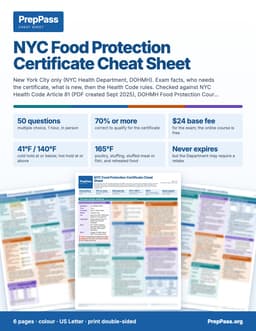
¿Examen en menos de dos semanas?
Esta guía es la enseñanza, para leer durante semanas. Si tu examen es en menos de dos semanas, la hoja de referencia a color imprimible es el otro producto: las cifras clave, por secciones.
6 páginas · US Letter · PDF imprimible · tuyo para siempre
Sobre el examen en sí
| Organismo administrador | New York City Department of Health and Mental Hygiene (DOHMH), Health Academy |
|---|---|
| Preguntas | No publicado por NYC DOHMH Lo que leímos y donde no aparece: NYC Health — Food Protection: Free Online Training |
| Tiempo límite | No publicado por NYC DOHMH Lo que leímos y donde no aparece: NYC Health — Food Protection: Classroom Course |
| Puntuación para aprobar | No publicado por NYC DOHMH Lo que leímos y donde no aparece: NYC Health — Food Protection Course Online Frequently Asked Questions (PDF) |
| Tarifas |
|
| Idiomas disponibles | Inglés + 36 idiomas más, que la autoridad no enumera individualmente |
Preguntas de práctica y capítulos gratis de NYC Food Protection Certificate →
Qué incluye — y qué no
Incluido
- NYC Health Code Article 81 — incl. the NYC-specific temps vs the FDA Food Code
- Time & temperature control, 2-stage cooling, cooking/reheat temps
- Contamination, personal hygiene, and pest control
- HACCP, active managerial control, letter grades & inspections
- 55 original practice questions with answer explanations
- PDF (print & tab it) + EPUB (phone / e-reader)
No incluido
- No se envía copia impresa — es un archivo que descargas y puedes imprimir tú
- El libro no incluye curso en vídeo, instructor ni tutorías — los vídeos gratis del sitio van aparte
- No incluye tu inscripción al examen ni la tasa del centro, que sigues pagando al organismo oficial
Lee un capítulo completo gratis
Un capítulo completo, tal como viene en el eBook. Desplázate en la ventana para leerlo aquí; sin descargas ni correo.
Lee el capítulo 2 aquí, sin salir de la página
No te dimos la introducción fácil — el capítulo gratis abre en una de las partes más exigentes del libro, para que juzgues la enseñanza donde el examen se pone difícil.
Introduction
Controlling time and temperature is the heart of food protection in New York City, and this is the largest topic on the exam. Because bacteria grow fastest in the danger zone, the certified supervisor must know the exact temperatures for cooking, cooling, reheating, and holding food — and must check them with an accurate thermometer, not by eye. This chapter also carries the two most important NYC-vs-FDA divergences in the whole book, so read the flags carefully.
The temperature danger zone
The temperature danger zone in New York City is 41°F to 140°F — the range in which bacteria multiply most rapidly. Every hazardous food should spend as little time as possible in this zone.
- Cold hazardous food must be held at 41°F or below.
- Hot hazardous food must be held at 140°F or above.
NYC-vs-FDA flag: NYC uses 140°F as the top of the danger zone and the hot-holding minimum. The federal FDA Food Code uses 135°F. On the NYC exam, answer 140°F.
When food does pass through the zone during cooking or cooling, it should move through quickly. As a general limit, hazardous food left in the danger zone for more than four cumulative hours must be discarded, because bacteria may have multiplied to dangerous levels or formed heat-stable toxins. Treat temperature as your primary defense and use time only as a backup control, with written procedures.
Cooking temperatures
Cooking to the correct internal temperature destroys the bacteria that cause illness. Measure at the thickest part of the food with a clean, calibrated thermometer, and take at least two readings in different spots. The NYC minimums:
- Poultry, stuffed foods, and stuffing — 165°F. This is the highest required cooking temperature.
- Ground / chopped meat (hamburger, chopped meat, ground pork) — 158°F. Grinding spreads surface bacteria throughout the meat, so ground meat needs a higher temperature than a whole cut.
- Pork that is not ground and not a whole roast (e.g., pork chops) — 150°F.
- Whole cuts and roasts of beef and lamb, fish, and shell eggs cooked for immediate service — generally 140°F to 145°F (145°F for whole roasts and shell eggs; 140°F is the general minimum).
NYC-vs-FDA flag: NYC teaches 158°F for ground/chopped meat. The federal FDA Food Code uses 155°F. This is a well-known NYC divergence — on the NYC exam, answer 158°F.
Never judge doneness by color alone; a burger can look brown and still be unsafe, or look pink and be fully cooked. The thermometer is the only reliable test.
Cooling — the two-stage rule
Cooling is one of the most dangerous steps in the flow of food, because the food sits inside the danger zone as it cools. NYC uses a two-stage cooling rule:
- 140°F down to 70°F within 2 hours (the first stage is the riskiest, so it has the tightest limit).
- 70°F down to 41°F within 4 more hours.
- Total cooling time: no more than 6 hours from 140°F to 41°F.
If the food does not reach 70°F within the first two hours, you must reheat it and start cooling again, or discard it. Speed cooling by:
- Dividing food into shallow pans
- Using an ice-water bath
- Adding ice as an ingredient
- Stirring with an ice paddle
Cooling is about surface area and speed, not just putting a deep pot in the cold.
Reheating, holding, and thawing
Reheating. When reheating hazardous food for hot holding, bring it to 165°F within 2 hours, and reheat only once. Never use holding equipment (like a steam table) to reheat — it warms food too slowly and lets bacteria grow.
Holding. Once cooked, food must be held out of the danger zone until served: hot at 140°F or above, cold at 41°F or below. Check holding temperatures at least every two hours so problems are caught early.
Thawing. Thaw frozen food safely by one of four methods:
- In the refrigerator at 41°F or below
- Under cold running water at 70°F or below
- In a microwave, if the food is cooked immediately after
- As part of the cooking process
Thawing on the counter at room temperature is not allowed — it leaves the outer layer in the danger zone for hours.
Using a thermometer
A thermometer is only useful if it is accurate. Calibrate a bimetallic stem thermometer in ice water, where it should read 32°F; adjust the nut until it does. Clean and sanitize the stem before and between uses so it does not move bacteria from raw chicken to the next food you check. Measure at the thickest part, wait for the reading to steady, and take more than one reading.
Key numbers & facts — memorize these cold
| Item | NYC value / rule | FDA Food Code (for contrast) |
|---|---|---|
| Danger zone | 41°F – 140°F | 41°F – 135°F |
| Cold holding | 41°F or below | 41°F or below |
| Hot holding | 140°F or above | 135°F or above |
| Poultry / stuffed foods | 165°F | 165°F |
| Ground / chopped meat (incl. ground pork) | 158°F | 155°F |
| Pork (chops / non-roast, non-ground) | 150°F | 145°F |
| Whole cuts/roasts, fish, eggs to order | ~140°F – 145°F | 145°F (whole cuts) |
| Cooling — stage 1 | 140°F → 70°F in 2 hours | 135°F → 70°F in 2 hours |
| Cooling — stage 2 | 70°F → 41°F in 4 more hours (6 total) | same total |
| Reheating for hot holding | 165°F within 2 hours, once | 165°F within 2 hours |
| Time-only control | discard after 4 cumulative hours in the zone | 4 hours |
| Check holding temps | at least every 2 hours | — |
| Thermometer calibration | reads 32°F in ice water | 32°F |
| Safe thawing | fridge · cold running water (≤70°F) · microwave (cook now) · during cooking | same |
Source: NYC Health Code Article 81 and the DOHMH Food Protection Course for the NYC values; FDA Food Code shown only to flag where NYC differs. Teach and answer with the NYC column on this exam.
Worked scenario
The situation. At 3:00 p.m. a cook makes a large pot of chicken soup, cooks it to 165°F, and then puts the whole deep, covered pot straight into the walk-in to save for tomorrow. At 9:00 p.m. — six hours later — a manager checks the center of the pot: it is still 95°F.
What went wrong? A deep pot cools very slowly; the outside chills while the thick center stays warm for hours, sitting in the danger zone. To pass NYC's rule the soup needed to reach 70°F within 2 hours and 41°F within 6 hours total. At six hours it is still 95°F — it failed the cooling rule, and bacteria have had all evening to grow.
The right move. The soup must be thrown out — you cannot rescue it now. Next time, cool it correctly: divide it into shallow pans, set them in an ice-water bath, stir with an ice paddle, and check with a thermometer so it drops from 140°F to 70°F within 2 hours and to 41°F within 4 more.
Common exam traps
- Answering 135°F for hot holding or the danger-zone top. That is the FDA number. NYC = 140°F. This is the single most common NYC trap.
- Answering 155°F for ground meat. Again the FDA number. NYC = 158°F.
- Reheating on a steam table. A steam table holds hot food; it cannot reheat cold food fast enough. Reheat to 165°F on a stove, oven, or microwave first.
- Counter thawing. Never an approved method. Know the four safe ways.
- Judging doneness by color. Only the internal temperature, read on a calibrated thermometer, proves food is safe.
- Forgetting the two-hour checkpoint in cooling. If food is not at 70°F by 2 hours, it is already out of compliance.
Antes de comprar
- ¿Cómo lo recibo?
- Paga y la descarga aparece en esta página al instante. Los enlaces también se te envían por correo. No hace falta cuenta.
- ¿Y si no es para mí?
- Escríbenos dentro de 14 días para un reembolso total, sin preguntas.
- ¿Va a desaparecer la práctica gratis?
- No. Todas las preguntas, el simulacro cronometrado y los capítulos gratis del sitio siguen gratis. Este libro es la mitad de estudio, no una valla alrededor de lo gratuito.
- ¿Puedo leerlo en el móvil?
- Sí — el EPUB es para móviles y e-readers, el PDF para imprimir y marcar. Recibes ambos.
Los detalles
The NYC DOHMH Food Protection Course exam every NYC food-service supervisor must pass — taught to the NYC Health Code (Article 81), including the NYC-specific temperatures the FDA Food Code doesn't use.
- Format: PDF + EPUB download · 47 pages
- 55 practice questions in the book, with a full answer key
- 240 free practice questions for this exam on PrepPass, included at no cost
- $14.99 one-time — no subscription
- 14-day money-back guarantee · refund policy
- Cross-referenced against: NYC Health Code Article 81 / NYC DOHMH Food Protection Course
- Last updated: September 2026
- Verificado con la fuente oficial(NYC Health Code Article 81 / NYC DOHMH Food Protection Course)
- 240 preguntas de práctica gratis
- Descarga instantánea, tuyo de por vida
¿Por qué comprar el libro si la práctica es gratis?
Nuestras preguntas de práctica y el simulacro cronometrado siguen gratis: nada del sitio se esconde tras este libro. El libro de $14.99 es la mitad de estudio: el material en sí, explicado en orden, en un archivo tuyo.
- Enseñanza sistemática — cada sección del examen explicada capítulo a capítulo, de principio a fin, no solo preguntas
- Imprímelo y márcalo — un PDF listo para papel que puedes resaltar, anotar y llevar a tu mesa de estudio
- Estudia en cualquier lugar, sin conexión — EPUB en tu teléfono o e-reader; sin wifi, sin pestañas
- Todo en un solo lugar — los capítulos y las preguntas de práctica en un archivo
- Tuyo de por vida — pago único de $14.99, descarga instantánea, sin suscripción
Y sin riesgo: Garantía de reembolso de 14 días — ¿no te convence? Escríbenos para un reembolso total, sin preguntas. Consulta la política de reembolso.
Garantía de reembolso de 14 días · reembolso total, sin preguntas.
Compra única, acceso de por vida a la descarga. El eBook es la guía completa de NYC Food Protection Certificate en PDF y EPUB. Resumen educativo, no asesoría profesional ni legal — confirma siempre las reglas vigentes con la fuente oficial. Última actualización: September 2026.