Property & Casualty Insurance Producer · Edición 2026
Property & Casualty Insurance Producer — Complete Study Guide (2026)
The general portion every state's P&C exam tests — property, homeowners, auto, commercial, liability and workers' comp — with a 100-question full-length practice exam. Pair it with your state's law.
- Los 10 capítulos — propiedad, vivienda, hogar, auto, comercial, casualty y compensación laboral — en un PDF + EPUB que conservas
- Un ejemplo resuelto y una hoja de cifras clave cerrando cada uno de los 10 capítulos
- 100 preguntas de práctica, cada respuesta razonada en lugar de solo marcada — ninguna está en el banco gratuito de este sitio
$19.99pago único · descarga de por vida · sin suscripción
PDF + EPUB · en inglés · 121 páginas · $19.99 pago único
Este libro está escrito en inglés — el PDF y el EPUB que descargas están en inglés.
Descarga inmediata tras el pago — sin cuenta y sin suscripción.
Garantía de devolución de 14 días: ¿no te convence por cualquier motivo? Escribe a support@preppass.org en los 14 días siguientes a la compra y te devolvemos el importe completo. Es una descarga, así que no hay nada que devolver por correo. Política de reembolso
Mira dentro del libro
Tres páginas reales, renderizadas directamente del PDF que descargas — una página de referencia, una de explicación y una pregunta resuelta, siempre en ese orden. Nada se rediseñó para verse mejor.
- Referencia rápidaAppendix C — Glossary of Key P&C Terms · Página 117 del PDF
Una página a la que puedes volver: cifras, plazos o términos reunidos en un solo lugar.
- Cómo se enseñaSection II — insureds, insured location, exclusions · Página 42 del PDF
Una página de explicación: el material enseñado en prosa, en el orden en que lo evalúa el examen.
- Una pregunta resueltaChapter 4 — The Dwelling Policy (DP) · Página 39 del PDF
Una pregunta de práctica con su respuesta y el razonamiento detrás — no solo la clave.
¿Preparas ambos? Hay precio de pareja
- Life & Health Insurance Producer — Complete Study Guide (2026)$19.99
- Property & Casualty Insurance Producer — Complete Study Guide (2026)$19.99
Compra ambos: $29.99 — ahorras $9.99 frente a comprarlos por separado
Por separado $39.98 · 24% de descuento · Un pago, los dos productos.
¿Ya compraste Life & Health Insurance Producer? No compres el paquete — lo incluye y pagarías dos veces por él. Consigue Property & Casualty Insurance Producer por separado por $19.99. Property & Casualty Insurance Producer · Qué incluye →
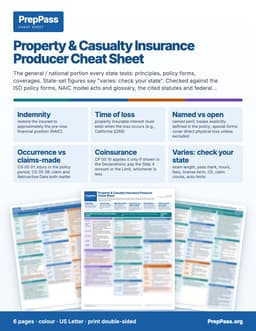
¿Examen en menos de dos semanas?
Esta guía es la enseñanza, para leer durante semanas. Si tu examen es en menos de dos semanas, la hoja de referencia a color imprimible es el otro producto: las cifras clave, por secciones.
6 páginas · US Letter · PDF imprimible · tuyo para siempre
Sobre el examen en sí
| Organismo administrador | No hay un organismo único: el departamento de seguros de cada estado otorga la licencia de propiedad y accidentes y fija su propio examen, normalmente administrado por un proveedor. En California lo administra PSI Services LLC; en Texas, Pearson VUE. Consulte la página de datos de su estado si PrepPass la tiene. Lo que leímos y donde no aparece: PSI / California Department of Insurance — Candidate Information Bulletin for California Insurance License Examinees (revised March 2026) |
|---|---|
| Preguntas | Lo fija cada estado. El examen de California tiene 150 preguntas. Consulte la página de datos de su estado si PrepPass la tiene. Lo que leímos y donde no aparece: PSI / California Department of Insurance — Candidate Information Bulletin for California Insurance License Examinees (revised March 2026) |
| Tiempo límite | Lo fija cada estado. California concede 195 minutos; el examen General Lines - Property & Casualty de Texas, 150 minutos. Consulte la página de datos de su estado si PrepPass la tiene. Lo que leímos y donde no aparece: PSI / California Department of Insurance — Candidate Information Bulletin for California Insurance License Examinees (revised March 2026) |
| Puntuación para aprobar | Lo fija cada estado. California publica 60%; el manual de Pearson VUE para Texas publica una puntuación escalada de 70 en una escala de 0–100, que según el manual no es el porcentaje de aciertos. Consulte la página de datos de su estado si PrepPass la tiene. Lo que leímos y donde no aparece: CDI — Examination Times and Number of Questions (CDI website table; stale on languages and, for time limits, disagrees with the CIB) |
| Tarifas | Lo fija cada estado. El manual de Pearson VUE para Texas indica $49 por intento para el examen General Lines - Property & Casualty. Consulte la página de datos de su estado si PrepPass la tiene. Lo que leímos y donde no aparece: Pearson VUE — Texas Insurance Licensing Candidate Handbook, October 2024 (#124400) |
| Idiomas disponibles | Lo fija cada estado; el manual de Pearson VUE para Texas incluye versiones en inglés y en español. Consulte la página de datos de su estado si PrepPass la tiene. Lo que leímos y donde no aparece: Pearson VUE — Texas Insurance Licensing Candidate Handbook, October 2024 (#124400) |
Preguntas de práctica y capítulos gratis de Property & Casualty Insurance Producer →
Qué incluye — y qué no
Incluido
- Property fundamentals, dwelling (DP) & homeowners (HO-2/3/4/5/6/8)
- Personal & commercial auto, CGL (occurrence vs claims-made)
- Workers' comp (exclusive remedy), casualty & liability doctrine
- Coinsurance, ISO forms, and the numbers the exam tests
- A 100-question full-length practice exam (general portion) with worked explanations
- PDF (print & tab it) + EPUB (phone / e-reader)
No incluido
- No se envía copia impresa — es un archivo que descargas y puedes imprimir tú
- El libro no incluye curso en vídeo, instructor ni tutorías — los vídeos gratis del sitio van aparte
- No incluye tu inscripción al examen ni la tasa del centro, que sigues pagando al organismo oficial
Contenido
Ver 20 secciones y la página en la que empieza cada una
- Chapter 1 — General Insurance Principlesp. 8
- Chapter 2 — Insurance Regulation, the Producer’s Legal Duties & Federal Lawp. 18
- Chapter 3 — Property Insurance Fundamentalsp. 28
- Chapter 4 — The Dwelling Policy (DP)p. 35
- Chapter 5 — Homeowners Insurance (HO Forms)p. 40
- Section I — Coverages A and Bp. 41
- Section I — Coverages C and Dp. 41
- Section I — special internal limits and scheduling valuablesp. 41
- Section II — Coverages E and Fp. 42
- Section II — insureds, insured location, exclusionsp. 42
- Chapter 6 — Commercial Property Insurancep. 47
- Chapter 7 — Auto Insurance — Personal and Commercialp. 53
- Chapter 8 — Casualty & Liability Insurancep. 60
- Chapter 9 — Workers’ Compensation Insurancep. 67
- Chapter 10 — How to Study Your State’s Rules (the State Portion)p. 73
- Practice Exam — 100 Questions (Full-Length General Portion)p. 77
- Answer Key with Explanationsp. 99
- Appendix A — Exam-Day Strategy: How to Attack a P&C Questionp. 111
- Appendix B — Rapid-Review Cram Sheet (50 High-Yield Facts)p. 113
- Appendix C — Glossary of Key P&C Termsp. 117
Tomado del PDF que descargas, con la página en la que empieza cada uno — no escrito a mano aquí.
Lee un capítulo completo gratis
Un capítulo completo, tal como viene en el eBook. Desplázate en la ventana para leerlo aquí; sin descargas ni correo.
Lee el capítulo 5 aquí, sin salir de la página
No te dimos la introducción fácil — el capítulo gratis abre en una de las partes más exigentes del libro, para que juzgues la enseñanza donde el examen se pone difícil.
The Homeowners (HO) policy is the most widely sold personal-lines property contract in the country and typically the largest single block on the general portion — about 15%. The package combines real-property, personal-property, loss-of-use, personal-liability, and medical-payments coverage in one contract with shared declarations, exclusions, and conditions. This chapter covers the standard HO forms, the four Section I property coverages, the two Section II liability coverages, exclusions, loss settlement, special internal limits, and the key conditions. These are ISO-standard, national forms; the state overlays (mandatory earthquake offers, wildfire moratoria, residual-market "FAIR" plans) belong to the state portion and are summarized in Chapter 10.
The standard HO forms at a glance
Carriers use the ISO Homeowners program or close proprietary equivalents:
- HO-2, Broad Form — dwelling and personal property on a named-peril basis (a list of roughly 16 perils).
- HO-3, Special Form — the workhorse owner-occupied contract. Open-peril on the dwelling and other structures; named-peril on personal property.
- HO-4, Contents Broad Form — the renter's/tenant's form. No dwelling coverage; protects the tenant's personal property, loss of use, liability, and medical payments.
- HO-5, Comprehensive Form — the broadest standard contract: open-peril on BOTH the dwelling AND personal property.
- HO-6, Unit-Owners Form — for condominium owners: interior building items, personal property, loss of use, liability, medical payments, and built-in loss-assessment coverage.
- HO-8, Modified Coverage Form — for older/historic homes whose replacement cost far exceeds market value; settles dwelling losses on an ACV or functional repair-cost basis.
Section I — Coverages A and B
- Coverage A — Dwelling: the dwelling on the residence premises, including attached structures and on-site building materials. Coverage A is the keystone because most other coverages are expressed as a percentage of it. The agent's first task is to determine the replacement cost of the dwelling with a cost estimator.
- Coverage B — Other Structures: detached structures separated by clear space (detached garage, shed, fence, gazebo). Provides an additional amount equal to 10% of Coverage A (a separate additional amount, not a sublimit). Structures rented to others or used for business are restricted/excluded.
Section I — Coverages C and D
- Coverage C — Personal Property: covers personal property owned or used by an insured anywhere in the world, automatically written at 50% of Coverage A on an owner-occupied HO-3 (different percentages apply on HO-4/HO-6, where Coverage C is the keystone). Off-premises personal property is covered, commonly up to 10% of Coverage C (or a stated minimum such as $1,000, whichever is greater).
- Coverage D — Loss of Use: pays the necessary increase in living costs above the normal baseline when a Section I peril makes the residence uninhabitable — additional living expense (ALE) for temporary lodging/meals, and fair rental value if the insured rented part of the home. Usually about 30% of Coverage A on an HO-3, payable for the shortest time to repair/replace or permanently relocate.
Section I — special internal limits and scheduling valuables
Within Coverage C, the form imposes special internal limits (sublimits) on classes of property that are easily stolen, hard to value, or invite moral hazard. Typical figures (edition-dependent) include roughly $200 on money/bullion; $1,500 on securities and on watercraft/trailers; $1,500 on theft of jewelry, watches, and furs; $2,500 on theft of firearms; $2,500 on theft of silverware; $2,500 on business property on premises. These caps apply per loss within the Coverage C limit — they are sublimits, not additional amounts, so they do not increase Coverage C. (Contrast Coverage B, which genuinely is a separate additional amount equal to 10% of Coverage A.) To insure valuables fully and on broader perils, add a Scheduled Personal Property endorsement (or a Personal Articles Floater): each item is listed at an appraised value, the deductible is generally waived, coverage is open-peril including mysterious disappearance, and the special-limit cap does not apply.
Section II — Coverages E and F
- Coverage E — Personal Liability: pays sums the insured is legally obligated to pay as damages for bodily injury or property damage caused by a covered occurrence, and includes a duty to defend with defense costs paid in addition to the limit. A common baseline limit is $100,000 per occurrence, though insureds routinely buy $300,000–$500,000 and pair the policy with a personal umbrella for $1 million or more.
- Coverage F — Medical Payments to Others: a small no-fault coverage paying reasonable medical expenses (typically within three years) for someone other than an insured injured on the insured location with permission, or off-premises by an insured, a residence employee, or an owned animal. Typical limits $1,000–$5,000 per person. It heads off small claims before they become lawsuits.
Section II — insureds, insured location, exclusions
An insured under Section II includes the named insured, resident spouse/partner, resident relatives, and others under age 21 in their care. An insured location includes the residence premises, other premises the insured uses in connection with it, vacant land, cemetery plots, and premises used temporarily (a hotel room, a vacation rental). Important Section II exclusions: business activities (a home daycare or for-profit venture needs a separate policy/endorsement), professional services, ownership/operation of most motor vehicles, watercraft over stated size/horsepower, and aircraft; intentional injury; communicable disease; molestation; controlled-substance offenses; injury to an insured; and obligations under workers' compensation (employee injuries belong on a WC policy).
Standard exclusions and companion coverages
Every HO form lists Section I exclusions that reveal the gaps needing separate coverage: earth movement (earthquake — needs an earthquake program/DIC), flood (needs NFIP or private flood), war/nuclear/government action, intentional loss, ordinance or law (add-back endorsement available), and wear and tear/settling/mold/vermin/faulty workmanship (inevitable, non-fortuitous). Some forms still cover an ensuing named peril (e.g., a fire that follows an excluded cause).
Loss settlement on the dwelling: 80% coinsurance and RC
The standard HO-3 dwelling loss-settlement clause uses an 80% coinsurance trigger. Carry Coverage A ≥ 80% of the dwelling's full replacement cost at the time of loss, and partial losses are paid at full replacement cost up to the limit with no depreciation deduction. Carry less than 80%, and the insurer pays the greater of (a) the ACV of the damaged part, or (b) the proportion the limit bears to 80% of full RC, up to the limit. To stay above the line as costs rise, insureds add Inflation Guard (auto-increases Coverage A), Extended Replacement Cost (pays a stated 25%/50% above the limit if needed), or Guaranteed Replacement Cost (removes the cap, subject to underwriting).
Personal-property settlement: ACV vs. RC
Unless endorsed, Coverage C settles on ACV (replacement cost minus depreciation). Most insureds add the Personal Property Replacement Cost endorsement, paying full RC for items actually replaced within a stated time (commonly 180 days). The endorsement still respects the special internal limits — adding it does not lift the jewelry-theft cap.
Mortgage clause, liberalization, and other conditions
The standard (union) mortgage clause protects the lender even when the insured's own claim would be denied; the insurer typically gives the mortgagee at least 10 days' notice for non-payment cancellation and more (often 30 days) for other cancellations, and the mortgagee may pay premium to keep the policy in force. The liberalization clause extends any broader form the insurer adopts during the term (without extra premium) automatically. Other conditions include appraisal (either party may demand it to resolve amount disputes), a suit-against-insurer time limit, an assignment condition (no transfer without consent), and subrogation/salvage rules.
### Key numbers & facts — Chapter 5 National ISO Homeowners concepts. Percentages are standard HO-3 defaults (edition-dependent). - HO-3 = open dwelling/other structures, named-peril contents (workhorse). HO-5 = open on both. HO-4 = renter's, no dwelling. HO-6 = condo + loss assessment. HO-8 = older homes, ACV. - Coverage B ≈ 10% of A (additional). Coverage C ≈ 50% of A (owner-occupied HO-3). Coverage D ≈ 30% of A. - Coverage E commonly $100,000 per occurrence; defense is in addition to the limit. - Coverage F (Med Pay) no-fault, ~$1,000–$5,000 per person, expenses within 3 years. - Special internal limits (typical): ~$200 money, $1,500 jewelry theft, $2,500 firearms theft, $2,500 silverware theft. - Dwelling loss settlement: 80% coinsurance trigger for full RC; below 80% → greater of ACV or the pro-rata amount. - Personal Property RC endorsement — replace within ~180 days; special limits still apply. - Excluded → companion coverage: earthquake (separate program), flood (NFIP), ordinance/law (endorsement). - State overlays (mandatory earthquake offer, wildfire moratorium, FAIR-type plans) are (state-set) — see Ch. 10.
Worked example
A homeowner's dwelling has a $400,000 replacement cost but she insured Coverage A for only $280,000 (70% of RC). A kitchen fire causes $60,000 of damage. Because she carries less than 80% of RC ($320,000 required), the RC settlement does not apply in full. The insurer pays the greater of the ACV of the damaged portion or the pro-rata amount: (280,000 ÷ 320,000) × 60,000 = $52,500 (before any deductible), versus the depreciated ACV of the damaged kitchen. She loses the depreciation/coinsurance shortfall for being under-insured — the reason Inflation Guard and periodic RC re-estimates matter.
Named exam traps
- HO-4 and HO-6 have no Coverage A percentage engine. On a renter's/condo form, Coverage C is the keystone, not 50% of a dwelling limit.
- Defense costs. On Coverage E, defense is outside (in addition to) the limit — a common wrong answer says it erodes the limit.
- Med Pay is no-fault and only for others. It does not pay the insured's own household members' medical bills.
- Scheduling doesn't lift Coverage C's RC vs. sublimit automatically. The Personal Property RC endorsement still respects special limits; only a Scheduled endorsement removes the sublimit for listed items.
- Earthquake/flood "must be in the HO." They are excluded — separate coverage required. Any answer covering flood under the HO is wrong.
Sources: ISO Homeowners program forms (HO-2/3/4/5/6/8) and standard endorsements; NFIP for the flood exclusion. State-specific homeowners overlays are treated in Chapter 10.
Antes de comprar
- ¿Cómo lo recibo?
- Paga y la descarga aparece en esta página al instante. Los enlaces también se te envían por correo. No hace falta cuenta.
- ¿Y si no es para mí?
- Escríbenos dentro de 14 días para un reembolso total, sin preguntas.
- ¿Va a desaparecer la práctica gratis?
- No. Todas las preguntas, el simulacro cronometrado y los capítulos gratis del sitio siguen gratis. Este libro es la mitad de estudio, no una valla alrededor de lo gratuito.
- ¿Puedo leerlo en el móvil?
- Sí — el EPUB es para móviles y e-readers, el PDF para imprimir y marcar. Recibes ambos.
Los detalles
The general portion every state's P&C exam tests — property, homeowners, auto, commercial, liability and workers' comp — with a 100-question full-length practice exam. Pair it with your state's law.
- Format: PDF + EPUB download · 121 pages
- 100 practice questions in the book, with a full answer key
- 324 free practice questions for this exam on PrepPass, included at no cost
- $19.99 one-time — no subscription
- 14-day money-back guarantee · refund policy
- Cross-referenced against: ISO forms / NAIC model acts / NFIP / TRIA
- Last updated: September 2026
- Verificado con la fuente oficial(ISO forms / NAIC model acts / NFIP / TRIA)
- 324 preguntas de práctica gratis
- Descarga instantánea, tuyo de por vida
Un insurance pre-license course cuesta $100–$500. Este libro enseña el mismo examen — las mismas reglas, verificadas a los estándares actuales — por un pago único de $19.99 que conservas de por vida.
¿Por qué comprar el libro si la práctica es gratis?
Nuestras preguntas de práctica y el simulacro cronometrado siguen gratis: nada del sitio se esconde tras este libro. El libro de $19.99 es la mitad de estudio: el material en sí, explicado en orden, en un archivo tuyo.
- Enseñanza sistemática — cada sección del examen explicada capítulo a capítulo, de principio a fin, no solo preguntas
- Imprímelo y márcalo — un PDF listo para papel que puedes resaltar, anotar y llevar a tu mesa de estudio
- Estudia en cualquier lugar, sin conexión — EPUB en tu teléfono o e-reader; sin wifi, sin pestañas
- Todo en un solo lugar — los capítulos y las preguntas de práctica en un archivo
- Tuyo de por vida — pago único de $19.99, descarga instantánea, sin suscripción
Y sin riesgo: Garantía de reembolso de 14 días — ¿no te convence? Escríbenos para un reembolso total, sin preguntas. Consulta la política de reembolso.
Garantía de reembolso de 14 días · reembolso total, sin preguntas.
Compra única, acceso de por vida a la descarga. El eBook es la guía completa de Property & Casualty Insurance Producer en PDF y EPUB. Resumen educativo, no asesoría profesional ni legal — confirma siempre las reglas vigentes con la fuente oficial. Última actualización: September 2026.