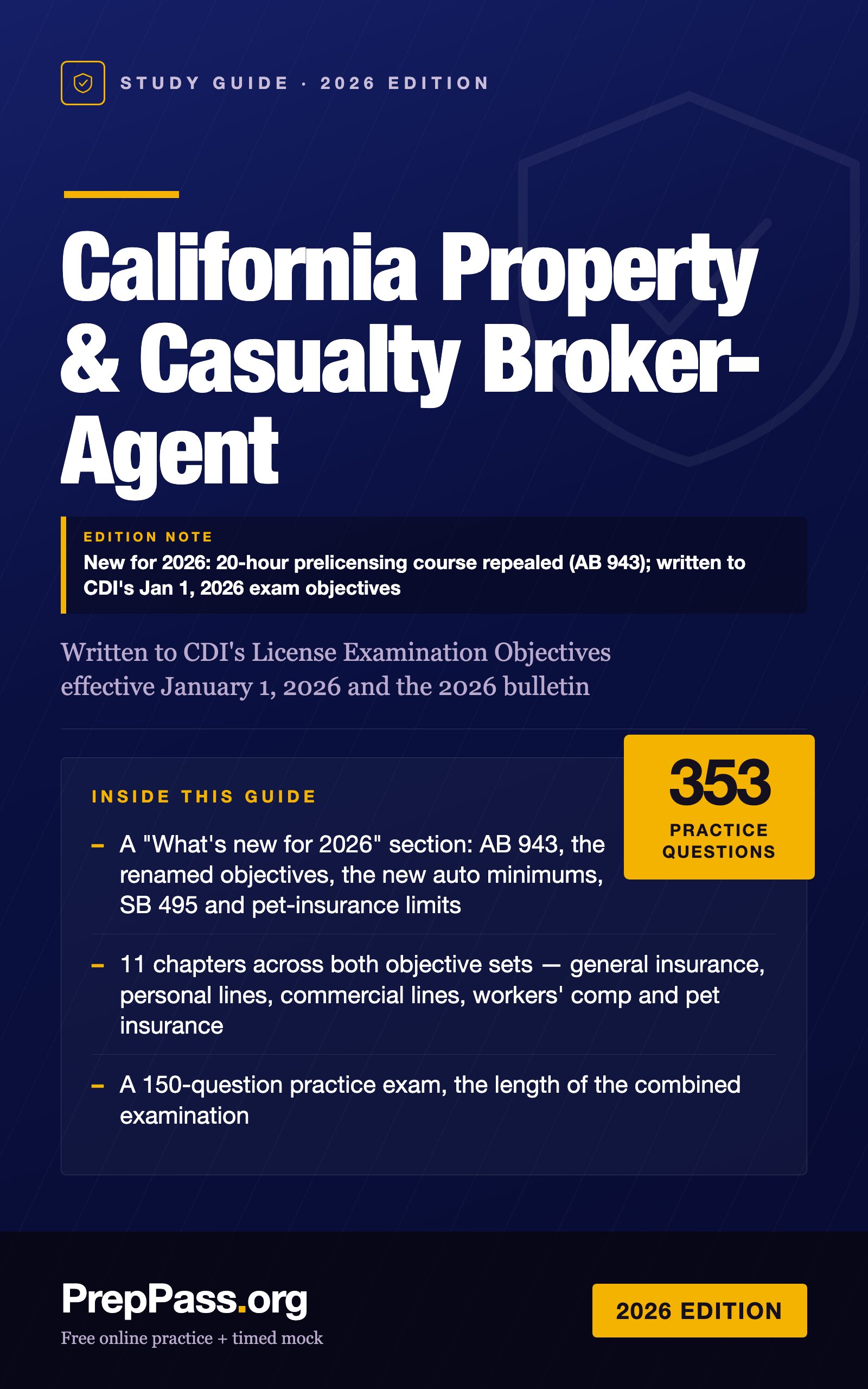
California Property & Casualty Broker-Agent · Edición 2026
California Property & Casualty Broker-Agent Study Guide — 2026 Edition
Nota de ediciónNew for 2026: 20-hour prelicensing course repealed (AB 943); written to CDI's Jan 1, 2026 exam objectives
Written to CDI's License Examination Objectives effective January 1, 2026 and the 2026 bulletin — no 20-hour prelicensing course since AB 943: 353 original questions and a 150-question practice exam.
- 353 preguntas originales de práctica de California P&C, cada una con explicación razonada, en un PDF + EPUB que conservas
PDF + EPUB · en inglés · 305 páginas · $24.99 pago único
Este libro está escrito en inglés — el PDF y el EPUB que descargas están en inglés.
Descarga inmediata tras el pago — sin cuenta y sin suscripción.
Garantía de devolución de 14 días: ¿no te convence por cualquier motivo? Escribe a support@preppass.org en los 14 días siguientes a la compra y te devolvemos el importe completo. Política de reembolso
Prueba primero 10 preguntas — gratis
Responde las 10, y al terminar verás cada respuesta explicada — con la sección de esta guía que la enseña. Unos 5 minutos, sin registro.
Empezar 10 preguntas gratisMira dentro del libro
Tres páginas reales, renderizadas directamente del PDF que descargas — una página de referencia, una de explicación y una pregunta resuelta, siempre en ese orden. Nada se rediseñó para verse mejor.
- Referencia rápidaChapter 10 — Commercial Casualty: CGL, Professional and Management Liability, Commercial Auto, Umbrella and Surety (Casualty Objectives IV.A–IV.C) · Página 189 del PDF
Una página a la que puedes volver: cifras, plazos o términos reunidos en un solo lugar.
- Cómo se enseñaChapter 2 — The Insurance Marketplace: Producers, Licensing and Ethics (Objectives I.C.1–I.C.2) · Página 49 del PDF
Una página de explicación: el material enseñado en prosa, en el orden en que lo evalúa el examen.
- Una pregunta resueltaChapter 4 — Legal Concept: Tort Law (Objective I.D) · Página 80 del PDF
Una pregunta de práctica con su respuesta y el razonamiento detrás — no solo la clave.
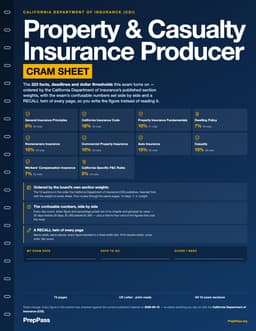
¿Examen en menos de dos semanas?
Esta guía es la enseñanza, para leer durante semanas. Si tu examen es en menos de dos semanas, el cuadernillo imprimible es el otro producto: cada cifra agrupada por valor, una cara para escribirla de memoria y una ruta para 14 días, 7, 3 o esta noche.
73 páginas · US Letter · PDF imprimible · tuyo para siempre
Sobre el examen en sí
| Organismo administrador | California Department of Insurance (CDI), Producer Licensing Bureau — examen administrado por PSI Services LLC |
|---|---|
| Preguntas | 150 preguntas |
| Tiempo límite | 195 minutos |
| Puntuación para aprobar | 60% |
| Tarifas |
Fuente: CDI — Licensing Fees |
| Idiomas disponibles | Inglés · Español · Chino simplificado · Vietnamita · Coreano · Tagalo |
Preguntas de práctica y capítulos gratis de California Property & Casualty Broker-Agent →
Qué incluye — y qué no
Incluido
- A "What's new for 2026" section: AB 943, the renamed objectives, the new auto minimums, SB 495 and pet-insurance limits
- 11 chapters across both objective sets — general insurance, personal lines, commercial lines, workers' comp and pet insurance
- A 150-question practice exam, the length of the combined examination
- A California numbers card: auto minimums, notice periods, claim deadlines and workers' comp figures
- 353 original questions, each with a worked explanation citing its source
- PDF + EPUB you keep
No incluido
- No se envía copia impresa — es un archivo que descargas y puedes imprimir tú
- El libro no incluye curso en vídeo, instructor ni tutorías — los vídeos gratis del sitio van aparte
- No incluye tu inscripción al examen ni la tasa del centro, que sigues pagando al organismo oficial
Contenido
Ver 16 secciones y la página en la que empieza cada una
- Chapter 1 — General Insurance: Concepts, Principles and Contract Law (Objectives I.A–I.B)p. 11
- Chapter 2 — The Insurance Marketplace: Producers, Licensing and Ethics (Objectives I.C.1–I.C.2)p. 31
- Chapter 3 — The Insurance Marketplace: Insurers, Regulation, Claims and Surplus Lines (Objectives I.C.3–I.C.5)p. 52
- Chapter 4 — Legal Concept: Tort Law (Objective I.D)p. 71
- Chapter 5 — Property and Casualty Basics, Policies and Classes of Insurance (Objectives II.A–II.C)p. 83
- Chapter 6 — Homeowners, Dwelling and Residential Valuation (Objectives III.A–III.C, property)p. 105
- Chapter 7 — Catastrophe Programs, Wildfire Mitigation, Personal Inland Marine and Pet Insurance (Objectives III.D–III.F and V)p. 125
- Chapter 8 — Personal Auto, Watercraft and Umbrella (Casualty Objectives III.A–III.D)p. 143
- Chapter 9 — Commercial Property, the Commercial Package Policy and the BOP (Property Objectives IV.A–IV.C)p. 163
- Chapter 10 — Commercial Casualty: CGL, Professional and Management Liability, Commercial Auto, Umbrella and Surety (Casualty Objectives IV.A–IV.C)p. 180
- Answer key & explanationsp. 194
- Chapter 11 — Workers’ Compensation in California (Casualty Objective IV.B.8)p. 197
- Practice Exam Section 2 — Property and Casualty Basics, Policy Provisions and California Rulesp. 221
- Practice Exam Section 7 — Pet Insurance (Questions 149–150)p. 249
- Appendix A — The Exam at a Glance, in One Tablep. 265
- Appendix B — Terms the Exam Expects You to Use Preciselyp. 268
Tomado del PDF que descargas, con la página en la que empieza cada uno — no escrito a mano aquí.
Lee un capítulo completo gratis
Un capítulo completo, tal como viene en el eBook. Desplázate en la ventana para leerlo aquí; sin descargas ni correo.
Lee el capítulo 8 aquí, sin salir de la página
No te dimos la introducción fácil — el capítulo gratis abre en una de las partes más exigentes del libro, para que juzgues la enseñanza donde el examen se pone difícil.
The Casualty outline spends most of its Personal Lines weight here: the California financial responsibility law, the ISO Personal Auto Policy, California's auto statutes on good drivers, cancellation and uninsured motorists, ride-hailing and car sharing, the assigned risk and low-cost programs, and then watercraft and umbrella coverage. Section III.A of the Casualty outline — residential liability and liability endorsements — was taught with the homeowners form in Chapter 6; this chapter starts with the boat.
III.B Marine — Personal Watercraft
A homeowners policy is a poor fit for most boats. Property coverage for watercraft of all types, including trailers and motors, is capped at $1,500[1], and Section II liability applies only to small craft — sailboats under 26 feet and boats with outboard motors of 25 total horsepower or less, among a few other exceptions[1]. A watercraft endorsement to the homeowners policy broadens liability and medical payments for small sailboats and outboard boats[2]; larger boats need a boat owners or yacht policy. Those policies typically combine:
- Liability — operations liability, passenger liability and, for fleets, flotilla coverage.
- Medical payments for people aboard.
- Physical damage to the boat, motor, trailer and equipment.
- For yachts, hull coverage on the vessel itself and protection and indemnity (P&I) — the marine term for liability coverage.
III.C Personal Auto
1.a The California Financial Responsibility Law
"All drivers and all owners of a motor vehicle shall at all times be able to establish financial responsibility ... and shall at all times carry in the vehicle evidence of the form of financial responsibility in effect for the vehicle"[3]. Financial responsibility is established by being self-insured, being insured under a qualifying policy or bond, being a public entity, being a cash depositor under the Vehicle Code, or another method the DMV authorizes[4]. CDI's auto guide lists the three ways most drivers use: liability insurance from an authorized insurer, a $35,000 cash deposit with the DMV, or a $35,000 surety bond[5].
Minimum limits. For policies issued or renewed on or after January 1, 2025, the minimum liability limits are $30,000 for bodily injury to one person, $60,000 for bodily injury to two or more people in one accident, and $15,000 for property damage[6]. The prior minimums were $15,000/$30,000/$5,000[6], and the minimums rise again for policies issued or renewed on or after January 1, 2035[6]. An auto liability policy issued in California must carry at least these limits[7]. CDI states the minimums the same way for consumers[5].
Notice requirements. An insurer must notify the DMV when a policy is written or the insured stops paying; CDI's guide tells consumers that the insurer "tells the California Department of Motor Vehicles (DMV) if you buy auto insurance or if you stop paying your premium"[5].
1.b Company policies versus the ISO form
The exam uses ISO's Personal Auto Policy (PP 00 01) as the standard[8], but a company's own policy may differ in wording, limits and endorsements, and California amendatory endorsements change the ISO form to meet California statutes (cancellation notice periods, uninsured motorist rules and so on). Always read the actual policy.
1.c The Personal Auto Policy: who and what is covered
- "You" and "your" — the named insured and a resident spouse. If the spouse moves out, the spouse remains "you" only until the earliest of 90 days after the move, the effective date of another policy naming the spouse, or the end of the policy period[9].
- "Family member" — a person related to you by blood, marriage or adoption who is a resident of your household, including a ward or foster child[9].
- "Your covered auto" — any vehicle shown in the declarations, a newly acquired auto, any trailer you own, and a temporary substitute for a covered auto out of use because of breakdown, repair, servicing, loss or destruction[9].
- Who is insured under Part A — you or any family member for any auto or trailer, and "Any person using 'your covered auto'"[9]. California law requires the policy to cover the named insured and anyone using the vehicle with permission[7].
- Territory — the United States, its territories or possessions, Puerto Rico, and Canada, plus transport between their ports[9].
- Share-the-expense versus for-hire. Part A excludes a vehicle used as a public or livery conveyance, including any time the insured is logged into a transportation network platform as a driver, but the exclusion "does not apply to: a. A share-the-expense car pool"[9].
Newly acquired autos
A newly acquired private passenger auto, pickup or van gets the broadest coverage provided for any vehicle shown in the declarations, for everything except damage to your auto, if you ask the insurer to insure it within 14 days after you become the owner[9]. For physical damage:
- Collision begins on the date you become the owner. If at least one listed auto has collision coverage, you must ask within 14 days; if none does, you must ask within four days, and a $500 collision deductible applies to a loss that happens before you ask[9].
- Other than collision follows the same 14-day / four-day pattern[9].
CDI's objectives state the same rule: if the insured has collision coverage on at least one listed auto, all coverage on the newly acquired auto begins on the date of ownership[10].
Rental cars and non-owned autos
A non-owned private passenger auto rented for a vacation is covered under Part A because "You or any 'family member'" are insured "for the ownership, maintenance or use of any auto"[9]. Under Part D, a non-owned auto gets the broadest coverage applicable to any covered auto[9], and the policy pays up to $30 a day for loss-of-use charges you owe on a non-owned auto[9]. Liability insurance on a vehicle you do not own is excess over other collectible insurance[9].
1.d Primary and excess coverage
The PAP's liability coverage on a vehicle you do not own is excess over other collectible insurance, while coverage for your covered auto is shared pro rata with other applicable insurance[9]. Part D's "other sources of recovery" clause makes coverage on a non-owned auto "excess over any other collectible source of recovery," including the owner's coverage[9].
1.e The Good Driver Discount
Proposition 103 requires auto rates to be based, in decreasing order of importance, on the insured's driving safety record, annual miles driven, and years of driving experience, then other factors the Commissioner adopts[11]. A person who qualifies may buy a Good Driver Discount policy from the insurer of his or her choice, and its rate must be "at least 20 percent below the rate the insured would otherwise have been charged for the same coverage"[11]. To qualify, a driver must have been licensed for the previous three years and, in those three years, not had more than one violation point, and not been principally at fault in an accident causing injury or death[12]. The absence of prior insurance cannot, by itself, be used to set rates or eligibility[11].
Credit. CDI's objectives state that a consumer credit report cannot be used in California as the basis for declining to insure or as a premium factor for auto insurance[10]. The rating statute explains why: auto rates must follow the approved factors, and "the use of any criterion without approval shall constitute unfair discrimination"[11].
1.f Cancellation and nonrenewal
California limits the reasons an insurer may cancel or nonrenew an auto policy. Proposition 103 allows a notice of cancellation or nonrenewal "only if it is based on one or more of the following reasons: (A) nonpayment of premium; (B) fraud or material misrepresentation affecting the policy or insured; (C) a substantial increase in the hazard insured against"[13]. Section 661 lists the cancellation grounds in more detail, including suspension or revocation of the license of the named insured or a regular driver[14].
Notice periods:
- Cancellation: at least 20 days, or at least 10 days after nonpayment for a nonpayment cancellation; the cancellation takes effect only if the nonpayment is not cured within the 10 days[15].
- Renewal offer: at least 20 days before expiration; nonrenewal notice: at least 30 days before expiration[16]. If the insurer fails to give either, the policy continues for 30 days after the notice is given[16].
CDI's guide puts the grounds plainly — fraud or material misrepresentation, nonpayment, or substantial increase in the hazard — and notes the 10-day notice for nonpayment[5].
1.h Ride-hailing (TNC) and personal vehicle sharing
- Personal auto policies rarely cover TNC driving. The ISO form excludes use as a public or livery conveyance, including whenever the driver is logged into a transportation network platform[9]. Insurers offer products that fill the gap; CDI's guide notes you can buy coverage for business use, "including when driving for a Transportation Network Company"[5].
- What the TNC must carry. From the moment a driver accepts a ride request until the ride ends, TNC insurance must be primary and at least $1,000,000 for death, personal injury and property damage, and the TNC must provide uninsured and underinsured motorist coverage of $60,000 per person and $300,000 per incident while a passenger is in the vehicle[17].
- Personal vehicle sharing. A privately insured car is not reclassified as commercial or for-hire just because it is shared through a personal vehicle sharing program, as long as the owner's sharing revenue does not exceed the annual cost of owning and operating the vehicle and the owner does not knowingly allow commercial use[18]. The PAP excludes liability while the car is enrolled in and being used through such a program by someone other than you or a family member[9] — so the program's own insurance must respond.
2. Liability, medical payments and uninsured motorists
Part A — Liability. "We will pay damages for 'bodily injury' or 'property damage' for which any 'insured' becomes legally responsible because of an auto accident," and "In addition to our limit of liability, we will pay all defense costs we incur"[9].
- Supplementary payments (in addition to the limit): up to $250 for bail bonds, premiums on appeal bonds, post-judgment interest, up to $250 a day for lost earnings to attend hearings at the insurer's request, and other reasonable expenses; these payments do not reduce the limit[9].
- Split limits versus single limit. A split limit states a per-person bodily injury limit, a per-accident bodily injury limit and a property damage limit; CDI's example: with $50,000/$100,000, the policy will not pay more than $50,000 for one person or $100,000 for one accident[5]. A combined single limit is one sum for bodily injury and property damage per accident[19].
- Out-of-state coverage. If an accident happens in a state with higher financial responsibility limits, the policy provides the higher limits; if a state requires nonresidents to carry compulsory coverage, the policy provides at least the required minimum[9].
- Other insurance. For a non-owned vehicle, the PAP liability coverage is excess[9].
- Key exclusions. Intentional injury; property damage to property owned or transported by the insured, or rented to or in the insured's care (except a residence or private garage); vehicles with fewer than four wheels or designed mainly for off-road use; vehicles furnished for your regular use[9].
Part B — Medical Payments. Pays reasonable medical and funeral expenses "because of 'bodily injury'" caused by an accident and sustained by an insured, incurred within three years of the accident[9], for you and family members while occupying a motor vehicle or as pedestrians struck by one, and for anyone occupying your covered auto[9]. CDI notes the minimum medical payments limit you can buy is $1,000 per person[5], and it pays "no matter who is at fault"[5].
Part C — Uninsured Motorists. Pays compensatory damages an insured is legally entitled to recover from the owner or operator of an uninsured motor vehicle because of bodily injury[9]. An "uninsured motor vehicle" includes one with no bodily injury liability policy, one whose limits are below the financial responsibility minimum, a hit-and-run vehicle whose owner and operator cannot be identified, and one whose insurer denies coverage or becomes insolvent[9].
California's uninsured motorist law:
- Every auto bodily injury liability policy issued in California must include uninsured motorist coverage unless the named insured and insurer agree in writing to delete it or reduce it — but not below the financial responsibility limits[20]. CDI: "If you choose not to buy it, you must sign a form, called a waiver"[5].
- Underinsured motorist coverage pays when the at-fault driver's limits are too low[5].
- Uninsured motorist property damage (UMPD) pays damage to your car caused by an identified at-fault uninsured driver, up to $3,500, if you do not have collision coverage[5].
- Collision deductible waiver pays your collision deductible when an uninsured at-fault driver damages your car[5].
- Umbrella and excess policies are not required to include uninsured motorist coverage: "A policy shall be excluded from the application of this section if the automobile liability coverage is provided only on an excess or umbrella basis"[20].
Credit reports and MVRs. Insurers order a Motor Vehicle Report from the DMV — "the state's official record of your accidents, traffic violations, and suspended licenses"[5] — and the federal Fair Credit Reporting Act governs the use of consumer reports; in California, as noted above, credit may not be used to decline or price auto insurance[10, 11].
3. Physical damage and endorsements
Part D — Coverage for Damage to Your Auto pays "for direct and accidental loss to 'your covered auto' or any 'non-owned auto', including its equipment, minus any applicable deductible"[9].
- Collision means "the upset of 'your covered auto' or a 'non-owned auto' or its impact with another vehicle or object"[9].
- Other than collision (OTC) — what many insurers still call comprehensive — includes missiles or falling objects, fire, theft, explosion or earthquake, windstorm, hail, water or flood, vandalism, riot, contact with bird or animal, and breakage of glass; glass broken in a collision may be treated as collision at the insured's option[9]. CDI's guide: comprehensive covers damage "caused by something other than a collision"[5]. OTC is a property coverage — it pays for damage to the insured's own car.
- Valuation. The insurer pays the lesser of actual cash value or the cost to repair or replace with like kind and quality; depreciation and physical condition are considered for a total loss; betterment is not paid[9]. CDI notes collision and comprehensive "provide compensation based on the market value of your car"[5].
- The insurer's options. It may pay in money or repair or replace the property, and may return stolen property[9].
- Transportation expenses. Without a deductible, up to $30 a day and $900 total for temporary transportation after a covered loss to your auto; for total theft, beginning 48 hours after the theft[9].
- Personal effects and equipment. Part D covers the auto "including its equipment"; it excludes loss to non-permanently installed electronic equipment and limits custom equipment to $1,500 unless endorsed[9].
- Exclusions include wear and tear, freezing, mechanical or electrical breakdown, road damage to tires, and livery use[9].
- Duties after a loss. Promptly notify the insurer of how, when and where the accident happened; cooperate; submit to physical exams and examinations under oath as required[9]; for uninsured motorist claims, promptly notify police of a hit-and-run[9]; and for damage to your auto, protect it from further loss and notify police of a theft[9].
Common endorsements the objectives list: miscellaneous type vehicle (motor homes, motorcycles, golf carts), limited Mexico coverage, towing and labor, trust, joint ownership, auto loan/lease (GAP) coverage, named non-owner coverage, extended non-owned liability for a vehicle furnished for regular use, optional transportation expense limits, and customizing equipment coverage[10]. CDI's guide describes GAP as paying the difference between the car's fair market value and what is owed on the loan or lease[5].
4. CAARP and the Low-Cost Automobile program
California Automobile Assigned Risk Plan (CAARP). The Commissioner approves a plan for the equitable apportionment among admitted liability insurers of applicants "who are in good faith entitled to but are unable to procure that insurance through ordinary methods," and all such insurers must participate[21]. CDI's guide: CAARP assigns a driver to an insurer, all participating insurers charge the same premiums, installments are allowed, and "There is no broker's fee if you buy a CAARP policy"[5]. Eligibility standards may consider the applicant's driving record, license suspensions, accidents, and the condition or use of the car[22].
California Low-Cost Automobile Insurance (CLCA). A program within CAARP[23]:
- Limits: $10,000 per person and $20,000 per accident for bodily injury, $3,000 for property damage — lower than the standard minimums but satisfying financial responsibility for program participants[5, 24].
- Eligibility: household income at or below 250% of the federal poverty level; at least 16 and continuously licensed for three years (or pay a surcharge); no more than one at-fault property damage accident or one moving-violation point in three years; no at-fault injury accident; no Vehicle Code felony or misdemeanor on the record[25]. CDI adds that the car must be worth $25,000 or less[5].
- Terms: a one-year term, renewable annually[24]; an installment plan with no more than 20% down[26]; uninsured motorist and medical payments available as options[27].
Sources cited in this excerpt
- Homeowners 3 - Special Form, HO 00 03 05 11 (specimen filed with and published by the Nevada Division of Insurance). Insurance Services Office, Inc., 2010-05-01. https://doi.nv.gov/uploadedFiles/doinvgov/_public-documents/Consumers/Home/American_Family/Homesite_HO_00_03_05_11.pdf
- Home Insurance Forms (consumer information page). Alabama Department of Insurance, 2026-09-24. https://aldoi.gov/Consumers/HomeInsForms.aspx
- California Vehicle Code section 16020, text as retrieved 2026-09-24 (Amended by Stats. 2022, Ch. 295, Sec. 13. (AB 2956) Effective January 1, 2023.). California Legislature (California Legislative Information, leginfo.legislature.ca.gov), 2023-01-01. https://leginfo.legislature.ca.gov/faces/codes_displaySection.xhtml?lawCode=VEH§ionNum=16020
- California Vehicle Code section 16021, text as retrieved 2026-09-24 (Amended by Stats. 2003, Ch. 594, Sec. 41. Effective January 1, 2004.). California Legislature (California Legislative Information, leginfo.legislature.ca.gov), 2004-01-01. https://leginfo.legislature.ca.gov/faces/codes_displaySection.xhtml?lawCode=VEH§ionNum=16021
- Automobile Insurance information guide (Form 901, February 2025). California Department of Insurance, 2025-02-01. https://www.insurance.ca.gov/01-consumers/105-type/95-guides/01-auto/upload/IG-Auto-Insurance-Updated-020525.pdf
- California Vehicle Code section 16056, text as retrieved 2026-09-24 (Amended (as added by Stats. 2022, Ch. 717, Sec. 3) by Stats. 2023, Ch. 204, Sec. 19. (AB 1140) Effective January 1, 2024. Operative January 1, 2025, by its own provisions.). California Legislature (California Legislative Information, leginfo.legislature.ca.gov), 2025-01-01. https://leginfo.legislature.ca.gov/faces/codes_displaySection.xhtml?lawCode=VEH§ionNum=16056
- California Insurance Code section 11580.1, text as retrieved 2026-09-24 (Amended by Stats. 2016, Ch. 31, Sec. 176. (SB 836) Effective June 27, 2016.). California Legislature (California Legislative Information, leginfo.legislature.ca.gov), 2016-06-27. https://leginfo.legislature.ca.gov/faces/codes_displaySection.xhtml?lawCode=INS§ionNum=11580.1
- Property License Examination Objectives (effective January 1, 2026). California Department of Insurance, 2026-01-01. https://www.insurance.ca.gov/0200-industry/0030-seek-pre-lic/upload/2025-Property-License-Examination-Objectives.docx
- Personal Auto Policy, PP 00 01 09 18 (specimen published by the Virginia State Corporation Commission, Bureau of Insurance). Insurance Services Office, Inc., 2018-09-01. https://www.scc.virginia.gov/media/sccvirginiagov-home/regulated-industries/insurance/insurance-companies/property-casualty-companies/personal-commercial-auto-forms/PP-00-01-09-18.pdf
- Casualty License Examination Objectives (effective January 1, 2026). California Department of Insurance, 2026-01-01. https://www.insurance.ca.gov/0200-industry/0030-seek-pre-lic/upload/2025-Casualty-License-Examination-Objectives.docx
- California Insurance Code section 1861.02, text as retrieved 2026-09-24 (Amended by Stats. 2015, Ch. 348, Sec. 14. (AB 1515) Effective January 1, 2016. Note: This section was added on Nov. 8, 1988, by initiative Prop. 103.). California Legislature (California Legislative Information, leginfo.legislature.ca.gov), 2016-01-01. https://leginfo.legislature.ca.gov/faces/codes_displaySection.xhtml?lawCode=INS§ionNum=1861.02
- California Insurance Code section 1861.025, text as retrieved 2026-09-24 (Amended by Stats. 2015, Ch. 348, Sec. 15. (AB 1515) Effective January 1, 2016.). California Legislature (California Legislative Information, leginfo.legislature.ca.gov), 2016-01-01. https://leginfo.legislature.ca.gov/faces/codes_displaySection.xhtml?lawCode=INS§ionNum=1861.025
- California Insurance Code section 1861.03, text as retrieved 2026-09-24 (Amended by Stats. 2018, Ch. 776, Sec. 13. (AB 3250) Effective January 1, 2019. Note: This section was added on Nov. 8, 1988, by initiative Prop. 103.). California Legislature (California Legislative Information, leginfo.legislature.ca.gov), 2019-01-01. https://leginfo.legislature.ca.gov/faces/codes_displaySection.xhtml?lawCode=INS§ionNum=1861.03
- California Insurance Code section 661, text as retrieved 2026-09-24 (Amended by Stats. 2012, Ch. 786, Sec. 5. (AB 2303) Effective January 1, 2013.). California Legislature (California Legislative Information, leginfo.legislature.ca.gov), 2013-01-01. https://leginfo.legislature.ca.gov/faces/codes_displaySection.xhtml?lawCode=INS§ionNum=661
- California Insurance Code section 662, text as retrieved 2026-09-24 (Amended by Stats. 2024, Ch. 793, Sec. 1. (SB 1295) Effective January 1, 2025.). California Legislature (California Legislative Information, leginfo.legislature.ca.gov), 2025-01-01. https://leginfo.legislature.ca.gov/faces/codes_displaySection.xhtml?lawCode=INS§ionNum=662
- California Insurance Code section 663, text as retrieved 2026-09-24 (Repealed (in Sec. 6) and added by Stats. 2013, Ch. 369, Sec. 7. (SB 251) Effective January 1, 2014. Section operative January 1, 2019, by its own provisions.). California Legislature (California Legislative Information, leginfo.legislature.ca.gov), 2014-01-01. https://leginfo.legislature.ca.gov/faces/codes_displaySection.xhtml?lawCode=INS§ionNum=663
- California Public Utilities Code section 5433, text as retrieved 2026-09-24 (Amended by Stats. 2025, Ch. 314, Sec. 3. (SB 371) Effective January 1, 2026.). California Legislature (California Legislative Information, leginfo.legislature.ca.gov), 2026-01-01. https://leginfo.legislature.ca.gov/faces/codes_displaySection.xhtml?lawCode=PUC§ionNum=5433
- California Insurance Code section 11580.24, text as retrieved 2026-09-24 (Amended by Stats. 2024, Ch. 244, Sec. 1. (AB 2743) Effective January 1, 2025.). California Legislature (California Legislative Information, leginfo.legislature.ca.gov), 2025-01-01. https://leginfo.legislature.ca.gov/faces/codes_displaySection.xhtml?lawCode=INS§ionNum=11580.24
- Commercial Insurance information guide (Form 700, June 2024). California Department of Insurance, 2024-06-01. https://www.insurance.ca.gov/01-consumers/105-type/95-guides/09-comm/upload/IG-Commercial-Insurance-Updated-061524.pdf
- California Insurance Code section 11580.2, text as retrieved 2026-09-24 (Amended by Stats. 2005, Ch. 294, Sec. 23. Effective January 1, 2006.). California Legislature (California Legislative Information, leginfo.legislature.ca.gov), 2006-01-01. https://leginfo.legislature.ca.gov/faces/codes_displaySection.xhtml?lawCode=INS§ionNum=11580.2
- California Insurance Code section 11620, text as retrieved 2026-09-24 (Amended by Stats. 2017, Ch. 534, Sec. 69. (AB 1699) Effective January 1, 2018.). California Legislature (California Legislative Information, leginfo.legislature.ca.gov), 2018-01-01. https://leginfo.legislature.ca.gov/faces/codes_displaySection.xhtml?lawCode=INS§ionNum=11620
- California Insurance Code section 11624, text as retrieved 2026-09-24 (Amended by Stats. 1993, Ch. 1133, Sec. 1. Effective January 1, 1994.). California Legislature (California Legislative Information, leginfo.legislature.ca.gov), 1994-01-01. https://leginfo.legislature.ca.gov/faces/codes_displaySection.xhtml?lawCode=INS§ionNum=11624
- California Insurance Code section 11629.7, text as retrieved 2026-09-24 (Amended by Stats. 2014, Ch. 487, Sec. 1. (SB 1273) Effective January 1, 2015.). California Legislature (California Legislative Information, leginfo.legislature.ca.gov), 2015-01-01. https://leginfo.legislature.ca.gov/faces/codes_displaySection.xhtml?lawCode=INS§ionNum=11629.7
- California Insurance Code section 11629.71, text as retrieved 2026-09-24 (Amended by Stats. 2014, Ch. 487, Sec. 2. (SB 1273) Effective January 1, 2015.). California Legislature (California Legislative Information, leginfo.legislature.ca.gov), 2015-01-01. https://leginfo.legislature.ca.gov/faces/codes_displaySection.xhtml?lawCode=INS§ionNum=11629.71
- California Insurance Code section 11629.73, text as retrieved 2026-09-24 (Amended by Stats. 2019, Ch. 274, Sec. 2. (SB 570) Effective January 1, 2020.). California Legislature (California Legislative Information, leginfo.legislature.ca.gov), 2020-01-01. https://leginfo.legislature.ca.gov/faces/codes_displaySection.xhtml?lawCode=INS§ionNum=11629.73
- California Insurance Code section 11629.72, text as retrieved 2026-09-24 (Amended by Stats. 2019, Ch. 274, Sec. 1. (SB 570) Effective January 1, 2020.). California Legislature (California Legislative Information, leginfo.legislature.ca.gov), 2020-01-01. https://leginfo.legislature.ca.gov/faces/codes_displaySection.xhtml?lawCode=INS§ionNum=11629.72
- California Insurance Code section 11629.75, text as retrieved 2026-09-24 (Repealed and added by Stats. 2019, Ch. 274, Sec. 5. (SB 570) Effective January 1, 2020.). California Legislature (California Legislative Information, leginfo.legislature.ca.gov), 2020-01-01. https://leginfo.legislature.ca.gov/faces/codes_displaySection.xhtml?lawCode=INS§ionNum=11629.75
Antes de comprar
- ¿Cómo lo recibo?
- Paga y la descarga aparece en esta página al instante. Los enlaces también se te envían por correo. No hace falta cuenta.
- ¿Y si no es para mí?
- Escríbenos dentro de 14 días para un reembolso total, sin preguntas.
- ¿Va a desaparecer la práctica gratis?
- No. Todas las preguntas, el simulacro cronometrado y los capítulos gratis del sitio siguen gratis. Este libro es la mitad de estudio, no una valla alrededor de lo gratuito.
- ¿Puedo leerlo en el móvil?
- Sí — el EPUB es para móviles y e-readers, el PDF para imprimir y marcar. Recibes ambos.
Los detalles
Written to CDI's License Examination Objectives effective January 1, 2026 and the 2026 bulletin — no 20-hour prelicensing course since AB 943: 353 original questions and a 150-question practice exam.
- Format: PDF + EPUB download · 305 pages
- 353 practice questions in the book, with a full answer key
- 531 free practice questions for this exam on PrepPass, included at no cost
- $24.99 one-time — no subscription
- 14-day money-back guarantee · refund policy
- Cross-referenced against: CDI Property and Casualty License Examination Objectives (effective January 1, 2026), PSI/CDI Candidate Information Bulletin (rev. Feb/Mar 2026) and the California Insurance Code (leginfo, September 2026)
- Verificado con la fuente oficial(CDI Property and Casualty License Examination Objectives (effective January 1, 2026), PSI/CDI Candidate Information Bulletin (rev. Feb/Mar 2026) and the California Insurance Code (leginfo, September 2026))
- 531 preguntas de práctica gratis
- Descarga instantánea, tuyo de por vida
¿Por qué comprar el libro si la práctica es gratis?
Nuestras preguntas de práctica y el simulacro cronometrado siguen gratis: nada del sitio se esconde tras este libro. El libro de $24.99 es la mitad de estudio: el material en sí, explicado en orden, en un archivo tuyo.
- Enseñanza sistemática — cada sección del examen explicada capítulo a capítulo, de principio a fin, no solo preguntas
- Imprímelo y márcalo — un PDF listo para papel que puedes resaltar, anotar y llevar a tu mesa de estudio
- Estudia en cualquier lugar, sin conexión — EPUB en tu teléfono o e-reader; sin wifi, sin pestañas
- Todo en un solo lugar — los capítulos y las preguntas de práctica en un archivo
- Tuyo de por vida — pago único de $24.99, descarga instantánea, sin suscripción
Y sin riesgo: Garantía de reembolso de 14 días — ¿no te convence? Escríbenos para un reembolso total, sin preguntas. Consulta la política de reembolso.
Garantía de reembolso de 14 días · reembolso total, sin preguntas.
Compra única, acceso de por vida a la descarga. El eBook es la guía completa de California Property & Casualty Broker-Agent en PDF y EPUB. Resumen educativo, no asesoría profesional ni legal — confirma siempre las reglas vigentes con la fuente oficial.