Cosmetology State Board · Edición 2026
Cosmetology State Board Exam — Complete Study Guide (2026)
The NIC-based written theory exam — infection control plus hair, skin, and nail science.
- 64 preguntas de práctica dentro del libro, con clave de respuestas completa
- 88 páginas de enseñanza, capítulo a capítulo — no un volcado de preguntas
- Contrastado con NIC content outline / EPA / OSHA
$14.99pago único · descarga de por vida · sin suscripción
PDF + EPUB · en inglés · 88 páginas · $14.99 pago único
Este libro está escrito en inglés — el PDF y el EPUB que descargas están en inglés.
Descarga inmediata tras el pago — sin cuenta y sin suscripción.
Garantía de devolución de 14 días: ¿no te convence por cualquier motivo? Escribe a support@preppass.org en los 14 días siguientes a la compra y te devolvemos el importe completo. Es una descarga, así que no hay nada que devolver por correo. Política de reembolso
Léelo antes de comprar: Not written for California's exam: this book follows the NIC national content outline and does not teach California's own laws and rules.
Leer el resto de este aviso
California's written exam has been PSI's national exam since July 2022; if you test there, read PSI's California content outline alongside this book.
Prueba primero 10 preguntas — gratis
Responde las 10, y al terminar verás cada respuesta explicada — con la sección de esta guía que la enseña. Unos 5 minutos, sin registro.
Empezar 10 preguntas gratisMira dentro del libro
Tres páginas reales, renderizadas directamente del PDF que descargas — una página de referencia, una de explicación y una pregunta resuelta, siempre en ese orden. Nada se rediseñó para verse mejor.
- Referencia rápida7. Nail Care — Manicuring & Pedicuring · Página 67 del PDF
Una página a la que puedes volver: cifras, plazos o términos reunidos en un solo lugar.
- Cómo se enseña7. Nail Care — Manicuring & Pedicuring · Página 60 del PDF
Una página de explicación: el material enseñado en prosa, en el orden en que lo evalúa el examen.
- Una pregunta resueltaChapter 1 — Infection Control, Safety & Sanitation · Página 69 del PDF
Una pregunta de práctica con su respuesta y el razonamiento detrás — no solo la clave.
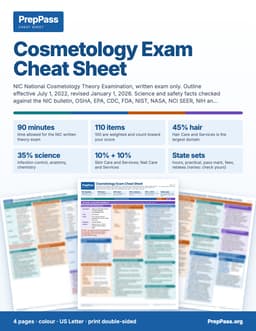
¿Examen en menos de dos semanas?
Esta guía es la enseñanza, para leer durante semanas. Si tu examen es en menos de dos semanas, la hoja de referencia a color imprimible es el otro producto: las cifras clave, por secciones.
4 páginas · US Letter · PDF imprimible · tuyo para siempre
How this book compares
Since 1 July 2022 California's Board of Barbering and Cosmetology has given the national written exam developed by PSI, and the Board links PSI's candidate bulletin with each exam's content outline. This book is written from the NIC national content outline, not from PSI's California outline, and does not teach California's own laws and rules.
| Resource | Price | What you get | Choose it if |
|---|---|---|---|
| This bookCosmetology State Board Exam — Complete Study Guide (2026)PrepPass | $14.99 | Downloadable review of the science on cosmetology written (theory) exams
| Choose this book for infection control and hair, skin and nail science taught in writing. Read your own state's exam outline and rules alongside it; California's law is not in this book. |
| From the exam bodyPSI Candidate Information Bulletin and content outlines (opens the publisher's page in a new tab)PSI, for the California Board of Barbering and Cosmetology | Free, linked from the Board's exam page | The outline and reference list California's written exam is built from | Read it in any case if you test in California: it is the outline your exam is written to. |
| AlternativeCosmetology Exam Secrets (opens the publisher's page in a new tab)Mometrix Test Preparation | $39.99 ebook; $44.99 printed book | Study guide with practice questions | Choose Mometrix if you want a printed copy. |
This book
Cosmetology State Board Exam — Complete Study Guide (2026)
PrepPass
- Price
- $14.99
- What you get
Downloadable review of the science on cosmetology written (theory) exams
- 64 practice questions with explanations
- 88 pages, PDF + EPUB
- Choose it if
- Choose this book for infection control and hair, skin and nail science taught in writing. Read your own state's exam outline and rules alongside it; California's law is not in this book.
From the exam body
PSI Candidate Information Bulletin and content outlines (opens the publisher's page in a new tab)
PSI, for the California Board of Barbering and Cosmetology
- Price
- Free, linked from the Board's exam page
- What you get
The outline and reference list California's written exam is built from
- Choose it if
- Read it in any case if you test in California: it is the outline your exam is written to.
Alternative
Cosmetology Exam Secrets (opens the publisher's page in a new tab)
Mometrix Test Preparation
- Price
- $39.99 ebook; $44.99 printed book
- What you get
Study guide with practice questions
- Choose it if
- Choose Mometrix if you want a printed copy.
Other resources' prices and contents are as listed on each publisher's or seller's own page, checked September 24, 2026. Prices change; confirm on the linked page before you buy. This book's price and contents come from our own catalog.
Sources (2)
- https://www.barbercosmo.ca.gov/applicants/national.shtml — read September 24, 2026
- https://www.mometrix.com/studyguides/cosmetology/ — read September 24, 2026
Qué incluye — y qué no
Incluido
- A “key facts” cram box in every chapter — the numbers, times and disinfectant rules on one page each
- A worked scenario and the exam traps, chapter by chapter, so you practice the wording the board actually uses
- All 4 NIC theory domains, weighted like the NIC written exam
- Infection control: EPA-registered disinfectants, wet disinfection, OSHA bloodborne
- Verified science: pH, the acid mantle, peroxide volumes, oxidation-color chemistry
- Hair, skin, and nail structure, disorders, and services
- 64 original practice questions with answer explanations
- State-set rules taught and flagged — confirm the numbers with your board
No incluido
- No se envía copia impresa — es un archivo que descargas y puedes imprimir tú
- El libro no incluye curso en vídeo, instructor ni tutorías — los vídeos gratis del sitio van aparte
- No incluye tu inscripción al examen ni la tasa del centro, que sigues pagando al organismo oficial
Contenido
Ver 11 secciones y la página en la que empieza cada una
- 7. Nail Care — Manicuring & Pedicuringp. 58
- Practice Questionsp. 69
- Chapter 1 — Infection Control, Safety & Sanitationp. 69
- Chapter 2 — Anatomy & Physiologyp. 71
- Chapter 3 — Bacteriology, Chemistry, Electricity & Lightp. 72
- Chapter 4 — Hair Care Servicesp. 74
- Chapter 5 — Chemical Texture & Haircoloringp. 76
- Chapter 6 — Skin Care & Facialsp. 77
- Chapter 7 — Nail Carep. 79
- Chapter 8 — Salon Business & Ethicsp. 81
- Answer Key & Explanationsp. 83
Tomado del PDF que descargas, con la página en la que empieza cada uno — no escrito a mano aquí.
Lee un capítulo completo gratis
Un capítulo completo, tal como viene en el eBook. Desplázate en la ventana para leerlo aquí; sin descargas ni correo.
Lee el capítulo 1 aquí, sin salir de la página
Introduction
If the exam had a single most important chapter, this is it — and not only because a large block of questions comes from it. Infection control is the part of cosmetology where a mistake can actually hurt a client, which is exactly why every state board writes it into law and why the NIC blueprint lists it first. The good news is that this material is highly learnable: it is definitions, a short hierarchy of "how clean is clean," a handful of disease-causing organisms, and a set of rules from two federal agencies — the EPA and OSHA — that the outline names directly.
The traps here are careful distinctions the exam builds wrong answers out of. Cleaning is not disinfection, and neither is sterilization. A single-use (disposable) item is not the same as a multi-use (reusable) item, and the two are handled in opposite ways. An EPA-registered hospital-grade disinfectant is a specific legal category, not just "a strong cleaner." And the number of minutes an implement must sit in that disinfectant is not a national fact — it is set by your state board. Learn the concept, and flag the number.
This chapter covers the three levels of decontamination; the categories of infection-causing organisms (bacteriology in brief — we return to it in Chapter 3); how disease is transmitted and how cross-contamination is prevented; EPA-registered disinfectants and correct "wet disinfection"; single-use versus multi-use tools; and the OSHA rules — the Bloodborne Pathogens Standard and Safety Data Sheets — that govern a blood-exposure incident and every chemical on your shelf.
Learning objectives
After this chapter you should be able to:
- Rank the three levels of decontamination — sterilization > disinfection > cleaning (sanitation) — and state what each does and does not destroy.
- Explain why a salon disinfects (it does not sterilize) most tools, and what an EPA-registered, hospital-grade disinfectant must be labeled to kill.
- Perform correct immersion ("wet") disinfection: fully submerge a cleaned implement for the manufacturer's stated contact time in a covered container, made fresh per the label.
- Distinguish single-use (disposable) items — used once, then thrown away — from multi-use (reusable) items that can be cleaned and disinfected.
- Identify the roles of the EPA (registers disinfectants) and OSHA (worker safety — Bloodborne Pathogens Standard and Hazard Communication / Safety Data Sheets).
- Apply a correct blood-exposure (exposure-incident) procedure, and recognize that the rule on discarding vs. disinfecting a blood-contaminated implement is state-set.
- Recognize the main routes of disease transmission and how cross-contamination is prevented in a salon.
Part A — The three levels of decontamination
"Decontamination" is the removal of pathogens and dirt from tools and surfaces. There are three levels, and the exam tests the order and the boundary between them constantly.
- Cleaning (sanitizing) — the lowest level. Mechanically removing visible dirt, debris, oils, and most microbes with soap or detergent and water. Cleaning reduces the number of organisms; it does not kill enough of them to make a tool safe on its own. Cleaning is always the required first step before disinfection — a disinfectant cannot work through a layer of hair, oil, or product. In salons, "sanitizing" (for example, a hand sanitizer, or wiping a station) is this lowest level.
- Disinfection — the middle level, and the salon's workhorse. Using a chemical agent (an EPA-registered disinfectant) to destroy most microorganisms on hard, non-porous surfaces and implements. Disinfection is strong enough to control disease on tools like metal shears, combs, and nippers, but it does not kill bacterial spores. This is the level state boards require for multi-use implements between clients.
- Sterilization — the highest level. Destroying all microbial life, including bacterial spores. True sterilization requires an autoclave (steam under pressure). Salons rarely sterilize; it is mostly relevant where instruments break the skin. Because most cosmetology tools do not need it, the correct salon standard for reusable tools is disinfection, not sterilization — a favorite exam distinction.
Memory hook: C-D-S climbs uphill — Clean, then Disinfect, and only medical/ spore situations need Sterilize. You always clean before you disinfect.
Source: NIC Content Outline I-A-2 (differentiate sanitation, disinfection, sterilization). Sterilization defined as destruction of all microbial life including spores; disinfection does not kill spores — standard EPA/CDC framework.
Part B — The organisms you are controlling (bacteriology in brief)
You are disinfecting against something. The exam expects you to know the broad categories. (Chapter 3 revisits bacterial shapes in detail.)
- Bacteria — one-celled microorganisms. Pathogenic (disease-causing, "harmful") bacteria are the minority; most bacteria are non-pathogenic (harmless or helpful). Bacteria are classified by shape into cocci (round), bacilli (rod-shaped), and spirilla (spiral). Some bacteria form spores — a resistant coating that survives heat and disinfectants, which is exactly why disinfection (which does not kill spores) is a step below sterilization.
- Viruses — much smaller than bacteria; they replicate only inside a host's living cells. Bloodborne viruses (hepatitis B and C, HIV) are the reason for the OSHA blood rules below.
- Fungi — molds, mildews, and yeasts. In the salon these show up as tinea infections (ringworm; tinea pedis is athlete's foot) and nail infections.
- Parasites — organisms that live on another organism. Pediculosis capitis (an infestation of head lice) and scabies (an itch mite) are the two the exam names; both are contagious and are contraindications to service.
An infection occurs when pathogens enter the body and multiply. A local infection is confined to one area (a pimple, an infected nail fold shows pus, a sign of infection). A general (systemic) infection has spread through the bloodstream to the whole body. A contagious (communicable) disease spreads from one person to another — the salon's whole job is to break that chain.
Source: NIC I-A-1 (cause/transmission of disease). Standard microbiology as taught in cosmetology fundamentals.
Part C — How disease spreads, and how cross-contamination is prevented
Pathogens move by direct transmission (touching, coughing, sharing an infected implement) and indirect transmission (touching a contaminated surface, tool, or towel). Cross-contamination is the spread of pathogens from one person, tool, or surface to another — for example, using a comb on a client with a scalp infection and then on the next client without disinfecting it.
The prevention rules the exam rewards:
- Clean and disinfect every multi-use tool between every client — no exceptions.
- Use single-use items once, then discard them. Never "double-dip": do not return a used wax applicator to the wax pot, and do not put a used implement back into a clean supply.
- Never contaminate a product container. Dispense creams and waxes with a clean spatula, not fingers; pour disinfectant or lotion out rather than dipping used tools into the bottle.
- Store clean and dirty separately. Disinfected implements go in a clean, covered, labeled container; used tools go in a separate labeled container until they are cleaned.
- Wash hands before and after each client, and after any contact with the face, scalp, or broken skin.
Part D — EPA-registered disinfectants and correct wet disinfection
State boards do not let salons use just any cleaner. They require an EPA-registered disinfectant — a product the U.S. Environmental Protection Agency has reviewed and assigned an EPA registration number (the EPA registers disinfectants because they are legally classified as pesticides). For salon implements, boards typically require one labeled as hospital-grade and effective as a bactericide, virucide, and fungicide (able to kill bacteria, viruses, and fungi). Some boards additionally require it to be tuberculocidal or pseudomonacidal — an example of a state-set requirement to confirm locally.
Correct immersion ("wet") disinfection — the tested procedure:
- Clean first. Wash the implement with soap and water to remove all hair, debris, and product. Disinfectant cannot penetrate soil.
- Fully immerse the cleaned implement in the disinfectant so all surfaces, including handles and hinges, are submerged.
- Leave it for the full contact time on the manufacturer's label. Many states require at least 10 minutes, but the exact required time is state-set and product-specific — the precise number of minutes is set by your state board and the product label, so confirm it in your state's rules and follow the label.
- Use a covered container (a "wet sanitizer" jar with a lid).
- Mix fresh and change it per the label — commonly daily, and immediately if it becomes cloudy or contaminated.
- Remove, rinse if the label says to, and store the implement in a clean, covered container.
Surfaces vs. immersion: hard non-porous surfaces (stations, chairs, shampoo bowls) are disinfected by spraying or wiping with the same EPA-registered disinfectant and letting it stay wet for the label's contact time. Porous items that absorb (emery boards, wooden pushers, foam buffers, paper) generally cannot be disinfected and must be treated as single-use.
Source: NIC I-A-5 (identify requirements of EPA); state salon rules (e.g., Connecticut, Florida, Texas board regulations) uniformly require EPA-registered, hospital-grade bactericidal/virucidal/fungicidal disinfectants with immersion for the label's contact time. Exact minutes and any tuberculocidal/pseudomonacidal add-on are state-set.
Part E — Single-use vs. multi-use
| Single-use (disposable) | Multi-use (reusable) | |
|---|---|---|
| Definition | Used once, on one client, then discarded | Can be cleaned and disinfected for reuse |
| Examples | Emery boards, wooden/orangewood pushers, cotton, gauze, wax strips, neck strips, gloves, buffers/foam | Metal shears, combs, brushes, metal nippers/pushers, clips, non-porous bowls |
| Why | Porous — they absorb and cannot be disinfected | Hard, non-porous — disinfectant reaches all surfaces |
| Rule | Throw away after one use | Clean → disinfect between every client |
The exam's trap: it will describe a porous item (an emery board, a buffer) and ask how to "disinfect" it. The correct answer is that you do not disinfect it — you discard it. Only hard, non-porous tools can be disinfected.
Part F — OSHA, Safety Data Sheets, and the blood-exposure procedure
Where the EPA governs the disinfectant, OSHA (the federal Occupational Safety and Health Administration) governs worker and client safety. Two OSHA rules are on the outline:
- Hazard Communication Standard → Safety Data Sheets (SDS). Every hazardous product in the salon (developers, relaxers, acetone, disinfectants) must have a Safety Data Sheet from the manufacturer, kept accessible to staff. The SDS lists the ingredients, hazards, safe handling and storage, first-aid, and what to do in a spill or fire. Knowing the SDS is where you go for chemical-safety information is a common test point. (The SDS was formerly called the "MSDS.")
- Bloodborne Pathogens Standard. Because services can nick skin, OSHA requires precautions against bloodborne pathogens — chiefly hepatitis B (HBV), hepatitis C (HCV), and HIV. The core idea is Universal (Standard) Precautions: treat all human blood and body fluids as if they are infectious, every time.
Exposure-incident procedure (if a client is cut and bleeds):
- Stop and protect. Put on gloves.
- Care for the client — stop the service, clean the wound, and apply an antiseptic and a dressing.
- Handle the blood. Discard blood-contaminated single-use items (cotton, wipes) in a proper container. Whether a multi-use implement that contacted blood must be discarded or may be cleaned and disinfected (or sterilized) is set by your state board — some states require discarding it, others allow disinfection, so confirm the rule in your state's regulations.
- Clean and disinfect the station and any contaminated surfaces.
- Remove gloves, wash hands, and (per employer/OSHA policy) document the incident.
Key facts — cram box
| Item | Fact |
|---|---|
| Three levels (low→high) | Cleaning/sanitizing → Disinfection → Sterilization |
| Cleaning | Removes debris & most microbes; always first, before disinfection |
| Disinfection | Kills most microbes on hard non-porous tools; does NOT kill spores; salon standard for reusables |
| Sterilization | Kills all life including spores; needs an autoclave |
| Salon disinfectant | EPA-registered, hospital-grade, labeled bactericidal + virucidal + fungicidal |
| EPA vs. OSHA | EPA registers disinfectants; OSHA = worker safety (Bloodborne Pathogens, SDS) |
| Wet disinfection | Clean first → fully immerse → full contact time (label) → covered container → fresh solution |
| Contact time (minutes) | State-set (often ≥10 min) — confirm in your state's rules and follow the label |
| Single-use (porous) | Emery boards, wax strips, buffers, cotton, gloves → discard after one use |
| Multi-use (non-porous) | Shears, combs, metal nippers → clean + disinfect between clients |
| Bloodborne pathogens | HBV, HCV, HIV; use Universal Precautions — treat all blood as infectious |
| After blood contact | Discard-vs-disinfect an implement is state-set — confirm in your state's rules |
| SDS | Where you find a product's hazards, handling, first-aid (formerly MSDS) |
Antes de comprar
- ¿Cómo lo recibo?
- Paga y la descarga aparece en esta página al instante. Los enlaces también se te envían por correo. No hace falta cuenta.
- ¿Y si no es para mí?
- Escríbenos dentro de 14 días para un reembolso total, sin preguntas.
- ¿Va a desaparecer la práctica gratis?
- No. Todas las preguntas, el simulacro cronometrado y los capítulos gratis del sitio siguen gratis. Este libro es la mitad de estudio, no una valla alrededor de lo gratuito.
- ¿Puedo leerlo en el móvil?
- Sí — el EPUB es para móviles y e-readers, el PDF para imprimir y marcar. Recibes ambos.
Los detalles
The NIC-based written theory exam — infection control plus hair, skin, and nail science.
- Format: PDF + EPUB download · 88 pages
- 64 practice questions in the book, with a full answer key
- 320 free practice questions for this exam on PrepPass, included at no cost
- $14.99 one-time — no subscription
- 14-day money-back guarantee · refund policy
- Cross-referenced against: NIC content outline / EPA / OSHA
- Last updated: August 2026
- Verificado con la fuente oficial(NIC content outline / EPA / OSHA)
- 320 preguntas de práctica gratis
- Descarga instantánea, tuyo de por vida
“I liked that I could study the explanation instead of only seeing right or wrong.”
Resultados individuales, compartidos con permiso. No es una tasa de aprobación.
¿Por qué comprar el libro si la práctica es gratis?
Nuestras preguntas de práctica y el simulacro cronometrado siguen gratis: nada del sitio se esconde tras este libro. El libro de $14.99 es la mitad de estudio: el material en sí, explicado en orden, en un archivo tuyo.
- Enseñanza sistemática — cada sección del examen explicada capítulo a capítulo, de principio a fin, no solo preguntas
- Imprímelo y márcalo — un PDF listo para papel que puedes resaltar, anotar y llevar a tu mesa de estudio
- Estudia en cualquier lugar, sin conexión — EPUB en tu teléfono o e-reader; sin wifi, sin pestañas
- Todo en un solo lugar — los capítulos y las preguntas de práctica en un archivo
- Tuyo de por vida — pago único de $14.99, descarga instantánea, sin suscripción
Y sin riesgo: Garantía de reembolso de 14 días — ¿no te convence? Escríbenos para un reembolso total, sin preguntas. Consulta la política de reembolso.
Garantía de reembolso de 14 días · reembolso total, sin preguntas.
Compra única, acceso de por vida a la descarga. El eBook es la guía completa de Cosmetology State Board en PDF y EPUB. Resumen educativo, no asesoría profesional ni legal — confirma siempre las reglas vigentes con la fuente oficial. Última actualización: August 2026.