California Guard Card (BSIS Security Guard) · Edición 2026
California Guard Card — Complete Study Guide (2026)
Powers to arrest, appropriate use of force, liability, observation & report writing, and terrorism awareness — California statute, cited to BSIS + Penal Code.
- 50 preguntas de práctica dentro del libro, con clave de respuestas completa
- 89 páginas de enseñanza, capítulo a capítulo — no un volcado de preguntas
- Contrastado con CA BSIS / B&P §7580+ / Penal Code / 16 CCR
$9.99pago único · descarga de por vida · sin suscripción
PDF + EPUB · en inglés · 89 páginas · $9.99 pago único
Este libro está escrito en inglés — el PDF y el EPUB que descargas están en inglés.
Descarga inmediata tras el pago — sin cuenta y sin suscripción.
Garantía de devolución de 14 días: ¿no te convence por cualquier motivo? Escribe a support@preppass.org en los 14 días siguientes a la compra y te devolvemos el importe completo. Es una descarga, así que no hay nada que devolver por correo. Política de reembolso
Datos del examen verificados por última vez con fuentes oficiales: septiembre de 2026.
Prueba primero 10 preguntas — gratis
Responde las 10, y al terminar verás cada respuesta explicada — con la sección de esta guía que la enseña. Unos 5 minutos, sin registro.
Empezar 10 preguntas gratisMira dentro del libro
Tres páginas reales, renderizadas directamente del PDF que descargas — una página de referencia, una de explicación y una pregunta resuelta, siempre en ese orden. Nada se rediseñó para verse mejor.
- Referencia rápidaChapter 2 — Appropriate Use of Force · Página 28 del PDF
Una página a la que puedes volver: cifras, plazos o términos reunidos en un solo lugar.
- Cómo se enseñaChapter 1 — Powers to Arrest · Página 12 del PDF
Una página de explicación: el material enseñado en prosa, en el orden en que lo evalúa el examen.
- Una pregunta resueltaPart II — Practice Exam · Página 66 del PDF
Una pregunta de práctica con su respuesta y el razonamiento detrás — no solo la clave.
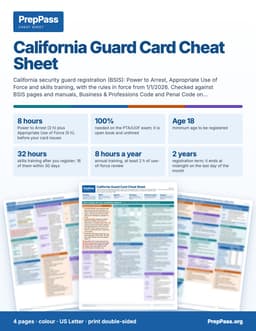
¿Examen en menos de dos semanas?
Esta guía es la enseñanza, para leer durante semanas. Si tu examen es en menos de dos semanas, la hoja de referencia a color imprimible es el otro producto: las cifras clave, por secciones.
4 páginas · US Letter · PDF imprimible · tuyo para siempre
Sobre el examen en sí
| Organismo administrador | Bureau of Security and Investigative Services (BSIS), California Department of Consumer Affairs — examen administrado por a BSIS-approved training school, or the employer where it has a Bureau-qualified instructor Fuente: 16 CCR § 628(b) — BSIS Regulations (BSIS-published compilation, PDF) |
|---|---|
| Preguntas | No publicado por BSIS Lo que leímos y donde no aparece: BSIS — Power to Arrest Answer Key (released to instructors on request) |
| Tiempo límite | El examen no tiene tiempo límite: BSIS indica a los administradores que permitan tiempo ilimitado. Lo que BSIS sí fija son las horas del curso — Power to Arrest 3 horas, Appropriate Use of Force 5 horas — que es duración del curso, no del examen. Lo que leímos y donde no aparece: BSIS — Power to Arrest and Appropriate Use of Force Training Manual (revised July 2023, PDF) |
| Puntuación para aprobar | 100% Fuente: 16 CCR § 628(b) — BSIS Regulations (BSIS-published compilation, PDF) |
| Tarifas |
Fuente: BSIS — Licensing Fees (fee schedule dated September 2025, PDF) |
| Idiomas disponibles | No publicado por BSIS Lo que leímos y donde no aparece: BSIS — Resources and Training Materials |
Preguntas de práctica y capítulos gratis de California Guard Card (BSIS Security Guard) →
Qué incluye — y qué no
Incluido
- Every chapter ends the same way: key numbers & deadlines, the exam traps named one by one, and the takeaways — so the night before is a re-read, not a re-study
- A worked California example in each chapter: the rule applied to a real guard scenario
- Powers to arrest vs peace-officer arrest; citizen's arrest (PC §837)
- Appropriate use of force (PC §835a) and the observe-and-report rule
- Liability, detention limits, and merchant's privilege (PC §490.5(f))
- Observation, documentation, and courtroom-ready report writing
- 50 original practice questions with answer explanations
- PDF (print & tab it) + EPUB (phone / e-reader)
No incluido
- No se envía copia impresa — es un archivo que descargas y puedes imprimir tú
- El libro no incluye curso en vídeo, instructor ni tutorías — los vídeos gratis del sitio van aparte
- No incluye tu inscripción al examen ni la tasa del centro, que sigues pagando al organismo oficial
Contenido
Ver 11 secciones y la página en la que empieza cada una
- Part I — The Study Guidep. 8
- Chapter 1 — Powers to Arrestp. 9
- Chapter 2 — Appropriate Use of Forcep. 22
- Chapter 3 — Liability & Legal Aspectsp. 31
- Chapter 4 — Observation, Documentation & Report Writingp. 39
- Chapter 5 — Communication, Public Relations & Ethicsp. 46
- Chapter 6 — Emergency Procedures & Officer Safetyp. 53
- Chapter 7 — Terrorism Awareness & Weapons of Mass Destructionp. 59
- Part II — Practice Examp. 66
- Part III — Answer Key & Explanationsp. 79
- Appendix — Quick statute & standard referencep. 88
Tomado del PDF que descargas, con la página en la que empieza cada uno — no escrito a mano aquí.
Lee un capítulo completo gratis
Un capítulo completo, tal como viene en el eBook. Desplázate en la ventana para leerlo aquí; sin descargas ni correo.
Lee el capítulo 4 aquí, sin salir de la página
No te dimos la introducción fácil — el capítulo gratis abre en una de las partes más exigentes del libro, para que juzgues la enseñanza donde el examen se pone difícil.
Introduction
A security guard's real product is information — accurate observation, clearly documented, delivered to the people who need it. The camera does not testify; you do. A theft, an assault, a slip-and-fall, a use of force: months later, the only reliable record of what happened is the report you wrote and the notes behind it. A vague, editorial, or contradictory report loses cases; a specific, factual, chronological one wins them. This chapter teaches you to see deliberately, note contemporaneously, and write in a way that would satisfy a judge reading it five years from now.
It covers patrol technique and situational awareness, the discipline of note-taking and the 5W + H report structure, systematic suspect and vehicle descriptions, and the legal limits on photography and audio recording in a two-party-consent state.
Learning objectives
After working through this chapter you should be able to:
- Patrol with varied patterns and situational awareness (Cooper's color codes; the OODA loop), using all your senses.
- Take contemporaneous notes and write a report answering Who, What, When, Where, Why, How with facts, not conclusions.
- Give a systematic head-to-toe suspect description and a CYMBALS vehicle description.
- Apply the two-party consent rule for audio (Penal Code §632) and the privacy limits on recording (Penal Code §647(j)), and treat images as evidence.
- Explain how contemporaneous notes refresh recollection for later testimony (Evidence Code §771).
Part A — Patrol patterns and situational awareness
Good patrols are neither random wandering nor predictable loops. A predictable patrol teaches a hostile actor exactly when you will be at the back dock; a varied patrol — changing direction, timing, and route, with deliberate pauses to listen — denies them that. Practical habits: walk against vehicle traffic so you can see drivers; use your nose (smoke, fuel, marijuana often register before anything is visible) and your ears (breaking glass, raised voices, alarms) as much as your eyes.
Two mental models anchor awareness:
- Cooper's color codes. White = oblivious (never acceptable on duty); Yellow = relaxed alert (your normal on-duty baseline); Orange = a specific possible threat identified, plan forming; Red = acting on the threat. Live in Yellow.
- The OODA loop. Observe, Orient, Decide, Act — cycle continuously so you keep updating on fresh information instead of locking onto your first guess.
Your post orders define the patrol path; your awareness determines whether the patrol accomplishes anything.
Part B — Notes and reports: the 5W + H, written contemporaneously
Every incident report answers six questions:
- Who — everyone involved, with full names where available, detailed descriptions where not, witness contact information, and your own name and post.
- What — what happened, in plain chronological order, with concrete facts ("the man swung his right fist at the cashier"), not conclusions ("he became aggressive").
- When — specific times from your watch or radio log, for each step.
- Where — the exact location on the property, detailed enough that a stranger could find it.
- Why — the hardest box: stick to facts and reported statements; do not guess at motive unless the subject told you.
- How — how the events unfolded and how they were resolved.
Take notes during the incident if it is safe, or immediately after while it is fresh. The bridge from raw notes to clean report to courtroom testimony months later is California Evidence Code §771, which allows a witness to refresh recollection from a writing made when the events were fresh. Two rules make a report defensible: write facts over conclusions ("the subject said he had three beers," not "the subject was drunk"), and apply the stranger test — could someone who was not there reconstruct what happened from your report alone? If not, rewrite it.
Part C — Suspect and vehicle descriptions that hold up
Build a suspect description head to toe so a responding officer can broadcast it without gaps: gender and approximate age; race/ethnicity if discernible; height and build; hair (color, length, style); eyes; facial hair, glasses, scars, tattoos; hat; shirt and outerwear with colors; pants; shoes; anything in the hands; and direction of travel. Practice the sequence out loud on slow shifts — the time to learn the script is not while someone is running away.
For vehicles, a common California mnemonic is CYMBALS: Color, Year, Make, Body style, All other (damage, decals, distinguishing marks), License, State. The license plate beats every other identifier — get it first if you can; if you cannot, get a partial plate and the state. For weapons, describe what you actually saw ("a black semi-automatic pistol with a stainless slide"), rather than guessing make and model. Use compass directions for travel, not "that way."
Part D — Photography, recording, and privacy
Phones make documentation easy and legally complicated at once.
- Video without sound, in a public space or your employer's premises where there is no reasonable expectation of privacy, is generally allowed.
- Audio is the harder line. California is a two-party (all-party) consent state under Penal Code §632: it is a crime to record a confidential communication without the consent of all parties. Body cameras that capture audio in private areas implicate §632 — know whether your company policy or a posted written notice supplies the needed consent.
- Privacy crimes. Penal Code §647(j) makes it a crime to photograph or record a person in a place where they have a reasonable expectation of privacy — restrooms, dressing rooms, hotel rooms — even with no audio.
- Treat images as evidence. Do not edit them, do not post them to social media, and turn them over to your supervisor with a clear chain of custody.
Write and photograph as if a judge will read and view it tomorrow — because one might.
California worked example
At 9:42 p.m. a guard hears glass break near the loading dock, moves to Yellow-to-Orange, and sees a man throw a laptop bag over a fence and run west toward Elm Street in a gray hooded sweatshirt.
The report writes itself if the observation was disciplined. When: 9:42 p.m. (from the radio log). Where: northeast loading dock, exterior. Who/What (facts): "I heard glass breaking; I observed a male adult, approximately 20–30, ~5'10", medium build, gray hooded sweatshirt, dark pants, throw a dark laptop bag over the north fence and run west on Elm Street." Suspect description head-to-toe, finishing with direction of travel (west). Vehicle, if one was used, in CYMBALS order with the plate captured first. The guard does not write "the burglar" (a conclusion) but "a male adult who threw a bag and fled." If the guard used a phone to photograph the broken window, those images are evidence — unedited, handed to the supervisor, not posted anywhere. Notes taken now let the guard refresh recollection (Evidence Code §771) if called to testify next year.
Key numbers & deadlines
Awareness models: Cooper's color codes (White / Yellow / Orange / Red — operate in Yellow); OODA loop (Observe, Orient, Decide, Act). Vary patrol patterns; use all senses. Report structure: 5W + H (Who, What, When, Where, Why, How); chronological, specific times/names/locations, facts over conclusions. Descriptions: suspect head-to-toe, ending with direction of travel; vehicle CYMBALS (Color, Year, Make, Body, All-other, License, State). Plate beats all other IDs. Recording law: audio = two-party consent, Penal Code §632 (crime to record a confidential communication without all-party consent). Penal Code §647(j) — criminal invasion of privacy (restrooms, dressing rooms, etc.). Treat images as evidence (no edits, chain of custody). Testimony: contemporaneous notes refresh recollection — Evidence Code §771.
Named exam traps
- "A good patrol follows the same reliable route every time." No — predictable patrols are exploitable. Vary route and timing.
- "Write your conclusion so it's clear ('he was drunk / he was the thief')." No — write facts ("said he had three beers"; "threw a bag and fled"). Conclusions belong to others.
- "Guess the make and model of the gun so the report looks complete." No — describe what you saw. Guessing invents evidence.
- "You can record any conversation on duty." No — audio needs all-party consent (§632); recording a confidential conversation without it is a crime.
- "A photo is just a photo — edit or share it freely." No — images are evidence; no edits, no social media, keep a chain of custody. Recording in restrooms/dressing rooms violates §647(j).
- "Notes don't matter once you file the report." No — contemporaneous notes are what let you refresh recollection (Evidence Code §771) in court months later.
Key takeaways
- Patrol with varied patterns and stay in Cooper's Yellow; run the OODA loop and use every sense.
- Write 5W + H, chronological, specific, and factual — pass the stranger test.
- Describe suspects head-to-toe (end with direction of travel) and vehicles by CYMBALS, capturing the plate first.
- Audio recording needs all-party consent (§632); respect privacy (§647(j)); treat images as evidence.
- Contemporaneous notes refresh recollection at trial (Evidence Code §771).
Sources
Cited to leginfo.legislature.ca.gov (Penal Code, Evidence Code). Awareness models (Cooper's color codes, OODA, CYMBALS) are standard security-training frameworks, not statutes.
- Cal. Penal Code §632 — recording of confidential communications (two-party consent).
- Cal. Penal Code §647(j) — invasion of privacy by recording/photography.
- Cal. Evidence Code §771 — refreshing recollection from a writing.
- Security-training frameworks: Cooper's color codes; the OODA loop (J. Boyd); CYMBALS vehicle- description mnemonic; the 5W + H report standard.
Antes de comprar
- ¿Cómo lo recibo?
- Paga y la descarga aparece en esta página al instante. Los enlaces también se te envían por correo. No hace falta cuenta.
- ¿Y si no es para mí?
- Escríbenos dentro de 14 días para un reembolso total, sin preguntas.
- ¿Va a desaparecer la práctica gratis?
- No. Todas las preguntas, el simulacro cronometrado y los capítulos gratis del sitio siguen gratis. Este libro es la mitad de estudio, no una valla alrededor de lo gratuito.
- ¿Puedo leerlo en el móvil?
- Sí — el EPUB es para móviles y e-readers, el PDF para imprimir y marcar. Recibes ambos.
Los detalles
Powers to arrest, appropriate use of force, liability, observation & report writing, and terrorism awareness — California statute, cited to BSIS + Penal Code.
- Format: PDF + EPUB download · 89 pages
- 50 practice questions in the book, with a full answer key
- 200 free practice questions for this exam on PrepPass, included at no cost
- $9.99 one-time — no subscription
- 14-day money-back guarantee · refund policy
- Cross-referenced against: CA BSIS / B&P §7580+ / Penal Code / 16 CCR
- Last updated: September 2026
- Verificado con la fuente oficial(CA BSIS / B&P §7580+ / Penal Code / 16 CCR)
- 200 preguntas de práctica gratis
- Descarga instantánea, tuyo de por vida
Un BSIS guard card training course cuesta $50–$150. Este libro enseña el mismo examen — las mismas reglas, verificadas a los estándares actuales — por un pago único de $9.99 que conservas de por vida.
¿Por qué comprar el libro si la práctica es gratis?
Nuestras preguntas de práctica y el simulacro cronometrado siguen gratis: nada del sitio se esconde tras este libro. El libro de $9.99 es la mitad de estudio: el material en sí, explicado en orden, en un archivo tuyo.
- Enseñanza sistemática — cada sección del examen explicada capítulo a capítulo, de principio a fin, no solo preguntas
- Imprímelo y márcalo — un PDF listo para papel que puedes resaltar, anotar y llevar a tu mesa de estudio
- Estudia en cualquier lugar, sin conexión — EPUB en tu teléfono o e-reader; sin wifi, sin pestañas
- Todo en un solo lugar — los capítulos y las preguntas de práctica en un archivo
- Tuyo de por vida — pago único de $9.99, descarga instantánea, sin suscripción
Y sin riesgo: Garantía de reembolso de 14 días — ¿no te convence? Escríbenos para un reembolso total, sin preguntas. Consulta la política de reembolso.
Garantía de reembolso de 14 días · reembolso total, sin preguntas.
Compra única, acceso de por vida a la descarga. El eBook es la guía completa de California Guard Card (BSIS Security Guard) en PDF y EPUB. Resumen educativo, no asesoría profesional ni legal — confirma siempre las reglas vigentes con la fuente oficial. Última actualización: September 2026.