CPA Exam — Tax Compliance and Planning (TCP) · Edición 2026
CPA TCP Study Guide — 2026 Edition
Nota de ediciónNew for 2026: written to the Jan 2026 TCP blueprint and H.R. 1 tax law tested from July 1, 2026
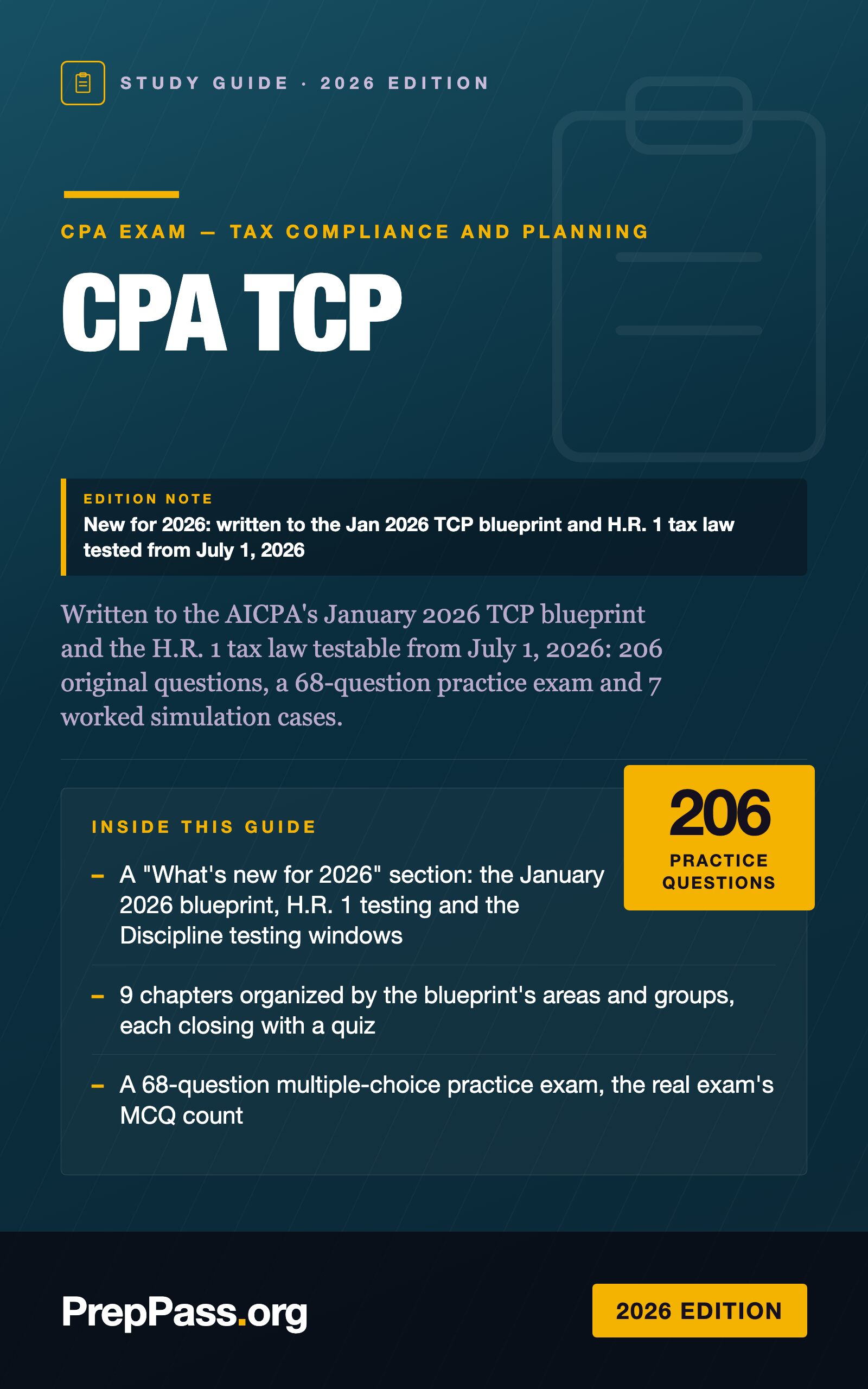
Written to the AICPA's January 2026 TCP blueprint and the H.R. 1 tax law testable from July 1, 2026: 206 original questions, a 68-question practice exam and 7 worked simulation cases.
- 206 preguntas originales de práctica de CPA TCP, cada una con explicación razonada, en un PDF + EPUB que conservas
PDF + EPUB · en inglés · 235 páginas · $19.99 pago único
Este libro está escrito en inglés — el PDF y el EPUB que descargas están en inglés.
Descarga inmediata tras el pago — sin cuenta y sin suscripción.
Garantía de devolución de 14 días: ¿no te convence por cualquier motivo? Escribe a support@preppass.org en los 14 días siguientes a la compra y te devolvemos el importe completo. Política de reembolso
Prueba primero 10 preguntas — gratis
Responde las 10, y al terminar verás cada respuesta explicada — con la sección de esta guía que la enseña. Unos 5 minutos, sin registro.
Empezar 10 preguntas gratisMira dentro del libro
Tres páginas reales, renderizadas directamente del PDF que descargas — una página de referencia, una de explicación y una pregunta resuelta, siempre en ese orden. Nada se rediseñó para verse mejor.
- Referencia rápidaChapter 1 — Individual Compliance and Tax Planning: Income, Deductions and Estimated Tax (Area I, Group A) · Página 26 del PDF
Una página a la que puedes volver: cifras, plazos o términos reunidos en un solo lugar.
- Cómo se enseñaChapter 2 — Passive Activity and At-Risk Limits, and Gift Tax Compliance and Planning (Area I, Groups B and C) · Página 42 del PDF
Una página de explicación: el material enseñado en prosa, en el orden en que lo evalúa el examen.
- Una pregunta resueltaChapter 4 — Entity Tax Compliance: C Corporations (Area II, Group A) · Página 88 del PDF
Una pregunta de práctica con su respuesta y el razonamiento detrás — no solo la clave.
Sobre el examen en sí
| Organismo administrador | American Institute of Certified Public Accountants (AICPA) — examen administrado por Prometric |
|---|---|
| Preguntas | 68 preguntas Fuente: AICPA — Uniform CPA Examination Blueprints (effective January 2026, PDF) |
| Tiempo límite | 240 minutos Fuente: AICPA — Uniform CPA Examination Blueprints (effective January 2026, PDF) |
| Puntuación para aprobar | Puntuación escalada de 75 en una escala de 0–99 Fuente: AICPA & CIMA — Learn more about CPA Exam scoring and pass rates |
| Tarifas | No publicado por Boards of Accountancy / NASBA Lo que leímos y donde no aparece: NASBA — CPA Exam Candidate Guide (07162026, PDF) |
| Idiomas disponibles | Inglés |
Preguntas de práctica y capítulos gratis de CPA Exam — Tax Compliance and Planning (TCP) →
Qué incluye — y qué no
Incluido
- A "What's new for 2026" section: the January 2026 blueprint, H.R. 1 testing and the Discipline testing windows
- 9 chapters organized by the blueprint's areas and groups, each closing with a quiz
- A 68-question multiple-choice practice exam, the real exam's MCQ count
- 7 worked task-based simulation cases, from gift-tax returns to partnership liquidations
- 206 original questions, each with a worked explanation citing its source
- PDF + EPUB you keep
No incluido
- No se envía copia impresa — es un archivo que descargas y puedes imprimir tú
- El libro no incluye curso en vídeo, instructor ni tutorías — los vídeos gratis del sitio van aparte
- No incluye tu inscripción al examen ni la tasa del centro, que sigues pagando al organismo oficial
Contenido
Ver 15 secciones y la página en la que empieza cada una
- Chapter 1 — Individual Compliance and Tax Planning: Income, Deductions and Estimated Tax (Area I, Group A)p. 10
- Chapter 2 — Passive Activity and At-Risk Limits, and Gift Tax Compliance and Planning (Area I, Groups B and C)p. 36
- Chapter 3 — Personal Financial Planning for Individuals (Area I, Group D)p. 54
- Answer key & explanationsp. 68
- Chapter 4 — Entity Tax Compliance: C Corporations (Area II, Group A)p. 71
- Chapter 5 — Entity Tax Compliance: S Corporations (Area II, Group B)p. 92
- Chapter 6 — Entity Tax Compliance: Partnerships (Area II, Group C)p. 105
- Chapter 7 — Entity Tax Compliance: Trusts and Tax-Exempt Organizations (Area II, Groups D and E)p. 120
- Chapter 8 — Entity Tax Planning (Area III)p. 134
- Chapter 9 — Property Transactions: Disposition of Assets (Area IV)p. 152
- Section II — Entity tax compliance (24 questions)p. 176
- Section III — Entity tax planning (10 questions)p. 182
- Section IV — Property transactions (10 questions)p. 184
- Appendix A — The exam at a glance, in one tablep. 212
- Appendix B — Terms the exam expects you to use preciselyp. 213
Tomado del PDF que descargas, con la página en la que empieza cada uno — no escrito a mano aquí.
Lee un capítulo completo gratis
Un capítulo completo, tal como viene en el eBook. Desplázate en la ventana para leerlo aquí; sin descargas ni correo.
Lee el capítulo 6 aquí, sin salir de la página
No te dimos la introducción fácil — el capítulo gratis abre en una de las partes más exigentes del libro, para que juzgues la enseñanza donde el examen se pone difícil.
Group C has four topics: the basis of a partner's interest; partnership and partner elections; transactions between a partner and the partnership; and ownership changes[1]. Partnership questions reward one habit above all others: keep inside basis and outside basis separate. Outside basis is the partner's basis in the partnership interest. Inside basis is the partnership's basis in its assets. Most partnership rules either preserve a built-in gain by carrying basis over from one to the other, or adjust one to match the other.
II.C.1 Basis of a partner's interest
Contributions of property
"No gain or loss shall be recognized to a partnership or to any of its partners in the case of a contribution of property to the partnership in exchange for an interest in the partnership"[2]. Unlike section 351 for corporations, there is no control requirement. The bases carry over:
- Outside basis = money plus "the adjusted basis of such property to the contributing partner"[3].
- Inside basis = "the adjusted basis of such property to the contributing partner at the time of the contribution"[4].
Built-in gain or loss at contribution stays with the contributing partner: income, gain, loss and deduction from contributed property "shall be shared among the partners so as to take account of the variation between the basis of the property to the partnership and its fair market value at the time of contribution"[5]. If the partnership distributes the contributed property to another partner within 7 years, the contributing partner recognizes the precontribution gain or loss[5].
Liabilities
Partnership debt is where partnership basis differs most from S corporation basis. Section 752 treats changes in a partner's share of liabilities as cash:
- "Any increase in a partner's share of the liabilities of a partnership ... shall be considered as a contribution of money by such partner to the partnership"[6] — it increases outside basis.
- "Any decrease in a partner's share of the liabilities of a partnership, or any decrease in a partner's individual liabilities by reason of the assumption by the partnership of such individual liabilities, shall be considered as a distribution of money to the partner"[6] — it decreases outside basis, and to the extent it exceeds basis, it is gain[7].
How liabilities are shared.
- A recourse liability is shared by the partners who bear the economic risk of loss for it: "A partner's share of recourse partnership liability equals the portion of that liability, if any, for which the partner or related person bears the economic risk of loss"[8]. A partner who lends to the partnership bears the economic risk of loss for that loan[8] — so a partner loan increases only the lending partner's basis.
- A nonrecourse liability is shared in three tiers: first by each partner's share of partnership minimum gain, then by the section 704(c) gain that would be allocated on a disposition of the encumbered property, and then — for the excess — "in accordance with the partner's share of partnership profits"[9].
Worked example — contribution of encumbered property. Rosa contributes a building (basis $120,000, value $300,000) subject to a $90,000 recourse mortgage to a new partnership in exchange for a one-third interest; the other two partners contribute cash. Assume the mortgage is shared equally, as each partner bears one-third of the economic risk of loss.
- Rosa's outside basis starts at $120,000.
- She is relieved of $90,000 of individual liability (a deemed distribution) and takes on a one-third share, $30,000 (a deemed contribution). Net decrease: $60,000.
- Outside basis = $120,000 − $60,000 = $60,000. No gain, because the net deemed distribution ($60,000) does not exceed her $120,000 basis.
- The partnership's basis in the building is $120,000.
If the mortgage had been $420,000, the net decrease of $280,000 would exceed her basis by $160,000, and she would recognize $160,000 of gain.
Annual adjustments
A partner's outside basis is increased by his distributive share of partnership income, including "income of the partnership exempt from tax"[10], and "decreased (but not below zero) by distributions by the partnership as provided in section 733 and by the sum of his distributive share" of losses and nondeductible, noncapital expenditures[10]. A partner's share of loss is allowed only to the extent of outside basis at the end of the partnership year; the excess carries forward[5].
Nonliquidating distributions
- Partnership: "No gain or loss shall be recognized to a partnership on a distribution to a partner of property, including money"[7].
- Partner — gain: only if money distributed (including a deemed distribution from a decrease in liabilities) exceeds outside basis[7].
- Partner — loss: not recognized on a nonliquidating distribution[7].
- Basis of distributed property: the partnership's basis carries over[11], but it cannot exceed the partner's outside basis reduced by money distributed in the same transaction[11].
- Outside basis is reduced by money and by the basis assigned to distributed property[12].
Worked example — nonliquidating distribution. Tom's outside basis is $25,000. The partnership distributes $10,000 cash and land with an inside basis of $30,000 and a value of $50,000.
- Cash first: $10,000 is less than $25,000; no gain. Remaining basis $15,000.
- Land: carryover basis of $30,000 is limited to $15,000.
- Tom's outside basis is $0, his basis in the land is $15,000, and he recognizes nothing now; the $35,000 of gain on the land (value $50,000 less basis $15,000) is deferred until he sells it.
Liquidating distributions
When a partner's entire interest is liquidated:
- The basis of property received "shall be an amount equal to the adjusted basis of such partner's interest in the partnership reduced by any money distributed in the same transaction"[11] — outside basis is substituted into the property, which may step its basis up or down.
- Gain is still recognized only if money exceeds outside basis[7].
- Loss is recognized only if the partner receives nothing but money, unrealized receivables and inventory, and the outside basis exceeds the money plus the partnership's basis in the receivables and inventory[7].
Worked example — liquidation. Uma's outside basis is $70,000. In liquidation she receives $20,000 cash and equipment with an inside basis of $30,000. Her basis in the equipment = $70,000 − $20,000 = $50,000 (stepped up from $30,000). No gain or loss. If instead she received only $20,000 cash, she would recognize a $50,000 loss, treated as loss from the sale or exchange of her partnership interest — a capital loss[7, 13].
Reviewing a partner's basis schedule
The review task is to check "a partner's basis schedule in a partnership for tax purposes and supporting documentation, including any source data used to create the schedule"[1]. The planted errors: omitting the partner's share of liabilities (or counting a guaranteed loan to another partner), treating a liability relief as income instead of a deemed distribution, omitting tax-exempt income, using the property's value instead of its basis for a contribution, or letting basis go below zero.
II.C.2 Partnership and partner elections
The blueprint's example list — "partnership tax year, adjustment to basis of property"[1] — points to two rules.
Required tax year. A partnership must use, in order: the majority interest taxable year — the year of one or more partners having an aggregate interest in profits and capital of more than 50 percent[14]; if none, the taxable year of all the principal partners[14]; otherwise the year prescribed by regulations (the year of least aggregate deferral). A different year requires a business purpose or a section 444 election.
The section 754 election. A partnership may elect to adjust the basis of its property "in the case of a distribution of property, in the manner provided in section 734 and, in the case of a transfer of a partnership interest, in the manner provided in section 743"[15]. The election applies to all distributions and transfers in the year of the election and all later years, and can be revoked only as the regulations allow[15]. Without an election, the basis of partnership property is not adjusted on a transfer — unless the partnership has a substantial built-in loss immediately after the transfer (inside basis exceeding value by more than $250,000, or a transferee allocated a loss of more than $250,000 on a hypothetical sale), in which case a downward adjustment is mandatory[16].
Organizational expenditures. A partnership may deduct up to $5,000 of organizational expenses in its first year, reduced by the amount by which they exceed $50,000, and amortize the rest over 180 months[17].
II.C.3 Transactions between a partner and the partnership
Services performed by a partner — guaranteed payments
"To the extent determined without regard to the income of the partnership, payments to a partner for services or the use of capital shall be considered as made to one who is not a member of the partnership, but only for the purposes of section 61(a) (relating to gross income) and ... section 162(a)"[18]. These are guaranteed payments:
- The partnership deducts them (if they are ordinary and necessary, not capital in nature)[19].
- The partner reports them as ordinary income[19].
- For other purposes they are treated as part of the partner's distributive share of ordinary income[19].
- Guaranteed payments for organizing the partnership or syndicating interests are capital expenses, not deductible[19].
- A minimum payment guarantee is a guaranteed payment only to the extent it exceeds the partner's distributive share[19].
Worked example. Vic receives a $60,000 guaranteed payment for services and has a 25% share of profits. Partnership income before the guaranteed payment is $200,000. The partnership deducts $60,000, leaving $140,000 of ordinary income, of which Vic's share is $35,000. Vic reports $95,000 of ordinary income ($60,000 + $35,000). The guaranteed payment does not reduce his outside basis (he was paid as a non-partner); the $35,000 share increases it.
Contributions and distributions
The rules in II.C.1 apply: contributions under sections 721–723; distributions under sections 731–733. Two anti-abuse rules sit behind them:
- Disguised sales. A contribution of property followed by a related distribution of money to the contributor may be recharacterized as a sale when the transfers, "viewed together, are properly characterized as a sale or exchange of property"[18].
- Related-party losses. No loss is allowed on a sale between a partnership and a person owning, directly or indirectly, more than 50 percent of the capital or profits interest[18].
II.C.4 Ownership changes
Allocating the year's income when a partner sells
"The taxable year of a partnership shall close with respect to a partner whose entire interest in the partnership terminates (whether by reason of death, liquidation, or otherwise)"[14]. When interests vary during the year, each partner's distributive share must take into account "the varying interests of the partners in the partnership during such taxable year"[14]. The regulations allow the interim closing method or the proration method — and, unlike S corporations, the default for partnerships is the interim closing: "Absent an agreement of the partners ... to use the proration method, the partnership shall use the interim closing method"[20].
Worked example. A calendar-year partnership earns $120,000 through June 30 and $30,000 from July 1 to December 31. On June 30, Wen sells her 20% interest to Xavier. Interim closing (default): Wen 20% × $120,000 = $24,000; Xavier 20% × $30,000 = $6,000. Proration (if the partners agree): the $150,000 is spread evenly by day, giving each roughly $15,000.
Adjusting inside basis after a transfer — section 743(b)
When a partnership with a section 754 election in effect (or a substantial built-in loss) has an interest transferred by sale or exchange or at death, it adjusts the basis of partnership property for the transferee only: it increases the adjusted basis of partnership property "by the excess of the basis to the transferee partner of his interest in the partnership over his proportionate share of the adjusted basis of the partnership property", or decreases it for the opposite difference[16].
Worked example. Xavier buys a one-third interest for $150,000. The partnership's only asset is land with an inside basis of $270,000 (Xavier's share $90,000) and a value of $450,000; there are no liabilities. With a section 754 election, the partnership records a $60,000 section 743(b) adjustment for Xavier ($150,000 − $90,000). If the land is later sold for $450,000, the partnership's $180,000 gain is allocated $60,000 to Xavier, but his $60,000 adjustment offsets it — he reports no gain, which is right, because he paid full value. Without the election he would report $60,000 of gain now and have a matching capital loss only when he disposes of his interest.
When a partnership terminates
A partnership terminates only if "no part of any business, financial operation, or venture of the partnership continues to be carried on by any of its partners in a partnership"[21]. A sale of 50% or more of the interests no longer causes a termination.
Sources cited in this excerpt
- Uniform CPA Examination Blueprints (approved Aug. 18, 2025; effective January 2026). American Institute of CPAs (AICPA), 2025-08-18. https://assets.ctfassets.net/rb9cdnjh59cm/71s84dkfo3KEsoLlz4vv6G/f4314469ec5368b5b4dd0d0184f00a71/CPA_Exam_Blueprints_2026.pdf
- 26 U.S. Code § 721 - Nonrecognition of gain or loss on contribution (text as in effect on retrieval). Legal Information Institute, Cornell Law School (U.S. Code, Title 26), retrieved 2026-09-24. https://www.law.cornell.edu/uscode/text/26/721
- 26 U.S. Code § 722 - Basis of contributing partner’s interest (text as in effect on retrieval). Legal Information Institute, Cornell Law School (U.S. Code, Title 26), retrieved 2026-09-24. https://www.law.cornell.edu/uscode/text/26/722
- 26 U.S. Code § 723 - Basis of property contributed to partnership (text as in effect on retrieval). Legal Information Institute, Cornell Law School (U.S. Code, Title 26), retrieved 2026-09-24. https://www.law.cornell.edu/uscode/text/26/723
- 26 U.S. Code § 704 - Partner’s distributive share (text as in effect on retrieval). Legal Information Institute, Cornell Law School (U.S. Code, Title 26), retrieved 2026-09-24. https://www.law.cornell.edu/uscode/text/26/704
- 26 U.S. Code § 752 - Treatment of certain liabilities (text as in effect on retrieval). Legal Information Institute, Cornell Law School (U.S. Code, Title 26), retrieved 2026-09-24. https://www.law.cornell.edu/uscode/text/26/752
- 26 U.S. Code § 731 - Extent of recognition of gain or loss on distribution (text as in effect on retrieval). Legal Information Institute, Cornell Law School (U.S. Code, Title 26), retrieved 2026-09-24. https://www.law.cornell.edu/uscode/text/26/731
- 26 CFR § 1.752-2 - Partner's share of recourse liabilities (text as in effect on retrieval). Legal Information Institute, Cornell Law School (Electronic Code of Federal Regulations, Title 26), retrieved 2026-09-24. https://www.law.cornell.edu/cfr/text/26/1.752-2
- 26 CFR § 1.752-3 - Partner's share of nonrecourse liabilities (text as in effect on retrieval). Legal Information Institute, Cornell Law School (Electronic Code of Federal Regulations, Title 26), retrieved 2026-09-24. https://www.law.cornell.edu/cfr/text/26/1.752-3
- 26 U.S. Code § 705 - Determination of basis of partner’s interest (text as in effect on retrieval). Legal Information Institute, Cornell Law School (U.S. Code, Title 26), retrieved 2026-09-24. https://www.law.cornell.edu/uscode/text/26/705
- 26 U.S. Code § 732 - Basis of distributed property other than money (text as in effect on retrieval). Legal Information Institute, Cornell Law School (U.S. Code, Title 26), retrieved 2026-09-24. https://www.law.cornell.edu/uscode/text/26/732
- 26 U.S. Code § 733 - Basis of distributee partner’s interest (text as in effect on retrieval). Legal Information Institute, Cornell Law School (U.S. Code, Title 26), retrieved 2026-09-24. https://www.law.cornell.edu/uscode/text/26/733
- 26 U.S. Code § 741 - Recognition and character of gain or loss on sale or exchange (text as in effect on retrieval). Legal Information Institute, Cornell Law School (U.S. Code, Title 26), retrieved 2026-09-24. https://www.law.cornell.edu/uscode/text/26/741
- 26 U.S. Code § 706 - Taxable years of partner and partnership (text as in effect on retrieval). Legal Information Institute, Cornell Law School (U.S. Code, Title 26), retrieved 2026-09-24. https://www.law.cornell.edu/uscode/text/26/706
- 26 U.S. Code § 754 - Manner of electing optional adjustment to basis of partnership property (text as in effect on retrieval). Legal Information Institute, Cornell Law School (U.S. Code, Title 26), retrieved 2026-09-24. https://www.law.cornell.edu/uscode/text/26/754
- 26 U.S. Code § 743 - Special rules where section 754 election or substantial built-in loss (text as in effect on retrieval). Legal Information Institute, Cornell Law School (U.S. Code, Title 26), retrieved 2026-09-24. https://www.law.cornell.edu/uscode/text/26/743
- 26 U.S. Code § 709 - Treatment of organization and syndication fees (text as in effect on retrieval). Legal Information Institute, Cornell Law School (U.S. Code, Title 26), retrieved 2026-09-24. https://www.law.cornell.edu/uscode/text/26/709
- 26 U.S. Code § 707 - Transactions between partner and partnership (text as in effect on retrieval). Legal Information Institute, Cornell Law School (U.S. Code, Title 26), retrieved 2026-09-24. https://www.law.cornell.edu/uscode/text/26/707
- Publication 541 (Rev. December 2025), Partnerships. Internal Revenue Service, 2025-12. https://www.irs.gov/pub/irs-pdf/p541.pdf
- 26 CFR § 1.706-4 - Determination of distributive share when a partner's interest varies (text as in effect on retrieval). Legal Information Institute, Cornell Law School (Electronic Code of Federal Regulations, Title 26), retrieved 2026-09-24. https://www.law.cornell.edu/cfr/text/26/1.706-4
- 26 U.S. Code § 708 - Continuation of partnership (text as in effect on retrieval). Legal Information Institute, Cornell Law School (U.S. Code, Title 26), retrieved 2026-09-24. https://www.law.cornell.edu/uscode/text/26/708
Antes de comprar
- ¿Cómo lo recibo?
- Paga y la descarga aparece en esta página al instante. Los enlaces también se te envían por correo. No hace falta cuenta.
- ¿Y si no es para mí?
- Escríbenos dentro de 14 días para un reembolso total, sin preguntas.
- ¿Va a desaparecer la práctica gratis?
- No. Todas las preguntas, el simulacro cronometrado y los capítulos gratis del sitio siguen gratis. Este libro es la mitad de estudio, no una valla alrededor de lo gratuito.
- ¿Puedo leerlo en el móvil?
- Sí — el EPUB es para móviles y e-readers, el PDF para imprimir y marcar. Recibes ambos.
Los detalles
Written to the AICPA's January 2026 TCP blueprint and the H.R. 1 tax law testable from July 1, 2026: 206 original questions, a 68-question practice exam and 7 worked simulation cases.
- Format: PDF + EPUB download · 235 pages
- 206 practice questions in the book, with a full answer key
- 112 free practice questions for this exam on PrepPass, included at no cost
- $19.99 one-time — no subscription
- 14-day money-back guarantee · refund policy
- Cross-referenced against: AICPA Uniform CPA Examination Blueprints (effective January 2026), the AICPA's H.R. 1 testing statement, NASBA candidate pages and the Internal Revenue Code, read September 2026
- Verificado con la fuente oficial(AICPA Uniform CPA Examination Blueprints (effective January 2026), the AICPA's H.R. 1 testing statement, NASBA candidate pages and the Internal Revenue Code, read September 2026)
- 112 preguntas de práctica gratis
- Descarga instantánea, tuyo de por vida
¿Por qué comprar el libro si la práctica es gratis?
Nuestras preguntas de práctica y el simulacro cronometrado siguen gratis: nada del sitio se esconde tras este libro. El libro de $19.99 es la mitad de estudio: el material en sí, explicado en orden, en un archivo tuyo.
- Enseñanza sistemática — cada sección del examen explicada capítulo a capítulo, de principio a fin, no solo preguntas
- Imprímelo y márcalo — un PDF listo para papel que puedes resaltar, anotar y llevar a tu mesa de estudio
- Estudia en cualquier lugar, sin conexión — EPUB en tu teléfono o e-reader; sin wifi, sin pestañas
- Todo en un solo lugar — los capítulos y las preguntas de práctica en un archivo
- Tuyo de por vida — pago único de $19.99, descarga instantánea, sin suscripción
Y sin riesgo: Garantía de reembolso de 14 días — ¿no te convence? Escríbenos para un reembolso total, sin preguntas. Consulta la política de reembolso.
Garantía de reembolso de 14 días · reembolso total, sin preguntas.
Compra única, acceso de por vida a la descarga. El eBook es la guía completa de CPA Exam — Tax Compliance and Planning (TCP) en PDF y EPUB. Resumen educativo, no asesoría profesional ni legal — confirma siempre las reglas vigentes con la fuente oficial.