Guía de estudio · Edición 2026
NCLEX-PN — Complete Study Guide (2026)
The practical/vocational nurse licensure exam across all four NCSBN client-need categories, with an LPN/LVN scope-and-delegation focus throughout.
- Extensión
- 82 páginas
- Preguntas de práctica en el libro
- 55
- Simulacro en línea de PrepPass
- 100 preguntas · 120 min
- Datos del examen verificados
- septiembre de 2026
- Entrega
- PDF + EPUB · en inglés · descarga inmediata
Sobre este libro
Datos del examen, a quién le sirve y qué cambió
Sobre el examen en sí
| Organismo administrador | National Council of State Boards of Nursing, Inc. (NCSBN) — examen administrado por Pearson VUE Fuente: NCSBN — 2026 NCLEX Examination Candidate Bulletin (PDF, April 2026) |
|---|---|
| Preguntas | 85–150 preguntas Fuente: NCSBN — NCLEX-PN® Test Plan, effective April 2026 (PDF) |
| Tiempo límite | 300 minutos Fuente: NCSBN — 2026 NCLEX Examination Candidate Bulletin (PDF, April 2026) |
| Puntuación para aprobar | Solo aprobado o reprobado — sin puntaje de corte fijo Fuente: NCSBN — Passing Standard (NCLEX-PN -0.18 logits, effective through March 31, 2029) |
| Tarifas |
Fuente: NCSBN — 2026 NCLEX Examination Candidate Bulletin (PDF, April 2026) |
| Idiomas disponibles | No publicado por NCSBN Lo que leímos y donde no aparece: NCSBN — 2026 NCLEX Examination Candidate Bulletin (PDF, April 2026) |
Mira dentro del libro
Tres páginas reales, renderizadas directamente del PDF que descargas — una página de referencia, una de explicación y una pregunta resuelta, siempre en ese orden. Nada se rediseñó para verse mejor.
- Referencia rápidaAppendix C — Glossary of key terms · Página 81 del PDF
Una página a la que puedes volver: cifras, plazos o términos reunidos en un solo lugar.
- Cómo se enseñaChapter 1 — Coordinated Care · Página 12 del PDF
Una página de explicación: el material enseñado en prosa, en el orden en que lo evalúa el examen.
- Una pregunta resueltaPractice Exam — 55 Questions · Página 53 del PDF
Una pregunta de práctica con su respuesta y el razonamiento detrás — no solo la clave.
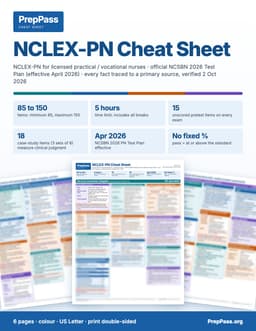
¿Examen en menos de dos semanas?
Esta guía es la enseñanza, para leer durante semanas. Si tu examen es en menos de dos semanas, la hoja de referencia a color imprimible es el otro producto: las cifras clave, por secciones.
6 páginas · US Letter · PDF imprimible · tuyo para siempre
Qué incluye — y qué no
Incluido
- All four NCSBN client-need categories at the published weights
- LPN/LVN scope vs RN, delegation, and 'initial vs. reinforce' traps
No incluido
- No se envía copia impresa — es un archivo que descargas y puedes imprimir tú
- El libro no incluye curso en vídeo, instructor ni tutorías — los vídeos gratis del sitio van aparte
Todo lo incluido y todo lo que no
Incluido
- Pharmacology: dose math, high-alert drugs, antidotes, hold parameters
- Safety & infection control, transfusion reactions, the 15-15 rule
- 55 original practice questions with answer explanations
- PDF (print & tab it) + EPUB (phone / e-reader)
No incluido
- No incluye tu inscripción al examen ni la tasa del centro, que sigues pagando al organismo oficial
Contenido
Ver 10 secciones y la página en la que empieza cada una
- Chapter 1 — Coordinated Carep. 11
- Chapter 2 — Safety and Infection Controlp. 20
- Chapter 3 — Health Promotion and Maintenancep. 26
- Chapter 4 — Psychosocial Integrityp. 32
- Chapter 5 — Physiological Integrityp. 38
- Chapter 6 — Pharmacology and Medication Administrationp. 45
- Practice Exam — 55 Questionsp. 53
- Answer Key — with explanationsp. 66
- Appendix A — Rapid-review cram sheetp. 73
- Appendix C — Glossary of key termsp. 81
Tomado del PDF que descargas, con la página en la que empieza cada uno — no escrito a mano aquí.
Lee un capítulo completo gratis
Un capítulo completo, tal como viene en el eBook. Desplázate en la ventana para leerlo aquí; sin descargas ni correo.
Lee el capítulo 6 aquí, sin salir de la página
No te dimos la introducción fácil — el capítulo gratis abre en una de las partes más exigentes del libro, para que juzgues la enseñanza donde el examen se pone difícil.
Introduction
Pharmacology carries more testable detail per page than any other area, and the LPN/LVN administers many medications, so the exam expects real competence: safe administration technique, correct routes, dosage calculation, monitoring parameters, and recognizing adverse reactions. Every dose calculation in this book has been recomputed; always recompute on the exam and double-check high-alert drugs.
You do not need to memorize a pharmacology textbook to do well here, but you do need a small set of high-yield anchors: the dose-calculation formula, the drugs that require a check before you give (digoxin and the apical pulse, potassium and the serum level, warfarin and the INR), the major antidotes (vitamin K, protamine, naloxone), the administration techniques the exam repeats (ventrogluteal for adult IM, no aspirate/no massage for subcutaneous heparin, do not crush enteric-coated tablets), and the difference between an expected side effect and a dangerous adverse reaction. Most pharmacology items reduce to one of those anchors. And underlying all of them is a single safety instinct: when something does not add up — an unfamiliar-looking pill, a dose that seems too high, a client concern — hold the medication and verify before you give it. You can always give a delayed dose; you cannot un-give a wrong one.
Principles of safe administration
- Apply the rights of administration. Confirm the right client, drug, dose, route, time — and document (many references add reason and response). Verify two identifiers first.
- Verify concerns before giving. If a client says a pill "looks different" or unfamiliar, hold it and verify the order and drug before administering. Never dismiss the concern.
- Calculate carefully. Use the core formula:
Desired ÷ Available × Quantity = amount to give.
Double-check high-alert calculations (insulin, heparin, opioids, pediatric doses) with a second nurse per policy.
- Use scored tablets correctly. Only scored tablets may be split to reach an ordered dose (such as 1.5 tablets); never split unscored, enteric-coated, or extended-release tablets.
Worked dose calculations (recomputed)
- Tablets. Order: 250 mg PO. Available: 125 mg per tablet. Desired ÷ Available × Quantity = 250 ÷ 125 × 1 = 2 tablets.
- Liquid. Order: 500 mg. Available: 250 mg per 5 mL. 500 ÷ 250 × 5 = 10 mL.
- Scored tablet. Order: 1.5 mg. Available: 1 mg scored tablets. 1.5 ÷ 1 × 1 = 1.5 tablets — permissible only because the tablet is scored.
- Weight-based. Order: 10 mg/kg for a 20 kg child. 10 × 20 = 200 mg total dose; then divide by the available concentration to find the volume.
A few habits keep dose math safe. Label your units and cancel them so the answer lands in the unit you want (mL, tablets, mg). Estimate before you compute: if the order is double the strength on hand, expect two of whatever the unit is — an answer of half a tablet for a double-strength order should make you stop and recheck. Question extreme answers: a calculation that tells you to give 15 tablets or 0.1 of a tablet is almost always a setup error, not a real order. And for high-alert drugs — insulin, heparin, opioids, chemotherapy, and pediatric doses — have a second nurse independently verify the calculation per policy, because these are the drugs where a decimal-point slip causes real harm.
Routes and techniques
- Intramuscular injections. The ventrogluteal site is preferred in adults because it avoids major nerves and vessels; the vastus lateralis is preferred for infants.
- Subcutaneous heparin. Inject at a 90-degree angle into the abdomen; do not aspirate and do not massage the site (reduces bruising and hematoma).
- Eye and ear drops. Place eye drops in the lower conjunctival sac (not on the cornea). For ear drops, pull the adult pinna up and back (down and back for a young child).
- Medications through feeding tubes. Verify placement, flush before and after each medication, and do not crush enteric-coated or extended-release tablets.
Monitoring parameters
Certain drugs require a specific check before or during administration — a favorite exam target.
| Drug / class | Check before/monitor | Hold or act if |
|---|---|---|
| Digoxin | Apical pulse for a full minute | Hold if adult apical rate < 60 bpm; report; watch for toxicity (nausea, visual halos) |
| Warfarin | PT / INR | High INR (e.g., 5.0) = bleeding risk; antidote = vitamin K |
| Heparin | aPTT | Antidote = protamine sulfate |
| Loop diuretics (furosemide) | Potassium | Causes hypokalemia; monitor and replace |
| Insulin (rapid-acting, lispro) | Food availability | Food within ~15 minutes of the dose |
| Potassium supplement | Serum potassium | Do not give if elevated (e.g., 5.8 mEq/L); never IV push — dilute and infuse slowly by pump |
| Aminoglycosides | Renal function, peak/trough | Nephrotoxic/ototoxic |
| Lithium | Lithium level, hydration | Narrow range; toxicity = vomiting, coarse tremor, confusion |
Reference ranges to know (verify against a current lab reference): serum potassium ~3.5–5.0 mEq/L; INR near 1.0 off anticoagulation (therapeutic target higher on warfarin). Blood products are infused with normal saline only, with two-nurse verification.
Two monitoring rules cause the most avoidable errors and are therefore tested hard. Digoxin: count the apical pulse for a full minute before every dose, and hold and report a rate below 60 in an adult; also watch for toxicity — nausea, vomiting, and visual disturbances such as yellow-green halos — especially when potassium is low, because hypokalemia potentiates digoxin. Potassium: it is a high-alert electrolyte that is never given by IV push under any circumstance — it must be diluted and infused slowly through a pump — and an oral or IV supplement is held when the serum level is already high (for example, 5.8 mEq/L). Confusing "the level is low, replace it" with "the level is high, hold it" is a classic trap; always read the value, not just the order.
Side effects and adverse reactions
- Opioid respiratory depression. For a respiratory rate of 8 with sedation, hold the opioid, stimulate the client, and notify the RN; the antidote is naloxone.
- Allergic reaction to an infusion. Itching, hives, and facial swelling mean stop the infusion and notify the RN — watch for anaphylaxis.
- ACE inhibitor cough. A persistent dry cough is a known effect; report it for a possible medication change.
- Expected vs. serious effects. Iron turns stools harmless dark/black; but metformin with muscle pain, weakness, and difficulty breathing may signal lactic acidosis — report. Teaching clients which effects are harmless and which are dangerous prevents both panic and delay.
The "expected versus serious" distinction is worth drilling because the wrong answer often treats a benign effect as an emergency or, worse, a true adverse reaction as nothing to worry about. Harmless, expected effects a client should be reassured about include iron's dark stools, the orange-red discoloration of urine and tears from rifampin, and mild drowsiness when starting some antihistamines. Effects that must be reported and acted on include a rash, hives, or facial swelling on any drug (possible allergy or anaphylaxis), a respiratory rate falling toward the single digits on an opioid, ringing in the ears or hearing changes on aminoglycosides or high-dose aspirin, and the muscle pain with breathlessness that can herald metformin-associated lactic acidosis. Teaching the client the specific warning signs to call about — rather than a vague "let us know if anything feels off" — is what turns a prescription into safe home use.
Client teaching and adherence
- Prevent acetaminophen toxicity. Do not exceed the maximum daily dose, and check combination products (many cold and pain remedies contain acetaminophen). [Confirm the current maximum daily limit against a drug reference — it has been revised over time.]
- Complete antibiotic courses. Finish the full prescription; do not save or share antibiotics (resistance).
- Teach correct timing. Take levothyroxine in the morning on an empty stomach; separate tetracyclines from dairy, antacids, and iron (they bind the drug).
- Do not stop certain drugs abruptly. Taper corticosteroids as directed to avoid adrenal insufficiency; do not stop beta-blockers or antiseizure drugs suddenly.
Key numbers & facts — Pharmacology
- Dose formula: Desired ÷ Available × Quantity. 250 mg ÷ 125 mg/tab = 2 tablets; 500 mg ÷ (250 mg/5 mL) = 10 mL.
- Digoxin: hold for apical pulse < 60 (full minute); toxicity = nausea, visual halos.
- Warfarin → PT/INR, antidote vitamin K; heparin → aPTT, antidote protamine.
- Potassium ~3.5–5.0 mEq/L; never IV push — dilute and infuse by pump; hold if elevated (e.g., 5.8).
- Furosemide → hypokalemia; monitor potassium.
- Rapid-acting insulin (lispro): food within ~15 min.
- Opioid RR 8 + sedation → hold, stimulate, notify; antidote naloxone.
- Ventrogluteal preferred IM site (adult); SubQ heparin — no aspirate, no massage.
- Levothyroxine: morning, empty stomach; separate tetracyclines from dairy/antacids.
- Iron = harmless dark stools; metformin + muscle pain/dyspnea = possible lactic acidosis (report).
- Blood = normal saline only, two-nurse check.
Worked example
Scenario. An order reads digoxin 0.125 mg PO daily. Before administering, you count the client's apical pulse for one full minute and get 52 beats per minute. What do you do: (a) give the dose as ordered; (b) give half the dose; (c) give the dose and recheck in an hour; (d) hold the dose and notify the RN? Reasoning. Digoxin is held when the adult apical pulse is below 60 bpm. A rate of 52 is below the threshold — hold and report. Answer: (d). Never "give half" a dose that is not ordered.
Scenario. Order: amoxicillin 500 mg PO. The pharmacy sends a suspension labeled 250 mg per 5 mL. How many mL do you give: (a) 5 mL; (b) 2.5 mL; (c) 10 mL; (d) 15 mL? Reasoning. Desired ÷ Available × Quantity = 500 ÷ 250 × 5 = 10 mL. Answer: (c).
Common exam traps
- Giving digoxin without counting the apical pulse for a full minute — or giving it when the rate is < 60.
- Aspirating or massaging a subcutaneous heparin site — do neither.
- Giving potassium IV push — always dilute and infuse slowly; never push.
- Crushing enteric-coated or extended-release tablets for a feeding tube.
- Mixing up antidotes — vitamin K for warfarin, protamine for heparin, naloxone for opioids.
- Miscalculating — always apply Desired ÷ Available × Quantity and double-check high-alert drugs.
Self-check
- Order 250 mg, tablets are 125 mg — how many tablets? (2.)
- Below what apical pulse do you hold digoxin in an adult? (60 bpm — count for a full minute.)
- Antidotes: warfarin, heparin, opioid? (Vitamin K; protamine sulfate; naloxone.)
- How is IV potassium given? (Diluted and infused slowly by pump — never IV push.)
- When is a client taught to take levothyroxine? (Morning, on an empty stomach.)
Preguntas frecuentes
¿Cómo lo recibo?
Paga y la descarga aparece en esta página al instante. Los enlaces también se te envían por correo. No hace falta cuenta.
¿Y si no es para mí?
Escríbenos dentro de 14 días para un reembolso total, sin preguntas.
¿Va a desaparecer la práctica gratis?
No. Todas las preguntas, el simulacro cronometrado y los capítulos gratis del sitio siguen gratis. Este libro es la mitad de estudio, no una valla alrededor de lo gratuito.
Más preguntas (1)
¿Puedo leerlo en el móvil?
Sí — el EPUB es para móviles y e-readers, el PDF para imprimir y marcar. Recibes ambos.
¿Por qué comprar el libro si la práctica es gratis?
Nuestras preguntas de práctica y el simulacro cronometrado siguen gratis: nada del sitio se esconde tras este libro. El libro de $14.99 es la mitad de estudio: el material en sí, explicado en orden, en un archivo tuyo.
- Enseñanza sistemática — cada sección del examen explicada capítulo a capítulo, de principio a fin, no solo preguntas
- Imprímelo y márcalo — un PDF listo para papel que puedes resaltar, anotar y llevar a tu mesa de estudio
- Estudia en cualquier lugar, sin conexión — EPUB en tu teléfono o e-reader; sin wifi, sin pestañas
- Todo en un solo lugar — los capítulos y las preguntas de práctica en un archivo
- Tuyo de por vida — pago único de $14.99, descarga instantánea, sin suscripción
Los detalles
- Verificado con la fuente oficial(NCSBN PN test plan / standard nursing pharmacology & lab references / CDC)
- 400 preguntas de práctica gratis
Un NCLEX review course cuesta $200–$800. Este libro enseña el mismo examen — las mismas reglas, verificadas a los estándares actuales — por un pago único de $14.99 que conservas de por vida.
Compra única, acceso de por vida a la descarga. El eBook es la guía completa de NCLEX-PN en PDF y EPUB. Resumen educativo, no asesoría profesional ni legal — confirma siempre las reglas vigentes con la fuente oficial.