NCLEX-RN Nursing Licensure · Edición 2026
NCLEX-RN Exam — Complete Study Guide (2026)
All 8 client-needs categories, weighted like the NCSBN test plan — with the CAT scoring explained honestly (no fake pass %).
- Los 7 capítulos de necesidades del cliente en un PDF + EPUB que conservas
- 120 preguntas de práctica, cada una con su justificación completa, dentro del libro
- Cifras y valores clínicos clave, un ejemplo resuelto, trampas nombradas y autoevaluación en cada uno de los 7 capítulos
$19.99pago único · descarga de por vida · sin suscripción
PDF + EPUB · en inglés · 105 páginas · $19.99 pago único
Este libro está escrito en inglés — el PDF y el EPUB que descargas están en inglés.
Descarga inmediata tras el pago — sin cuenta y sin suscripción.
Garantía de devolución de 14 días: ¿no te convence por cualquier motivo? Escribe a support@preppass.org en los 14 días siguientes a la compra y te devolvemos el importe completo. Es una descarga, así que no hay nada que devolver por correo. Política de reembolso
Datos del examen verificados por última vez con fuentes oficiales: septiembre de 2026.
Prueba primero 10 preguntas — gratis
Responde las 10, y al terminar verás cada respuesta explicada — con la sección de esta guía que la enseña. Unos 5 minutos, sin registro.
Empezar 10 preguntas gratisMira dentro del libro
Tres páginas reales, renderizadas directamente del PDF que descargas — una página de referencia, una de explicación y una pregunta resuelta, siempre en ese orden. Nada se rediseñó para verse mejor.
- Referencia rápidaAnswer Key & Explanations · Página 103 del PDF
Una página a la que puedes volver: cifras, plazos o términos reunidos en un solo lugar.
- Cómo se enseñaAnswer Key & Explanations · Página 94 del PDF
Una página de explicación: el material enseñado en prosa, en el orden en que lo evalúa el examen.
- Cómo se enseñaAnswer Key & Explanations · Página 97 del PDF
Una página de explicación: el material enseñado en prosa, en el orden en que lo evalúa el examen.
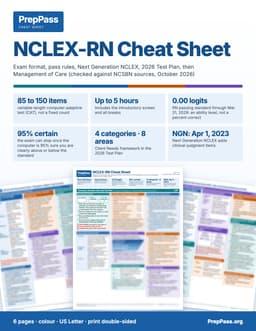
¿Examen en menos de dos semanas?
Esta guía es la enseñanza, para leer durante semanas. Si tu examen es en menos de dos semanas, la hoja de referencia a color imprimible es el otro producto: las cifras clave, por secciones.
6 páginas · US Letter · PDF imprimible · tuyo para siempre
Sobre el examen en sí
| Organismo administrador | National Council of State Boards of Nursing, Inc. (NCSBN) — examen administrado por Pearson VUE Fuente: NCSBN — 2026 NCLEX Examination Candidate Bulletin (PDF, April 2026) |
|---|---|
| Preguntas | 85–150 preguntas Fuente: NCSBN — NCLEX-RN® Test Plan, effective April 2026 (PDF) |
| Tiempo límite | 300 minutos Fuente: NCSBN — 2026 NCLEX Examination Candidate Bulletin (PDF, April 2026) |
| Puntuación para aprobar | Solo aprobado o reprobado — sin puntaje de corte fijo Fuente: NCSBN — Passing Standard (NCLEX-RN 0.00 logits, effective through March 31, 2029) |
| Tarifas |
Fuente: NCSBN — 2026 NCLEX Examination Candidate Bulletin (PDF, April 2026) |
| Idiomas disponibles | Inglés · Francés Fuente: NCSBN — NCLEX Frequently Asked Questions (“How is the NCLEX translated?”) |
Preguntas de práctica y capítulos gratis de NCLEX-RN Nursing Licensure →
Qué incluye — y qué no
Incluido
- All 7 client-needs chapters, weighted like the NCSBN test plan
- Prioritization (ABC / Maslow), delegation, and safety frameworks
- Labs, fluid & electrolytes, acid-base, and high-alert medications
- How the variable-length CAT is scored — no fake “X% to pass”
- 120 original practice questions with answer explanations
- PDF (print & tab it) + EPUB (phone / e-reader)
No incluido
- No se envía copia impresa — es un archivo que descargas y puedes imprimir tú
- El libro no incluye curso en vídeo, instructor ni tutorías — los vídeos gratis del sitio van aparte
- No incluye tu inscripción al examen ni la tasa del centro, que sigues pagando al organismo oficial
Contenido
Ver 2 secciones y la página en la que empieza cada una
- Practice Questionsp. 67
- Answer Key & Explanationsp. 93
Tomado del PDF que descargas, con la página en la que empieza cada uno — no escrito a mano aquí.
Lee un capítulo completo gratis
Un capítulo completo, tal como viene en el eBook. Desplázate en la ventana para leerlo aquí; sin descargas ni correo.
Lee el capítulo 6 aquí, sin salir de la página
No te dimos la introducción fácil — el capítulo gratis abre en una de las partes más exigentes del libro, para que juzgues la enseñanza donde el examen se pone difícil.
Introduction
Pharmacological and Parenteral Therapies is tied for the second-largest content area, and it tests safe medication administration end to end: applying the rights of medication administration, calculating doses accurately, monitoring the labs and vital signs specific to each drug class, recognizing adverse effects and toxicity, and handling high-alert parenteral therapies without a fatal error. It is a high-stakes category because a medication mistake reaches the client directly, which is exactly why the exam layers so many safety checks into it.
The category has a memorization core — which lab monitors which anticoagulant, which vital sign holds which cardiac drug, which electrolyte a loop diuretic depletes — but it rewards reasoning about mechanism. If you know why a loop diuretic wastes potassium, you don't have to memorize that furosemide causes hypokalemia; it follows. If you know why ACE inhibitors cause a dry cough (bradykinin accumulation), the teaching point is obvious. Throughout this chapter the numbers and rules are paired with their mechanism so the knowledge holds under pressure.
Above all, this category is about high-alert discipline. Certain drugs — insulin, heparin, IV potassium, blood products, digoxin, lithium — cause disproportionate harm when given wrong, so they carry extra rules: independent double-checks, holding parameters, dilution and slow infusion, and level monitoring for narrow-therapeutic-range drugs. The recurring correct answer is the cautious one: verify, double-check, hold and notify, and never take a shortcut with a high-alert drug.
Key concepts
| Item | Rule | Why it matters |
|---|---|---|
| Rights of administration | Right client, drug, dose, route, time, documentation | The core safety checklist |
| Documented allergy | Hold the drug and notify the prescriber | A hard contraindication |
| Dose calculation | Desired ÷ available × quantity | Prevents under/overdose |
| High-alert double-check | Second nurse verifies insulin, heparin, pediatric doses, blood | Catches lethal errors |
| Warfarin monitoring | PT / INR; reversed by vitamin K | Wrong lab = wrong drug |
| Heparin monitoring | aPTT; reversed by protamine sulfate | Distinguish from warfarin |
| Digoxin | Hold for apical pulse < 60; watch for toxicity | Further slows the heart |
| Loop diuretic (furosemide) | Causes hypokalemia — monitor potassium | Dysrhythmia risk |
| Aminoglycosides | Monitor renal function + peak/trough | Nephrotoxic/ototoxic |
| Lithium | Narrow range — vomiting, coarse tremor, confusion = toxicity | Level monitoring + hydration |
| IV potassium | Never IV push; dilute, infuse slowly via pump | Rapid push can be fatal |
| Rapid-acting insulin (lispro) | Food within ~15 minutes | Prevents hypoglycemia |
| Blood products | Infuse with normal saline only, verify with second nurse | Prevents reaction |
Safe medication administration
Every administration runs through the rights of medication administration — verify the right client, drug, dose, route, time, and documentation (many programs add right reason and right response). Client identity is confirmed with two identifiers before any drug. These checks feel routine precisely so that they catch the non-routine error — the look-alike drug name, the transposed dose, the wrong client.
Allergies are a hard stop. When the client has a documented allergy to a drug, the nurse holds the medication and notifies the prescriber to clarify or change the order — you do not give a smaller "test" dose, do not pre-medicate with an antihistamine and give it anyway, and do not give it and "monitor closely." A documented allergy is a contraindication, and overriding it risks a life-threatening reaction. This is one of the most reliable right answers in the category: allergy → hold and notify.
Documentation is immediate and truthful: record administration promptly after giving the drug, and never chart a medication before it is given. Charting ahead of administration is both a veracity violation (Chapter 1) and a setup for a real error if the dose is then missed or changed. Right checks, allergy discipline, honest and timely documentation — this is the safety spine the rest of the category hangs on.
Dosage calculation
Accurate calculation prevents both underdosing and overdosing, and the workhorse method is desired over available: divide the ordered (desired) dose by the dose on hand and multiply by the quantity the dose comes in. If 250 mg is ordered and the pharmacy supplies 125 mg tablets, then 250 ÷ 125 = 2 tablets. Set the problem up the same way every time and the arithmetic becomes routine.
Two safety habits protect the calculation. Convert units before you calculate — make sure everything is in the same units (mg to mg, not mg to g) — because a unit mismatch is how a tenfold error sneaks in. And double-check high-alert drugs: have a second nurse independently verify insulin, heparin, and pediatric doses, where a small error does large harm. Independent verification means the second nurse calculates without being told your answer.
Finally, question any dose that seems off. A calculation that requires an unusual number of tablets or vials, or a dose that seems far too high, is a signal to stop and re-verify rather than proceed. The professional instinct the exam is cultivating is that a strange-looking answer is probably a wrong answer — recheck the math and the order before the drug reaches the client.
Drug classes and monitoring
Each drug class has signature parameters, and the anticoagulants are the most tested pair. Warfarin is monitored with the PT and INR and reversed by vitamin K; heparin is monitored with the aPTT and reversed by protamine sulfate. Keep the pairs straight — using aPTT for warfarin, or giving vitamin K for a heparin overdose, are classic wrong answers. So for a client bleeding on IV heparin with a very high aPTT, the antidote is protamine sulfate, not vitamin K (that's for warfarin) and not naloxone (that's for opioids).
Cardiac drugs have holding parameters tied to vital signs. Hold digoxin for an apical heart rate below 60 beats/minute in an adult, because digoxin further slows the heart and bradycardia may signal toxicity — so an apical rate of 52 means hold and notify, while a normal blood pressure, respiratory rate, or temperature would not. Before a beta-blocker such as metoprolol, check the apical heart rate and blood pressure, since beta-blockers lower both and the dose is held for significant bradycardia or hypotension per parameters.
Two more classes round out the section. Loop diuretics such as furosemide promote potassium excretion and cause hypokalemia — monitor potassium and watch for muscle weakness and dysrhythmias (not hyperkalemia, hypernatremia, or hypercalcemia). And aminoglycoside antibiotics are nephrotoxic and ototoxic, so monitor renal function and peak-and-trough drug levels to keep the drug in its safe window. Each rule is really a mechanism: the diuretic dumps potassium, the aminoglycoside stresses the kidney, so those are what you watch.
Adverse effects and toxicity
Recognizing trouble early prevents harm, and several drugs have hallmark warnings. Opioids (such as morphine) can cause respiratory depression and sedation, so assess respiratory rate and level of sedation before and after administration, and start a bowel regimen (stool softener, fluids, fiber) to prevent the constipation opioids reliably cause — withholding fluids or fiber is the wrong direction. Lithium has a narrow therapeutic range, and vomiting, coarse tremors, and confusion signal toxicity, requiring level monitoring and adequate hydration; these are not "normal side effects to ignore."
ACE inhibitors commonly cause a persistent dry cough (from bradykinin accumulation) that clients should be taught to report, while angioedema, though rare, is an emergency. Corticosteroids taken long term must be tapered, never stopped abruptly, to prevent adrenal insufficiency — they are taken with food, and blood glucose is monitored because steroids raise it. So "stop when symptoms improve" and "take on an empty stomach" are wrong for long-term steroids.
A few other teaching points recur. Phenytoin causes gingival hyperplasia, so meticulous oral hygiene is taught; doses are never skipped, and a rash is reported because it may signal a serious reaction. The pattern across the section is that each drug carries a specific, mechanism-based warning — respiratory rate for opioids, tremor and confusion for lithium, cough for ACE inhibitors, taper for steroids, gum care for phenytoin — and the exam tests whether you can attach the right warning to the right drug.
Parenteral and high-alert therapies
Parenteral therapy is where the highest-alert rules live, and IV potassium is the headline: never give potassium by IV push. It must be diluted and infused slowly with an infusion pump, because rapid IV administration can cause fatal cardiac arrest; cardiac monitoring is maintained during the infusion. "Undiluted for faster effect" and "rapid IV push" are dangerous, always-wrong answers. This is the single most important safety rule in the chapter.
Insulin and blood products carry their own timing and verification rules. Rapid-acting insulin such as lispro begins working within about 15 minutes, so ensure the client has food available within roughly 15 minutes of the injection to prevent hypoglycemia — two hours later is far too long. Blood products are infused with normal saline only (never dextrose or another solution) and are verified by a second qualified nurse for client and product before hanging, with baseline vital signs taken first.
Finally, food-and-drug interactions get specific teaching. Clients on MAOIs must avoid tyramine-rich foods — aged cheese and cured meats — which can trigger a hypertensive crisis; fresh fruit, rice, and steamed vegetables are safe. Clients on tetracycline must separate the dose from dairy and antacids, because the calcium in them binds the drug and blocks absorption (and doses are never doubled when missed). Across parenteral and high-alert therapy, the through-line is the same as the whole category: dilute, verify, time correctly, teach the interaction, and never shortcut a high-alert drug.
Key numbers & clinical values
- Hold digoxin for an apical pulse < 60 beats/minute.
- Rapid-acting insulin (lispro) — ensure food within ~15 minutes.
- Dose calculation — desired ÷ available × quantity (e.g., 250 mg ÷ 125 mg/tab = 2 tablets).
- Warfarin → PT/INR (reverse with vitamin K); heparin → aPTT (reverse with protamine sulfate).
- Loop diuretic (furosemide) → hypokalemia (monitor potassium; normal potassium ~3.5–5.0 mEq/L, see Chapter 7).
- Aminoglycosides — monitor renal function + peak/trough.
- IV potassium — never IV push; dilute and infuse slowly via pump.
- Blood products — normal saline only, second-nurse verification.
- Lithium — narrow range; vomiting, coarse tremor, confusion = toxicity.
Worked example
Scenario. You are about to give digoxin and find an apical heart rate of 52 beats/minute. What do you do? Reasoning. Hold digoxin for an apical rate below 60 — it further slows the heart and bradycardia may signal toxicity — and notify the provider. A normal BP, respiratory rate, or temperature would not stop the dose. Hold and notify.
Scenario. A client on IV heparin has an aPTT far above range and is bleeding. Which antidote? Reasoning. Heparin is reversed by protamine sulfate. Vitamin K reverses warfarin; naloxone reverses opioids. Give protamine sulfate.
Common exam traps
- Swapping the anticoagulant labs/antidotes. Warfarin = PT/INR + vitamin K; heparin = aPTT + protamine. Don't cross them.
- Giving a drug despite a documented allergy. Always hold and notify — no test dose, no "give and monitor."
- IV push potassium. Never — dilute and infuse slowly via pump.
- Expecting hyperkalemia from a loop diuretic. Furosemide causes hypokalemia.
- Stopping long-term steroids abruptly. Taper to avoid adrenal insufficiency; take with food.
- Charting a med before giving it. Document promptly after administration, never before.
Self-check
- What is the antidote for heparin, and how is heparin monitored? (Protamine sulfate; monitored by aPTT.)
- Below what apical heart rate do you hold digoxin? (Below 60 beats per minute.)
- Order: 250 mg; supply: 125 mg tablets. How many tablets? (Two tablets — desired ÷ available.)
- Which electrolyte imbalance does furosemide cause? (Hypokalemia.)
- Can IV potassium be given by IV push? (No — never; it must be diluted and infused slowly via pump.)
Antes de comprar
- ¿Cómo lo recibo?
- Paga y la descarga aparece en esta página al instante. Los enlaces también se te envían por correo. No hace falta cuenta.
- ¿Y si no es para mí?
- Escríbenos dentro de 14 días para un reembolso total, sin preguntas.
- ¿Va a desaparecer la práctica gratis?
- No. Todas las preguntas, el simulacro cronometrado y los capítulos gratis del sitio siguen gratis. Este libro es la mitad de estudio, no una valla alrededor de lo gratuito.
- ¿Puedo leerlo en el móvil?
- Sí — el EPUB es para móviles y e-readers, el PDF para imprimir y marcar. Recibes ambos.
Los detalles
All 8 client-needs categories, weighted like the NCSBN test plan — with the CAT scoring explained honestly (no fake pass %).
- Format: PDF + EPUB download · 105 pages
- 120 practice questions in the book, with a full answer key
- 400 free practice questions for this exam on PrepPass, included at no cost
- $19.99 one-time — no subscription
- 14-day money-back guarantee · refund policy
- Cross-referenced against: NCSBN NCLEX-RN Test Plan
- Last updated: August 2026
- Verificado con la fuente oficial(NCSBN NCLEX-RN Test Plan)
- 400 preguntas de práctica gratis
- Descarga instantánea, tuyo de por vida
Un NCLEX review course cuesta $200–$800. Este libro enseña el mismo examen — las mismas reglas, verificadas a los estándares actuales — por un pago único de $19.99 que conservas de por vida.
¿Por qué comprar el libro si la práctica es gratis?
Nuestras preguntas de práctica y el simulacro cronometrado siguen gratis: nada del sitio se esconde tras este libro. El libro de $19.99 es la mitad de estudio: el material en sí, explicado en orden, en un archivo tuyo.
- Enseñanza sistemática — cada sección del examen explicada capítulo a capítulo, de principio a fin, no solo preguntas
- Imprímelo y márcalo — un PDF listo para papel que puedes resaltar, anotar y llevar a tu mesa de estudio
- Estudia en cualquier lugar, sin conexión — EPUB en tu teléfono o e-reader; sin wifi, sin pestañas
- Todo en un solo lugar — los capítulos y las preguntas de práctica en un archivo
- Tuyo de por vida — pago único de $19.99, descarga instantánea, sin suscripción
Y sin riesgo: Garantía de reembolso de 14 días — ¿no te convence? Escríbenos para un reembolso total, sin preguntas. Consulta la política de reembolso.
Garantía de reembolso de 14 días · reembolso total, sin preguntas.
Compra única, acceso de por vida a la descarga. El eBook es la guía completa de NCLEX-RN Nursing Licensure en PDF y EPUB. Resumen educativo, no asesoría profesional ni legal — confirma siempre las reglas vigentes con la fuente oficial. Última actualización: August 2026.