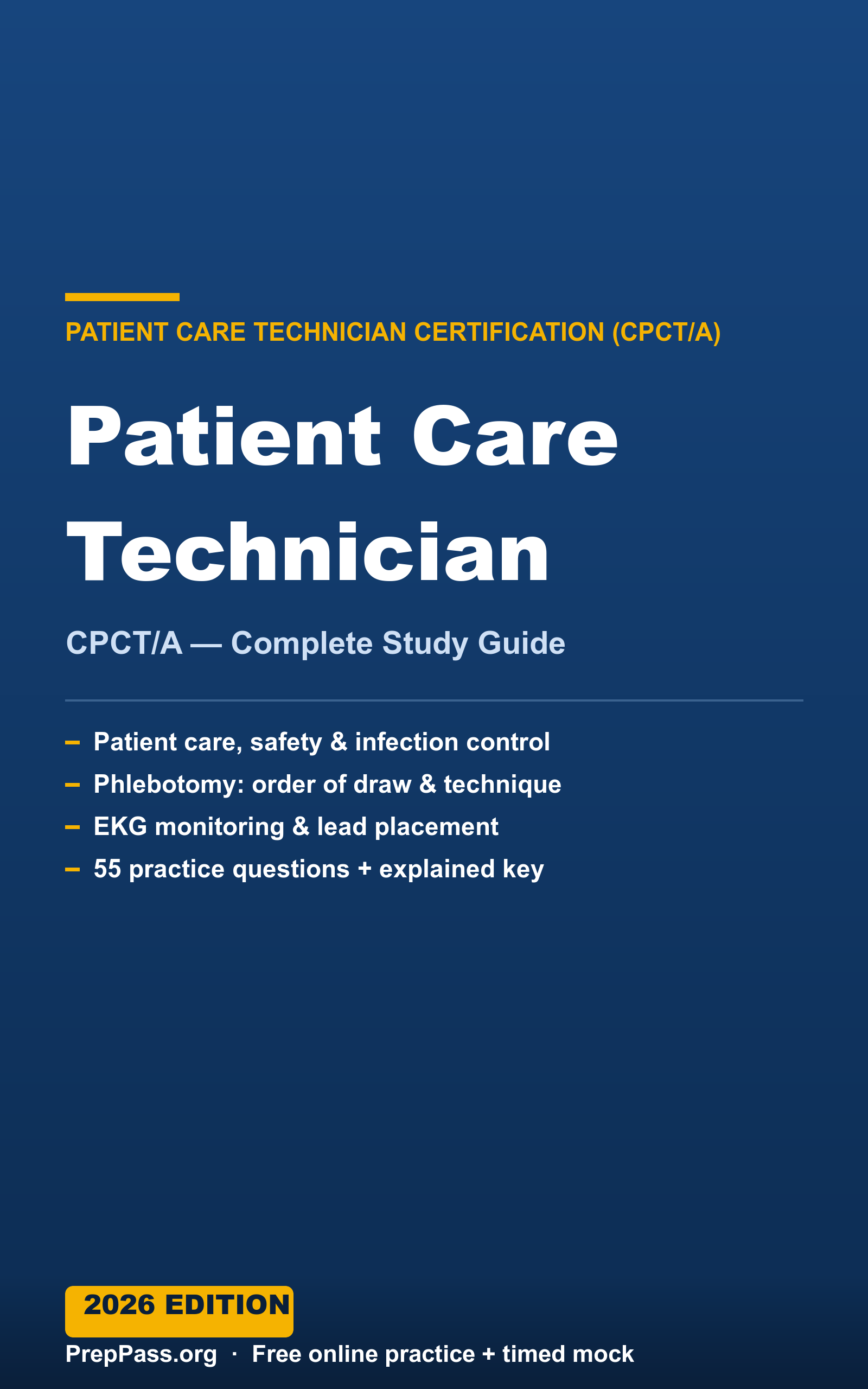
Patient Care Technician (CPCT/A) — Complete Study Guide (2026)
Patient care, safety and infection control, phlebotomy, and EKG monitoring for the CPCT/A-style certification — the CNA + phlebotomy + EKG skills in one guide.
Ten el libro completo — PDF + EPUB
Las preguntas de práctica y el simulacro siguen gratis. El libro es la mitad de estudio:
- Enseñado capítulo a capítulo — cada sección explicada en orden, no solo preguntas
- Imprímelo y márcalo — una referencia en papel para subrayar y anotar
- Funciona sin conexión — PDF para imprimir, EPUB para el móvil o e-reader
- Todo en un archivo — capítulos, resúmenes y preguntas de práctica juntos
Garantía de devolución de 14 días — ¿no te convence? Escríbenos y te reembolsamos el 100%, sin preguntas. Política de reembolso
El Capítulo 1 es gratis en esta página — pruébalo antes de comprar. Un solo pago desbloquea el libro completo (PDF + EPUB, preguntas con explicaciones, resúmenes por capítulo).
Descarga instantánea PDF + EPUB · pago único, tuyo para siempre · sin suscripción · garantía de reembolso de 14 días · ¿aún lo dudas? lee el Capítulo 1 gratis abajo.
El capítulo inicial completo — el mismo texto del eBook. Desplázate en la ventana para leerlo aquí; sin descargas ni correo.
Patient care is everything you do at the bedside: measuring vital signs, moving people safely, keeping skin intact, feeding and toileting, tracking fluids, and helping patients regain independence. It is the largest slice of the test because it is the largest slice of the job. The unifying skill here is recognizing normal versus abnormal, then reporting. A patient care technician measures, observes, and reports; the nurse and provider interpret and treat. Your job is to get an accurate number, know instantly whether it is inside or outside the expected range, and pass anything out of range up the chain. Learn the normal adult values cold — a large share of this section simply asks whether a value or a technique is inside or outside them.
1.1 Vital Signs and Normal Adult Ranges
Vital signs are the objective baseline measurements taken at nearly every encounter: temperature, pulse, respirations, and blood pressure, with pulse oximetry and pain frequently added. They are called "vital" because they track the body's most basic functions, and a value outside the expected range is often the first sign that something is wrong. You are responsible for measuring them precisely and recording them clearly — and for noticing an out-of-range value and flagging it. You are not responsible for diagnosing what it means.
Pulse (heart rate). The normal adult resting pulse is 60 to 100 beats per minute. Below 60 is bradycardia; above 100 is tachycardia. Technique is tested as often as the number. Count a regular radial pulse for 30 seconds and multiply by two, but count an irregular pulse for a full 60 seconds so you do not miss beats. The radial artery at the wrist is the routine adult site. When the rhythm is irregular, the apical pulse — heard with a stethoscope at the fifth intercostal space, left midclavicular line — is the most accurate site and is counted for a full minute.
Respirations. The normal adult rate is 12 to 20 breaths per minute, where one respiration is one full inhalation plus one exhalation. The most tested point is technique: count respirations without telling the patient, because awareness of being watched changes the breathing pattern. The classic method is to keep your fingers on the wrist as if still taking the pulse and count the rise and fall of the chest.
Temperature. The traditional average adult oral temperature is 98.6°F (37°C), with a normal range of roughly 97.0°F to 99.0°F. The route matters and must be charted with the reading, because the sites are not interchangeable — a rectal reading runs about a degree higher than oral, and an axillary (armpit) reading about a degree lower.
Blood pressure. Under current ACC/AHA categories, normal is less than 120/80 mmHg. The systolic number (the first sound) is charted over the diastolic (the last sound) — always systolic/diastolic, never averaged into one number and never reversed. Cuff size is a favorite trap: a cuff that is too small falsely raises the reading; a cuff that is too large falsely lowers it.
Orthostatic (postural) blood pressure is checked to detect the dizziness of position change. Measure the blood pressure and pulse with the patient lying down, then again after the patient sits or stands, and compare. A drop of about 20 mmHg systolic or 10 mmHg diastolic on standing suggests orthostatic hypotension — a fall risk you report before the patient walks.
Pulse oximetry. Normal oxygen saturation (SpO₂) on room air is 95% to 100%. A reading in the low 90s or below warrants prompt notification after you confirm the probe placement, because nail polish, cold fingers, and poor perfusion all produce falsely low readings. Confirm the probe first, then report a genuine low value at once.
Pain is often called the "fifth vital sign." It is subjective — you record what the patient rates it, typically on a 0-to-10 scale, in the patient's own terms, without judging whether the number seems too high or too low.
1.2 Positioning, Mobility, and Transfers
Moving a patient safely protects the patient from a fall and protects you from a back injury that can end a career. Plan the move before you start, tell the patient what you are going to do, and count out loud so you move together.
Know the positions. Supine is flat on the back, face up. Prone is face-down. Lateral is side-lying. Fowler's positions are sitting up: High-Fowler's raises the head of the bed 60 to 90 degrees and is the position of choice for a patient with difficulty breathing, because it lets the chest expand fully. Sims' (left side-lying with the upper knee drawn up) is used for enemas and rectal care.
Use a gait belt. Apply it snugly around the waist over clothing, with room for a few fingers underneath, before transferring or ambulating a weight-bearing patient. Never place it under the arms, around the neck, or around the thighs — those placements can restrict breathing or cause serious injury.
Assistive devices. A cane is held on the strong side, opposite the weak leg, and the cane and the weak leg advance together so the cane shares the load. Position a wheelchair for transfer on the patient's stronger side and lock the brakes.
Dangle before ambulating. A patient who has been on bed rest sits on the edge of the bed and dangles the legs for a few minutes before standing, letting the circulation adjust so they do not become dizzy from orthostatic hypotension.
Range of motion. Perform passive range-of-motion exercises — where you move the joint for a patient who cannot move it independently — slowly through the normal range, stopping at pain or resistance, to prevent contractures. Never force a joint past resistance.
If a patient starts to fall, do not try to hold them upright. Using the gait belt, ease them slowly to the floor or into a nearby chair, protect the head, and stay with them. If a walking patient reports dizziness, lower them to a safe position and stay; do not leave to fetch help while they stand.
1.3 Hygiene, Skin, and Pressure-Injury Prevention
Skin is the body's first defense, and keeping it intact is one of the technician's most important preventive jobs. Immobile patients are the ones at risk, and small daily habits prevent large wounds.
Reposition at least every 2 hours. Turn and reposition immobile patients at least every 2 hours to relieve pressure over bony prominences — the sacrum, heels, and hips. In the lateral position, pad the hip (greater trochanter), shoulder, and ankles. Prevention beats any dressing.
Recognize a Stage 1 pressure injury. Intact skin with non-blanchable redness (redness that does not turn white when pressed) over a bony area is a Stage 1 pressure injury. Report it and relieve the pressure immediately. Higher stages involve open skin loss — into the dermis (Stage 2), into fat (Stage 3), or down to muscle, tendon, or bone (Stage 4).
Perineal care moves front to back. On a female patient, cleanse from front to back, away from the urethra, using a clean section of cloth for each stroke so you do not move bacteria toward the urinary opening.
Oral care for the unconscious patient. Turn the patient to a side-lying position with the head turned to the side so fluid drains out of the mouth rather than into the airway, and use only small amounts of fluid. This is an aspiration-prevention rule, not just a comfort measure.
Check bath-water temperature. Comfortably warm bath water is about 100–105°F; check it with a thermometer or your inner wrist before the patient enters to prevent scald burns.
1.4 Nutrition, Elimination, and Intake & Output
Tracking what goes in and what comes out is a core measuring task, and feeding a patient safely is a core safety task.
Intake versus output. Intake includes oral fluids, IV fluids, and foods that are liquid at room temperature (gelatin, ice cream). Output includes urine, emesis (vomit), liquid stool, and drainage. The trap is that IV fluids and gelatin are intake, while only fluid leaving the body is output.
Convert household measures. For I&O math, 1 ounce ≈ 30 mL and 1 cup (8 oz) ≈ 240 mL. So 4 ounces of water is 4 × 30 = 120 mL. Learn the 30-mL-per-ounce conversion cold, because the arithmetic questions all hinge on it.
Feed dysphagia patients upright. A patient with dysphagia (difficulty swallowing) — including a stroke patient with one-sided weakness — eats sitting fully upright at about 90 degrees, with food placed on the stronger side of the mouth, and stays upright for at least 30 minutes after eating. Lying flat, tilting the head back, or rushing all raise the risk of aspiration.
Honor NPO orders strictly. NPO means nothing by mouth — no food, no fluids, and no ice chips. If an NPO patient asks for water, you withhold it, explain why, and report the request to the nurse. Do not "just give a little water" or offer ice.
Prevent catheter infection. Keep the urinary drainage bag below the level of the bladder and off the floor to prevent urine from flowing back toward the bladder, which would carry bacteria with it.
1.5 Restorative Care and Activities of Daily Living
Restorative care promotes the patient's highest possible level of independence. The guiding rule is to let patients do as much of their own self-care as they safely can, rather than doing everything for them "to save time" — doing too much fosters dependence and weakness.
Support normal elimination. Within the technician's role, encourage fluids, fiber-rich foods, and activity as allowed to relieve constipation and support normal bowel function. Restricting fluids or enforcing bed rest works against normal elimination.
Measure daily weights consistently. Weigh the patient at the same time each day, ideally before breakfast, in similar clothing, on the same scale. Consistency is what makes a day-to-day weight trend meaningful for tracking fluid status.
Make the occupied bed safely. Raise the bed to hip height to protect your back, keep the far side rail up while turning the patient, and return the bed to its lowest position when finished.
Key Numbers & Facts — Chapter 1 (memorize cold)
| Item | Value / rule |
|---|---|
| Pulse (adult resting) | 60–100 bpm; <60 bradycardia, >100 tachycardia |
| Pulse counting | Regular: 30 s ×2; irregular: full 60 s |
| Apical pulse site | 5th intercostal space, left midclavicular line |
| Respirations (adult) | 12–20/min; count without telling the patient |
| Oral temp (adult) | Avg 98.6°F (37°C); rectal ~1° higher, axillary ~1° lower |
| BP normal | < 120/80 mmHg |
| Cuff too small / too large | Falsely high / falsely low |
| Orthostatic drop | ≥20 mmHg systolic or ≥10 mmHg diastolic on standing |
| SpO₂ normal | 95–100% on room air |
| Difficulty breathing → position | High-Fowler's (60–90°) |
| Gait belt | Waist, over clothing; never neck/arms/thighs |
| Cane | Held on the strong side; advances with the weak leg |
| Reposition to prevent pressure injury | At least every 2 hours |
| Stage 1 pressure injury | Intact skin, non-blanchable redness |
| Perineal care (female) | Front to back, away from the urethra |
| Unconscious oral care | Side-lying, head turned |
| I&O conversion | 1 oz ≈ 30 mL |
| Output = | Urine, emesis, liquid stool, drainage (not IV fluids/gelatin) |
| NPO | Nothing by mouth — including ice chips |
| Urinary drainage bag | Below the bladder, off the floor |
| Dysphagia feeding | Upright 90°, food on strong side, upright 30 min after |
| Daily weight | Same time (before breakfast), same scale, similar clothing |
Clinical Walkthrough — A Morning Round
You start a resting adult patient's vitals. The radial pulse is 78 and regular, so you count 30 seconds and double it; 78 is inside 60–100, normal. Respirations are 16 — normal — and you count them without announcing it, keeping your hand on the wrist. SpO₂ reads 97% on room air: normal. The patient mentions feeling "woozy when I stand," so before letting them walk you check orthostatic pressures — lying, then standing — and note whether the systolic falls 20 or more. The patient is scheduled for a procedure and marked NPO; when they ask for water you explain the order and tell the nurse, rather than offering ice. Before you leave you reposition them off the sacrum — it has been nearly two hours — and lower the bed. Nothing here required a diagnosis. Every action was measure, recognize normal-versus-abnormal, protect, and report: the whole job of patient care in one round.
Exam Traps — Chapter 1
- The irregular-pulse shortcut trap. You may count a regular pulse for 30 seconds, but an irregular pulse must be counted for a full minute. "30 seconds ×2" for an irregular rhythm is wrong.
- The cuff-size trap. Too-small cuff → falsely high; too-large cuff → falsely low. Test-writers love to flip these.
- The output trap. IV fluids and gelatin are intake. Only fluid leaving the body (urine, emesis, liquid stool, drainage) is output.
- The NPO "just water/ice" trap. NPO means nothing by mouth — ice chips count. Withhold and report.
- The "hold the patient up" trap. During a fall, ease the patient to the floor; never try to hold them upright or leave them standing to get help.
- The perineal-direction trap. Always front to back on a female patient. "Back to front" carries bacteria to the urethra and is wrong.
- The restorative-care trap. The goal is independence. An option that does everything for the patient "to save time" is wrong.
Qué incluye el eBook
¿Por qué comprar el libro si la práctica es gratis?
Nuestras preguntas de práctica y el simulacro cronometrado siguen gratis: nada del sitio se esconde tras este libro. El libro de $9.99 es la mitad de estudio: el material en sí, explicado en orden, en un archivo tuyo.
- Enseñanza sistemática — cada sección del examen explicada capítulo a capítulo, de principio a fin, no solo preguntas
- Imprímelo y márcalo — un PDF listo para papel que puedes resaltar, anotar y llevar a tu mesa de estudio
- Estudia en cualquier lugar, sin conexión — EPUB en tu teléfono o e-reader; sin wifi, sin pestañas
- Todo en un solo lugar — capítulos, resúmenes por capítulo y preguntas de práctica en un archivo
- Tuyo de por vida — pago único de $9.99, descarga instantánea, sin suscripción
Y sin riesgo: Garantía de reembolso de 14 días — ¿no te convence? Escríbenos para un reembolso total, sin preguntas. Consulta la política de reembolso.
Garantía de reembolso de 14 días · reembolso total, sin preguntas.
Compra única, acceso de por vida a la descarga. El eBook es la guía completa de Patient Care Technician (CPCT/A) en PDF y EPUB. Resumen educativo, no asesoría profesional ni legal — confirma siempre las reglas vigentes con la fuente oficial. Última actualización: August 2026.