Guía de estudio · Edición 2026
PMP Study Guide — 2026 Edition (July 2026 exam)
Written task by task to PMI's PMP Examination Content Outline.
Edición: New for 2026: written to PMI's July 2026 PMP exam — 180 questions, 240 min, People 33/Process 41/Business Env 26
- Extensión
- 234 páginas
- Preguntas de práctica en el libro
- 301
- Datos del examen verificados
- septiembre de 2026
- Archivo actualizado
- octubre de 2026
- Entrega
- PDF + EPUB · en inglés · descarga inmediata
Sobre este libro
Written task by task to PMI's PMP Examination Content Outline – July 2026: People 33%, Process 41%, Business Environment 26%. 301 original questions and a full 180-question practice exam.
Datos del examen, a quién le sirve y qué cambió
Sobre el examen en sí
| Organismo administrador | Project Management Institute (PMI) Fuente: PMI — Project Management Professional (PMP)® Examination Content Outline – July 2026 (PDF) |
|---|---|
| Preguntas | 180 preguntas Fuente: PMI — Project Management Professional (PMP)® Certification page (About the Exam; price; eligibility) |
| Tiempo límite | 240 minutos Fuente: PMI — Project Management Professional (PMP)® Certification page (About the Exam; price; eligibility) |
| Puntuación para aprobar | No publicado por PMI Lo que leímos y donde no aparece: PMI — Project Management Professional (PMP)® Certification page (About the Exam; price; eligibility) |
| Tarifas |
Fuente: PMI — Project Management Professional (PMP)® Certification page (About the Exam; price; eligibility) |
| Idiomas disponibles | Inglés · Árabe · Portugués (Brasil) · Chino simplificado · Chino tradicional · Francés · Alemán · Indonesio · Italiano · Japonés · Coreano · Polaco · Ruso · Español · Turco Fuente: PMI — Project Management Professional (PMP)® Certification page (About the Exam; price; eligibility) |
Mira dentro del libro
Tres páginas reales, renderizadas directamente del PDF que descargas — una página de referencia, una de explicación y una pregunta resuelta, siempre en ese orden. Nada se rediseñó para verse mejor.
- Referencia rápidaChapter 7 — Business Environment, Part 2: Risk, Improvement, Organizational Change and the External Environment (Domain III, Tasks 5–8) · Página 202 del PDF
Una página a la que puedes volver: cifras, plazos o términos reunidos en un solo lugar.
- Cómo se enseñaChapter 6 — Business Environment, Part 1: Governance, Compliance, Change and Issues (Domain III, Tasks 1–4) · Página 128 del PDF
Una página de explicación: el material enseñado en prosa, en el orden en que lo evalúa el examen.
- Una pregunta resueltaChapter 7 — Business Environment, Part 2: Risk, Improvement, Organizational Change and the External Environment (Domain III, Tasks 5–8) · Página 184 del PDF
Una pregunta de práctica con su respuesta y el razonamiento detrás — no solo la clave.
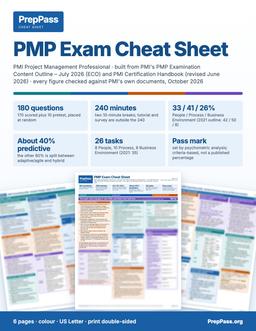
¿Examen en menos de dos semanas?
Esta guía es la enseñanza, para leer durante semanas. Si tu examen es en menos de dos semanas, la hoja de referencia a color imprimible es el otro producto: las cifras clave, por secciones.
6 páginas · US Letter · PDF imprimible · tuyo para siempre
Qué incluye — y qué no
Incluido
- All 26 tasks of the July 2026 outline in 7 chapters, domain by domain
- A "What's new for 2026" section: the new weights, 240 minutes, 10 pretest items and the rebuilt task list
No incluido
- No se envía copia impresa — es un archivo que descargas y puedes imprimir tú
- El libro no incluye curso en vídeo, instructor ni tutorías — los vídeos gratis del sitio van aparte
Todo lo incluido y todo lo que no
Incluido
- A full 180-question practice exam weighted People 33 / Process 41 / Business Environment 26
- 301 original questions, each with a worked explanation citing its source
- A quick reference: earned value and schedule formulas, risk responses, contract types and the decision rules the exam rewards
- PDF + EPUB you keep
No incluido
- No incluye tu inscripción al examen ni la tasa del centro, que sigues pagando al organismo oficial
Contenido
Ver 9 secciones y la página en la que empieza cada una
- Chapter 1 — People, Part 1: Vision, Conflict, Leadership and Stakeholder Engagement (Domain I, Tasks 1–4)p. 14
- Chapter 2 — People, Part 2: Expectations, Knowledge Transfer and Communication (Domain I, Tasks 5–8)p. 34
- Chapter 3 — Process, Part 1: Integrated Planning, Scope and Value-Based Delivery (Domain II, Tasks 1–3)p. 51
- Chapter 4 — Process, Part 2: Resources, Procurement and Finance (Domain II, Tasks 4–6)p. 71
- Chapter 5 — Process, Part 3: Quality, Schedule, Status and Closure (Domain II, Tasks 7–10)p. 92
- Chapter 6 — Business Environment, Part 1: Governance, Compliance, Change and Issues (Domain III, Tasks 1–4)p. 112
- Chapter 7 — Business Environment, Part 2: Risk, Improvement, Organizational Change and the External Environment (Domain III, Tasks 5–8)p. 131
- Appendix A — The exam at a glance, in one tablep. 225
- Appendix B — Terms the exam expects you to use preciselyp. 228
Tomado del PDF que descargas, con la página en la que empieza cada uno — no escrito a mano aquí.
Lee un capítulo completo gratis
Un capítulo completo, tal como viene en el eBook. Desplázate en la ventana para leerlo aquí; sin descargas ni correo.
Lee el capítulo 4 aquí, sin salir de la página
No te dimos la introducción fácil — el capítulo gratis abre en una de las partes más exigentes del libro, para que juzgues la enseñanza donde el examen se pone difícil.
This chapter covers the three Process tasks that deal with what the project consumes: people and physical resources, goods and services bought from outside, and money. "Plan and manage finance" is a task of its own in the July 2026 outline[1]; in 2021, budget and resources shared one task. The finance task is also where most of the exam's arithmetic lives — earned value, forecasts and reserves — so the chapter works through the numbers step by step.
Task 4 — Plan and manage resources
The enablers are: define and plan resources based on requirements; and manage and optimize resource needs and availability[1].
Define and plan resources based on requirements
Resources are people (skills, roles, headcount), equipment, materials, facilities and services. Planning them starts from the scope: each work package or backlog item implies skills and quantities. Useful structures:
- A resource breakdown structure — "a hierarchical representation of resources by category and type"[2].
- A responsibility assignment matrix — "a grid that shows the project resources assigned to each work package"[2] (the RACI chart from Chapter 1 is one form).
- An organizational breakdown structure — which organizational units perform which activities[2].
- A resource calendar — "the working days and shifts during which each specific resource is available"[2].
These come together in the resource management plan, which "describes how project resources are acquired, allocated, monitored, and controlled"[2].
Organizational structure changes what the project manager can do. In a functional organization, "the project manager has limited authority to assign work and apply resources"[2]; in a matrix, authority is shared with functional managers[2]; in a projectized organization, "the project manager has full authority to assign work and apply resources"[2]. In a matrix or functional setting, getting the right person often means negotiating with the functional manager — with evidence of what the project needs and when.
In adaptive teams, resource planning looks different: stable, cross-functional teams are formed and the work flows to them. The question becomes "does the team have the skills to finish backlog items to the definition of done?" rather than "which named person does task 3.2.1?"
Manage and optimize resource needs and availability
Plans meet reality: people are over-allocated, equipment arrives late, a key specialist is pulled onto another project. Two schedule techniques address over-allocation:
- Resource leveling adjusts the schedule to fit resource limits and "may affect the critical path"[2] — the finish date can move.
- Resource smoothing uses "free and total float ... without affecting the critical path"[2] — the finish date does not move, but not every peak can be removed.
Other responses: acquire additional resources, re-sequence work, use a vendor, cross-train team members, or negotiate priorities across projects with the portfolio or functional managers. For physical resources, just-in-time delivery reduces storage cost but raises the risk of delay.
Worked example. A database specialist is scheduled at 150% for three weeks on activities that have float. Smoothing — delaying some of her activities within their float — removes the overload without moving the finish date. If her overloaded activities were on the critical path, only leveling (which may push the finish date), adding capacity, or re-scoping would solve it.
Exam trap — leveling versus smoothing. If a question says the end date must not move, the answer is smoothing (or adding resources). If resource limits are absolute and the date can move, it is leveling.
Task 5 — Plan and manage procurement
The enablers are: plan procurement; execute a procurement management plan; select preferred contract types; evaluate vendor performance; verify objectives of the procurement agreement are met; participate in agreement negotiations; determine a negotiation strategy; manage suppliers and contracts; plan and manage the procurement strategy; and develop a delivery solution[1]. PMI describes the PMBOK® Guide – Eighth Edition as giving "Expanded coverage of AI, PMOs, and procurement"[3], and procurement has more enablers than any other Process task.
Plan procurement and the procurement strategy
Procurement begins with a make-or-buy decision: "whether particular work can be best accomplished by the project team or if it should be purchased from outside sources"[2]. Consider capability, capacity, cost (including total cost of ownership — "the direct and indirect costs of a product or service"[2]), risk, control, intellectual property and schedule.
The decisions are recorded in:
- The procurement management plan — "how a team will acquire goods and services from outside of the performing organization"[2].
- A sourcing strategy plan — "which elements of the project will be insourced, outsourced, or both"[2].
- A statement of work for each purchase — "a narrative description of products, services, or results to be delivered"[2].
Many organizations — and every government — have procurement policies the project must follow: who may sign, competitive bidding thresholds, approved-vendor lists. Those are organizational process assets and compliance requirements, not suggestions.
Select preferred contract types — who carries the cost risk
Contract type decides who absorbs the cost if the work costs more than expected. The U.S. Federal Acquisition Regulation is a good public source for how contract types allocate risk.
Fixed-price family — the seller carries most of the cost risk.
- Firm-fixed-price (FFP): "the buyer pays the seller a set amount ... regardless of the seller's costs"[2]. The FAR says it "places upon the contractor maximum risk and full responsibility for all costs and resulting profit or loss"[4] and should be used "when the risk involved is minimal or can be predicted with an acceptable degree of certainty"[4]. Best when scope is well defined.
- Fixed-price incentive fee (FPIF): a set amount plus an additional amount if defined performance criteria are met[2]; under the FAR the final price is adjusted by a formula and "is subject to a price ceiling, negotiated at the outset"[4].
- Fixed price with economic price adjustment (FP-EPA): allows "predefined final adjustments to the contract price due to changed conditions such as inflation"[2] — used for long contracts exposed to commodity or currency swings.
Cost-reimbursable family — the buyer carries most of the cost risk.
- Cost-reimbursable: "payment to the seller for the seller's actual costs, plus a fee typically representing the seller's profit"[2]; the FAR: "payment of allowable incurred costs, to the extent prescribed in the contract"[4]. Used when scope is uncertain — research, development, early design.
- Cost plus fixed fee (CPFF): allowable costs plus a fixed fee[2]. The FAR notes it "provides the contractor only a minimum incentive to control costs"[4].
- Cost plus incentive fee (CPIF): the fee is "adjusted later by a formula based on the relationship of total allowable costs to total target costs"[4] — the seller shares in savings or overruns.
- Cost plus award fee (CPAF): an award amount based on "a judgmental evaluation ... sufficient to provide motivation for excellence in contract performance"[4].
Time and materials (T&M) — PMI calls it "a hybrid contractual arrangement containing aspects of both cost-reimbursable and fixed-price contracts"[2]: fixed hourly rates, open quantity. The FAR allows it "only when it is not possible at the time of placing the contract to estimate accurately the extent or duration of the work"[4], and warns that it "provides no positive profit incentive to the contractor for cost control or labor efficiency"[4], so the buyer must monitor it closely. It also cautions against "protracted use of a cost-reimbursement or time-and-materials contract after experience provides a basis for firmer pricing"[4].
| Scope definition | Typical contract choice | Cost risk sits mostly with |
|---|---|---|
| Clear, stable, well defined | Firm-fixed-price | Seller |
| Clear but long, with volatile input prices | Fixed price with economic price adjustment | Shared by formula |
| Clear, and performance can be rewarded | Fixed-price incentive fee | Mostly seller, up to a ceiling |
| Uncertain, research or development | Cost-reimbursable (CPFF, CPIF, CPAF) | Buyer |
| Unknown quantity, need to start now | Time and materials | Buyer |
Agile contracting. Fixed-price, fixed-scope contracts fit poorly with changing requirements. The GAO says acquisition strategies "should reflect contracts that are flexible enough to allow for lower-level requirements to be refined over time"[5]. Common patterns: fixed price per iteration or per increment with a variable backlog; a capped time-and-materials engagement; a fixed-price contract with a change mechanism that lets the product owner swap backlog items of equal size. The GAO also notes that "While a contract cannot be modified without a contracting officer's authority, the product owner should be empowered to prioritize the detailed requirements within the scope of the product vision"[5]. The Agile Manifesto's "Customer collaboration over contract negotiation"[6] does not mean no contract; it means the contract should support collaboration rather than replace it.
Participate in negotiations; determine a negotiation strategy
The project manager often supports rather than leads contract negotiation — the contracting or procurement officer holds the authority. The project manager contributes knowledge of scope, risks, priorities and acceptable trade-offs. A negotiation strategy sets objectives (must-haves, nice-to-haves), the walk-away position, who speaks for the buyer, and what information to share. Good negotiations aim at an agreement both parties can perform; a contract that bankrupts the seller is a project risk.
Execute the procurement plan; manage suppliers and contracts
Execution means soliciting, evaluating and selecting sellers against published criteria, awarding the contract, and then administering it: tracking deliverables and payments, managing contract changes through the agreed contract change process, and keeping records. Only people with contracting authority can change a contract. A project manager who verbally approves extra work from a vendor has created a claim, not a change.
Evaluate vendor performance; verify agreement objectives are met
Vendor performance is evaluated against the contract — deliverables, quality, schedule, service levels — using inspections, reviews, audits and performance reports. Before closing a contract, verify that its objectives were met: all deliverables accepted, obligations fulfilled, open claims resolved, final payment made, records archived.
Develop a delivery solution
"Develop a delivery solution"[1] sits at the end of the procurement enablers. It asks the project manager to shape how bought goods and services will be integrated into what the project delivers — for example combining a vendor's platform with in-house configuration and a phased rollout — rather than treating each purchase in isolation.
Worked example. A city needs a vendor to build a permit portal. Requirements will evolve with user research. A firm-fixed-price contract for "the complete portal" would force the vendor to price uncertainty in, or to fight every change. A better structure might be a fixed price per two-week increment with a product owner on the city side prioritizing a backlog, plus clear acceptance criteria and a definition of done — flexible scope inside controlled cost per increment.
Exam trap — the handshake change. When a vendor says "your team lead asked us to add this," the right answer is not to pay because the work is done. Contract changes follow the contract's change process and are approved by someone with contracting authority.
Task 6 — Plan and manage finance
The enablers are: analyze project financial needs; quantify risk and contingency financial allocations; plan spend tracking throughout the project life cycle; plan financial reporting; anticipate future finance challenges; monitor financial variations and work with the governance process; and manage financial reserves[1].
Analyze project financial needs
Estimate what the project will cost and when the money will be needed. Estimates become more accurate as the project progresses:
- A rough order of magnitude (ROM) estimate is "an initial estimate of the cost of a project or parts of a project, with a rough accuracy range"[2].
- Analogous estimating uses "historical data from a similar activity or project"[2] — fast, less accurate.
- Parametric estimating uses "an algorithm ... based on historical data and project parameters"[2] (for example cost per square meter).
- Bottom-up estimating aggregates "the estimates of the lower-level components of the work breakdown structure"[2] — slow, most accurate.
A financial management plan "describes how finances will be planned, structured, and controlled"[2]. Funding timing matters as much as the total: a project can be within budget and still stall because cash arrives after invoices are due.
Quantify risk and contingency allocations; manage reserves
PMI distinguishes two reserves:
- Contingency reserve: "time or money allocated in the schedule or cost baseline for known risks with active response strategies"[2]. It is inside the cost baseline and usually controlled by the project manager.
- Management reserve: "time or money that management sets aside in addition to the schedule or cost baseline and releases for unforeseen work that is within the scope"[2]. It is outside the cost baseline; using it normally requires management approval and a baseline change.
That gives the budget stack:
- Cost baseline — "the approved version of the time-phased project budget, excluding any management reserves"[2] = work package estimates + contingency reserves.
- Project budget — "the sum of work package cost estimates, contingency reserve, and management reserve"[2].
Quantifying reserves is a risk exercise: expected monetary value ("the estimated value of an outcome expressed in monetary terms"[2]), commonly probability × impact summed across risks, or simulation. Reserve analysis is "a method used to evaluate the amount of risk on the project and the amount of schedule and budget reserve to determine whether the reserve is sufficient for the remaining risk"[2]; it is repeated as risks close or appear.
Terminology trap. Other organizations use these words differently. The GAO's cost guide, for example, notes that it uses "contingency" and "management reserve" in its own senses and that "other organizations may use the terms differently"[7]. On the PMP, use PMI's definitions above.
Plan spend tracking and financial reporting
Decide at the start how spending will be captured (from finance systems, timesheets, invoices), at what level (control accounts — "a management control point where scope, budget, actual cost, and schedule are integrated and compared to earned value"[2]), how often, and who receives what. An S-curve — "a graph that displays cumulative costs over a specific time period"[2] — is the classic picture of planned versus actual spend.
Earned value management
Earned value management "combines scope, schedule, cost, and resource measurements to assess project performance and progress"[2]. Its inputs:
- BAC, budget at completion: "the sum of all budgets established for the work to be performed"[2].
- PV, planned value: "the authorized budget assigned to scheduled work"[2].
- EV, earned value: "the measure of work performed expressed in terms of the budget authorized for that work"[2]. In practice, BAC × percent complete for the work measured.
- AC, actual cost: "the realized cost incurred for the work performed"[2].
The measures (EV is always first):
| Measure | Formula | Reading | Source |
|---|---|---|---|
| Cost variance | CV = EV − AC | Negative = over budget | [2] |
| Schedule variance | SV = EV − PV | Negative = behind schedule | [2] |
| Cost performance index | CPI = EV ÷ AC | Below 1.0 = work cost more than planned | [2, 7] |
| Schedule performance index | SPI = EV ÷ PV | Below 1.0 = less work done than planned | [2, 7] |
| Estimate at completion | EAC = AC + ETC; if current cost efficiency continues, EAC = BAC ÷ CPI | Expected total cost | [2, 7] |
| Estimate to complete | ETC = EAC − AC | Money still needed | [2] |
| Variance at completion | VAC = BAC − EAC | Negative = projected overrun | [2, 7] |
| To-complete performance index | TCPI = (BAC − EV) ÷ (BAC − AC) to hit BAC, or (BAC − EV) ÷ (EAC − AC) to hit EAC | Efficiency needed on the remaining work | [2] |
The GAO's general forecasting formula is "EAC = ACWP (cumulative) + (BAC – BCWP (cumulative)) / efficiency index"[7] — in PMI terms, EAC = AC + (BAC − EV) ÷ efficiency index. Using CPI as the index gives EAC = AC + (BAC − EV) ÷ CPI, which simplifies to BAC ÷ CPI. If the remaining work will be done at the planned rate instead (a one-time problem that will not recur), the index is 1 and EAC = AC + (BAC − EV).
Worked example. BAC = $200,000. At month 4 the plan called for 50% complete; the team is 40% complete and has spent $95,000.
- PV = 0.50 × 200,000 = $100,000. EV = 0.40 × 200,000 = $80,000. AC = $95,000.
- CV = 80,000 − 95,000 = −$15,000 (over budget). SV = 80,000 − 100,000 = −$20,000 (behind schedule).
- CPI = 80,000 ÷ 95,000 ≈ 0.84. SPI = 80,000 ÷ 100,000 = 0.80.
- EAC (current efficiency continues) = 200,000 ÷ 0.84 ≈ $237,500. ETC ≈ 237,500 − 95,000 = $142,500. VAC ≈ 200,000 − 237,500 = −$37,500.
- TCPI to finish on the original budget = (200,000 − 80,000) ÷ (200,000 − 95,000) = 120,000 ÷ 105,000 ≈ 1.14.
A TCPI of 1.14 against a CPI of 0.84 says the team would have to become far more efficient than it has been. The GAO's rule of thumb: "if the TCPI is more than 5 percentage points higher than the CPI, the EAC is too optimistic"[7]. It also notes that "once a program is 20 percent complete, the cumulative CPI does not vary much from its value"[7] — early cost trouble rarely fixes itself.
Two more facts that trip candidates:
- A negative schedule variance disappears at completion: "A negative schedule variance eventually disappears when the full scope of work is completed because at this point the amount of work accomplished is equal to the amount of work planned"[7]. So late in a project, SV understates a schedule problem; check the critical path.
- Variances are signals to investigate, not verdicts: "An unfavorable CPI—one less than 1.0—may indicate that work is being performed less efficiently or that material is costing more than planned"[7] — or that costs were booked wrongly.
Sources cited in this excerpt
- Project Management Professional (PMP) Examination Content Outline – July 2026 (July 2026 PMP Certification Exam Update). Project Management Institute (PMI), 2026-07. https://www.pmi.org/-/media/pmi/documents/public/pdf/certifications/new-pmp-examination-content-outline-2026.pdf
- PMI Lexicon of Project Management Terms, Version 5.0 (last updated January 2026). Project Management Institute (PMI), 2026-01. https://www.pmi.org/-/media/pmi/documents/registered/pdf/pmbok-standards/pmi-lexicon-pm-terms.pdf
- PMBOK® Guide – Eighth Edition (product overview page). Project Management Institute (PMI), 2026-09-24. https://www.pmi.org/standards/pmbok
- Federal Acquisition Regulation Part 16 – Types of Contracts (FAC 2026-01, effective 03/13/2026). U.S. General Services Administration, Acquisition.gov, 2026-03-13. https://www.acquisition.gov/far/part-16
- GAO-20-590G Agile Assessment Guide: Best Practices for Agile Adoption and Implementation. U.S. Government Accountability Office, 2020-09. https://www.gao.gov/assets/gao-20-590g.pdf
- Manifesto for Agile Software Development. agilemanifesto.org, 2001. https://agilemanifesto.org/
- GAO-20-195G Cost Estimating and Assessment Guide: Best Practices for Developing and Managing Program Costs. U.S. Government Accountability Office, 2020-03. https://www.gao.gov/assets/gao-20-195g.pdf
Preguntas frecuentes
¿Cómo lo recibo?
Paga y la descarga aparece en esta página al instante. Los enlaces también se te envían por correo. No hace falta cuenta.
¿Y si no es para mí?
Escríbenos dentro de 14 días para un reembolso total, sin preguntas.
¿Va a desaparecer la práctica gratis?
No. Todas las preguntas, el simulacro cronometrado y los capítulos gratis del sitio siguen gratis. Este libro es la mitad de estudio, no una valla alrededor de lo gratuito.
Más preguntas (1)
¿Puedo leerlo en el móvil?
Sí — el EPUB es para móviles y e-readers, el PDF para imprimir y marcar. Recibes ambos.
¿Por qué comprar el libro si la práctica es gratis?
Nuestras preguntas de práctica y el simulacro cronometrado siguen gratis: nada del sitio se esconde tras este libro. El libro de $19.99 es la mitad de estudio: el material en sí, explicado en orden, en un archivo tuyo.
- Enseñanza sistemática — cada sección del examen explicada capítulo a capítulo, de principio a fin, no solo preguntas
- Imprímelo y márcalo — un PDF listo para papel que puedes resaltar, anotar y llevar a tu mesa de estudio
- Estudia en cualquier lugar, sin conexión — EPUB en tu teléfono o e-reader; sin wifi, sin pestañas
- Todo en un solo lugar — los capítulos y las preguntas de práctica en un archivo
- Tuyo de por vida — pago único de $19.99, descarga instantánea, sin suscripción
Los detalles
- Verificado con la fuente oficial(PMI's PMP Examination Content Outline – July 2026 and PMI Certification Handbook (June 2026), read 2026-09-24; not PMBOK)
- 407 preguntas de práctica gratis
Un PMP boot camp cuesta $999–$2,447. Este libro enseña el mismo examen — las mismas reglas, verificadas a los estándares actuales — por un pago único de $19.99 que conservas de por vida.
Compra única, acceso de por vida a la descarga. El eBook es la guía completa de PMP (Project Management Professional) en PDF y EPUB. Resumen educativo, no asesoría profesional ni legal — confirma siempre las reglas vigentes con la fuente oficial. Última actualización: October 2026.