Guía de estudio · Edición 2026
PTCB Pharmacy Technician (PTCE) — Complete Study Guide (2026)
Medications, Patient Safety, Order Entry, and Federal Requirements — with pharmacy-math worked examples and DEA/USP references.
Edición: New for 2026: weighted to the PTCE Content Outline effective January 6, 2026.
- Extensión
- 461 páginas
- Preguntas de práctica en el libro
- 522
- Simulacro en línea de PrepPass
- 90 preguntas · 110 min
- Datos del examen verificados
- septiembre de 2026
- Archivo actualizado
- octubre de 2026
- Entrega
- PDF + EPUB · en inglés · descarga inmediata
Sobre este libro
Tarifa de solicitud CPhT y examen PTCE: $129 por intento, que se paga a PTCB. Repetir el examen vuelve a costarlo. Esta guía: $19.99, pago único.
Datos del examen, a quién le sirve y qué cambió
Sobre el examen en sí
| Organismo administrador | Pharmacy Technician Certification Board (PTCB) — examen administrado por Pearson VUE Fuente: PTCB — Become a Certified Pharmacy Technician (CPhT) |
|---|---|
| Preguntas | 90 preguntas (80 calificadas, 10 de prueba sin calificar) Fuente: PTCB — Become a Certified Pharmacy Technician (CPhT) |
| Tiempo límite | 110 minutos Fuente: PTCB — Become a Certified Pharmacy Technician (CPhT) |
| Puntuación para aprobar | Puntuación escalada de 1,400 en una escala de 1,000–1,600 Fuente: PTCB — Become a Certified Pharmacy Technician (CPhT) |
| Tarifas |
|
| Idiomas disponibles | No publicado por PTCB Lo que leímos y donde no aparece: PTCB — Become a Certified Pharmacy Technician (CPhT) |
Mira dentro del libro
Tres páginas reales, renderizadas directamente del PDF que descargas — una página de referencia, una de explicación y una pregunta resuelta, siempre en ese orden. Nada se rediseñó para verse mejor.
- Referencia rápidaGlossary · Página 452 del PDF
Una página a la que puedes volver: cifras, plazos o términos reunidos en un solo lugar.
- Cómo se enseñaPart III — Domain Practice Sets · Página 358 del PDF
Una página de explicación: el material enseñado en prosa, en el orden en que lo evalúa el examen.
- Una pregunta resueltaPart III — Domain Practice Sets · Página 345 del PDF
Una pregunta de práctica con su respuesta y el razonamiento detrás — no solo la clave.
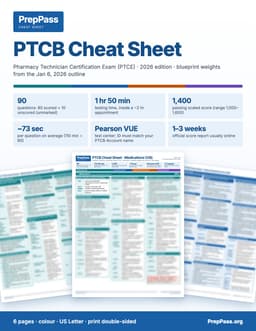
¿Examen en menos de dos semanas?
Esta guía es la enseñanza, para leer durante semanas. Si tu examen es en menos de dos semanas, la hoja de referencia a color imprimible es el otro producto: las cifras clave, por secciones.
6 páginas · US Letter · PDF imprimible · tuyo para siempre
Qué incluye — y qué no
Incluido
- All 4 knowledge domains, weighted like the outline effective January 2026 (Medications 35%, Federal Requirements 18.75%)
- Pharmacy math worked step by step (days supply, IV rate, alligation, ratio strength)
No incluido
- No se envía copia impresa — es un archivo que descargas y puedes imprimir tú
- El libro no incluye curso en vídeo, instructor ni tutorías — los vídeos gratis del sitio van aparte
Todo lo incluido y todo lo que no
Incluido
- DEA schedules, refill rules, and required forms (222/224/106/41)
- USP <795>/<797>/<800> storage, garbing, and compounding rules
- 522 original practice questions in all: three 90-question practice exams weighted to the outline plus domain practice sets, every answer explained
- Exam review, not an introduction: it assumes pharmacy training or work experience and basic arithmetic; it also summarises PTCB's eligibility, fee and retake rules
- PDF (print & tab it) + EPUB (phone / e-reader)
No incluido
- No incluye tu inscripción al examen ni la tasa del centro, que sigues pagando al organismo oficial
Contenido
Ver 6 secciones y la página en la que empieza cada una
- Part II — Full-Length Practice Examsp. 222
- Practice Exam 1 — Answer Key and Explanationsp. 223
- Practice Exam 2 — Answer Key and Explanationsp. 262
- Practice Exam 3 — Answer Key and Explanationsp. 302
- Part III — Domain Practice Setsp. 340
- Glossaryp. 452
Tomado del PDF que descargas, con la página en la que empieza cada uno — no escrito a mano aquí.
Lee un capítulo completo gratis
Un capítulo completo, tal como viene en el eBook. Desplázate en la ventana para leerlo aquí; sin descargas ni correo.
Lee el capítulo 4 aquí, sin salir de la página
The free chapter is Chapter 4, Order Entry and Processing: the pharmacy math, worked step by step, and a fair sample of the book's pace. Chapter 1 (drug names and classes) is denser reference.
Introduction — the most improvable domain on the exam
This is the chapter where the arithmetic lives, and arithmetic is the one part of the PTCE you can reliably move from weak to strong in a fortnight. The reason is structural: the exam changes the numbers, not the methods. There are perhaps twenty genuinely different calculation skills in pharmacy practice. Once you can do each one without looking anything up, a new question is a new set of digits in a shape you already recognise.
Three rules before any of it.
Write the units down and carry them through. Most wrong answers in pharmacy maths are not arithmetic failures — they are unit failures. Milligrams got divided by millilitres and nobody noticed. If your units cancel to the unit the question asked for, you are probably right; if they do not, you are certainly wrong.
Convert before you calculate. Pounds to kilograms, teaspoonfuls to millilitres, grams to milligrams — do all of it first, in a separate line, before any division happens.
Sanity-check the size of the answer. A child's dose that came out larger than an adult's, an infusion that will finish in four minutes, a days supply of 900 — these are not close calls. Ask whether the number could be true before you write it down.
And one rule that is about safety rather than arithmetic: a calculation that produces a surprising number is escalated, not trusted. If you work a dose and it looks wrong, you do not adjust it to look right. You take it to the pharmacist.
4.1a Sig codes and prescription abbreviations
Reading a sig
A prescriber compresses directions into abbreviations, most of them from Latin. The technician's job is to expand them into plain patient language stating how much, by what route, how often, and for what, written at a reading level the patient can actually use.
| Category | Code | Meaning |
|---|---|---|
| Frequency | QD / q.d. | once daily — banned abbreviation, spell out "daily" |
BID | twice daily | |
TID | three times daily | |
QID | four times daily | |
QAM | every morning | |
QPM | every evening | |
QHS | at bedtime | |
q4h, q6h, q8h, q12h | every 4, 6, 8, 12 hours | |
QOD | every other day — banned, spell out | |
TIW | three times a week — banned, write "3 times weekly" | |
PRN | as needed | |
STAT | immediately | |
| Route | PO | by mouth |
SL | sublingual | |
PR | per rectum | |
IV / IM / SUBQ | intravenous / intramuscular / subcutaneous | |
OD / OS / OU | right eye / left eye / each eye — banned, spell out | |
AD / AS / AU | right ear / left ear / each ear — banned, spell out | |
NGT | nasogastric tube | |
| Quantity and form | tab / cap | tablet / capsule |
gtt | drop | |
tsp / tbsp | teaspoonful (5 mL) / tablespoonful (15 mL) | |
ss | one half | |
ut dict / UD | as directed | |
aa | of each | |
q.s. | a sufficient quantity | |
q.s. ad | add a sufficient quantity to make | |
| Timing and condition | AC | before meals |
PC | after meals | |
HS | at bedtime | |
NPO | nothing by mouth | |
disp | dispense | |
sig | write on the label |
Worked expansion
The sig i tab PO BID PRN pain, disp #20 expands to:
i tab— one tabletPO— by mouthBID— twice dailyPRN pain— as needed for paindisp #20— dispense 20 tablets
The patient label reads: "Take one tablet by mouth twice daily as needed for pain." Not "1 tab PO BID PRN," and not "take as directed" — the patient has to be able to follow it.
Roman numerals
Quantities and doses still appear in Roman numerals, and misreading one is a quantity error.
| Symbol | Value |
|---|---|
ss | ½ |
i / I | 1 |
v / V | 5 |
x / X | 10 |
l / L | 50 |
c / C | 100 |
d / D | 500 |
m / M | 1,000 |
The rule: a smaller numeral after a larger one is added; a smaller numeral before a larger one is subtracted. So XXX is 30, XL is 40, LX is 60, XC is 90, CX is 110, and iss is 1½.
The wrong turn: reading XL as 60 instead of 40, or XC as 110 instead of 90. Whenever a smaller symbol sits to the left, subtract.
Medical terminology and symbols
A handful of terms and symbols recur in orders and profiles:
| Term or symbol | Meaning |
|---|---|
Rx | prescription, "recipe" |
℞ only | prescription-only (legend) product |
c̄ | with |
s̄ | without |
> / < | greater than / less than |
↑ / ↓ | increase / decrease |
Δ | change |
@ | at — avoid in orders; mistaken for "2" |
HTN | hypertension |
DM | diabetes mellitus |
CHF | congestive heart failure |
COPD | chronic obstructive pulmonary disease |
GERD | gastro-oesophageal reflux disease |
UTI | urinary tract infection |
URI | upper respiratory infection |
RA | rheumatoid arthritis |
CKD | chronic kidney disease |
NKDA | no known drug allergies |
hypo- / hyper- | below normal / above normal |
-itis | inflammation |
-emia | in the blood |
-algia | pain |
brady- / tachy- | slow / fast |
### Key numbers & deadlines — reading orders 5 mL per teaspoonful. 15 mL per tablespoonful. These two conversions appear in more days-supply questions than any others. Banned in orders:
U,IU,QD,QOD,cc,µg,MS,D/C,TIW,SC/SQ, and the eye/ear abbreviations. Roman numerals: smaller before larger subtracts.XL= 40, not 60.iss= 1½. The patient label is written in plain language, never in the prescriber's shorthand.
4.1b The conversions everything else rests on
The metric ladder
Every metric conversion in pharmacy is a factor of 1,000, and every error is a decimal point that moved the wrong number of places.
| From | To | Multiply by |
|---|---|---|
| kilogram (kg) | gram (g) | 1,000 |
| gram (g) | milligram (mg) | 1,000 |
| milligram (mg) | microgram (mcg) | 1,000 |
| litre (L) | millilitre (mL) | 1,000 |
Worked example — grams to milligrams.
An order calls for 0.25 g of a drug. The stock is labelled in milligrams. - Step 1. Identify the factor: g → mg is × 1,000. - Step 2. 0.25 g × 1,000 = 250 mg. Answer: 250 mg.
The wrong turn: moving the decimal point two places instead of three, which produces 25 mg — one tenth of the dose. This is the single most common metric error in pharmacy, and it produces exactly the tenfold discrepancy that the leading-zero and trailing-zero rules in Chapter 3 exist to prevent. If a conversion produces an answer that is off by a factor of ten, count the places again.
Household and apothecary conversions
These are conventional equivalences. A well-written exam question states the factor it wants you to use, and you should use the stated factor rather than a more precise one.
| Measure | Conventional metric equivalent |
|---|---|
| 1 teaspoonful (tsp) | 5 mL |
| 1 tablespoonful (tbsp) | 15 mL |
| 1 fluid ounce (fl oz) | 30 mL |
| 1 cup | 240 mL |
| 1 pint | 480 mL |
| 1 quart | 960 mL |
| 1 gallon | 3,840 mL |
| 1 pound (lb) | 454 g |
| 1 kilogram (kg) | 2.2 lb |
| 1 inch | 2.54 cm |
Worked example — fluid ounces to millilitres.
A prescription directs the patient to take 8 fluid ounces of a solution. - Step 1. Conventional factor: 1 fl oz = 30 mL. - Step 2. 8 × 30 = 240 mL. Answer: 240 mL.
The wrong turn: using the weight ounce (about 28.35 g) instead of the fluid ounce. That produces 226.8, and more importantly it produces grams where the question asked for millilitres. The unit check catches it: you were asked for a volume and you produced a mass.
Temperature conversion
°C = (°F − 32) × 5/9 · °F = (°C × 9/5) + 32
Worked example — Fahrenheit to Celsius.
A refrigerator log reads 41 °F. Is the unit within the 2–8 °C vaccine range? - Step 1. Subtract 32: 41 − 32 = 9. - Step 2. Multiply by 5/9: 9 × 5 ÷ 9 = 5. - Step 3. Compare: 5 °C is inside 2–8 °C. In range. Answer: 5 °C, in range.
Worked example — Celsius to Fahrenheit.
A label says store at 25 °C. What is that in Fahrenheit? - Step 1. Multiply by 9/5: 25 × 9 ÷ 5 = 45. - Step 2. Add 32: 45 + 32 = 77. Answer: 77 °F — which is the upper end of controlled room temperature, 20–25 °C / 68–77 °F.
The wrong turn: doing the operations in the wrong order — multiplying before subtracting when converting °F to °C, or adding 32 before multiplying when going the other way. Converting 41 °F by multiplying first gives 41 × 5/9 = 22.8, then − 32 = −9.2, which is nonsense but not obviously nonsense on a stressful exam. Subtract first going down; add last coming up.
Ratio and proportion — the workhorse
Most pharmacy calculations reduce to one setup: a known relationship on one side, the unknown on the other, in the same units, cross-multiplied.
Worked example — how much liquid contains the dose.
Stock is 250 mg per 5 mL. The dose ordered is 400 mg. How many mL? - Step 1. Write the known: 250 mg / 5 mL. - Step 2. Write the unknown in the same orientation: 400 mg / x mL. - Step 3. Cross-multiply: 250 × x = 400 × 5 → 250x = 2,000. - Step 4. Divide: x = 2,000 ÷ 250 = 8. Answer: 8 mL.
The wrong turn: setting the proportion up inverted — 250/400 = 5/x worked the wrong way round gives 3.125 mL, which is less than the volume that holds the smaller 250 mg dose. That is the sanity check: a bigger dose needs a bigger volume. If your answer moved the wrong direction, you inverted the ratio.
4.1c Days supply — six different products, six different setups
Days supply = total quantity dispensed ÷ amount used per day. The formula never changes. What changes is what counts as "amount used per day," and that is where the errors are.
Solid oral dosage forms
Worked example.
90 tablets, sig one tablet three times daily. - Step 1. Amount per day = 1 × 3 = 3 tablets. - Step 2. 90 ÷ 3 = 30. Answer: a 30-day supply.
The wrong turn: dividing by the number of tablets per dose rather than per day, or ignoring the frequency entirely and answering 90 days. A quantity divided by a dose is not a days supply.
Split and uneven daily doses
Worked example.
90 tablets, sig one tablet in the morning and two at bedtime. - Step 1. Add the day's doses: 1 + 2 = 3 tablets per day. - Step 2. 90 ÷ 3 = 30. Answer: a 30-day supply.
The wrong turn: treating "twice daily" as the daily total and dividing by 2, which gives 45 days. Count tablets per day, not administrations per day. These are only the same number when every dose is one unit.
Liquids
Worked example.
A 300 mL bottle of suspension, sig one teaspoonful three times daily. - Step 1. Convert the dose: 1 tsp = 5 mL. - Step 2. Amount per day = 5 mL × 3 = 15 mL. - Step 3. 300 ÷ 15 = 20. Answer: a 20-day supply.
The wrong turn: dividing the bottle by the number of doses per day instead of the millilitres per day — 300 ÷ 3 = 100 days, which would be five times the true figure and a guaranteed insurance rejection. For liquids the denominator is always mL per day.
Insulin
Worked example.
One 10 mL vial of U-100 insulin, patient uses 40 units per day. - Step 1. Units in the vial: 100 units/mL × 10 mL = 1,000 units. - Step 2. 1,000 ÷ 40 = 25. Answer: a 25-day supply.
The wrong turn: dividing the millilitres by the units — 10 ÷ 40 = 0.25 — which produces a quarter of a day. The unit check kills it instantly: mL ÷ units does not give days. Convert the vial to units first, every time.
The second wrong turn: assuming 100 units/mL when the product is concentrated. A U-300 pen holds three times the units of a U-100 pen of the same volume, and a days-supply calculation that assumes U-100 will be a third of the true figure. Read the strength.
Eye drops
Drop counts depend on the dropper, so the question must give you the drops-per-millilitre figure. Use the figure you are given.
Worked example.
A 5 mL bottle, sig one drop in each eye twice daily. The question states 20 drops per mL. - Step 1. Drops in the bottle: 5 mL × 20 = 100 drops. - Step 2. Drops per day: 1 drop × 2 eyes × 2 times daily = 4 drops. - Step 3. 100 ÷ 4 = 25. Answer: a 25-day supply.
The wrong turn: forgetting that "each eye" doubles the drops. Counting 2 drops per day instead of 4 gives 50 days — exactly double, and exactly the sort of error that lets a glaucoma patient run out two weeks early.
Inhalers and metered devices
Worked example.
An inhaler labelled 200 actuations, sig two puffs four times daily. - Step 1. Actuations per day: 2 × 4 = 8. - Step 2. 200 ÷ 8 = 25. Answer: a 25-day supply.
The wrong turn: dividing by the number of administrations (4) rather than actuations (8), giving 50 days. Two puffs is two actuations.
Topicals
Worked example.
A 30 g tube, sig apply 1 gram to the affected area twice daily. - Step 1. Grams per day: 1 × 2 = 2 g. - Step 2. 30 ÷ 2 = 15. Answer: a 15-day supply.
The wrong turn: treating the tube size as a volume in millilitres. A cream is dispensed by weight; 30 g is not 30 mL, and the two are only equal when the specific gravity is exactly 1.
### Key numbers & deadlines — days supply Days supply = total quantity ÷ amount used per day. The denominator is in the same unit as the quantity. Liquids: convert to mL per day first. 1 tsp = 5 mL; 1 tbsp = 15 mL. U-100 insulin: 100 units/mL, so a 10 mL vial is 1,000 units. Check for U-200, U-300 and U-500 products. "Each eye" doubles the drops. So does "each ear" and "each nostril." Two puffs four times daily is eight actuations a day, not four. Creams and ointments are dispensed by weight, not volume. A days-supply error is both a billing problem and a safety problem. Too long and the patient runs out early with no refill; too short and a controlled substance accumulates.
Preguntas frecuentes
¿Cómo lo recibo?
Paga y la descarga aparece en esta página al instante. Los enlaces también se te envían por correo. No hace falta cuenta.
¿Y si no es para mí?
Escríbenos dentro de 14 días para un reembolso total, sin preguntas.
¿Va a desaparecer la práctica gratis?
No. Todas las preguntas, el simulacro cronometrado y los capítulos gratis del sitio siguen gratis. Este libro es la mitad de estudio, no una valla alrededor de lo gratuito.
Más preguntas (1)
¿Puedo leerlo en el móvil?
Sí — el EPUB es para móviles y e-readers, el PDF para imprimir y marcar. Recibes ambos.
¿Por qué comprar el libro si la práctica es gratis?
Nuestras preguntas de práctica y el simulacro cronometrado siguen gratis: nada del sitio se esconde tras este libro. El libro de $19.99 es la mitad de estudio: el material en sí, explicado en orden, en un archivo tuyo.
- Enseñanza sistemática — cada sección del examen explicada capítulo a capítulo, de principio a fin, no solo preguntas
- Imprímelo y márcalo — un PDF listo para papel que puedes resaltar, anotar y llevar a tu mesa de estudio
- Estudia en cualquier lugar, sin conexión — EPUB en tu teléfono o e-reader; sin wifi, sin pestañas
- Todo en un solo lugar — los capítulos y las preguntas de práctica en un archivo
- Tuyo de por vida — pago único de $19.99, descarga instantánea, sin suscripción
Los detalles
- Verificado con la fuente oficial(PTCE Content Outline effective 2026-01-06 / 21 CFR / USP / ISMP)
- 400 preguntas de práctica gratis
Un PTCE exam prep course cuesta $80–$400. Este libro enseña el mismo examen — las mismas reglas, verificadas a los estándares actuales — por un pago único de $19.99 que conservas de por vida.
Compra única, acceso de por vida a la descarga. El eBook es la guía completa de PTCB Pharmacy Technician (PTCE) en PDF y EPUB. Resumen educativo, no asesoría profesional ni legal — confirma siempre las reglas vigentes con la fuente oficial. Última actualización: October 2026.