Guía de estudio · Edición 2026
RBT Practice Test Book 2026 — 3rd Edition Outline
Written to the BACB Test Content Outline that took effect in 2026 — the one older books were not.
Edición: Written to the BACB's RBT Test Content Outline (3rd ed.), which the exam uses from 2026; older books predate it.
- Extensión
- 441 páginas
- Preguntas de práctica en el libro
- 444
- Simulacro en línea de PrepPass
- 85 preguntas · 90 min
- Datos verificados y archivo actualizado
- octubre de 2026
- Entrega
- PDF + EPUB · en inglés · descarga inmediata
Sobre este libro
Tarifa por cita de examen (por cada cita, incluidas las repeticiones): $45 por intento, que se paga a Pearson VUE. Repetir el examen vuelve a costarlo. Esta guía: $29.99, pago único.
Datos del examen, a quién le sirve y qué cambió
Sobre el examen en sí
| Organismo administrador | Behavior Analyst Certification Board, Inc. (BACB) — examen administrado por Pearson VUE Fuente: BACB — Registered Behavior Technician Handbook (PDF, updated 06/2026) |
|---|---|
| Preguntas | 85 preguntas (75 calificadas, 10 de prueba sin calificar) Fuente: BACB — Registered Behavior Technician Handbook (PDF, updated 06/2026) |
| Tiempo límite | 90 minutos Fuente: BACB — Registered Behavior Technician Handbook (PDF, updated 06/2026) |
| Puntuación para aprobar | No publicado por BACB Lo que leímos y donde no aparece: BACB — Registered Behavior Technician Handbook (PDF, updated 06/2026) |
| Tarifas |
Fuente: BACB — Registered Behavior Technician Handbook (PDF, updated 06/2026) |
| Idiomas disponibles | Inglés Fuente: BACB — Registered Behavior Technician Handbook (PDF, updated 06/2026) |
Mira dentro del libro
Tres páginas reales, renderizadas directamente del PDF que descargas — una página de referencia, una de explicación y una pregunta resuelta, siempre en ese orden. Nada se rediseñó para verse mejor.
- Referencia rápidaPart IV — Domain practice sets · Página 418 del PDF
Una página a la que puedes volver: cifras, plazos o términos reunidos en un solo lugar.
- Cómo se enseñaPart III — Two full-length practice forms · Página 279 del PDF
Una página de explicación: el material enseñado en prosa, en el orden en que lo evalúa el examen.
- Una pregunta resueltaPart IV — Domain practice sets · Página 314 del PDF
Una pregunta de práctica con su respuesta y el razonamiento detrás — no solo la clave.
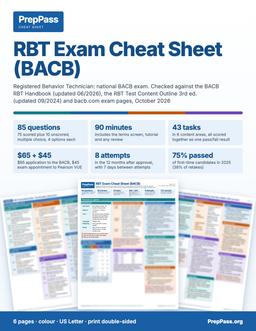
¿Examen en menos de dos semanas?
Esta guía es la enseñanza, para leer durante semanas. Si tu examen es en menos de dos semanas, la hoja de referencia a color imprimible es el otro producto: las cifras clave, por secciones.
6 páginas · US Letter · PDF imprimible · tuyo para siempre
How this book compares
BACB publishes the RBT Test Content Outline (3rd ed.) for free; it applies to exams from January 1, 2026. This book gives you full practice exams written to it; Mometrix sells a study guide with practice tests.
| Resource | Price | What you get | Choose it if |
|---|---|---|---|
| This bookRBT Practice Test Book 2026 — 3rd Edition OutlinePrepPass | $29.99 | Downloadable practice-test book for the RBT exam
| Choose this book if you want full practice exams written to the current outline and scored by domain. It does not replace the training BACB requires. |
| From the exam bodyRBT Test Content Outline (3rd ed.) (opens the publisher's page in a new tab)Behavior Analyst Certification Board (BACB) | Free (PDF) | The official list of tasks the exam tests | Read it in any case: every exam question is written to one of its tasks. |
| AlternativeRBT Exam Secrets (opens the publisher's page in a new tab)Mometrix Test Preparation | $19.99 ebook; $24.99 printed book | Study guide with practice tests
| Choose Mometrix if you want a printed copy. |
This book
RBT Practice Test Book 2026 — 3rd Edition Outline
PrepPass
- Price
- $29.99
- What you get
Downloadable practice-test book for the RBT exam
- 444 practice questions, each mapped to its outline task and explained
- 441 pages, PDF + EPUB
- Choose it if
- Choose this book if you want full practice exams written to the current outline and scored by domain. It does not replace the training BACB requires.
From the exam body
RBT Test Content Outline (3rd ed.) (opens the publisher's page in a new tab)
Behavior Analyst Certification Board (BACB)
- Price
- Free (PDF)
- What you get
The official list of tasks the exam tests
- Choose it if
- Read it in any case: every exam question is written to one of its tasks.
Alternative
RBT Exam Secrets (opens the publisher's page in a new tab)
Mometrix Test Preparation
- Price
- $19.99 ebook; $24.99 printed book
- What you get
Study guide with practice tests
- Three full-length practice tests with detailed answer explanations (per the product title)
- Choose it if
- Choose Mometrix if you want a printed copy.
Other resources' prices and contents are as listed on each publisher's or seller's own page, checked September 24, 2026. Prices change; confirm on the linked page before you buy. This book's price and contents come from our own catalog.
Sources (2)
- https://www.bacb.com/test-content-outlines-for-bacb-certifications/ — read September 24, 2026
- https://www.mometrix.com/studyguides/rbt/ — read September 24, 2026
Qué incluye — y qué no
Incluido
- Written to the 2026 3rd-edition outline — including the tasks that are new in it
- Exam review for people who have finished the 40-hour training; it does not replace the training or the competency assessment, and it does not teach behavior analysis from zero
No incluido
- No se envía copia impresa — es un archivo que descargas y puedes imprimir tú
- El libro no incluye curso en vídeo, instructor ni tutorías — los vídeos gratis del sitio van aparte
Todo lo incluido y todo lo que no
Incluido
- Every answer mapped to its domain and task, so you can score yourself by domain the same day
- 444 questions in all: two full 85-question practice exams weighted to the six official domains, six domain practice sets and 20 worked walkthroughs of the best-answer method
- The 43-task self-audit checklist — find your weak tasks before the exam finds them
- The best-answer method: worked scenarios showing why the “almost right” option loses
- A 14-day retake study plan keyed to your own diagnostic results
- Retake rules current to the 06/2026 Handbook: 7-day wait, up to 8 attempts in 12 months
- Every question in the forms and the domain sets comes with all four options explained — why the key is best AND why each of the other three loses
- PDF (print & tab it) + EPUB (phone / e-reader)
No incluido
- No incluye tu inscripción al examen ni la tasa del centro, que sigues pagando al organismo oficial
Contenido
Ver 12 secciones y la página en la que empieza cada una
- Part I — The Study Guidep. 24
- Chapter 1 — Data Collection and Graphingp. 25
- Chapter 2 — Behavior Assessmentp. 42
- Chapter 3 — Behavior Acquisitionp. 55
- Part I — Shaping (C.10.)p. 68
- Chapter 4 — Behavior Reductionp. 77
- Chapter 5 — Documentation and Reportingp. 97
- Chapter 6 — Ethicsp. 111
- Part I — Interpersonal and professional skills (F.9.)p. 124
- Part II — The Retake Toolkitp. 134
- Part III — Two full-length practice formsp. 179
- Part IV — Domain practice setsp. 288
Tomado del PDF que descargas, con la página en la que empieza cada uno — no escrito a mano aquí.
Lee un capítulo completo gratis
Un capítulo completo, tal como viene en el eBook. Desplázate en la ventana para leerlo aquí; sin descargas ni correo.
Lee el capítulo 1 aquí, sin salir de la página
The free chapter is Chapter 1, Data Collection and Graphing: it shows the level of the whole book, a compact review that defines each term and then drills the distinctions the exam turns on, written for someone who has met the terms in training.
Introduction
Data is the part of this job that cannot be faked, and it is the part of the exam that cannot be bluffed. Every other domain depends on this one: an acquisition program is only working if the data say so, a behavior plan is only justified if the data say so, and your session note is only honest if it matches what you recorded.
Domain A is 13 scored questions, the third-largest domain behind Behavior Acquisition and Behavior Reduction, and it is the domain that changed most in the 3rd edition. The old Measurement domain asked you to collect data and plot it. The new Data Collection and Graphing domain also asks you to compute summary measures (A.6.), read a graph and describe its trend (A.7.), and explain what goes wrong when data or implementation are sloppy (A.8.). Those three tasks are new. If your last attempt included graph-reading items or a "responses per hour" arithmetic item and they felt like they came from nowhere, this is why.
The good news is that Domain A is the most learnable domain on the exam. The distinctions are crisp, the arithmetic is simple, and the traps are a short, fixed list. This chapter walks through the two families of measurement (continuous and discontinuous), permanent product, observable and measurable description, the three summary calculations you will actually be asked for, how to read a line graph, and what procedural fidelity means.
Learning objectives
After working through this chapter you should be able to:
- A.1. Implement continuous measurement procedures — frequency, duration, latency, and interresponse time — and choose the right one for a described behavior.
- A.2. Implement discontinuous measurement procedures — partial interval, whole interval, and momentary time sampling — and state which over-estimates and which under-estimates occurrence.
- A.3. Implement permanent product recording procedures, and recognize when a permanent product is and is not available.
- A.4. Enter data and update graphs accurately, on the correct axes, in the correct phase.
- A.5. Describe behavior and environment in observable and measurable terms, and rewrite a subjective description into an objective one.
- A.6. Calculate and summarize data in different ways — rate, mean duration, and percentage — from raw session data.
- A.7. Identify trends in graphed data, including level, trend direction, variability, and what a phase-change line means.
- A.8. Describe the risks associated with unreliable data collection and poor procedural fidelity, and explain why both threaten the client, not just the paperwork.
Part A — Continuous measurement: counting the behavior itself (A.1.)
Continuous measurement means you record every occurrence of the behavior during the observation period. Nothing is estimated. Four procedures, and the exam expects you to pick between them from a one-sentence description.
Frequency (count). A tally of how many times the behavior occurred. Use it when the behavior has a clear beginning and end and each instance takes roughly the same amount of time. "Ravi hit the table 7 times." Frequency alone is only interpretable if the observation periods are the same length — which is exactly why rate exists (see A.6.).
Duration. How long the behavior lasts, from onset to offset. Use it when how long is the clinically important part: tantrums, on-task engagement, crying, self-stimulation. You can record total duration across a session, or duration per occurrence, from which you compute mean duration.
Latency. The time from a stimulus or instruction to the start of the behavior. Use it when the concern is how long it takes the learner to get going after a demand. "The RBT says 'put on your shoes'; 42 seconds pass before Maya reaches for a shoe." Latency starts at the antecedent event and stops when the behavior begins.
Interresponse time (IRT). The time between the end of one occurrence of a behavior and the start of the next. Use it when the concern is spacing or pacing: how long between two requests, two bites, two vocalizations. IRT and rate move in opposite directions — shorter IRTs mean a higher rate.
The discrimination that matters most: latency versus IRT. Both are time-between measures, which is why the exam loves them together. Latency is measured from something the environment did (an instruction, a cue) to the behavior starting. IRT is measured from one behavior to the next occurrence of the same behavior. If the stem mentions an instruction or an SD, and the clock starts there, it is latency. If the clock starts at the end of a response, it is IRT.
| Procedure | Clock starts | Clock stops | Answers the question |
|---|---|---|---|
| Frequency | — (tally) | — | How many times? |
| Duration | Behavior begins | Behavior ends | How long does it last? |
| Latency | Antecedent/instruction | Behavior begins | How long until it starts? |
| IRT | One response ends | Next response begins | How much time between them? |
Part B — Discontinuous measurement: sampling the behavior (A.2.)
Discontinuous measurement divides the observation into intervals and records whether the behavior occurred, rather than recording every instance. It is an estimate, chosen because it lets one person watch a behavior while also teaching. Three procedures — and the exam tests them almost entirely through what each one over- or under-estimates.
Partial-interval recording. Mark the interval if the behavior occurred at any point during it, even for one second, even once. Because a single brief occurrence scores the whole interval, partial interval over-estimates how much the behavior actually occurred. It is usually chosen for behaviors you want to decrease, since over-estimating a problem behavior is the conservative error.
Whole-interval recording. Mark the interval only if the behavior occurred for the entire interval, start to finish. A behavior that stops for two seconds in the middle does not score. Because of that, whole interval under-estimates occurrence. It is usually chosen for behaviors you want to increase, such as on-task engagement or sustained play, since under-estimating a desired behavior is the conservative error there.
Momentary time sampling (MTS). Look at the one moment the interval ends and record whether the behavior is occurring right then. What happens in between is not recorded at all. MTS may over- or under-estimate depending on the behavior; because it requires attention only at fixed moments, it is the least intrusive of the three and the most practical for a teacher or an RBT running a group.
All three are reported as a percentage of intervals — number of intervals scored divided by total intervals, times 100. This is the single most-missed detail in the domain. Interval methods never yield a count of responses. If an option says "momentary time sampling; recorded as 4 occurrences," it is wrong on the reporting even if the procedure were right.
| Procedure | You score an interval when… | Bias | Typically used for |
|---|---|---|---|
| Partial interval | Behavior occurs at any point in the interval | Over-estimates | Behaviors to decrease |
| Whole interval | Behavior occurs throughout the entire interval | Under-estimates | Behaviors to increase |
| Momentary time sampling | Behavior is occurring at the moment the interval ends | Either direction | Group settings, long observations |
A memory hook that survives exam pressure: Partial is Plus (inflates), Whole is Weak (deflates), and Momentary is a Moment (a snapshot, nothing in between).
Part C — Permanent product recording (A.3.)
Permanent product recording measures the outcome the behavior leaves behind rather than the behavior as it happens: the completed worksheet, the number of shirts folded, the beads strung, the dishes in the rack, the photograph of a made bed.
Its advantage is that you do not have to be watching. Its requirements are strict:
- There must be a durable outcome that reliably results from the behavior. "Was polite to peers" leaves no product. "Put 12 blocks in the bin" does.
- The product must be attributable to the client. If a sibling helped, or a teacher finished the last three problems, the product no longer measures the client's behavior. The exam likes this one: a stem where someone else may have contributed is testing whether you notice that permanent product has become invalid.
- It tells you nothing about how the behavior occurred. Twenty completed math problems could be twenty independent responses or twenty fully prompted ones. If the program cares about independence, prompt level, or topography, permanent product is the wrong measure.
Permanent product versus direct observation is a scope question in disguise: use permanent product when the outcome is the target, and direct observation when the process is the target.
Part D — Observable and measurable description (A.5.)
Task A.5. asks you to describe behavior and environment in observable and measurable terms. This shows up in Domain A as "which description is best written," and again in Domain E as "which session note is objective." It is the same skill in two places, and it is one of the cheapest points on the exam to secure.
A description is observable if two people watching the same event would agree it happened, and measurable if you could count it, time it, or otherwise quantify it.
| Not observable/measurable | Observable and measurable |
|---|---|
| "Jonah was aggressive." | "Jonah struck the therapist's arm with a closed fist 4 times." |
| "Amara was frustrated and shut down." | "Amara placed her head on the desk and did not respond to 3 consecutive instructions." |
| "Ben had a meltdown for a while." | "Ben screamed and dropped to the floor for 6 minutes 40 seconds." |
| "Client was uncooperative today." | "Client completed 2 of 10 presented trials." |
| "Sara enjoyed the activity." | "Sara remained at the table and manipulated the materials for 9 of 10 intervals." |
The words the exam plants to signal a bad description are internal-state and evaluative words: angry, frustrated, upset, anxious, defiant, unmotivated, refused, enjoyed, attempted, manipulative, attention-seeking. Notice that "attention-seeking" is on that list. It states a function — a conclusion drawn from data — as though it were an observation. An RBT records what happened; the analysis of why belongs to the supervising BCBA.
Also describe the environment the same way: not "the room was chaotic," but "four peers were present and the fire alarm sounded at 10:14."
Part E — Entering data and updating graphs (A.4.)
Task A.4. is the mechanical one, and it is mostly about not corrupting the record.
The conventional line graph. Behavior data are plotted on a line graph with the behavior measure on the y-axis (vertical) and time or sessions on the x-axis (horizontal). Each session is one data point. Points within the same condition are connected; points are not connected across a phase-change line.
The phase-change line is a vertical line separating conditions — baseline from intervention, or one intervention from the next — usually labeled at the top ("Baseline," "DRA + extinction"). Its purpose is to let anyone reading the graph see what changed and when. Drawing a connecting line across it visually implies continuity that did not exist, which is why the convention is to break the line.
Practical rules the exam can turn into items:
- Enter data during or immediately after the session, not from memory hours later. Delay is a data-integrity problem, not a paperwork problem.
- Record what actually happened, including a session that went badly, a session cut short, or a session where you made an implementation error. Data that flatter you are worse than no data.
- If a session did not occur, that is not a zero. A zero means the behavior was measured and did not occur. A missed session is a gap.
- If you notice a data-entry error later, correct it through the documented process and tell your supervisor — do not quietly overwrite it.
- Graph on the schedule the program specifies, so that the person making decisions is looking at current data.
Part F — Calculating and summarizing data (A.6.)
New in the 3rd edition, and arithmetic-light. Three computations cover almost everything.
Rate = count ÷ time. Rate converts a raw count into something comparable across sessions of different lengths. Always state the unit.
Worked: An RBT records 15 instances of aggression during a 90-minute session. Rate per minute = 15 ÷ 90 = 0.17 per minute. Rate per hour = 15 ÷ 1.5 hours = 10 per hour.
That example is not arbitrary — it is the shape of the BACB's own published sample question in the current Handbook. Get comfortable converting minutes to hours: 90 minutes is 1.5 hours, 30 minutes is 0.5 hours, 45 minutes is 0.75 hours. The trap is dividing by 90 and then labeling the result "per hour."
Mean duration = total duration ÷ number of occurrences. Not divided by the session length, and not divided by the number of intervals.
Worked: Three tantrums lasting 4, 7, and 4 minutes. Total duration = 15 minutes. Mean duration = 15 ÷ 3 = 5 minutes per occurrence. Total duration (15 minutes) and mean duration (5 minutes) are different summaries of the same data, and an item will offer you both.
Percentage = (part ÷ whole) × 100. The judgment is entirely in choosing the denominator.
Worked: Maya responds independently on 12 of 20 trials: 12 ÷ 20 × 100 = 60% independent responding. Worked: Stereotypy is scored in 4 of 10 intervals: 4 ÷ 10 × 100 = 40% of intervals — note the units. It is 40% of intervals, not "40% of the session" and not "4 occurrences."
Choosing the summary that fits the measure is itself testable:
| Raw data | Correct summary |
|---|---|
| Count in sessions of unequal length | Rate (per minute or per hour) |
| Several timed episodes | Total duration and/or mean duration |
| Trials with a correct/incorrect outcome | Percentage of trials |
| Interval recording sheet | Percentage of intervals |
| Time from instruction to response, several trials | Mean latency |
Preguntas frecuentes
¿Cómo lo recibo?
Paga y la descarga aparece en esta página al instante. Los enlaces también se te envían por correo. No hace falta cuenta.
¿Y si no es para mí?
Escríbenos dentro de 14 días para un reembolso total, sin preguntas.
¿Va a desaparecer la práctica gratis?
No. Todas las preguntas, el simulacro cronometrado y los capítulos gratis del sitio siguen gratis. Este libro es la mitad de estudio, no una valla alrededor de lo gratuito.
Más preguntas (1)
¿Puedo leerlo en el móvil?
Sí — el EPUB es para móviles y e-readers, el PDF para imprimir y marcar. Recibes ambos.
¿Por qué comprar el libro si la práctica es gratis?
Nuestras preguntas de práctica y el simulacro cronometrado siguen gratis: nada del sitio se esconde tras este libro. El libro de $29.99 es la mitad de estudio: el material en sí, explicado en orden, en un archivo tuyo.
- Enseñanza sistemática — cada sección del examen explicada capítulo a capítulo, de principio a fin, no solo preguntas
- Imprímelo y márcalo — un PDF listo para papel que puedes resaltar, anotar y llevar a tu mesa de estudio
- Estudia en cualquier lugar, sin conexión — EPUB en tu teléfono o e-reader; sin wifi, sin pestañas
- Todo en un solo lugar — los capítulos y las preguntas de práctica en un archivo
- Tuyo de por vida — pago único de $29.99, descarga instantánea, sin suscripción
Los detalles
- Verificado con la fuente oficial(BACB RBT Test Content Outline (3rd ed.) · RBT Ethics Code (2.0))
- 403 preguntas de práctica gratis
Compra única, acceso de por vida a la descarga. El eBook es la guía completa de RBT (Registered Behavior Technician) en PDF y EPUB. Resumen educativo, no asesoría profesional ni legal — confirma siempre las reglas vigentes con la fuente oficial. Última actualización: October 2026.