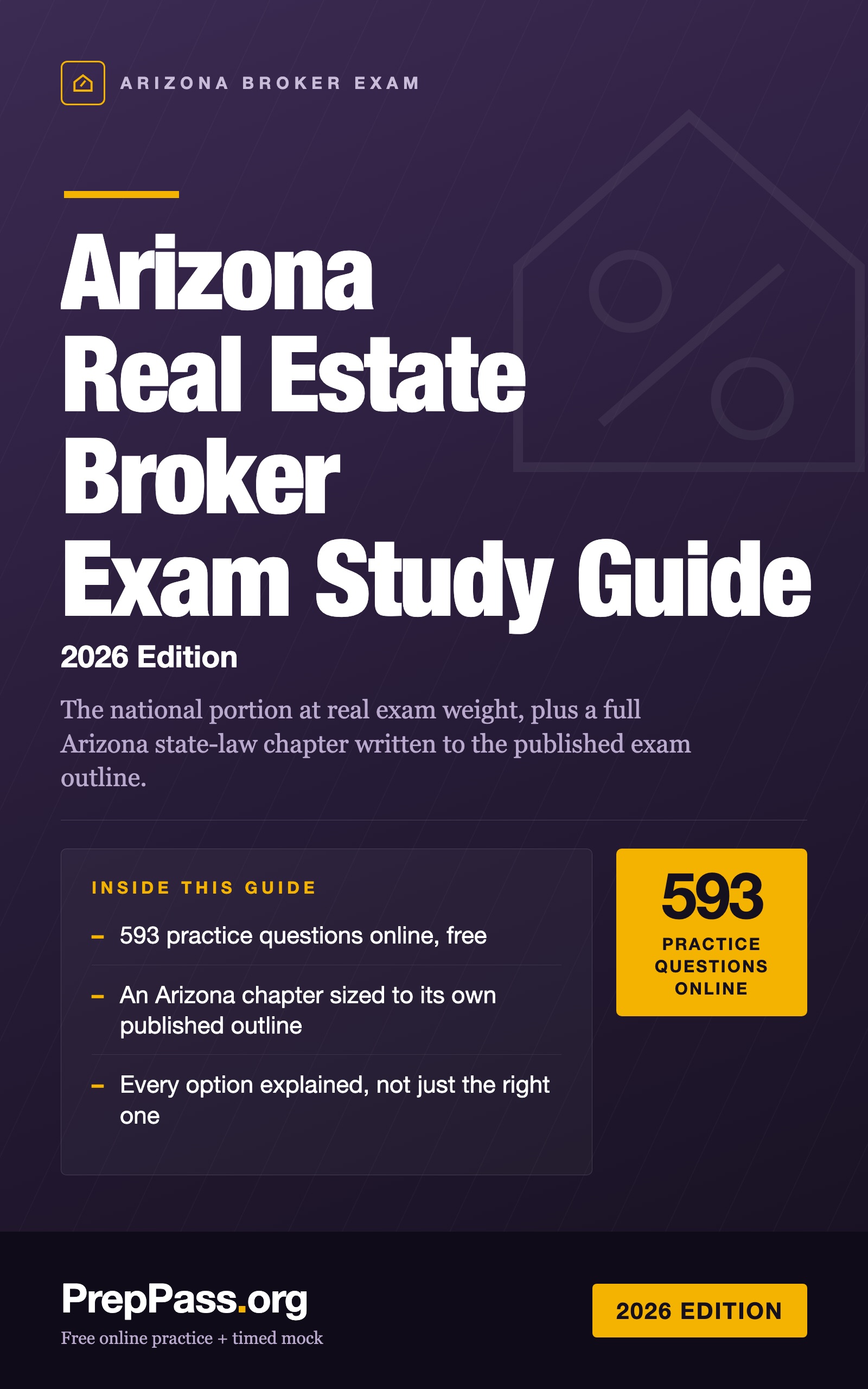
Arizona Real Estate Broker · Edición 2026
Arizona Real Estate Broker Exam Study Guide (2026)
Arizona runs a single integrated paper with no separate national portion, so the whole exam is Arizona content. The Arizona chapter is sized to the published outline — 29 areas, 180 scored items — area by area, not flattened.
- Los 8 capítulos de la porción nacional más un capítulo completo de ley inmobiliaria de Arizona — PDF + EPUB que conservas
- Un examen de práctica nacional de 60 preguntas, con una clave que explica las cuatro opciones y no solo la correcta
- Un set de práctica propio sobre la ley inmobiliaria de Arizona, con clave de respuestas razonada
PDF + EPUB · en inglés · 335 páginas · $14.99 pago único
Este libro está escrito en inglés — el PDF y el EPUB que descargas están en inglés.
Descarga inmediata tras el pago — sin cuenta y sin suscripción. Política de reembolso
Prueba primero 10 preguntas — gratis
Responde las 10, y al terminar verás cada respuesta explicada — con la sección de esta guía que la enseña. Unos 5 minutos, sin registro.
Empezar 10 preguntas gratisMira dentro del libro
Tres páginas reales, renderizadas directamente del PDF que descargas — una de explicación, una pregunta resuelta y una de referencia. Nada se rediseñó para verse mejor.
- Referencia rápidaPart C — Encumbrances a broker must read off a title report · Página 102 del PDF
Una página a la que puedes volver: cifras, plazos o términos reunidos en un solo lugar.
- Una pregunta resueltaAnswer Key and Explanations · Página 174 del PDF
Una pregunta de práctica con su respuesta y el razonamiento detrás — no solo la clave.
- Cómo se enseñaPart II — Arizona State Law & Practice · Página 333 del PDF
Una página de explicación: el material enseñado en prosa, en el orden en que lo evalúa el examen.
Qué incluye — y qué no
Incluido
- An Arizona chapter written to the published exam outline, area by area
- Where Arizona law departs from the national rule — both stated, so neither is guessed
- Supervision, trust accounts, brokerage operation and broker math
- An Arizona practice set with every option explained, not just the right one
- 593 practice questions online, free, from the same bank
- PDF (print & tab it) + EPUB (phone / e-reader)
No incluido
- No se envía copia impresa — es un archivo que descargas y puedes imprimir tú
- El libro no incluye curso en vídeo, instructor ni tutorías — los vídeos gratis del sitio van aparte
- No incluye tu inscripción al examen ni la tasa del centro, que sigues pagando al organismo oficial
Contenido
Ver 29 capítulos y la página en la que empieza cada uno
- Part C — Advertising and recordkeeping compliancep. 14
- Part D — Consumer contact and transaction integrityp. 16
- 2. Trust Funds, Escrow, and the Client’s Moneyp. 30
- Part C — Records that survive an auditp. 33
- Part D — Disputed moneyp. 34
- 3. Agency at the Broker Levelp. 40
- Part C — Fiduciary duties, at the level a broker is examined onp. 44
- Part D — Dual agency, designated agency, and the alternativesp. 46
- 4. Contracts and Brokerage Agreementsp. 55
- Part C — Options, rights of first refusal, and installment contractsp. 60
- Part D — Between contract and closingp. 61
- 5. Fair Housing, Accessibility, and Antitrust: The Exposure You Carry Personallyp. 72
- Part C — The exemptions, and why they rarely save anyonep. 78
- Part D — Disability: the distinction the exam always testsp. 79
- 6. Ownership, Land Use Controls, and Transfer of Titlep. 95
- Part C — Encumbrances a broker must read off a title reportp. 101
- Part D — Legal descriptionsp. 103
- 7. Valuation, Financing, and the Federal Lending Lawsp. 113
- Part C — The instrumentsp. 121
- Part D — Loan programs, structures, and qualifyingp. 123
- 8. Disclosures, Environmental Risk, and Property Managementp. 136
- Part C — The management agreement and the manager’s authorityp. 142
- Part D — Leases and tenanciesp. 144
- Practice Exam — 60 Questionsp. 153
- Answer Key and Explanationsp. 170
- Appendix A — Broker Math Cheat Sheetp. 221
- Appendix B — Glossaryp. 243
- Appendix C — Exam-Day Strategyp. 262
- Part II — Arizona State Law & Practicep. 267
Tomado del PDF que descargas, con la página en la que empieza cada uno — no escrito a mano aquí.
Lee un capítulo completo gratis
Un capítulo completo, tal como viene en el eBook. Desplázate en la ventana para leerlo aquí; sin descargas ni correo.
Lee el capítulo 9 aquí, sin salir de la página
No te dimos la introducción fácil — el capítulo gratis abre en una de las partes más exigentes del libro, para que juzgues la enseñanza donde el examen se pone difícil.
What the Arizona broker exam actually is
Start with the fact that governs everything else in this chapter: there is no national portion of the Arizona broker examination. The Pearson VUE Arizona Real Estate Candidate Handbook, bulletin #090300, says so twice in the same block. The broker outline is headed "Arizona Real Estate Broker's Examination Content Outline / Effective September 23, 2019 / (Designed for a single 180 question examination)," and the handbook's own description of the paper reads: "It is a single examination consisting of one hundred eighty (180) questions, plus fifteen (15) pretest questions."
One paper. 180 scored questions plus 15 unscored pretest items, 195 items in all, in 315 minutes. Passing is 75 percent. There is no separate general portion to pass, no separate state portion to pass, and no partial credit for clearing one half of a paper that does not have halves.
That has a consequence for how you should read this book. The national manuscript in Part I is not a description of an Arizona exam section — Arizona has no such section. It is the general body of real estate knowledge that the Arizona outline assumes you already have while it asks you Arizona questions about it. Twenty-nine of Arizona's areas are titled the way any state's outline is titled — contracts, appraisal, financing, leases, escrow — and the questions inside them are drawn on Arizona statutes and Arizona practice. The split between "national manuscript" and "state chapter" in this edition is a packaging convenience: it lets one carefully written general text serve every state edition. It is not a description of your test paper. Every question you will be asked is an Arizona question.
The published breakdown, and the number that is missing
The broker outline prints twenty-nine areas. Twenty-eight of them carry a question count. One does not.
| # | Area (published order) | Items |
|---|---|---|
| I | Real Estate Statutes | 28 |
| II | Commissioner's Rules | 18 |
| III | Agency Relationships & Managerial Duties | 14 |
| IV | Contracts and Contract Law | 10 |
| V | Property Interests, Estates & Tenancies | 10 |
| VI | Government Rights in Real Property | 4 |
| VII | Income Tax Aspects of Real Estate | 3 |
| VIII | Arizona Water Law | 5 |
| IX | Environmental Law | 6 |
| X | Land Descriptions | 4 |
| XI | Land Development | 4 |
| XII | Encumbrances | 3 |
| XIII | Acquisitions/Transfer of Title | 5 |
| XIV | Escrow and Settlement | 4 |
| XV | Fair Housing, ADA & RESPA | 3 |
| XVI | Leases & Leasehold Estates | 5 |
| XVII | Commercial Leasing & Building Terminology | 3 |
| XVIII | Property Insurance & Warranties | 2 |
| XIX | Appraisal | 3 |
| XX | Primary & Secondary Markets / Financing Concepts | 3 |
| XXI | Residential & Commercial Financing | 4 |
| XXII | Financing Documents | 3 |
| XXIII | Deed of Trust | — no count printed — |
| XXIV | Deed of Trust Foreclosure | 5 |
| XXV | Disclosure & Consumer Protection | 8 |
| XXVI | Math Calculations | 11 |
| XXVII | Cooperative Nature of Real Estate | 2 |
| XXVIII | Business Accounting | 2 |
| XXIX | ADRE Audits | 5 |
| Printed counts, total | 177 | |
| Declared examination total | 180 |
The twenty-eight printed counts sum to 177 against a declared 180, and area XXIII prints no count at all. Every other area on the page renders as "AREA NAME – N QUESTIONS." Area XXIII renders as "XXIII.DEED OF TRUST," full stop.
You will find study guides that quietly assign the missing three items to area XXIII, because 177 + 3 = 180 and the arithmetic is irresistible. We have not done that, and you should be suspicious of anyone who has. The handbook does not say those three items belong to XXIII. It does not say where they go. Assigning them manufactures a published figure that the published document does not contain, and a candidate who studies from a manufactured figure is studying from a guess dressed as a fact. This chapter is proportioned to the 177 counted items, and it tells you plainly that three of your 180 are unallocated by the vendor. Practically, deeds of trust are thoroughly covered anyway: area XXII (Financing Documents, 3 items) is about the note and the deed of trust, and area XXIV (Deed of Trust Foreclosure, 5 items) is about what happens when the deed of trust is enforced. Study those and area XXIII takes care of itself, whatever the residual three turn out to be.
Three more things in this handbook that will mislead you if nobody warns you
First — and this is the big one — the same handbook contains a salesperson outline effective January 1, 2026, and it is a completely different document. Arizona rewrote its salesperson state outline for 2026 and left the broker outline at its 2019 version. The salesperson outline has ten areas with names like "Arizona Real Estate Regulatory Framework," "Arizona Consumer Protection Laws," "Advertising," "Arizona Agency," and "Licensee Duties and Obligations." The broker outline has twenty-nine areas with the names in the table above. They share almost no structure.
Now consider what happens when you, or an AI assistant, or a tutoring service, goes looking for "the current Arizona real estate exam outline." The 2026 date wins. The salesperson outline is newer, cleaner, and sits earlier in the file. Anyone extracting "the current Arizona outline" from this PDF lands on the salesperson one. A broker candidate who studies to a ten-area 2026 salesperson outline will walk into a twenty-nine-area 2019 broker paper with no preparation for Arizona water law, no preparation for ADRE audits, no preparation for business accounting, and eleven math items they were not expecting. Check the heading on whatever outline you are reading. The broker block is the one that says Broker's and September 23, 2019.
Second, the broker outline is old. September 23, 2019 is coming up on seven years. Arizona law did not stand still: as Section 30 of this chapter sets out in detail, six Commissioner's Rules were amended by final rulemaking effective December 13, 2025, and one of those amendments created a rule that has no counterpart anywhere in the 2019 outline's vocabulary. An outline's age does not freeze the law it points at. The outline tells the item writers what subjects to test; the law of the subject is whatever it is on the day you sit. Where this chapter states a rule that has moved since 2019, it says so and gives the date.
Third, area XVII is misnamed. It is printed as "COMMERCIAL LEASING & BUILDING TERMINOLOGY – 3 QUESTIONS," and its single lettered subtopic is "A. Arizona Residential Landlord Tenant Act – 3 Questions." The subtopic's count equals the whole area's count. So all three of area XVII's items are on the Residential Landlord and Tenant Act, A.R.S. Title 33, Chapter 10 — a statute that by its own terms does not apply to commercial tenancies at all. A candidate who reads the area heading and revises triple-net structures, load factors and usable-versus-rentable square footage has revised for zero of those three items. Study the subtopic, not the heading. Section XVII below does exactly that.
Who runs the license
The regulator is the Arizona Department of Real Estate (ADRE), headed by the Real Estate Commissioner. The statute is A.R.S. Title 32, Chapter 20; the rules are A.A.C. Title 4, Chapter 28, cited throughout as "R4-28-something" and known as the Commissioner's Rules.
One caution about sources before you go further. The Arizona handbook publishes no reference list for the broker exam. It carries two things that look like one and are not. There is a "Real Estate General/National Resources" list of commercial textbooks, which is expressly for the general/national portion — a portion the broker exam does not have. And there is a "Bibliography" that belongs to the Cemetery Salesperson and Broker state law outline, a different exam entirely, and which cites the Arizona Real Estate Law Book 2016 Edition, now a decade stale. Neither is a broker reference list. The absence is itself worth knowing: every citation in this chapter was derived from the authorities named inside the broker outline's own area and subtopic headings and then checked against the primary text at azleg.gov and azsos.gov. They are not a vendor-published list and this chapter does not present them as one.
Fees, course hours and dollar thresholds change. Where this chapter prints one, verify it against ADRE before you rely on it.
I. Real Estate Statutes — 28 of 177 items
The largest area on the paper, and by a wide margin: more than one item in six. It runs from a clause of the state constitution through the Department, licensing, regulation, property management, subdivisions, the recovery fund and timeshares. Give it the study time its size deserves.
Article XXVI — why an Arizona licensee may draft a deed
Most states solve the unauthorized-practice-of-law problem with a rule that lets licensees fill blanks on approved forms. Arizona solved it in the state constitution. Article XXVI, Section 1 gives any licensed broker or salesperson acting as agent for a party "the right to draft or fill out and complete, without charge, any and all instruments incident thereto including, but not limited to, preliminary purchase agreements and earnest money receipts, deeds, mortgages, leases, assignments, releases, contracts for sale of realty, and bills of sale."
Two features of that sentence get tested. The list reaches well past the offer stage — it names deeds and mortgages, which are conveyancing and security instruments, and it is expressly illustrative ("including, but not limited to"). And the whole authority is bought with the words "without charge." The licensee may prepare the paperwork precisely because no separate fee is taken for doing it. A licensee who charges a drafting fee has stepped outside the constitutional grant and into the practice of law for compensation.
Trap. Nothing in Article XXVI requires an attorney to countersign, requires the instruments to be filed with the Department, or limits the authority to escrow closings or to Department-published forms. Those are all invented conditions, and all four appear as distractors.
The Department, the Commissioner and the advisory board
A.R.S. 32-2102 places administration of Chapter 20 in the state real estate department; 32-2107 puts the Commissioner in charge of it. A.R.S. 32-2106(A): the Commissioner "is appointed by the governor" and "shall serve at the pleasure of the governor." No fixed term, and no election. Subsection (B) adds the qualifications: at least five years in real estate, title insurance, banking or mortgage brokerage, plus three years of administrative experience, and no financial interest in a brokerage at the date of appointment.
Beside the Commissioner sits the real estate advisory board: A.R.S. 32-2104(A) establishes a board "composed of ten members who are appointed by the governor," each serving a six-year term, with three terms expiring on January 31 of each odd-numbered year. Subsection (B) fixes the mix of brokerage, commercial, multifamily and public members.
Trap. The board advises. It does not appoint the Commissioner, is not elected by licensees, and is not appointed by the legislature. Every one of those is a printed distractor somewhere.
Compare this with the national manuscript's general account of a real estate commission, which describes a multi-member commission that itself holds rulemaking and disciplinary authority. Arizona is not built that way. Authority is concentrated in a single appointed Commissioner serving at will; the ten-member body beside him has no power to license, discipline or make rules.
Licensing: the broker ladder
Unlicensed activity. A.R.S. 32-2122(B) makes it "unlawful for any person, corporation, partnership or limited liability company to engage in any business, occupation or activity listed in subsection A of this section without first obtaining a license." Subsection (A) covers real estate, cemetery and membership camping brokers and salespersons. There is no working-for-free exception, no supervision exception, and no one-transaction allowance; those defenses appear nowhere in the section, and all three are printed distractors.
Age. A.R.S. 32-2124(D): "before receiving any license provided for by this chapter, an applicant must be at least eighteen years of age." It is a condition of receiving the license, not of sitting the exam, and no higher age is set anywhere in Chapter 20.
Experience. A.R.S. 32-2124(A)(1) requires an original broker applicant to have "been an active licensed real estate salesperson or real estate broker for at least three years during the five years immediately preceding the time of application." The statute counts active licensure, not hours worked or transactions closed, so there is no full-time test. Subsection (A)(7) lets the Commissioner accept an equivalent amount of active experience in the same field within the preceding five years.
Education. A.R.S. 32-2124(C) requires "a real estate broker's course that is prescribed and approved by the commissioner and that is at least ninety classroom hours, or the equivalent," at a certified school, and that the applicant have "satisfactorily passed an examination on the course." A.A.C. R4-28-401(A)(1) sets that course examination at a minimum of 75 percent. The course may be taken live or by distance learning, but the course examination must be proctored in person.
And then the clinic. A.R.S. 32-2136 requires attendance at a broker management clinic — three courses of three hours each — before an original broker license is activated. This is the step candidates forget exists, because it sits after the exam rather than before it.
Entity licenses. A.R.S. 32-2125(A): a corporation, limited liability company or partnership seeking an entity broker's license must designate a natural person licensed as a broker who is an officer of the corporation, a manager or member of the LLC, or a partner of the partnership. The entity license "shall extend no authority to act as designated broker to any other person," and it runs concurrently with that individual's license. Registering shareholders, naming an outside broker on a service contract, or designating a salesperson are all impossible.
Branch offices. A.R.S. 32-2127(A): a broker maintaining more than one place of business "shall procure an additional license for each branch office maintained." Subsection (B) requires the branch license to be in the same name as the principal license, posted in the branch, with a conforming sign carrying the words "branch office." Subsection (C) requires each branch to be managed by a broker or a licensed salesperson. A branch does not need its own designated broker or its own trust account.
Continuing education. A.R.S. 32-2130(A) conditions renewal on evidence of twenty-four credit hours for salespersons and associate brokers in each twenty-four-month period of licensure. The structure comes from R4-28-402 and is covered under area II.
Trust funds — the broker's exposure
This is where a broker's license is actually lost, and area I gives it real weight.
Where the money goes. A.R.S. 32-2151(A): a broker who does not immediately place entrusted money "in a neutral escrow depository in this state" must place it on receipt "in a trust fund account in a federally insured or guaranteed account in a depository located in this state." The parties may agree otherwise in writing; subsection (D) sets the conditions for an out-of-state depository. The operating account is expressly out of bounds — subsection (E) confirms the section does not permit commingling.
Reconciliation. A.R.S. 32-2151(B)(3): "on a monthly basis the broker must complete a three-way reconciliation between the trust fund account bank statements, client ledgers and trust fund account ledgers and provide an explanation for any variation." The three legs are the bank statement, the individual client ledgers and the trust account ledger, and all three must agree. Subsection (C)(5) makes failure to reconcile regularly a violation in its own right — you do not need a shortfall to be disciplined, only an unreconciled account.
The broker's own money. A.R.S. 32-2151(C)(2) treats depositing others' money in a personal account, or commingling, as a violation, then carves out one exception: "it is not commingling if a broker deposits personal monies of not more than $5,000 to keep the account open or to avoid charges for an insufficient minimum balance." Capped at that figure, tied to that purpose. There is no operating-expense cushion and no first-year grace period.
Set that beside the national manuscript's general treatment of commingling, which states the principle and leaves the tolerance to state law. Arizona's tolerance is $5,000 and it exists for exactly one reason — keeping the account open. California's equivalent, for comparison, is $200. Do not carry a figure across a state line.
Property management — a statutory scheme of its own
Arizona regulates property management inside the real estate chapter, and the deadlines are specific.
A.R.S. 32-2173(A)(1)(c) requires a property management agreement to "specify a beginning and an ending date." The same paragraph requires all material terms, signature by the owner and by the firm's designated broker or an authorized licensee, cancellation provisions agreeable to both parties, and provision for the disposition of all money collected, including tenant deposits. The statute sets no minimum fee, no fixed notice period and no occupancy guarantee.
A.R.S. 32-2174(A): "all property management accounts shall be designated as trust accounts on the broker's records." Subsection (B) requires a broker's trust account for the owner's money unless the owner directs deposit directly into the owner's own account — to which the broker must not have access — and permits trust accounts to bear interest. That designation is what pulls the account inside the Department's audit reach.
A.R.S. 32-2174(D): "within three banking days after receiving monies that are not subject to dispute or contingency, the property management firm shall deposit the monies in either the owner's direct account or the property management firm's trust account for the benefit of the owner." Banking days, and the qualifier matters — money genuinely in dispute or held pending a contingency is outside the three-day clock.
The termination cascade — A.R.S. 32-2173(C) — is a favorite item because it has three different deadlines running from one event:
| After a management agreement terminates | Deadline |
|---|---|
| List of all tenant security obligations to the owner | 5 days |
| Reimbursement of money remaining in the property accounts, less what is needed for unpaid obligations incurred during the term | 35 days |
| Final accounts receivable and payable list, and final bank reconciliation | 75 days |
Antes de comprar
- ¿Cómo lo recibo?
- Paga y la descarga aparece en esta página al instante. Los enlaces también se te envían por correo. No hace falta cuenta.
- ¿Y si no es para mí?
- Escríbenos dentro de 14 días para un reembolso total, sin preguntas.
- ¿Va a desaparecer la práctica gratis?
- No. Todas las preguntas, el simulacro cronometrado y los capítulos gratis del sitio siguen gratis. Este libro es la mitad de estudio, no una valla alrededor de lo gratuito.
- ¿Puedo leerlo en el móvil?
- Sí — el EPUB es para móviles y e-readers, el PDF para imprimir y marcar. Recibes ambos.
Los detalles
Arizona runs a single integrated paper with no separate national portion, so the whole exam is Arizona content. The Arizona chapter is sized to the published outline — 29 areas, 180 scored items — area by area, not flattened.
- Format: PDF + EPUB download · 335 pages
- 80 practice questions in the book, with a full answer key
- 593 free practice questions for this exam on PrepPass, included at no cost
- $14.99 one-time — no subscription
- 14-day money-back guarantee · refund policy
- Cross-referenced against: Arizona Constitution, Article XXVI · A.R.S. Title 32, Chapter 20 · A.A.C. Title 4, Chapter 28 (Commissioner's Rules) · Arizona Constitution, Article X (State and School Lands) · Pearson VUE — Arizona Real Estate Candidate Handbook #090300 (rev Handbook 02/2026 (PDF created 2026-02-23); BROKER outline Effective September 23, 2019)
- Last updated: September 2026
- Verificado con la fuente oficial(Arizona Constitution, Article XXVI · A.R.S. Title 32, Chapter 20 · A.A.C. Title 4, Chapter 28 (Commissioner's Rules) · Arizona Constitution, Article X (State and School Lands) · Pearson VUE — Arizona Real Estate Candidate Handbook #090300 (rev Handbook 02/2026 (PDF created 2026-02-23); BROKER outline Effective September 23, 2019))
- 593 preguntas de práctica gratis
- Descarga instantánea, tuyo de por vida
Un real estate broker pre-license course cuesta $200–$1,000. Este libro enseña el mismo examen — las mismas reglas, verificadas a los estándares actuales — por un pago único de $14.99 que conservas de por vida.
¿Por qué comprar el libro si la práctica es gratis?
Nuestras preguntas de práctica y el simulacro cronometrado siguen gratis: nada del sitio se esconde tras este libro. El libro de $14.99 es la mitad de estudio: el material en sí, explicado en orden, en un archivo tuyo.
- Enseñanza sistemática — cada sección del examen explicada capítulo a capítulo, de principio a fin, no solo preguntas
- Imprímelo y márcalo — un PDF listo para papel que puedes resaltar, anotar y llevar a tu mesa de estudio
- Estudia en cualquier lugar, sin conexión — EPUB en tu teléfono o e-reader; sin wifi, sin pestañas
- Todo en un solo lugar — capítulos, resúmenes por capítulo y preguntas de práctica en un archivo
- Tuyo de por vida — pago único de $14.99, descarga instantánea, sin suscripción
Y sin riesgo: Garantía de reembolso de 14 días — ¿no te convence? Escríbenos para un reembolso total, sin preguntas. Consulta la política de reembolso.
Garantía de reembolso de 14 días · reembolso total, sin preguntas.
Compra única, acceso de por vida a la descarga. El eBook es la guía completa de Arizona Real Estate Broker en PDF y EPUB. Resumen educativo, no asesoría profesional ni legal — confirma siempre las reglas vigentes con la fuente oficial. Última actualización: September 2026.