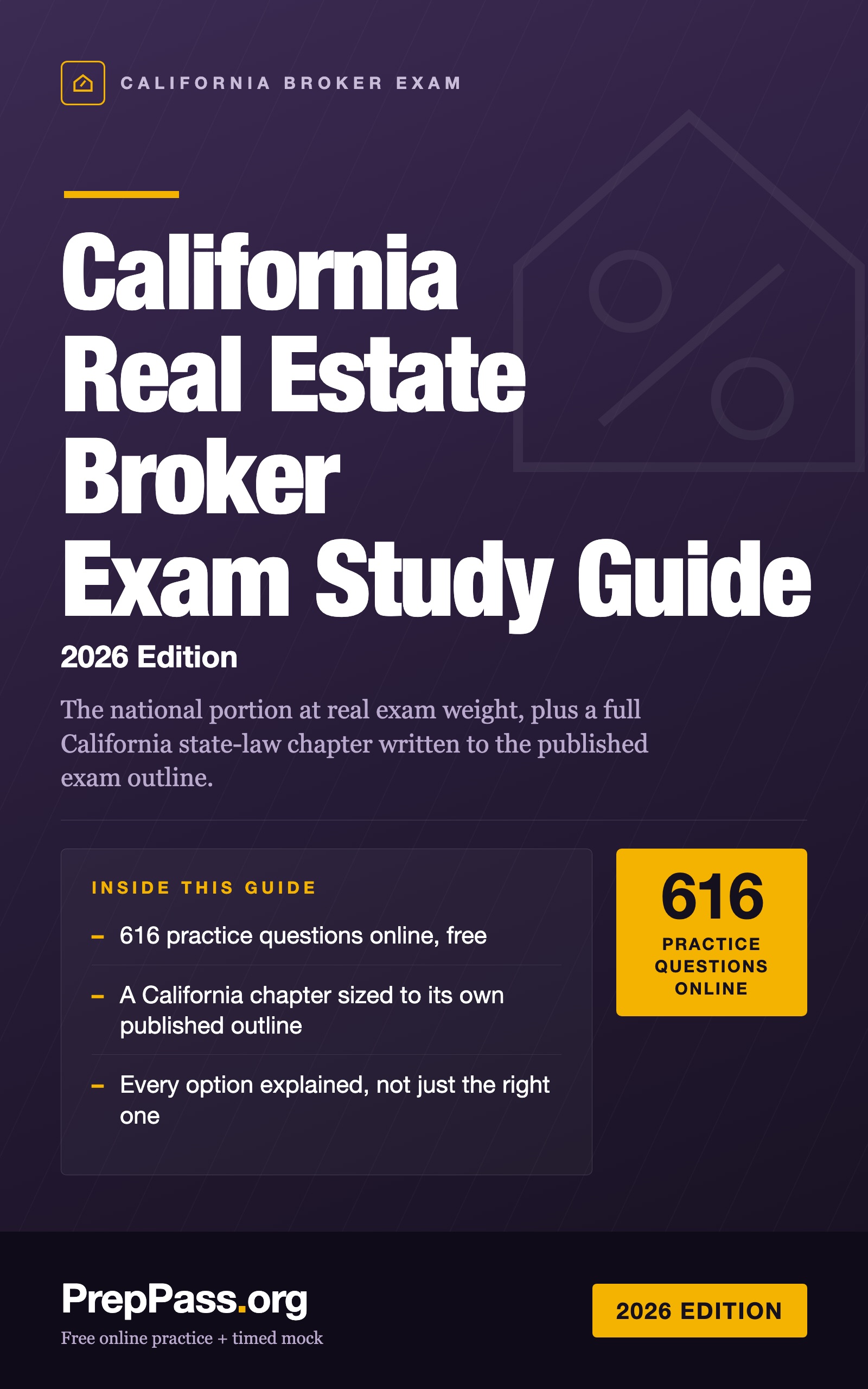
California Real Estate Broker · Edición 2026
California Real Estate Broker Exam Study Guide (2026)
California runs a single integrated paper with no separate national portion, so the whole exam is California content. The California chapter is sized to the published outline — 7 areas, 200 scored items — area by area, not flattened.
- Los 8 capítulos de la porción nacional más un capítulo completo de ley inmobiliaria de California — PDF + EPUB que conservas
- Un examen de práctica nacional de 60 preguntas, con una clave que explica las cuatro opciones y no solo la correcta
- Un set de práctica propio sobre la ley inmobiliaria de California, con clave de respuestas razonada
PDF + EPUB · en inglés · 332 páginas · $14.99 pago único
Este libro está escrito en inglés — el PDF y el EPUB que descargas están en inglés.
Descarga inmediata tras el pago — sin cuenta y sin suscripción. Política de reembolso
Prueba primero 10 preguntas — gratis
Responde las 10, y al terminar verás cada respuesta explicada — con la sección de esta guía que la enseña. Unos 5 minutos, sin registro.
Empezar 10 preguntas gratisMira dentro del libro
Tres páginas reales, renderizadas directamente del PDF que descargas — una de explicación, una pregunta resuelta y una de referencia. Nada se rediseñó para verse mejor.
- Referencia rápidaPart C — Encumbrances a broker must read off a title report · Página 102 del PDF
Una página a la que puedes volver: cifras, plazos o términos reunidos en un solo lugar.
- Una pregunta resueltaAnswer Key and Explanations · Página 174 del PDF
Una pregunta de práctica con su respuesta y el razonamiento detrás — no solo la clave.
- Cómo se enseñaPart II — California State Law & Practice · Página 325 del PDF
Una página de explicación: el material enseñado en prosa, en el orden en que lo evalúa el examen.
Qué incluye — y qué no
Incluido
- A California chapter written to the published exam outline, area by area
- Where California law departs from the national rule — both stated, so neither is guessed
- Supervision, trust accounts, brokerage operation and broker math
- A California practice set with every option explained, not just the right one
- 616 practice questions online, free, from the same bank
- PDF (print & tab it) + EPUB (phone / e-reader)
No incluido
- No se envía copia impresa — es un archivo que descargas y puedes imprimir tú
- El libro no incluye curso en vídeo, instructor ni tutorías — los vídeos gratis del sitio van aparte
- No incluye tu inscripción al examen ni la tasa del centro, que sigues pagando al organismo oficial
Contenido
Ver 29 capítulos y la página en la que empieza cada uno
- Part C — Advertising and recordkeeping compliancep. 14
- Part D — Consumer contact and transaction integrityp. 16
- 2. Trust Funds, Escrow, and the Client’s Moneyp. 30
- Part C — Records that survive an auditp. 33
- Part D — Disputed moneyp. 34
- 3. Agency at the Broker Levelp. 40
- Part C — Fiduciary duties, at the level a broker is examined onp. 44
- Part D — Dual agency, designated agency, and the alternativesp. 46
- 4. Contracts and Brokerage Agreementsp. 55
- Part C — Options, rights of first refusal, and installment contractsp. 60
- Part D — Between contract and closingp. 61
- 5. Fair Housing, Accessibility, and Antitrust: The Exposure You Carry Personallyp. 72
- Part C — The exemptions, and why they rarely save anyonep. 78
- Part D — Disability: the distinction the exam always testsp. 79
- 6. Ownership, Land Use Controls, and Transfer of Titlep. 95
- Part C — Encumbrances a broker must read off a title reportp. 101
- Part D — Legal descriptionsp. 103
- 7. Valuation, Financing, and the Federal Lending Lawsp. 113
- Part C — The instrumentsp. 121
- Part D — Loan programs, structures, and qualifyingp. 123
- 8. Disclosures, Environmental Risk, and Property Managementp. 136
- Part C — The management agreement and the manager’s authorityp. 142
- Part D — Leases and tenanciesp. 144
- Practice Exam — 60 Questionsp. 153
- Answer Key and Explanationsp. 170
- Appendix A — Broker Math Cheat Sheetp. 221
- Appendix B — Glossaryp. 243
- Appendix C — Exam-Day Strategyp. 262
- Part II — California State Law & Practicep. 267
Tomado del PDF que descargas, con la página en la que empieza cada uno — no escrito a mano aquí.
Lee un capítulo completo gratis
Un capítulo completo, tal como viene en el eBook. Desplázate en la ventana para leerlo aquí; sin descargas ni correo.
Lee el capítulo 9 aquí, sin salir de la página
No te dimos la introducción fácil — el capítulo gratis abre en una de las partes más exigentes del libro, para que juzgues la enseñanza donde el examen se pone difícil.
What the California broker exam actually is
Begin with the fact that shapes everything else here: there is no national portion of the California broker examination. California does not use Pearson VUE or PSI content outlines. The Department of Real Estate administers its own examination, writes its own items, and publishes its own content description. The broker exam is one paper of 200 multiple-choice questions in 4 hours, and the pass mark is 75 percent. Nothing is split; there is no general section to clear separately.
So read Part I of this book for what it is. The national manuscript is not a description of a section of your test paper — California has no such section. It is the general body of real estate knowledge that DRE's seven headings assume you already have while asking you California questions about it. Value theory, the three approaches, amortization, leverage, the mechanics of a lease: DRE tests all of it, and tests it through California statutes and California practice. The "national manuscript plus state chapter" arrangement in this edition is a packaging convenience that lets one carefully written general text serve every state edition. It is not a description of your exam. Every one of your 200 questions is a California question.
The published weights — and the number DRE does not publish
DRE publishes percentages only. Here they are, verbatim from DRE's own broker examination content page, each one qualified by DRE with the word "approximately":
| Area (DRE's detailed heading, in published order) | DRE's published weight | Items, derived |
|---|---|---|
| Property Ownership and Land Use Controls and Regulations | approximately 15% | 30 |
| Laws of Agency and Fiduciary Duties | approximately 17% | 34 |
| Property Valuation and Financial Analysis | approximately 14% | 28 |
| Financing | approximately 9% | 18 |
| Transfer of Property | approximately 8% | 16 |
| Practice of Real Estate and Mandated Disclosures | approximately 25% | 50 |
| Contracts | approximately 12% | 24 |
| 100% | 200 |
The right-hand column is ours, not DRE's, and you should treat it that way. DRE publishes no item counts anywhere. Those figures are simply each percentage multiplied by the 200-question total, which happens to come out exact in all seven cases with no rounding — 30/34/28/18/16/50/24, summing to 200. That arithmetic is clean, and it is still a derivation. If a study guide tells you "the California broker exam has 34 agency questions," it is telling you something DRE has never said. This chapter is proportioned to those derived counts because proportion is the useful thing; it labels them derived because honesty about a source is the difference between a study guide and a rumour.
Two more qualifications DRE itself attaches, and they matter:
"Approximately." Every percentage on the page carries it. A 25 percent area is not guaranteed to be exactly fifty items on your form.
"Not totally comprehensive." DRE prints a list of subtopics under each heading and then says the list is not exhaustive. So the subtopics tell you the shape of an area, not its boundary. An item can be inside a heading without appearing in the printed subtopics — which is the single best argument for reading the underlying California statutes rather than memorizing DRE's bullet list.
DRE names the seven areas twice on the same page, and the two lists disagree
This is not a typo hunt; it changes what you study. DRE's page carries a short summary list of the seven areas near the top and a detailed, percentage-bearing set of headings below it. They do not match.
| Summary list says | Detailed, percentage-bearing heading says |
|---|---|
| Laws of Agency | Laws of Agency and Fiduciary Duties |
| Valuation and Market Analysis | Property Valuation and Financial Analysis |
| Practice of Real Estate and Mandated Disclosures | Practice of Real Estate and Mandated Disclosures |
The differences are substantive. "Valuation and Market Analysis" sounds like comparative pricing; "Property Valuation and Financial Analysis" adds an investment-arithmetic half — capitalization, cash-on-cash return, leverage, the income ladder — that a candidate reading the summary heading would not have revised. Likewise "Laws of Agency" versus "Laws of Agency and Fiduciary Duties."
This chapter uses the detailed headings throughout, because those are the headings carrying the weights. Where a percentage is attached to a name, that name is the one DRE is actually describing.
Who runs the license, and one thing DRE does not publish
The regulator is the California Department of Real Estate, headed by the Real Estate Commissioner. The statute is the Real Estate Law, Business and Professions Code Division 4, Part 1, sections 10000 and following. The rules are the Commissioner's Regulations, Title 10 of the California Code of Regulations, cited here as "Regulation 2725" and the like. Escrow agents and finance lenders are supervised by a different body, the Department of Financial Protection and Innovation; the California Association of Realtors is a private trade association with no licensing power at all.
DRE's broker content page publishes no statute list, no rule list and no bibliography. Its only statutory gesture is an opening sentence paraphrasing Business and Professions Code section 10153 without citing it. That absence is itself worth knowing, because it means every citation you will see in any California broker guide — including this one — is derived rather than vendor-published. The citations in this chapter were derived from the subject matter of DRE's own subtopics and then checked against the primary text at leginfo.legislature.ca.gov. They are not DRE's list and this chapter does not present them as one.
A warning about sources, learned the hard way. While this edition was being built, an automated fetch of a DRE-hosted PDF returned a fabricated version of Civil Code section 1670.50 — wrong section number, wrong operative date, wrong trigger. It read plausibly. If you are checking California law, check it at leginfo.legislature.ca.gov, which is the Legislature's own text, and treat anything else — including summaries on regulator websites, and including anything an AI hands you — as a lead rather than an authority.
Fees, course hours, dollar thresholds and inflation-adjusted figures change. Where this chapter prints one, verify it before you rely on it.
I. Property Ownership and Land Use Controls and Regulations — approximately 15% (about 30 items)
DRE lists eleven subtopics here, running from classes of property through water rights and special categories of land. It is the vocabulary the rest of the exam is written in.
Fixtures, and the test California actually uses
Civil Code section 660 deems a thing affixed to land when it is "attached by roots," "imbedded in it," "resting permanently on it," or "permanently attached to what is thus permanent" by cement, plaster, nails, bolts or screws. The test is the manner of annexation. Not cost — an expensive chandelier hanging on a hook is personal property. Not who installed it, and not whether a contractor was licensed. A purchase-agreement inventory can allocate items by contract and override the default result, but it is not the statutory test.
Trade fixtures run the other way. Civil Code section 1019 lets a tenant remove "any time during the continuance of his term, anything affixed thereto for purposes of trade, manufacture, ornament, or domestic use, if the removal can be effected without injury to the premises, unless the thing has, by the manner in which it is affixed, become an integral part of the premises." Note the condition: the right turns on removing without injury, not on repairing damage afterwards. Bolted commercial ovens and a walk-in cooler in a leased restaurant remain the tenant's personal property. And emblements — annual crops produced by a farm tenant's own labor — are the tenant's personalty, with a right to re-enter and harvest after the tenancy ends.
Concurrent ownership — where California differs
Joint tenancy — Civil Code section 683. A joint interest is one owned by two or more persons in equal shares by a title created by a single will or transfer "when expressly declared in that will or transfer to be a joint tenancy." Without the express declaration, co-owners take as tenants in common. Family relationship is irrelevant, notarisation and recording do not create it, and unequal shares or different acquisition times defeat the unities of interest and time.
Tenancy in common carries no right of survivorship; each cotenant's undivided fractional interest is freely transferable in life and passes at death by will or by intestate succession. Escheat happens only where there is no will and no heirs.
Community property with right of survivorship — Civil Code section 682.1. Where the transfer document expressly declares it, the property passes to the surviving spouse on the first death without administration, the same way joint tenancy property does, while keeping its community-property character. Ordinary community property without that declaration sends half through the decedent's will or intestate succession. Section 682.1 does not convert the halves into separate property, does not let one spouse convey alone, and is a title vesting, not a property-tax provision.
And the interaction that gets tested: a conveyance by one joint tenant destroys the unities of time and title as to that share, so the transferee holds as a tenant in common with the remaining owner and survivorship is lost between them. The right of survivorship does not run with the land.
Property characteristics, descriptions and encumbrances
DRE lists all three as subtopics and the items are definitional. Physical characteristics of land are immobility, indestructibility and non-homogeneity (uniqueness); economic characteristics are scarcity, improvements, permanence of investment, and area preference — situs. It is area preference that captures why a hillside lot's value turns on its view, access and school district, and non-homogeneity that explains why comparables need adjusting.
Descriptions. "Lot 14, Block 3, Tract 22417, as per map recorded in Book 512, Pages 8 to 11, of Maps" is a lot, block and tract description — a reference to a recorded map, and the commonest legal description in California's developed areas. Metes and bounds uses a point of beginning with courses and distances; the rectangular survey names township, range, section and principal meridian, where a section is one square mile and 640 acres, a quarter section 160, a township six miles on a side containing 36 numbered sections, and 43,560 square feet make an acre. Much of coastal and southern California is described by metes and bounds or by recorded tract maps because of the Spanish and Mexican land grants that predate the federal survey.
Encumbrances divide into money encumbrances (liens: deeds of trust, judgment liens created by recording an abstract of judgment, property tax liens, mechanics liens), which secure payment and are foreclosable, and non-money encumbrances (easements, recorded CC&Rs, encroachments), which restrict use or possession. An encroachment clouds title and supports an action to remove it, but involves no debt. An easement in gross benefits a person or entity rather than a parcel, and California recognizes commercial easements in gross — a utility's transmission line — as transferable; an easement appurtenant requires a dominant tenement, which a utility owning no adjoining land does not have. A license is revocable permission creating no interest, and a profit à prendre is the right to remove soil, timber or minerals.
Government rights in land, and where regulation stops
The four government rights are police power, eminent domain, taxation and escheat. Escheat operates only where an owner dies intestate with no heirs, passing title to the state — a tax sale, by contrast, sells to a purchaser rather than vesting title in the state.
A downzoning that reduces market value is a valid exercise of the police power and ordinarily requires no compensation, so long as an economically viable use remains. Inverse condemnation applies only where regulation goes so far as to be a taking; a routine downzoning is not one, and it is not a special assessment either. Eminent domain is the power that takes on payment of just compensation.
Zoning relief. A variance permits deviation from a development standard — setback, height, lot coverage — where strict application would deprive the owner of privileges enjoyed by others because of a hardship peculiar to the property. A conditional use permit addresses use, not dimensions; a zone change is a legislative act; a general plan amendment changes the policy designation. A use lawful when established that a later ordinance prohibits is a legal nonconforming use, which ordinances typically let continue while restricting enlargement, rebuilding after destruction and resumption after abandonment, often with an amortization period. It is neither a variance (which must be applied for and granted) nor spot zoning.
Adverse possession — California's fifth element
Code of Civil Procedure section 325 requires possession that is hostile, open, notorious and continuous for five years — and, on top of that, that the claimant or predecessors "timely paid all state, county or municipal taxes" levied on the land during those five years, proven by certified records of the county tax collector. The tax element is the one most candidates forget and the one California actually enforces. No notice of claim is recorded; the owner's permission destroys the claim, because possession must be hostile; and the period is five years, not twenty.
Homestead
Code of Civil Procedure section 704.730 gives an automatic homestead exemption of a statutory dollar amount set within a floor and a ceiling and adjusted annually for inflation. Look up the current published figure; do not carry one in your head, and do not accept one printed in a book. It is not unlimited protection of all equity, it requires no recording (a declared homestead is a separate, optional device), and it does not bar foreclosure of a consensual lien such as a deed of trust the owner signed.
The two subdivision statutes — keep them apart
DRE's subtopics list "Public Controls," and this is the distinction the exam most reliably tests inside it.
- The Subdivided Lands Law, Business and Professions Code section 11000 and following, is the DRE-administered consumer-protection statute. It requires the Commissioner's public report before subdivision interests may be offered or sold.
- The Subdivision Map Act, Government Code section 66410 and following, is the separate local statute administered by cities and counties. It governs tentative and final maps and the physical design of the subdivision.
Two schemes, two administrators, two triggers. They are routinely confused, and an item that offers both is testing whether you can tell a sales-disclosure statute from a mapping statute.
Zoning consistency — Government Code section 65860 requires a city or county zoning ordinance to be consistent with the jurisdiction's adopted general plan. The general plan is the constitution for local land use, and an inconsistent ordinance is vulnerable to challenge. DRE has no approval role over local zoning, there is no voter-ratification requirement, and adjoining jurisdictions routinely zone differently.
Private controls. Where a recorded CC&R conflicts with what zoning permits, the more restrictive of the two controls — the owner must satisfy both, because public land use controls and private restrictions operate independently. Zoning does not repeal a covenant, and a covenant cannot authorize what the agency forbids. And a recorded covenant limiting use, occupancy or transfer of housing on a protected basis such as race is void and unenforceable; the Government Code supplies a restrictive covenant modification process so an owner or association can have the offending language struck from the recorded document. That process exists precisely because the clauses survive in old records, so the recording date does not save them.
Environmental hazard zones
California layers mapped state hazard regimes on the federal law in the national manuscript. The Alquist-Priolo Earthquake Fault Zoning Act directs the State Geologist to delineate earthquake fault zones along known active faults; property inside one must be disclosed, and the earthquake fault zone is one of the six hazards on the Natural Hazard Disclosure Statement under Civil Code section 1103.2 (see area VI). Alquist-Priolo does not prohibit sales near a fault and imposes no blanket retrofit duty — it regulates construction across fault traces through local permitting. Earthquake insurance in California is optional and is never a recording condition.
Civil Code section 1101.4 required noncompliant plumbing fixtures in single-family residential property to be replaced with water-conserving fixtures on or before 1 January 2017, and subdivision (c) requires the seller to disclose that requirement in writing to the buyer and whether the property includes any noncompliant fixtures. No mould inspection, consumption history or supplier rate disclosure is mandated by the section.
Water rights — four doctrines, and California uses all of them
- Riparian — attaches to land bordering a flowing watercourse, entitles the owner to reasonable use, and is not lost by non-use.
- Appropriative — created by permit or license from the State Water Resources Control Board, may be used far from the stream, and can be lost by non-use.
- Littoral — land bordering a lake or the sea rather than a stream.
- Correlative — how overlying owners share a common percolating groundwater basin reasonably.
Accretion is the gradual deposit of soil by the action of water; the deposited material is alluvion and belongs to the riparian owner. Avulsion is sudden and violent and does not move boundaries the same way; reliction is the gradual withdrawal of water exposing land; erosion is the opposite of accretion.
Special categories of land
Under the Williamson Act (the California Land Conservation Act), a landowner contracts with a city or county to restrict land to agricultural or open-space use, and in exchange the land is assessed on its actual agricultural income value rather than full unrestricted market value. It is a reduced assessment, not a tax exemption, it has nothing to do with the Subdivided Lands Law public report, and the contract renews automatically each year unless a notice of nonrenewal starts a phase-out — so there is no thirty-day conversion.
Antes de comprar
- ¿Cómo lo recibo?
- Paga y la descarga aparece en esta página al instante. Los enlaces también se te envían por correo. No hace falta cuenta.
- ¿Y si no es para mí?
- Escríbenos dentro de 14 días para un reembolso total, sin preguntas.
- ¿Va a desaparecer la práctica gratis?
- No. Todas las preguntas, el simulacro cronometrado y los capítulos gratis del sitio siguen gratis. Este libro es la mitad de estudio, no una valla alrededor de lo gratuito.
- ¿Puedo leerlo en el móvil?
- Sí — el EPUB es para móviles y e-readers, el PDF para imprimir y marcar. Recibes ambos.
Los detalles
California runs a single integrated paper with no separate national portion, so the whole exam is California content. The California chapter is sized to the published outline — 7 areas, 200 scored items — area by area, not flattened.
- Format: PDF + EPUB download · 332 pages
- 80 practice questions in the book, with a full answer key
- 616 free practice questions for this exam on PrepPass, included at no cost
- $14.99 one-time — no subscription
- 14-day money-back guarantee · refund policy
- Cross-referenced against: 10 CCR (Commissioner's Regulations) Sections 2725, 2830-2835 · Rev. & Tax. Code Sections 11911, 60, 63.1, 69.6, 18032 · Prob. Code Sections 10309, 10311 · Pub. Res. Code Sections 2621-2621.9, 4136, 21000, 30000 · California Department of Real Estate (self-administered) (rev read live 2026-09-01; DRE publishes no revision date on the page)
- Last updated: September 2026
- Verificado con la fuente oficial(10 CCR (Commissioner's Regulations) Sections 2725, 2830-2835 · Rev. & Tax. Code Sections 11911, 60, 63.1, 69.6, 18032 · Prob. Code Sections 10309, 10311 · Pub. Res. Code Sections 2621-2621.9, 4136, 21000, 30000 · California Department of Real Estate (self-administered) (rev read live 2026-09-01; DRE publishes no revision date on the page))
- 616 preguntas de práctica gratis
- Descarga instantánea, tuyo de por vida
Un real estate broker pre-license course cuesta $200–$1,000. Este libro enseña el mismo examen — las mismas reglas, verificadas a los estándares actuales — por un pago único de $14.99 que conservas de por vida.
¿Por qué comprar el libro si la práctica es gratis?
Nuestras preguntas de práctica y el simulacro cronometrado siguen gratis: nada del sitio se esconde tras este libro. El libro de $14.99 es la mitad de estudio: el material en sí, explicado en orden, en un archivo tuyo.
- Enseñanza sistemática — cada sección del examen explicada capítulo a capítulo, de principio a fin, no solo preguntas
- Imprímelo y márcalo — un PDF listo para papel que puedes resaltar, anotar y llevar a tu mesa de estudio
- Estudia en cualquier lugar, sin conexión — EPUB en tu teléfono o e-reader; sin wifi, sin pestañas
- Todo en un solo lugar — capítulos, resúmenes por capítulo y preguntas de práctica en un archivo
- Tuyo de por vida — pago único de $14.99, descarga instantánea, sin suscripción
Y sin riesgo: Garantía de reembolso de 14 días — ¿no te convence? Escríbenos para un reembolso total, sin preguntas. Consulta la política de reembolso.
Garantía de reembolso de 14 días · reembolso total, sin preguntas.
Compra única, acceso de por vida a la descarga. El eBook es la guía completa de California Real Estate Broker en PDF y EPUB. Resumen educativo, no asesoría profesional ni legal — confirma siempre las reglas vigentes con la fuente oficial. Última actualización: September 2026.