Materiales de Estudio
Domina cada tema del examen, en lenguaje claro.
The framework chapter — blue-sky law, the federal/state/SRO split, the Administrator, and the vocabulary the whole exam is built on.
Introduction
The Series 63 is a law exam and nothing else. It does not ask you to price a bond, read a balance sheet, or build a portfolio — that is the Series 65. The Series 63 asks one kind of question in a hundred different costumes: under state securities law, who has to register, what has to be registered, what may a regulator do about it, and what conduct is forbidden? Master the vocabulary and the handful of clean distinctions in this chapter and the rest of the book becomes a set of variations on a theme.
The single most valuable habit you can build for this exam is to slow down on the definitions. Nearly every trick question on the Series 63 turns on whether a person, a product, or a transaction fits inside a defined term. If you know precisely who is an "agent," what counts as a "security," and when an "offer" has been made, you will answer questions the exam expects most candidates to miss.
Blue-sky laws and the Uniform Securities Act
State securities laws are called "blue-sky laws" — the phrase comes from an early court's description of promoters who would sell "so many feet of blue sky." Every U.S. state, plus the District of Columbia and several territories, has its own blue-sky statute regulating the sale of securities within its borders.
Because fifty separate statutes would be chaos, the North American Securities Administrators Association (NASAA) publishes a model law — the Uniform Securities Act (USA) — that states adapt into their own codes. The Series 63 tests the model act, not any one state's version. That is why this book teaches the model rule and flags any figure that an individual state can set for itself. When you sit the exam, the correct answer is the uniform rule unless the question tells you otherwise.
Source note. Section citations in this book (for example, "USA §401") refer to the Uniform Securities Act as published by NASAA. Most states adopted the 1956 Act (as amended); some adopted the 2002 revision. Where the two versions differ on a tested number, the text flags it and tells you which version the figure comes from. The Series 63 has historically tested the 1956 figures; confirm against your state's adopted version if you need the exact local number.
The three regulators — and how they fit together
Three layers of regulation sit on top of the securities business. The Series 63 is about the state layer, but you must know how the three interact.
- Federal law, enforced by the Securities and Exchange Commission (SEC): the Securities Act of 1933 (registration of new issues), the Securities Exchange Act of 1934 (the secondary market and broker-dealers), the Investment Company Act of 1940, and the Investment Advisers Act of 1940.
- State law, enforced by each state's Administrator: the Uniform Securities Act. This is your exam.
- Self-regulatory organizations (SROs), chiefly FINRA: industry rules and the qualification exams. FINRA administers the Series 63 on NASAA's behalf, but the content is state law.
The dividing line between federal and state authority was redrawn by the National Securities Markets Improvement Act of 1996 (NSMIA). NSMIA created the category of "federal covered" securities and advisers — matters Congress assigned to the SEC and largely preempted from state registration. A state cannot register a federal covered security, but it can still require a notice filing and a fee, and it always keeps its antifraud authority. Hold onto that idea: preemption removes state registration, never state antifraud jurisdiction.
The Administrator
The Administrator is the state official (or agency, division, commissioner, or secretary of state) who enforces the USA. The exam always calls this person "the Administrator" regardless of the real-world title. The Administrator may make rules and orders, but a rule or order may never be broader than the statute allows.
Crucially, the Administrator's authority is territorial. Under USA §414, the Administrator has jurisdiction over an offer or sale if the offer originated in the state, was directed into the state, or was accepted in the state. An offer to sell made in State A to a customer in State B is subject to both Administrators. This "originated / directed into / accepted in" test is one of the most heavily tested single facts on the Series 63.
The vocabulary the whole exam runs on
"Person"
A person (USA §401) is defined extremely broadly — an individual, corporation, partnership, association, joint-stock company, trust, government, or political subdivision. The exam's favorite trick is the non-persons: a minor, a deceased individual, and a person adjudicated mentally incompetent are not "persons" for these purposes.
"Security"
A security (USA §401) is any of a long list — note, stock, bond, debenture, evidence of indebtedness, investment contract, certificate of interest in a profit-sharing arrangement, voting-trust certificate, and more. When something is not obviously on the list, courts apply the Howey test: an investment contract (and therefore a security) exists when there is (1) an investment of money, (2) in a common enterprise, (3) with an expectation of profit, (4) derived primarily from the efforts of others.
Know the items that are NOT securities, because they generate easy points: fixed insurance and fixed annuity contracts, whole-life policies, commodities and commodity futures themselves, precious metals and collectibles held directly, currency, and the retirement account itself (an IRA or 401(k) is an account, not a security). The classic reversal: a variable annuity and variable life contract are securities, because the contract owner bears the investment risk.
"Offer" and "Sale"
A "sale" includes every contract of sale or disposition of a security for value. An "offer" includes every attempt to dispose of a security, or solicitation of an offer to buy, for value. The phrase for value is the key. Therefore NOT offers or sales: a bona fide gift of a security, a true stock dividend or split, a bona fide pledge, and a class vote on a merger. Two reversals: a gift of assessable stock is a sale, and a security carrying a warrant or right is treated as an offer of the underlying security.
Key facts — cram box
- Series 63 tests the Uniform Securities Act (NASAA model "blue-sky" law) plus NASAA Model Rules and Statements of Policy.
- Administrator = state securities regulator (title varies). (USA §401)
- Jurisdiction (USA §414): offer/sale is covered if it originated in, directed into, or accepted in the state; interstate offers are subject to both states.
- NSMIA (1996): created federal covered status; preempts state registration but never antifraud; states may require a notice filing + fee.
- Person (§401): broad; minors, deceased persons, and adjudicated incompetents are NOT persons.
- Security / Howey (§401): money + common enterprise + expected profit + primarily others' efforts.
- NOT securities: fixed/whole-life insurance, fixed annuities, commodities/futures, collectibles, currency, the account itself. Variable annuities/variable life ARE securities.
- Offer/Sale (§401): any attempt to dispose/solicit for value. Not a sale: bona fide gift, true stock dividend, bona fide pledge, class merger vote. Is a sale: gift of assessable stock; a right/warrant offers the underlying.
Worked example — jurisdiction and "offer"
Fact pattern. An agent registered in State X phones from her State X office a prospect who answers while vacationing in State Y; the prospect, back home in State Z, mails a signed subscription agreement, which the firm accepts at its State X home office. Which Administrators have jurisdiction?
Reasoning. Apply §414's three triggers. State X — the offer originated there and the sale was accepted there. State Y — the offer was directed into it when the prospect received the call. State Z — the offer to buy was directed from it when the prospect acted.
Answer. All three Administrators (X, Y, Z). A single transaction can touch several states at once, and an offer need not be accepted for a state to have jurisdiction — merely directing it in is enough.
Exam traps
- "Registration" ≠ "approval." It is prohibited to tell a client that registration means the Administrator approved or passed on the merits.
- Uniform rule, not your home state. Answer with the model act unless a state variation is given.
- Non-persons. Watch for a "deceased person," "minor," or "incompetent" in a list of who may register.
- Fixed vs. variable. Fixed = not a security; variable = a security. Read the adjective.
- Gift trap. A bona fide gift is not a sale — unless the stock is assessable.
- Antifraud always survives. For a federal covered security the state cannot register, the Administrator still keeps antifraud jurisdiction.
Registration of Persons Under State Law
The Series 63 exam is built on the Uniform Securities Act, the model blue-sky law that nearly every state has adapted. More than a third of the exam turns on a single chain of reasoning: read the definitions, decide whether the individual or firm falls inside one of them, check whether an exclusion or exemption removes them, and only then ask whether registration is required in that particular state. This chapter walks through the four registration categories, the exclusions that quietly resolve most exam questions, and the mechanics of applying for, renewing, and withdrawing a registration.
Ethical Practices and Fiduciary Obligations
This is the largest single behavioral section of the exam and the part that most closely mirrors daily practice. The NASAA model rules on dishonest and unethical business practices catalog the conduct that gets agents and advisers disciplined: trading that serves the representative rather than the client, misuse of customer money and securities, misleading communications, and undisclosed conflicts. The organizing question behind almost every scenario is simple. Whose interest was actually served, and did the customer receive every material fact needed to judge the recommendation?
Registration and Exemption of Securities
Securities, like people, must be registered in a state unless something takes them out of the requirement. Three things can do that: the security may be a federal covered security whose state registration is preempted, it may be an exempt security, or it may be sold in an exempt transaction. Keeping those three ideas apart is the single most valuable habit for this part of the exam, because the same instrument can require registration in one sale and not in the next. This chapter covers the three registration methods, the preemption rules, and the two families of exemptions.
The Administrator, Enforcement, and Liability
The last section of the exam covers the official who runs the state securities program and the remedies available when the act is broken. The recurring theme is the division of labor between the Administrator and the courts. The Administrator investigates, subpoenas, issues cease and desist orders, and denies, suspends, or revokes registrations; courts issue injunctions, impose criminal sentences, and review final orders. Alongside those public remedies sits a private one: an investor who was sold securities unlawfully can sue to get the money back, and a firm that discovers its own violation can cut off that liability with a proper rescission offer.
Practica por tema
Jump straight into free practice questions for any single NASAA Series 63 content area.
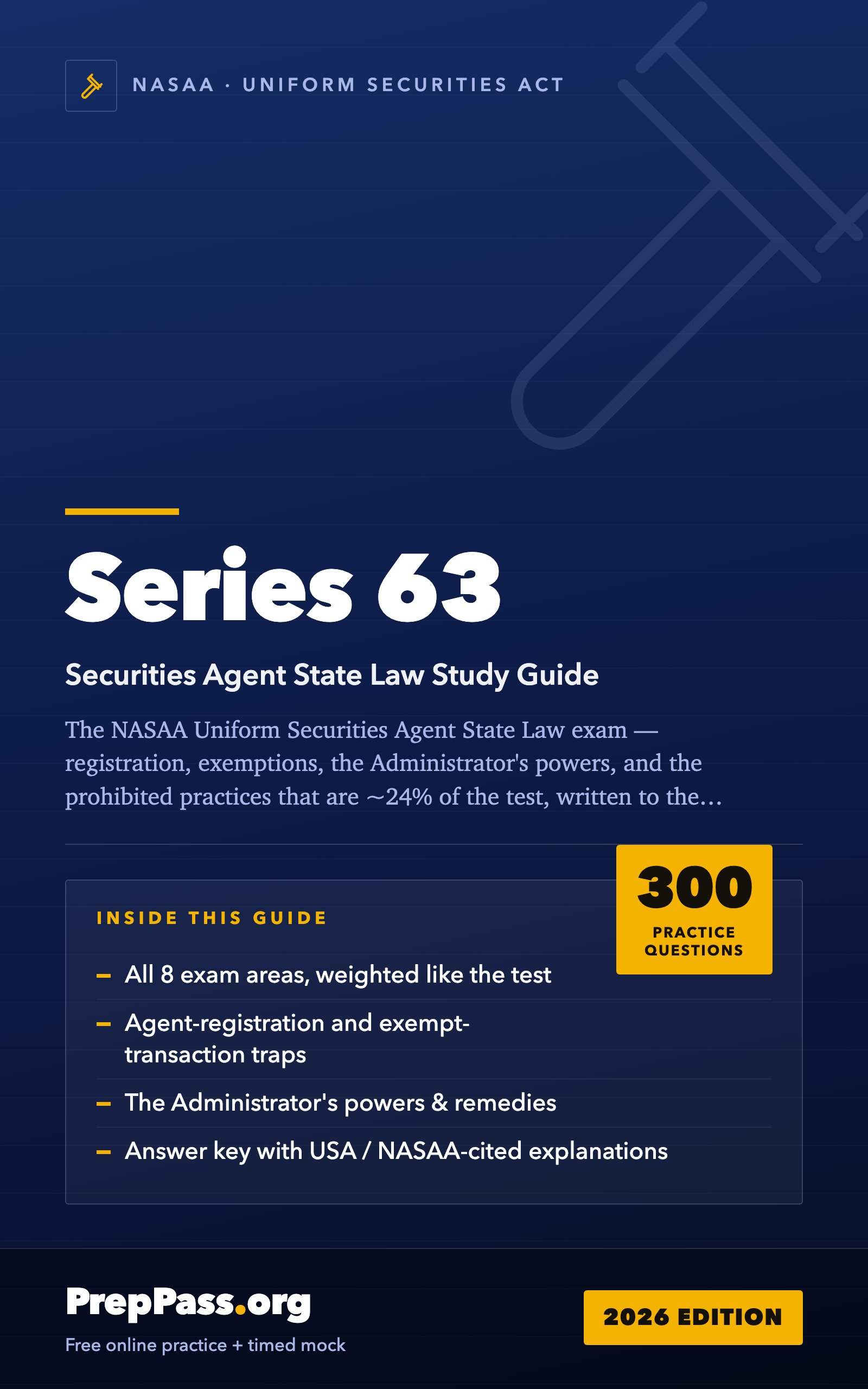
La práctica sigue gratis. La guía completa de Series 63 es el material en sí, explicado de principio a fin — un PDF + EPUB descargable que conservas.