Guía de estudio · Edición 2026
Series 63 — Securities Agent State Law Study Guide (2026)
Twelve chapters that teach the Uniform Securities Act section by section, with the conduct rules around it, written to NASAA's June 2023 test specifications.
- Extensión
- 769 páginas (182 de enseñanza + banco de preguntas)
- Preguntas de práctica en el libro
- 1,084
- Simulacro en línea de PrepPass
- 60 preguntas · 75 min
- Datos verificados y archivo actualizado
- octubre de 2026
- Entrega
- PDF + EPUB · en inglés · descarga inmediata
Léelo antes de comprar: This is an independent study aid, not affiliated with or endorsed by NASAA, FINRA, the SEC, any state securities Administrator, or any test-delivery vendor (including Prometric).
Leer el resto de este aviso
State securities law changes, varies by state, and differs between the 1956 and 2002 model Uniform Securities Acts; every rule and figure here is written to the model level Series 63 tests, but confirm the current rules and your state's adopted version before relying on any figure.
Sobre este libro
Tarifa del examen: $147 por intento, que se paga a FINRA. Repetir el examen vuelve a costarlo. Esta guía: $24.99, pago único.
Datos del examen, a quién le sirve y qué cambió
Sobre el examen en sí
| Organismo administrador | North American Securities Administrators Association (NASAA) — examen administrado por FINRA Fuente: FINRA — Series 63 – Uniform Securities Agent State Law Exam |
|---|---|
| Preguntas | 65 preguntas (60 calificadas, 5 de prueba sin calificar) Fuente: FINRA — Series 63 – Uniform Securities Agent State Law Exam |
| Tiempo límite | 75 minutos Fuente: FINRA — Series 63 – Uniform Securities Agent State Law Exam |
| Puntuación para aprobar | 43 de 60 correctas Fuente: FINRA — Series 63 – Uniform Securities Agent State Law Exam |
| Tarifas |
Fuente: NASAA — Exam FAQs |
| Idiomas disponibles | Inglés Fuente: NASAA — Exam FAQs |
Mira dentro del libro
Tres páginas reales, renderizadas directamente del PDF que descargas — una página de referencia, una de explicación y una pregunta resuelta, siempre en ese orden. Nada se rediseñó para verse mejor.
- Referencia rápidaAppendix — Question Bank 1,084 practice questions with answers and explanations · Página 647 del PDF
Una página a la que puedes volver: cifras, plazos o términos reunidos en un solo lugar.
- Cómo se enseñaChapter 3 — Broker-dealers, agents, registration and the uniform forms · Página 38 del PDF
Una página de explicación: el material enseñado en prosa, en el orden en que lo evalúa el examen.
- Una pregunta resueltaAppendix — Question Bank 1,084 practice questions with answers and explanations · Página 321 del PDF
Una pregunta de práctica con su respuesta y el razonamiento detrás — no solo la clave.
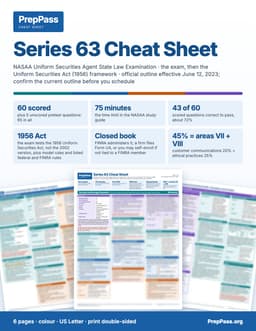
¿Examen en menos de dos semanas?
Esta guía es la enseñanza, para leer durante semanas. Si tu examen es en menos de dos semanas, la hoja de referencia a color imprimible es el otro producto: las cifras clave, por secciones.
6 páginas · US Letter · PDF imprimible · tuyo para siempre
Qué incluye — y qué no
Incluido
- Twelve chapters that teach the Uniform Securities Act section by section, with the 1956 and 2002 Act differences flagged
- Every chapter closes with a key-facts box and a named exam-traps list
No incluido
- No se envía copia impresa — es un archivo que descargas y puedes imprimir tú
- El libro no incluye curso en vídeo, instructor ni tutorías — los vídeos gratis del sitio van aparte
Todo lo incluido y todo lo que no
Incluido
- NASAA's eight subject areas, with the official weights printed in the exam-at-a-glance table
- The marquee traps: agent must register versus exempt, exempt security versus exempt transaction, discretion versus time and price
- The Administrator's powers and the civil and criminal remedies
- 182 pages of teaching, then a question bank of 1084 practice questions, grouped by topic, with answers and explanations
- PDF (print & tab it) + EPUB (phone / e-reader)
No incluido
- No incluye tu inscripción al examen ni la tasa del centro, que sigues pagando al organismo oficial
Contenido
Ver 13 secciones y la página en la que empieza cada una
- Chapter 1 — The Uniform Securities Act, its versions, and where it reachesp. 11
- Chapter 2 — Investment advisers and their representativesp. 18
- Chapter 3 — Broker-dealers, agents, registration and the uniform formsp. 28
- Chapter 4 — What a security is, and how securities get registered, exempted or preemptedp. 46
- Chapter 5 — Antifraud, the Administrator’s powers, and civil and criminal liabilityp. 65
- Chapter 6 — What customers must be told, what may not be said, and the standard of carep. 81
- Chapter 7 — Opening accounts: new-account information, margin and optionsp. 95
- Chapter 8 — Communications with the public: advertising, social media, tombstones and bank lobbiesp. 105
- Chapter 9 — How the industry gets paid: fees, commissions, markups, disclosure and wrap accountsp. 117
- Chapter 10 — Custody, discretion, trading authority and the standard of carep. 129
- Chapter 11 — Conflicts, prohibited conduct and the NASAA listsp. 143
- Chapter 12 — SIPC, prudent investing, privacy and recordkeepingp. 169
- Appendix — Question Bank 1,084 practice questions with answers and explanationsp. 183
Tomado del PDF que descargas, con la página en la que empieza cada uno — no escrito a mano aquí.
Lee un capítulo completo gratis
Un capítulo completo, tal como viene en el eBook. Desplázate en la ventana para leerlo aquí; sin descargas ni correo.
Lee el capítulo 9 aquí, sin salir de la página
No te dimos la introducción fácil — el capítulo gratis abre en una de las partes más exigentes del libro, para que juzgues la enseñanza donde el examen se pone difícil.
This chapter covers advisory fees, commissions, markups, disclosure of compensation (including soft dollars and referral fees) and wrap fee programs.
Why compensation gets its own chapter: it is where the interests of the seller and the customer diverge most plainly. Every rule below does one of three things. It caps what may be charged, forces it to be disclosed, or bans a payment that would skew advice.
9.1 Advisory fees
Fee structures
| Structure | How it works | Main concern |
|---|---|---|
| Asset-based fee | A percentage of assets under management, billed quarterly or monthly | Incentive to gather assets and to discourage withdrawals or paying off a mortgage |
| Hourly or fixed (flat) fee | Planning engagements | Reasonableness; refund of unearned prepaid fees |
| Performance-based fee | Share of capital gains or appreciation | Incentive to take excessive risk; limited by Advisers Act section 205 |
| Commission-based | Paid by product issuers | Conflict of interest; also may require broker-dealer registration (Chapter 3) |
| Fee plus commission | Hybrid | Disclose both; avoid double-charging |
Reasonableness and disclosure
A fee must be reasonable. NASAA Model Rule 102(a)(4)-1(j) names charging a client an unreasonable advisory fee as an unethical practice, and the broker-dealer list does the same for unreasonable fees (statement of policy item 1.m). Factors regulators consider: the fees other advisers charge for similar services; the nature and extent of services; and the size of the account. There is no single percentage cap.
Fees must be disclosed in the adviser's brochure (Form ADV Part 2A, delivered under SEC Rule 204-3 at or before entering the contract and annually thereafter), with the method of billing, whether fees are negotiable, and whether fees are billed in advance or in arrears. The written advisory contract must set out the services, the fee and how it is calculated, the duration, and the procedure for termination (Model Rule 102(a)(4)-1(p)). Fees paid in advance must be refunded pro rata on termination for the unearned portion. Under the NASAA model rules, an adviser that has custody, or that requires payment of fees of more than $500 per client six or more months in advance, files an audited balance sheet (Model Rule 203(c)-1(a)); an adviser with discretionary authority but no custody files a balance sheet that need not be audited (203(c)-1(b)), in each case within 90 days after fiscal year-end. The matching minimum net worth is $35,000 with custody, $10,000 with discretion but no custody, and a positive net worth for prepayment of more than $500 per client six or more months in advance (Model Rule 202(d)-1).
Performance-based fees (Advisers Act section 205)
Section 205(a)(1) generally prohibits an adviser from entering a contract that provides for compensation based on a share of capital gains or capital appreciation of the client's funds. The reason is the incentive to speculate with someone else's money when the adviser shares the upside and not the downside. The exceptions that matter:
- Contracts with a qualified client (Rule 205-3). A qualified client has at least a stated amount under management with the adviser, or a net worth above a stated amount (excluding the primary residence), or is a qualified purchaser, or is an executive officer, director or similar person of the adviser (or an employee who participates in investment activities and has worked for at least 12 months). The dollar thresholds are adjusted for inflation every five years. By an SEC order dated April 28, 2026 (Release IA-6961; 91 FR 23520, May 1, 2026), effective June 29, 2026, the test became at least $1,400,000 under the adviser's management (measured immediately after entering the contract) or a net worth of more than $2,700,000 (the adviser must reasonably believe this immediately before the contract; the primary residence is excluded). The old figures were $1,100,000 and $2,200,000. The order is not generally retroactive: a contract that satisfied the conditions in effect when it was entered into stays valid, but a person who becomes a new party to it later is tested under the conditions then in effect (Rule 205-3(c)(1)).
- A fulcrum fee: a fee that increases and decreases proportionately with the investment record measured against an index, over a specified period (section 205(b)(2)).
- Certain contracts with business development companies and with non-US residents.
Other points tested:
- The prohibition covers sharing in capital gains or appreciation. A fee that is a percentage of assets under management is not a performance fee, even if the assets rise.
- For performance fees the client must typically be told of the risks (incentive to take risks, valuation issues, and possible higher fees overall).
- Federal covered advisers follow section 205 as federal law. State-registered advisers are subject to section 205 through the state rule (Model Rule 102(a)(4)-1(r)), which applies the federal standard.
- The adviser may not receive compensation on the basis of a share of capital gains in a client's account for a contract that is not exempt. Penalty: the contract may be void under section 215 of the Advisers Act.
Worked example — an asset-based fee
An adviser charges 1.25% a year on $480,000, billed quarterly in advance. Annual fee = 480,000 x 0.0125 = $6,000. Quarterly = $1,500. If the client terminates after the first month of a quarter has passed, the unearned portion is two months of three: $1,000 is refunded (assuming a pro rata refund and no other charges).
Scenario 1: the performance fee
An adviser tells a client with $400,000 in liquid assets and $900,000 net worth: "I charge 20% of your gains each year and nothing on losses." The client has no other assets.
Analysis. Under the thresholds now in force, $400,000 managed is below $1.4 million and net worth of $900,000 is below $2.7 million, and the client is not a qualified purchaser. The client is not a qualified client. The performance fee is prohibited. Under the old thresholds the answer would also have been "no." The adviser should use an asset-based fee.
9.2 Commissions
A commission is what a broker-dealer charges for acting as agent: executing a trade for a customer's account and receiving a fee for the service, without selling from its own inventory.
Reasonableness: FINRA Rule 2121 and the 5% policy
FINRA Rule 2121 says a member must buy or sell securities at a price that is fair, taking into consideration all relevant circumstances including market conditions, expenses involved, and the fact that the member is entitled to a profit; if acting as agent, the commission must be fair. Supplementary Material .01 contains the 5% Policy. Points confirmed in the text:
- It is a guide, not a rule. There is no safe harbor at or below 5% and no automatic violation above it. "A mark-up pattern of 5% or even less may be considered unfair or unreasonable."
- It applies to all securities, including fixed income, in these transactions: a riskless principal trade (the firm buys in the market to fill a customer order it already has), a sale from inventory, a purchase from a customer (the "markdown"), agency commission, and certain proceeds transactions.
- The factors for fairness: the type of security; the availability of the security in the market (thinly traded securities justify more); the price (a lower price generally supports a higher percentage); the amount of money involved (small trades justify a higher percentage); disclosure; the pattern of markups; and the nature of the member's business.
- Disclosure helps but does not cure. Telling the customer the markup beforehand is a factor, but it does not justify an unfair one.
- The key figure is the markup over the prevailing market price. In the absence of other evidence, the member's own contemporaneous cost is the best evidence of the prevailing market price.
- Excessive expenses cannot be used to justify a high markup.
- Public offerings at the stated price are outside the policy. Supplementary Material .01(d) says the Mark-Up Policy "is not applicable to the sale of securities where a prospectus or offering circular is required to be delivered and the securities are sold at the specific public offering price." The price is fixed and disclosed in the prospectus, so there is no dealer-set markup to test. The exclusion does not depend on whether the buyer is retail or institutional, and it covers the selling dealer as well as the underwriter.
Commissions from the customer's side
- A commission of 2% on a $15,000 trade = $300.
- A commission can be negotiated; a firm may charge different customers different rates, but it must not discriminate unfairly and should apply a published schedule consistently.
- Breakpoints (Chapter 6 context): mutual fund sales charges decline as the amount invested grows. FINRA Rule 2341 sets the outer limits: aggregate sales charges not above 8.5% of the offering price for funds without an asset-based sales charge (lower if the fund lacks specified features such as rights of accumulation or quantity discounts), an asset-based sales charge of no more than 0.75% of average net assets per year, and service fees of no more than 0.25% a year. A fund that has a sales charge or total sales-related charges and service fees above 0.25% of average net assets cannot be called "no-load."
- Breakpoint and letter-of-intent disclosure. NASAA's Statement of Policy on dishonest or unethical practices in connection with investment company shares (adopted April 27, 1997, item A.3) treats it as unethical, in soliciting investment company shares, to fail to disclose to a customer any relevant (i) sales charge discount on purchases at or above a breakpoint, or (ii) letter of intent feature, if available, that will reduce the sales charge. Example: a customer plans to invest $48,000 in a fund family whose sales charge falls at $50,000. The agent must tell the customer about the breakpoint discount and any letter of intent, so the customer can decide whether to invest more. Saying nothing is the violation.
- 12b-1 fees pay for distribution and shareholder services out of fund assets. FINRA Rule 2341(d) limits the asset-based sales charge to .75 of 1% per year of average net assets and the service fees to .25 of 1% per year; these are two separate caps, and together they give the 1.00% annual ceiling used in exam questions.
Worked example — is the commission within the 5% guide?
A customer buys $15,000 of stock through an agent. The firm charges $300. $300 / $15,000 = 2.0%. This sits well below the 5% guide but must still be fair in light of the factors. For a $1,000 trade of a thinly traded $2 stock, a $50 commission (5%) is within the guide; $90 (9%) would invite scrutiny.
9.3 Markups and markdowns
When a broker-dealer acts as principal, it sells from, or buys for, its own account. It earns a markup (the difference between the price paid by the customer and the prevailing market price) when it sells to a customer, and a markdown when it buys from one. Customers must be told whether the firm acted as agent or principal on the confirmation (SEC Rule 10b-10). The firm that makes a market and sells to the customer owes disclosure of that role.
Computations
Markup is based on prevailing market price (the firm's contemporaneous cost is the best evidence if no other).
- Percentage markup = (price to customer - prevailing market price) / prevailing market price.
- Dollar markup = per-share markup x shares.
Example 1 (inventory sale). Prevailing market price $48; the customer pays $50 for 200 shares. Per-share markup = $2. Dollar markup = 2 x 200 = $400. Percentage = 2 / 48 = 4.17% (4.1667%).
Example 2 (riskless principal). Customer orders 100 shares. The firm buys at $20 and immediately sells to the customer at $21. Markup = $1 per share = $100 = 1 / 20 = 5.00%. Because the firm filled an existing order with a simultaneous purchase, its cost is the prevailing market price. A 5.00% markup is at the guide and would call for scrutiny of the factors, particularly on a low-priced security.
Example 3 (markdown or cost basis). The firm bought at 11.40 and sold at 12.00 on 1,000 shares. Markup = $0.60 x 1,000 = $600 = 0.60 / 11.40 = 5.26%, which is above the guide.
(All three computations were checked with a script.)
Where else markups appear
- Municipal and fixed income markups are judged under MSRB Rule G-30 and FINRA 2121 respectively. A different test than equities, but the same fairness principle. [not in scope for the state-law exam]
- Markups on inactive or low-priced securities and penny stocks attract more attention: broker-dealers must disclose compensation on penny stock sales (Rule 15g-4) and the NASAA statement of policy lists charging unreasonable prices (item 1.k) as unethical.
- Charging a price not reasonably related to the market is a violation of FINRA Rules 2010 and 2121, and it is a dishonest practice under the state act (section 204(a)(2)(G)).
Scenario 2: the thin bond
A firm buys a thinly traded corporate bond at 82 and sells it to a retiree at 90 minutes later. The firm tells the customer, "We are acting as principal." There is no mention of the markup.
Analysis. Markup = 8 / 82 = 9.76%. Disclosure that it acted as principal is required, but the markup is far above the 5% guide with no strong justification, and the disclosure did not mention the amount. The firm must be able to justify it using the factors (thin trading, size, etc.). It likely cannot. Cost is the best evidence of prevailing market because the sale followed the purchase. The price is not reasonably related to the market.
Preguntas frecuentes
¿Cómo lo recibo?
Paga y la descarga aparece en esta página al instante. Los enlaces también se te envían por correo. No hace falta cuenta.
¿Y si no es para mí?
Escríbenos dentro de 14 días para un reembolso total, sin preguntas.
¿Va a desaparecer la práctica gratis?
No. Todas las preguntas, el simulacro cronometrado y los capítulos gratis del sitio siguen gratis. Este libro es la mitad de estudio, no una valla alrededor de lo gratuito.
Más preguntas (1)
¿Puedo leerlo en el móvil?
Sí — el EPUB es para móviles y e-readers, el PDF para imprimir y marcar. Recibes ambos.
¿Por qué comprar el libro si la práctica es gratis?
Nuestras preguntas de práctica y el simulacro cronometrado siguen gratis: nada del sitio se esconde tras este libro. El libro de $24.99 es la mitad de estudio: el material en sí, explicado en orden, en un archivo tuyo.
- Enseñanza sistemática — cada sección del examen explicada capítulo a capítulo, de principio a fin, no solo preguntas
- Imprímelo y márcalo — un PDF listo para papel que puedes resaltar, anotar y llevar a tu mesa de estudio
- Estudia en cualquier lugar, sin conexión — EPUB en tu teléfono o e-reader; sin wifi, sin pestañas
- Todo en un solo lugar — los capítulos y las preguntas de práctica en un archivo
- Tuyo de por vida — pago único de $24.99, descarga instantánea, sin suscripción
Los detalles
- Verificado con la fuente oficial(Uniform Securities Act / NASAA test specifications and model rules)
- 1,084 preguntas de práctica gratis
Un Series 63 exam prep course cuesta $150–$500. Este libro enseña el mismo examen — las mismas reglas, verificadas a los estándares actuales — por un pago único de $24.99 que conservas de por vida.
Compra única, acceso de por vida a la descarga. El eBook es la guía completa de Series 63 en PDF y EPUB. Resumen educativo, no asesoría profesional ni legal — confirma siempre las reglas vigentes con la fuente oficial. Última actualización: October 2026.