Học liệu
Nắm vững mọi nội dung của kỳ thi, bằng ngôn ngữ dễ hiểu.
AFQT test. Appears in 11 of the 19 published service composites — and is doubled in the Navy's Basic Electricity and Electronics composite.
Introduction
Arithmetic Reasoning hides the math inside a story. Mathematics Knowledge hands it to you directly: solve this equation, simplify this expression, find this area, evaluate this exponent. There is no translation step, which means there is nowhere to hide either. You either know the rule or you do not.
That makes MK the most memorizable of the four AFQT tests, and therefore the fastest one to improve. Every formula this test uses fits on one sheet of paper — Appendix A of this book is that sheet. A candidate with three weeks and a weak MK score is in a far better position than a candidate with three weeks and a weak WK score, because a formula can be learned on Tuesday and used on Wednesday.
MK also does double duty. The same algebra that MK tests directly is the algebra you need for Ohm's law in Chapter 7 and for mechanical advantage in Chapter 8. Learning to rearrange a formula here pays off in two more chapters.
This chapter works thirty-three examples across every topic the test uses. Work them with a pencil.
Learning objectives
After working this chapter you should be able to:
- Apply the order of operations correctly, including to nested and signed expressions.
- Use the laws of exponents and simplify square roots.
- Identify factors, multiples, primes, the greatest common factor and the least common multiple.
- Add, subtract, multiply and divide fractions, including mixed numbers.
- Combine like terms, distribute, multiply two binomials, and factor simple quadratics.
- Solve one-step, two-step and variables-on-both-sides linear equations, and check by substitution.
- Rearrange a formula to isolate any variable in it.
- Solve linear inequalities, including the sign flip.
- Solve a system of two linear equations by substitution or elimination.
- Apply the angle rules for lines, triangles and parallel lines cut by a transversal.
- Use the Pythagorean theorem and recognise the common triples and special right triangles.
- Compute perimeter, area, circumference, volume and surface area for the standard figures.
- Find slope, midpoint and distance on the coordinate plane.
Key formulas & facts
| Topic | Formula / rule |
|---|---|
| Order of operations | Parentheses → Exponents → Multiply/Divide (left to right) → Add/Subtract (left to right) |
| Exponent: product | aᵐ × aⁿ = aᵐ⁺ⁿ |
| Exponent: quotient | aᵐ ÷ aⁿ = aᵐ⁻ⁿ |
| Exponent: power of a power | (aᵐ)ⁿ = aᵐⁿ |
| Exponent: zero | a⁰ = 1 (for a ≠ 0) |
| Exponent: negative | a⁻ⁿ = 1 ÷ aⁿ |
| Square root | √a × √b = √(ab); √144 = 12 |
| Signed numbers | Subtracting a negative adds; a negative times a negative is positive |
| Distribution | a(b + c) = ab + ac |
| FOIL | (a + b)(c + d) = ac + ad + bc + bd |
| Difference of squares | a² − b² = (a + b)(a − b) |
| Perfect square | (a + b)² = a² + 2ab + b² |
| Solving equations | Do the same inverse operation to both sides |
| Inequalities | Multiplying or dividing by a negative reverses the inequality sign |
| Straight angle | 180 degrees; a full turn is 360 degrees |
| Complementary / supplementary | Sum to 90 / sum to 180 degrees |
| Triangle angle sum | 180 degrees |
| Pythagorean theorem | a² + b² = c², c the hypotenuse |
| Common triples | 3-4-5, 5-12-13, 8-15-17, and any multiple |
| 45-45-90 triangle | legs x, x; hypotenuse x√2 |
| 30-60-90 triangle | short leg x, long leg x√3, hypotenuse 2x |
| Area of a triangle | ½ × base × height |
| Rectangle | area = lw; perimeter = 2l + 2w |
| Parallelogram / trapezoid | bh / ½(b₁ + b₂)h |
| Circle | circumference = 2πr = πd; area = πr² (π ≈ 3.14) |
| Rectangular solid | volume = lwh; surface area = 2(lw + lh + wh) |
| Cube | volume = s³; surface area = 6s² |
| Cylinder | volume = πr²h |
| Slope | (y₂ − y₁) ÷ (x₂ − x₁) |
| Midpoint | ((x₁ + x₂)/2 , (y₁ + y₂)/2) |
| Distance | √((x₂ − x₁)² + (y₂ − y₁)²) |
Part A — Number properties and operations
Order of operations
Evaluate in this order, and never out of it:
- Parentheses (and anything inside a radical or above/below a fraction bar, which act as invisible parentheses)
- Exponents
- Multiplication and division, left to right — they have equal priority
- Addition and subtraction, left to right — equal priority
The two places people go wrong are both about "equal priority." Multiplication does not outrank division, and addition does not outrank subtraction. When operations of equal priority sit side by side, work left to right.
Worked example 1 — order of operations, written out
Evaluate 4² + 3³.
Exponents first. 4² = 4 × 4 = 16. 3³ = 3 × 3 × 3 = 27. Then add. 16 + 27 = 43. The trap. Adding first: 4 + 3 = 7, then something with the exponents. Exponents outrank addition, always.
Worked example 2 — equal priority, left to right
Evaluate 24 ÷ 6 × 2.
Division and multiplication have equal priority, so work left to right. 24 ÷ 6 = 4. Then 4 × 2 = 8. The trap. Doing the multiplication first because "multiplication comes before division in the mnemonic": 6 × 2 = 12, then 24 ÷ 12 = 2. That gives 2, which is wrong, and 2 will be among the choices. The rule to fix in your mind. The mnemonic lists multiplication and division together on one line, and addition and subtraction together on another. Within a line, left to right.
Worked example 3 — nested parentheses and a negative
Evaluate 3 × (8 − (5 − 9)) ÷ 2.
Innermost parentheses first. 5 − 9 = −4. Next parentheses. 8 − (−4). Subtracting a negative adds: 8 + 4 = 12. Now left to right through the multiplication and division. 3 × 12 = 36. Then 36 ÷ 2 = 18. The two traps in one problem. Doing 8 − 5 first (ignoring the inner parentheses) and mishandling the double negative. Write each stage on its own line; that is what stops both.
Exponents
An exponent counts repeated multiplication: 3³ = 3 × 3 × 3 = 27. The laws you need:
- Same base, multiplying — add the exponents. 2³ × 2⁴ = 2⁷ = 128.
- Same base, dividing — subtract the exponents. 5⁶ ÷ 5² = 5⁴ = 625.
- A power raised to a power — multiply the exponents. (3²)³ = 3⁶ = 729.
- Anything to the zero power is 1 (except zero itself). 7⁰ = 1.
- A negative exponent means the reciprocal. 2⁻³ = 1 ÷ 2³ = 1/8.
Worked example 4 — the exponent laws, applied
Simplify (2³ × 2²) ÷ 2⁴.
Numerator — same base, multiplying, so add exponents. 2³ × 2² = 2⁵. Now divide — same base, so subtract exponents. 2⁵ ÷ 2⁴ = 2¹ = 2. Check the long way. 8 × 4 = 32; 32 ÷ 16 = 2. ✓ The trap. Multiplying the exponents in the numerator: 3 × 2 = 6, giving 2⁶ ÷ 2⁴ = 4. Exponents multiply only when a power is raised to a power, not when two powers are multiplied.
Square roots
The square root of a number is the value that, multiplied by itself, gives it: √144 = 12 because 12 × 12 = 144.
Memorize the perfect squares to 15 — they appear constantly, in geometry as well as here:
| n | 1 | 2 | 3 | 4 | 5 | 6 | 7 | 8 | 9 | 10 | 11 | 12 | 13 | 14 | 15 |
|---|---|---|---|---|---|---|---|---|---|---|---|---|---|---|---|
| n² | 1 | 4 | 9 | 16 | 25 | 36 | 49 | 64 | 81 | 100 | 121 | 144 | 169 | 196 | 225 |
Simplifying a root: pull out the largest perfect-square factor. √50 = √(25 × 2) = √25 × √2 = 5√2.
Worked example 5 — simplifying a radical
Simplify √72.
Find the largest perfect square that divides 72. The perfect squares are 4, 9, 16, 25, 36… and 36 divides 72. 72 = 36 × 2. √72 = √36 × √2 = 6√2. Check it numerically. 6 × 1.414 ≈ 8.49, and 8.49² ≈ 72.1. ✓ A slower but safe route if you do not spot 36: 72 = 4 × 18, so √72 = 2√18; then 18 = 9 × 2, so 2√18 = 2 × 3√2 = 6√2. Same answer. Pulling out squares in stages always works.
Factors, multiples, primes
- A factor divides a number evenly. The factors of 12 are 1, 2, 3, 4, 6, 12.
- A multiple is that number times a whole number. The multiples of 12 are 12, 24, 36, 48…
- A prime has exactly two factors, 1 and itself: 2, 3, 5, 7, 11, 13, 17, 19, 23, 29. Two is the only even prime, and 1 is not prime.
- The greatest common factor (GCF) is the largest number dividing both.
- The least common multiple (LCM) is the smallest number both divide into.
Worked example 6 — GCF and LCM
Find the GCF and the LCM of 12 and 18.
Prime-factorize both. 12 = 2 × 2 × 3 = 2² × 3 18 = 2 × 3 × 3 = 2 × 3² GCF — take the lowest power of each shared prime. Shared primes are 2 and 3. Lowest power of 2 is 2¹; lowest power of 3 is 3¹. GCF = 2 × 3 = 6. LCM — take the highest power of every prime that appears. Highest power of 2 is 2²; of 3 is 3². LCM = 4 × 9 = 36. Check both. 6 divides 12 and 18. ✓ 36 is divisible by 12 (three times) and by 18 (twice). ✓ A useful cross-check. GCF × LCM = the product of the two numbers: 6 × 36 = 216, and 12 × 18 = 216. ✓ That identity holds for any pair and is a free way to catch an error.
Signed numbers
Three rules cover almost everything:
- Subtracting a negative is adding. 5 − (−3) = 5 + 3 = 8.
- A negative times a negative is positive; a negative times a positive is negative.
- A negative raised to an even power is positive; to an odd power, negative. (−2)² = 4, but (−2)³ = −8.
And one notational trap: −2² and (−2)² are different. Without parentheses, the exponent attaches to the 2 alone and the minus sign is applied afterwards: −2² = −(2²) = −4. With parentheses, the whole −2 is squared: (−2)² = +4.
Part B — Fractions
The four operations
- Multiply: multiply straight across, then reduce. (2/3) × (3/4) = 6/12 = 1/2.
- Divide: invert the second fraction and multiply. (2/3) ÷ (3/4) = (2/3) × (4/3) = 8/9.
- Add or subtract: get a common denominator first, then combine the numerators only.
- Mixed numbers: convert to improper fractions before doing anything else.
Worked example 7 — adding fractions with unlike denominators
Compute 3/4 + 5/6.
Find the LCM of the denominators. 4 = 2², 6 = 2 × 3, so the LCM is 2² × 3 = 12. Convert both. 3/4 = 9/12 (multiply top and bottom by 3). 5/6 = 10/12 (multiply top and bottom by 2). Add the numerators only. 9/12 + 10/12 = 19/12. Convert to a mixed number. 19 ÷ 12 = 1 remainder 7, so 1 7/12. The trap, named. Adding denominators: 3/4 + 5/6 = 8/10. This is the most common fraction error there is. Denominators tell you what size the pieces are; you do not add the sizes, you make them the same and then add how many you have.
Worked example 8 — dividing mixed numbers
Compute 2½ ÷ 1¼.
Convert to improper fractions first. 2½ = (2 × 2 + 1)/2 = 5/2. 1¼ = (1 × 4 + 1)/4 = 5/4. Divide by inverting the second and multiplying. (5/2) ÷ (5/4) = (5/2) × (4/5). Cancel before multiplying — it keeps the numbers small. The 5s cancel; 4 ÷ 2 = 2. Result: 2. Check. 1¼ × 2 = 2½. ✓ The trap. Trying to divide the whole parts and the fractions separately. Convert to improper fractions and the problem becomes mechanical.
Worked example 9 — comparing fractions without decimals
Which is larger, 5/8 or 7/11?
Cross-multiply, comparing the products in the right positions. 5 × 11 = 55 (this belongs to 5/8) 7 × 8 = 56 (this belongs to 7/11) 56 > 55, so 7/11 is larger. Check with decimals. 5/8 = 0.625; 7/11 = 0.636… ✓ Why cross-multiplication works. You are multiplying both fractions by the same positive quantity (8 × 11), which cannot change which is bigger. It is faster than long division and it does not round.
Arithmetic Reasoning
Arithmetic Reasoning tests your ability to solve real-world word problems using basic arithmetic. Rather than testing raw calculation, it measures whether you can translate a situation into the right operation and carry it out accurately. This subtest counts toward the AFQT score that determines eligibility, so it is one of the most important sections. Success comes from reading carefully, identifying what is asked, and choosing the correct sequence of steps.
Word Knowledge
Word Knowledge measures the size of your vocabulary and your ability to choose the word that most nearly means a given word. Questions may present a word alone or used in a sentence, and you pick the closest synonym from four choices. A strong vocabulary, combined with strategies for unfamiliar words, is the key to this subtest, which also feeds the AFQT score.
Paragraph Comprehension
Paragraph Comprehension measures how well you understand written passages. Each question gives a short passage followed by a question about its meaning, main idea, or details. This subtest is part of the AFQT, so careful reading pays off. The goal is to answer based only on what the passage states or clearly implies, not outside knowledge.
Mathematics Knowledge
Mathematics Knowledge tests your understanding of mathematical concepts and principles, including algebra and geometry. Unlike Arithmetic Reasoning, these questions focus on the math itself rather than word problems. This subtest also contributes to the AFQT score. Mastering formulas, algebraic manipulation, and geometric relationships is the path to a strong score.
General Science
General Science covers a broad range of topics from life science, physical science, and earth and space science. Questions test general knowledge you would gain from middle and high school courses. While this subtest is not part of the AFQT, it counts toward line scores for many technical military jobs. A broad review across biology, chemistry, physics, and earth science prepares you best.
Electronics Information
Electronics Information tests knowledge of electrical principles, circuits, and components. Questions cover current, voltage, resistance, and common parts like resistors, capacitors, and diodes. This subtest is not part of the AFQT but is important for electronics and technical military careers. Understanding Ohm's law and the roles of basic components is central to a good score.
Mechanical Comprehension
Mechanical Comprehension tests your understanding of physical and mechanical principles, including forces, simple machines, and the properties of materials. Questions often show a situation and ask how objects will move or how much force is needed. This subtest is not part of the AFQT but counts toward mechanical and technical job qualifications. Understanding simple machines and basic physics is the foundation for success.
Auto and Shop Information
Auto and Shop Information tests knowledge of automobiles, tools, and shop practices. Questions cover engine components, automotive systems, common hand and power tools, and their uses. This subtest is not part of the AFQT but supports qualification for mechanical and maintenance military jobs. Familiarity with how engines work and what each tool does is the key to a strong score.
Luyện theo chủ đề
Jump straight into free practice questions for any single ASVAB content area.
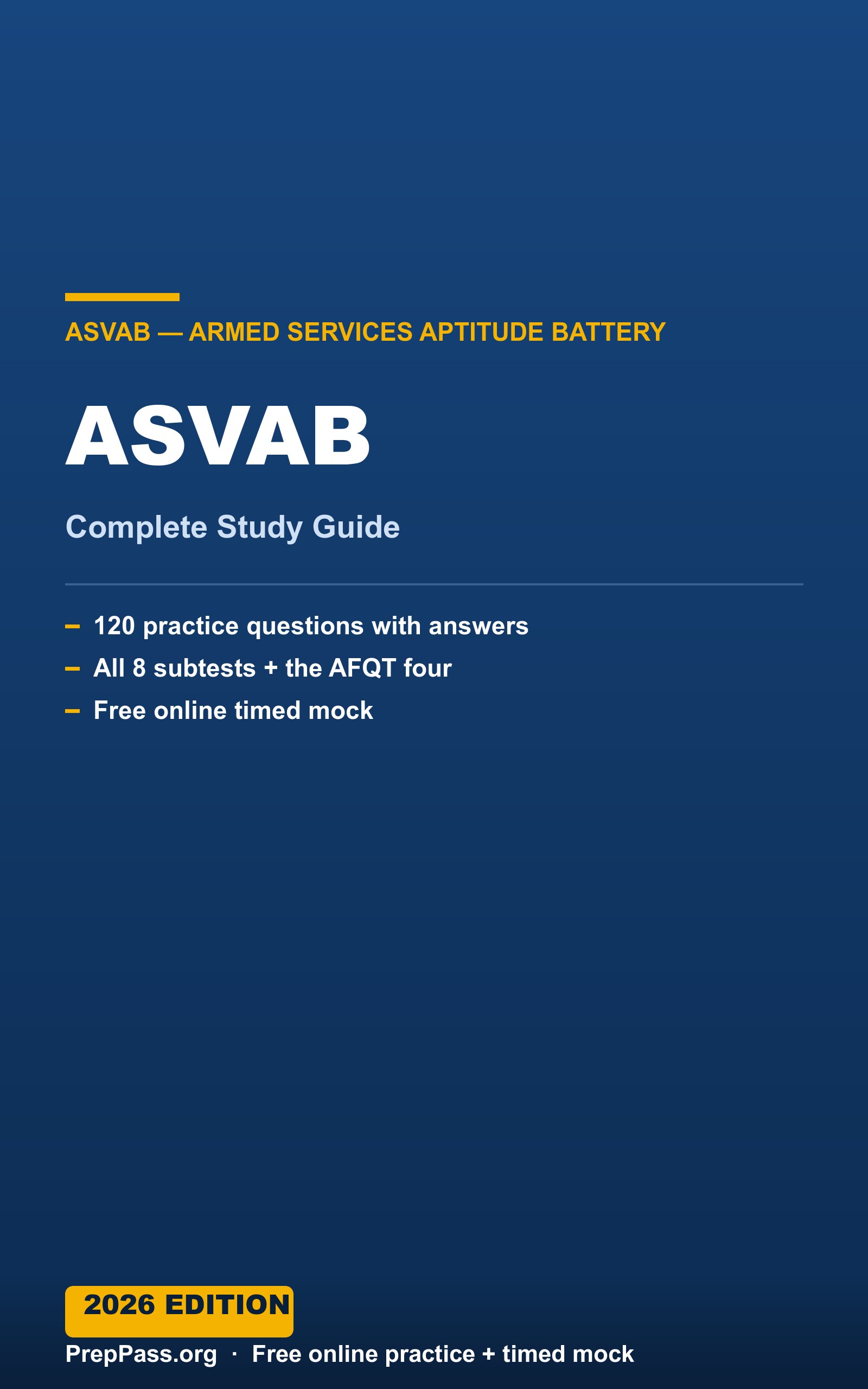
Trong sách hướng dẫn ASVAB: 9 chương phần thi, mỗi chương có bảng dữ kiện quan trọng, ví dụ giải sẵn, bẫy đề được gọi tên và bài tự kiểm tra. Luyện tập ở đây vẫn miễn phí.