ASVAB · Ấn bản 2026
ASVAB — Complete Study Guide (2026)
All ten ASVAB tests in nine chapters — the four AFQT tests that decide enlistment eligibility taught first, and Assembling Objects included.
- 9 chương phần thi, mỗi chương có bảng dữ kiện quan trọng, ví dụ giải sẵn, bẫy đề được gọi tên và bài tự kiểm tra
- Một đề thi thử đầy đủ ở cuối sách, kèm lập luận cho từng đáp án
- 8 phụ lục tra cứu: bảng công thức, công thức điểm tổng hợp, gốc từ, từ vựng, kế hoạch ôn tập, chiến lược ngày thi, câu hỏi cho nhà tuyển quân và bảng thuật ngữ
$19.99trả một lần · tải trọn đời · không thuê bao
PDF + EPUB · tiếng Anh · 328 trang · $19.99 trả một lần
Sách này được viết bằng tiếng Anh — tệp PDF và EPUB bạn tải về đều bằng tiếng Anh.
Tải ngay sau khi thanh toán — không cần tài khoản, không thuê bao.
Đảm bảo hoàn tiền 14 ngày: không hài lòng vì bất kỳ lý do gì? Email support@preppass.org trong vòng 14 ngày kể từ khi mua để được hoàn tiền đầy đủ. Đây là bản tải xuống nên không phải gửi trả gì cả. Chính sách hoàn tiền
Thông tin kỳ thi được đối chiếu với nguồn chính thức lần gần nhất: tháng 9 năm 2026.
Thử 10 câu trước — miễn phí
Trả lời hết 10 câu, nộp bài xong sẽ thấy lời giải từng câu — kèm phần trong sách này dạy nội dung đó. Khoảng 5 phút, không cần đăng ký.
Bắt đầu 10 câu miễn phíXem bên trong cuốn sách
Ba trang thật, kết xuất thẳng từ tệp PDF bạn sẽ tải — lần lượt là một trang tra cứu, một trang giảng giải, và một câu hỏi có lời giải. Không trang nào được vẽ lại cho đẹp.
- Trang tra cứu nhanhChapter 3 — Word Knowledge (WK) · Trang 71 của PDF
Một trang để lật lại: các con số, mốc thời hạn hoặc thuật ngữ gom về một chỗ.
- Cách giảng dạyChapter 1 — Scores, Line Scores, and the Job You Actually Want · Trang 26 của PDF
Trang giảng giải: kiến thức được trình bày bằng văn xuôi, theo trình tự kỳ thi kiểm tra.
- Một câu hỏi có lời giảiChapter 1 — Scores, Line Scores, and the Job You Actually Want · Trang 21 của PDF
Một câu luyện tập kèm đáp án và lập luận đằng sau — không chỉ là đáp án.
Ôn cả hai môn? Có giá combo
- ASVAB — Complete Study Guide (2026)$19.99
- ASVAB — Cheat Sheet (2026)$9.99
Mua cả hai: $22.99 — tiết kiệm $6.99 so với mua riêng
Mua riêng $29.98 · giảm 23% · Một lần thanh toán, cả hai phần.
Đã mua ASVAB rồi? Đừng mua combo — combo có sẵn cuốn đó và bạn sẽ trả tiền hai lần. Mua riêng ASVAB với giá $19.99. ASVAB · Combo gồm gì →
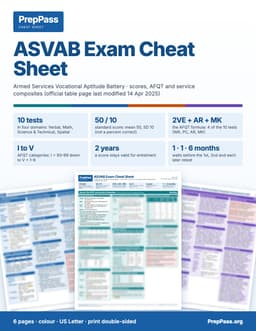
Thi trong vòng hai tuần?
Sách này là phần giảng dạy, đọc trong nhiều tuần. Nếu bạn thi trong vòng hai tuần, bảng tra cứu màu in được là sản phẩm còn lại: các con số then chốt, xếp theo từng phần.
6 trang · US Letter · PDF in được · giữ vĩnh viễn
Về chính kỳ thi này
| Cơ quan quản lý | U.S. Department of Defense Nguồn: Official ASVAB — What to Expect When You Take the ASVAB |
|---|---|
| Số câu hỏi | 135 câu hỏi Nguồn: Official ASVAB — ASVAB Fact Sheet, Enlistment Testing Program (PDF, revised April 2025) |
| Thời gian làm bài | 197 phút Nguồn: Official ASVAB — ASVAB Fact Sheet, Enlistment Testing Program (PDF, revised April 2025) |
| Điểm đậu | Không có điểm đậu. Việc đủ điều kiện nhập ngũ phụ thuộc vào điểm AFQT, được tính từ bốn bài (Arithmetic Reasoning, Mathematics Knowledge, Paragraph Comprehension, Word Knowledge) và báo cáo dưới dạng bách phân vị từ 1-99 — thứ hạng so với mẫu toàn quốc năm 1997 gồm thanh niên 18 đến 23 tuổi, không phải tỷ lệ phần trăm câu trả lời đúng. Các trang ASVAB của Bộ Quốc phòng không nêu mức AFQT tối thiểu để nhập ngũ. Những trang chúng tôi đã đọc và không tìm thấy: Official ASVAB — Understanding ASVAB Scores |
| Lệ phí | U.S. Department of Defense không công bố Những trang chúng tôi đã đọc và không tìm thấy: Official ASVAB — What to Expect When You Take the ASVAB |
| Ngôn ngữ thi | Tiếng Anh Nguồn: Official ASVAB — Frequently Asked Questions (applicants) |
Có gì — và không có gì
Bao gồm
- Key numbers & facts boxed in every test chapter, plus a self-check to close it
- Worked examples with the arithmetic shown, and the common traps named — not just the answer
- All 10 tests in 9 chapters, with the AFQT four (AR, WK, PC, MK) taught first — Assembling Objects included
- Math and algebra/geometry worked step by step with checked arithmetic
- General science, electronics, mechanical, and auto & shop review
- Word Knowledge roots and Paragraph Comprehension strategy
- 120 original practice questions with answer explanations
- PDF (print & tab it) + EPUB (phone / e-reader)
Không bao gồm
- Không gửi bản in — đây là tệp bạn tải về và có thể tự in
- Sách không kèm khoá video, giảng viên hay kèm riêng — video miễn phí trên trang là phần khác
- Không bao gồm lệ phí đăng ký thi hay phí trung tâm khảo thí — bạn vẫn nộp cho cơ quan chính thức
Mục lục
Xem 26 phần và trang bắt đầu của từng phần
- Part I — What the ASVAB actually decidestr. 6
- Chapter 1 — Scores, Line Scores, and the Job You Actually Wanttr. 6
- Part II — The nine tests, taughttr. 6
- Answer Key with Explanations.tr. 8
- Chapter 2 — Arithmetic Reasoning (AR)tr. 41
- Chapter 3 — Word Knowledge (WK)tr. 70
- Chapter 4 — Paragraph Comprehension (PC)tr. 102
- Chapter 5 — Mathematics Knowledge (MK)tr. 122
- Part I — The coordinate plane Quantity Formulatr. 145
- Chapter 6 — General Science (GS)tr. 150
- Part I — Astronomytr. 168
- Chapter 7 — Electronics Information (EI)tr. 174
- Part I — Magnetism and machinestr. 191
- Chapter 8 — Mechanical Comprehension (MC)tr. 196
- Chapter 9 — Auto & Shop Information (AS)tr. 220
- Part I — Shop: cutting, striking, driving, grippingtr. 236
- Chapter 10 — Assembling Objects (AO)tr. 246
- Answer Key with Explanationstr. 283
- Appendix A — Master formula & fact sheettr. 295
- Appendix B — The composite formulas, on one pagetr. 306
- Appendix C — Word parts for Word Knowledgetr. 309
- Appendix D — High-frequency vocabularytr. 315
- Appendix E — Study planstr. 320
- Appendix F — Exam-day strategytr. 322
- Appendix G — What to ask your recruitertr. 324
- Appendix H — Glossary of key termstr. 326
Lấy từ chính tệp PDF bạn tải về, kèm trang bắt đầu của từng phần — không phải gõ tay ở đây.
Đọc miễn phí trọn một chương
Trọn vẹn một chương, đúng như trong eBook. Cuộn cửa sổ để đọc ngay tại đây; không cần tải, không cần email.
Đọc chương 5 ngay tại đây, không rời trang
Chúng tôi không đưa phần mở đầu dễ dãi — chương miễn phí mở thẳng vào một trong những phần đậm đặc nhất của cuốn sách, để bạn đánh giá cách dạy ở đúng chỗ kỳ thi trở nên khó.
AFQT test. Appears in 11 of the 19 published service composites — and is doubled in the Navy's Basic Electricity and Electronics composite.
Introduction
Arithmetic Reasoning hides the math inside a story. Mathematics Knowledge hands it to you directly: solve this equation, simplify this expression, find this area, evaluate this exponent. There is no translation step, which means there is nowhere to hide either. You either know the rule or you do not.
That makes MK the most memorizable of the four AFQT tests, and therefore the fastest one to improve. Every formula this test uses fits on one sheet of paper — Appendix A of this book is that sheet. A candidate with three weeks and a weak MK score is in a far better position than a candidate with three weeks and a weak WK score, because a formula can be learned on Tuesday and used on Wednesday.
MK also does double duty. The same algebra that MK tests directly is the algebra you need for Ohm's law in Chapter 7 and for mechanical advantage in Chapter 8. Learning to rearrange a formula here pays off in two more chapters.
This chapter works thirty-three examples across every topic the test uses. Work them with a pencil.
Learning objectives
After working this chapter you should be able to:
- Apply the order of operations correctly, including to nested and signed expressions.
- Use the laws of exponents and simplify square roots.
- Identify factors, multiples, primes, the greatest common factor and the least common multiple.
- Add, subtract, multiply and divide fractions, including mixed numbers.
- Combine like terms, distribute, multiply two binomials, and factor simple quadratics.
- Solve one-step, two-step and variables-on-both-sides linear equations, and check by substitution.
- Rearrange a formula to isolate any variable in it.
- Solve linear inequalities, including the sign flip.
- Solve a system of two linear equations by substitution or elimination.
- Apply the angle rules for lines, triangles and parallel lines cut by a transversal.
- Use the Pythagorean theorem and recognise the common triples and special right triangles.
- Compute perimeter, area, circumference, volume and surface area for the standard figures.
- Find slope, midpoint and distance on the coordinate plane.
Key formulas & facts
| Topic | Formula / rule |
|---|---|
| Order of operations | Parentheses → Exponents → Multiply/Divide (left to right) → Add/Subtract (left to right) |
| Exponent: product | aᵐ × aⁿ = aᵐ⁺ⁿ |
| Exponent: quotient | aᵐ ÷ aⁿ = aᵐ⁻ⁿ |
| Exponent: power of a power | (aᵐ)ⁿ = aᵐⁿ |
| Exponent: zero | a⁰ = 1 (for a ≠ 0) |
| Exponent: negative | a⁻ⁿ = 1 ÷ aⁿ |
| Square root | √a × √b = √(ab); √144 = 12 |
| Signed numbers | Subtracting a negative adds; a negative times a negative is positive |
| Distribution | a(b + c) = ab + ac |
| FOIL | (a + b)(c + d) = ac + ad + bc + bd |
| Difference of squares | a² − b² = (a + b)(a − b) |
| Perfect square | (a + b)² = a² + 2ab + b² |
| Solving equations | Do the same inverse operation to both sides |
| Inequalities | Multiplying or dividing by a negative reverses the inequality sign |
| Straight angle | 180 degrees; a full turn is 360 degrees |
| Complementary / supplementary | Sum to 90 / sum to 180 degrees |
| Triangle angle sum | 180 degrees |
| Pythagorean theorem | a² + b² = c², c the hypotenuse |
| Common triples | 3-4-5, 5-12-13, 8-15-17, and any multiple |
| 45-45-90 triangle | legs x, x; hypotenuse x√2 |
| 30-60-90 triangle | short leg x, long leg x√3, hypotenuse 2x |
| Area of a triangle | ½ × base × height |
| Rectangle | area = lw; perimeter = 2l + 2w |
| Parallelogram / trapezoid | bh / ½(b₁ + b₂)h |
| Circle | circumference = 2πr = πd; area = πr² (π ≈ 3.14) |
| Rectangular solid | volume = lwh; surface area = 2(lw + lh + wh) |
| Cube | volume = s³; surface area = 6s² |
| Cylinder | volume = πr²h |
| Slope | (y₂ − y₁) ÷ (x₂ − x₁) |
| Midpoint | ((x₁ + x₂)/2 , (y₁ + y₂)/2) |
| Distance | √((x₂ − x₁)² + (y₂ − y₁)²) |
Part A — Number properties and operations
Order of operations
Evaluate in this order, and never out of it:
- Parentheses (and anything inside a radical or above/below a fraction bar, which act as invisible parentheses)
- Exponents
- Multiplication and division, left to right — they have equal priority
- Addition and subtraction, left to right — equal priority
The two places people go wrong are both about "equal priority." Multiplication does not outrank division, and addition does not outrank subtraction. When operations of equal priority sit side by side, work left to right.
Worked example 1 — order of operations, written out
Evaluate 4² + 3³.
Exponents first. 4² = 4 × 4 = 16. 3³ = 3 × 3 × 3 = 27. Then add. 16 + 27 = 43. The trap. Adding first: 4 + 3 = 7, then something with the exponents. Exponents outrank addition, always.
Worked example 2 — equal priority, left to right
Evaluate 24 ÷ 6 × 2.
Division and multiplication have equal priority, so work left to right. 24 ÷ 6 = 4. Then 4 × 2 = 8. The trap. Doing the multiplication first because "multiplication comes before division in the mnemonic": 6 × 2 = 12, then 24 ÷ 12 = 2. That gives 2, which is wrong, and 2 will be among the choices. The rule to fix in your mind. The mnemonic lists multiplication and division together on one line, and addition and subtraction together on another. Within a line, left to right.
Worked example 3 — nested parentheses and a negative
Evaluate 3 × (8 − (5 − 9)) ÷ 2.
Innermost parentheses first. 5 − 9 = −4. Next parentheses. 8 − (−4). Subtracting a negative adds: 8 + 4 = 12. Now left to right through the multiplication and division. 3 × 12 = 36. Then 36 ÷ 2 = 18. The two traps in one problem. Doing 8 − 5 first (ignoring the inner parentheses) and mishandling the double negative. Write each stage on its own line; that is what stops both.
Exponents
An exponent counts repeated multiplication: 3³ = 3 × 3 × 3 = 27. The laws you need:
- Same base, multiplying — add the exponents. 2³ × 2⁴ = 2⁷ = 128.
- Same base, dividing — subtract the exponents. 5⁶ ÷ 5² = 5⁴ = 625.
- A power raised to a power — multiply the exponents. (3²)³ = 3⁶ = 729.
- Anything to the zero power is 1 (except zero itself). 7⁰ = 1.
- A negative exponent means the reciprocal. 2⁻³ = 1 ÷ 2³ = 1/8.
Worked example 4 — the exponent laws, applied
Simplify (2³ × 2²) ÷ 2⁴.
Numerator — same base, multiplying, so add exponents. 2³ × 2² = 2⁵. Now divide — same base, so subtract exponents. 2⁵ ÷ 2⁴ = 2¹ = 2. Check the long way. 8 × 4 = 32; 32 ÷ 16 = 2. ✓ The trap. Multiplying the exponents in the numerator: 3 × 2 = 6, giving 2⁶ ÷ 2⁴ = 4. Exponents multiply only when a power is raised to a power, not when two powers are multiplied.
Square roots
The square root of a number is the value that, multiplied by itself, gives it: √144 = 12 because 12 × 12 = 144.
Memorize the perfect squares to 15 — they appear constantly, in geometry as well as here:
| n | 1 | 2 | 3 | 4 | 5 | 6 | 7 | 8 | 9 | 10 | 11 | 12 | 13 | 14 | 15 |
|---|---|---|---|---|---|---|---|---|---|---|---|---|---|---|---|
| n² | 1 | 4 | 9 | 16 | 25 | 36 | 49 | 64 | 81 | 100 | 121 | 144 | 169 | 196 | 225 |
Simplifying a root: pull out the largest perfect-square factor. √50 = √(25 × 2) = √25 × √2 = 5√2.
Worked example 5 — simplifying a radical
Simplify √72.
Find the largest perfect square that divides 72. The perfect squares are 4, 9, 16, 25, 36… and 36 divides 72. 72 = 36 × 2. √72 = √36 × √2 = 6√2. Check it numerically. 6 × 1.414 ≈ 8.49, and 8.49² ≈ 72.1. ✓ A slower but safe route if you do not spot 36: 72 = 4 × 18, so √72 = 2√18; then 18 = 9 × 2, so 2√18 = 2 × 3√2 = 6√2. Same answer. Pulling out squares in stages always works.
Factors, multiples, primes
- A factor divides a number evenly. The factors of 12 are 1, 2, 3, 4, 6, 12.
- A multiple is that number times a whole number. The multiples of 12 are 12, 24, 36, 48…
- A prime has exactly two factors, 1 and itself: 2, 3, 5, 7, 11, 13, 17, 19, 23, 29. Two is the only even prime, and 1 is not prime.
- The greatest common factor (GCF) is the largest number dividing both.
- The least common multiple (LCM) is the smallest number both divide into.
Worked example 6 — GCF and LCM
Find the GCF and the LCM of 12 and 18.
Prime-factorize both. 12 = 2 × 2 × 3 = 2² × 3 18 = 2 × 3 × 3 = 2 × 3² GCF — take the lowest power of each shared prime. Shared primes are 2 and 3. Lowest power of 2 is 2¹; lowest power of 3 is 3¹. GCF = 2 × 3 = 6. LCM — take the highest power of every prime that appears. Highest power of 2 is 2²; of 3 is 3². LCM = 4 × 9 = 36. Check both. 6 divides 12 and 18. ✓ 36 is divisible by 12 (three times) and by 18 (twice). ✓ A useful cross-check. GCF × LCM = the product of the two numbers: 6 × 36 = 216, and 12 × 18 = 216. ✓ That identity holds for any pair and is a free way to catch an error.
Signed numbers
Three rules cover almost everything:
- Subtracting a negative is adding. 5 − (−3) = 5 + 3 = 8.
- A negative times a negative is positive; a negative times a positive is negative.
- A negative raised to an even power is positive; to an odd power, negative. (−2)² = 4, but (−2)³ = −8.
And one notational trap: −2² and (−2)² are different. Without parentheses, the exponent attaches to the 2 alone and the minus sign is applied afterwards: −2² = −(2²) = −4. With parentheses, the whole −2 is squared: (−2)² = +4.
Part B — Fractions
The four operations
- Multiply: multiply straight across, then reduce. (2/3) × (3/4) = 6/12 = 1/2.
- Divide: invert the second fraction and multiply. (2/3) ÷ (3/4) = (2/3) × (4/3) = 8/9.
- Add or subtract: get a common denominator first, then combine the numerators only.
- Mixed numbers: convert to improper fractions before doing anything else.
Worked example 7 — adding fractions with unlike denominators
Compute 3/4 + 5/6.
Find the LCM of the denominators. 4 = 2², 6 = 2 × 3, so the LCM is 2² × 3 = 12. Convert both. 3/4 = 9/12 (multiply top and bottom by 3). 5/6 = 10/12 (multiply top and bottom by 2). Add the numerators only. 9/12 + 10/12 = 19/12. Convert to a mixed number. 19 ÷ 12 = 1 remainder 7, so 1 7/12. The trap, named. Adding denominators: 3/4 + 5/6 = 8/10. This is the most common fraction error there is. Denominators tell you what size the pieces are; you do not add the sizes, you make them the same and then add how many you have.
Worked example 8 — dividing mixed numbers
Compute 2½ ÷ 1¼.
Convert to improper fractions first. 2½ = (2 × 2 + 1)/2 = 5/2. 1¼ = (1 × 4 + 1)/4 = 5/4. Divide by inverting the second and multiplying. (5/2) ÷ (5/4) = (5/2) × (4/5). Cancel before multiplying — it keeps the numbers small. The 5s cancel; 4 ÷ 2 = 2. Result: 2. Check. 1¼ × 2 = 2½. ✓ The trap. Trying to divide the whole parts and the fractions separately. Convert to improper fractions and the problem becomes mechanical.
Worked example 9 — comparing fractions without decimals
Which is larger, 5/8 or 7/11?
Cross-multiply, comparing the products in the right positions. 5 × 11 = 55 (this belongs to 5/8) 7 × 8 = 56 (this belongs to 7/11) 56 > 55, so 7/11 is larger. Check with decimals. 5/8 = 0.625; 7/11 = 0.636… ✓ Why cross-multiplication works. You are multiplying both fractions by the same positive quantity (8 × 11), which cannot change which is bigger. It is faster than long division and it does not round.
Trước khi mua
- Nhận sách thế nào?
- Thanh toán xong, mục tải xuống hiện ngay trên trang này. Liên kết cũng được gửi qua email. Không cần tài khoản.
- Nếu sách không hợp thì sao?
- Gửi email trong vòng 14 ngày để được hoàn tiền đầy đủ, không cần lý do.
- Phần luyện tập miễn phí có bị bỏ không?
- Không. Mọi câu hỏi luyện tập, bài thi thử tính giờ và các chương miễn phí trên trang vẫn miễn phí. Cuốn sách là nửa "học", không phải hàng rào quanh phần miễn phí.
- Đọc trên điện thoại được không?
- Được — EPUB cho điện thoại và máy đọc sách, PDF để in và dán tab. Bạn nhận cả hai.
Chi tiết
All ten ASVAB tests in nine chapters — the four AFQT tests that decide enlistment eligibility taught first, and Assembling Objects included.
- Format: PDF + EPUB download · 328 pages
- 120 practice questions in the book, with a full answer key
- 800 free practice questions for this exam on PrepPass, included at no cost
- $19.99 one-time — no subscription
- 14-day money-back guarantee · refund policy
- Cross-referenced against: ASVAB subtest outline / officialasvab.com
- Last updated: September 2026
- Đối chiếu từ nguồn chính thức(ASVAB subtest outline / officialasvab.com)
- 800 câu hỏi luyện tập miễn phí
- Tải ngay, thuộc về bạn trọn đời
Một ASVAB prep course có giá $88–$118. Cuốn sách này dạy cùng một kỳ thi — cùng quy định, đối chiếu theo chuẩn hiện hành — chỉ với $19.99 trả một lần, thuộc về bạn trọn đời.
Vì sao mua sách khi phần luyện tập miễn phí?
Câu hỏi luyện tập và bài thi thử tính giờ vẫn miễn phí — không có gì trên trang bị giấu sau cuốn sách này. Cuốn sách $19.99 là nửa "học": chính phần kiến thức, dạy theo trình tự, trong một tệp thuộc về bạn.
- Dạy có hệ thống — mọi phần thi giảng theo từng chương, từ đầu đến cuối, không chỉ là câu hỏi
- In ra & dán nhãn — PDF sẵn sàng để in, tô đậm, ghi chú và mang tới bàn học
- Học mọi nơi, ngoại tuyến — EPUB trên điện thoại hay máy đọc sách; không cần wifi, không cần tab trình duyệt
- Tất cả một chỗ — các chương và câu hỏi luyện tập trong một tệp
- Của bạn trọn đời — trả một lần $19.99, tải ngay, không thuê bao
Và không rủi ro: Đảm bảo hoàn tiền 14 ngày — không hài lòng? Email cho chúng tôi để hoàn tiền đầy đủ, không cần lý do. Xem chính sách hoàn tiền.
Đảm bảo hoàn tiền 14 ngày · hoàn tiền đầy đủ, không cần lý do.
Mua một lần, truy cập tải về trọn đời. eBook là trọn bộ hướng dẫn ôn ASVAB ở dạng PDF và EPUB. Bản tóm tắt mang tính giáo dục, không phải tư vấn chuyên môn hay pháp lý — luôn xác nhận quy định hiện hành với nguồn chính thức. Cập nhật lần cuối: September 2026.