ASVAB Practice Test
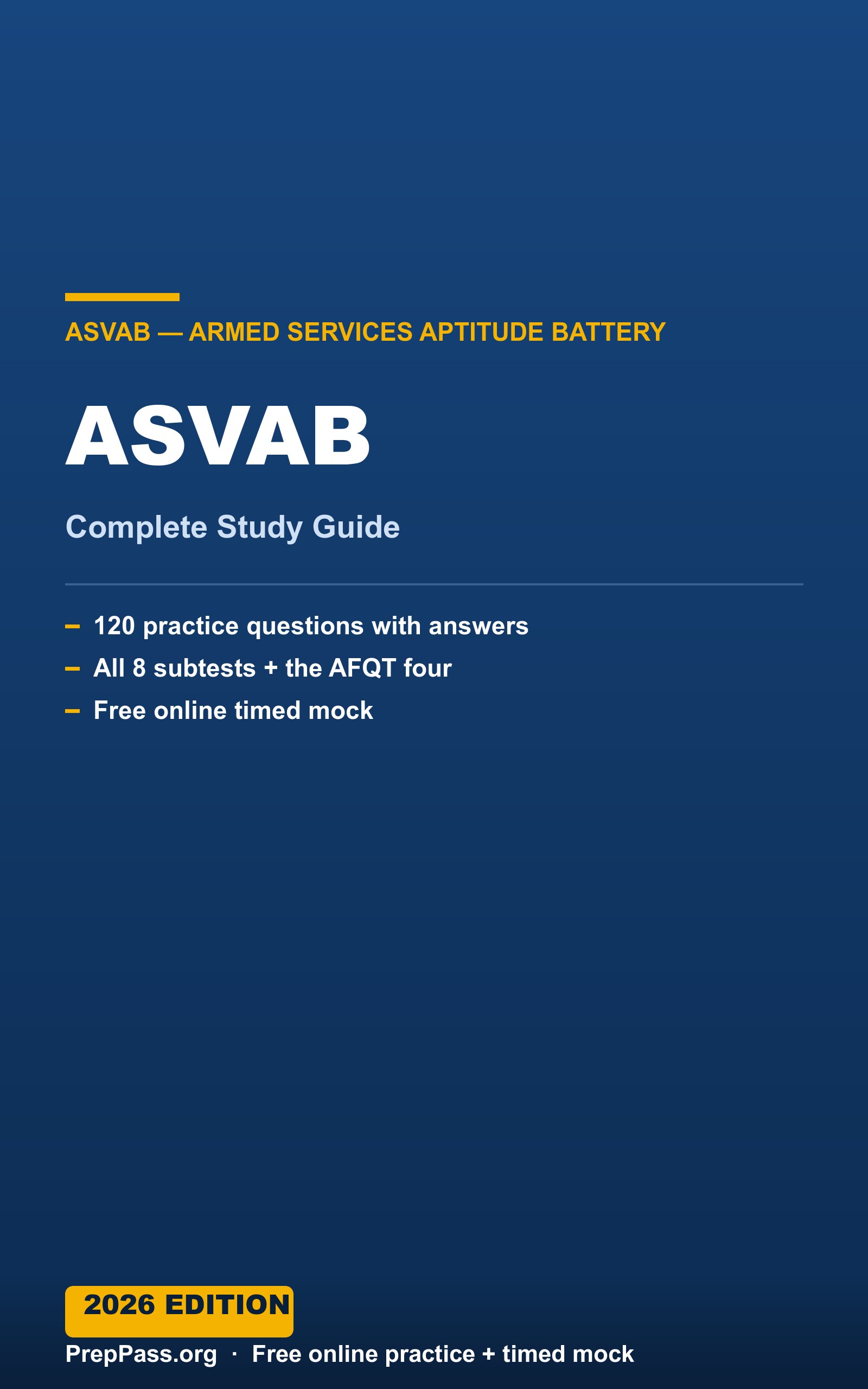
Trong sách hướng dẫn ASVAB: 9 chương phần thi, mỗi chương có bảng dữ kiện quan trọng, ví dụ giải sẵn, bẫy đề được gọi tên và bài tự kiểm tra. Luyện tập ở đây vẫn miễn phí.
Câu hỏi thường gặp
Có bao nhiêu câu hỏi luyện tập ASVAB ở đây?+
Một ngân hàng đầy đủ câu hỏi ASVAB nguyên gốc theo các lĩnh vực chính thức, có trọng số như bài thi thật, kèm giải thích. Miễn phí, không cần đăng ký.
Kỳ thi ASVAB như thế nào?+
Bài thi trắc nghiệm. Luyện theo chủ đề ở đây, rồi làm bài thi thử tính giờ để đánh giá mức sẵn sàng.
Đây có phải câu hỏi thi thật không?+
Không. Mọi câu hỏi đều 100% nguyên gốc, viết từ nguồn công khai kèm giải thích. Chúng tôi không sao chép câu hỏi thi thật hay tài liệu ôn thi trả phí.
Tôi có thể học bằng tiếng Trung hoặc tiếng Tây Ban Nha không?+
Phần luyện tập của PrepPass có tiếng Anh, 中文 và Español. Kỳ thi chính thức bằng tiếng Anh — chuyển ngôn ngữ câu hỏi sang tiếng Anh bất cứ lúc nào để làm quen thuật ngữ ngày thi.
Có sách hướng dẫn học ASVAB không?+
Có — PrepPass bán ASVAB — Complete Study Guide (2026), bản tải về PDF + EPUB, $19.99 trả một lần; phần luyện tập trên trang này vẫn miễn phí mà không cần sách. Xem sách hướng dẫn học →
Câu hỏi luyện tập mẫu
Một vài câu hỏi thực tế từ ngân hàng miễn phí này, kèm giải thích đầy đủ. Dùng công cụ luyện tập ở trên cho toàn bộ.
- 1. Arithmetic Reasoning
A train travels at a constant speed of 60 miles per hour. How long will it take to travel 180 miles?
- a.3.5 hours
- b.2 hours
- c.4 hours
- d.3 hours
Đáp án: d
Giải thích: Time equals distance divided by speed. Dividing 180 miles by 60 miles per hour gives 3 hours. Keeping the units consistent lets the miles cancel and leaves hours.
- 2. Electronics Information
A device that stores electrical charge is a:
- a.inductor
- b.resistor
- c.transformer
- d.capacitor
Đáp án: d
Giải thích: A capacitor stores electrical energy in an electric field between two plates. A resistor limits current, while an inductor stores energy in a magnetic field.
- 3. Arithmetic Reasoning
A shipment of 1,250 items has a defect rate of 4 percent. How many items are not defective?
- a.1,200 items
- b.1,206 items
- c.1,150 items
- d.1,246 items
Đáp án: a
Giải thích: Four percent of 1,250 is 50 defective items, so 1,250 - 50 = 1,200 are good.
- 4. Paragraph Comprehension
Coral reefs cover less than one percent of the ocean floor but shelter roughly a quarter of all marine species. The coral animal builds a stone skeleton, and generations of skeletons stack into a structure full of crevices. It is the crevices, more than the coral itself, that make the reef so crowded. The passage attributes the variety of reef life mainly to
- a.the many hiding places
- b.the warmth of the water
- c.the clarity of the water
- d.the coral animal's diet
Đáp án: a
Giải thích: The final sentence says it is the crevices, more than the coral itself, that make the reef so crowded.
- 5. General Science
A solar eclipse occurs when
- a.the Earth passes between the moon and the sun
- b.the moon moves into the Earth's own shadow
- c.the moon passes between the Earth and the sun
- d.the sun passes behind the far side of Earth
Đáp án: c
Giải thích: In a solar eclipse the moon blocks the sun from part of the Earth's surface. When the moon moves into Earth's shadow instead, the result is a lunar eclipse.
- 6. Arithmetic Reasoning
Two convoys leave bases 360 miles apart at the same time and drive toward each other on the same road, one at 50 miles per hour and the other at 40 miles per hour. How long until they meet?
- a.4.5 hours
- b.8.0 hours
- c.9.0 hours
- d.4.0 hours
Đáp án: d
Giải thích: Two vehicles closing on each other shut the gap at the SUM of their speeds: 50 + 40 = 90 mph, so the time is 360 / 90 = 4.0 hours. Averaging the speeds instead of adding gives 360 / 45 = 8.0 hours, and sending each convoy half the distance at its own speed gives 180 / 40 = 4.5 hours.
- 7. Mathematics Knowledge
What is the value of 40 - 6 x (9 - 5)^2 / 8?
- a.12
- b.28
- c.37
- d.68
Đáp án: b
Giải thích: Parentheses first, then the exponent, then multiply and divide left to right, and add or subtract last. 9 - 5 = 4 and 4^2 = 16; then 6 x 16 = 96 and 96 / 8 = 12, so 40 - 12 = 28. Skipping the exponent leaves 37, and doing 40 - 6 before multiplying gives 68.
- 8. Word Knowledge
Obstinate most nearly means
- a.obsolete
- b.yielding
- c.obedient
- d.stubborn
Đáp án: d
Giải thích: An obstinate mule or an obstinate refusal will not be moved by argument or evidence. Latin ob, against, plus stare, to stand: standing against you, the same stare behind stationary and obstacle. Yielding and obedient are its opposites, and obsolete, meaning out of date, only shares the opening letters.
- 9. Paragraph Comprehension
A tsunami sometimes announces itself by pulling the water off the beach, exposing sand and rocks that are normally under several feet of sea. The sight draws people out to look. The water that withdrew is the trough ahead of the wave, and it returns as a wall moving faster than anyone can run on wet sand. Anyone who sees the sea retreat without warning should move inland and uphill at once, and should not wait for an official alarm. The main purpose of this paragraph is to
- a.compare a tsunami with an ordinary storm wave
- b.warn readers about a sight that looks harmless
- c.explain how the sea floor shapes a wave's height
- d.describe how coastal alarm systems are operated
Đáp án: b
Giải thích: The paragraph names an inviting sight, says what it actually is, and closes with an instruction to move at once without waiting for an alarm. That shape is a warning. Alarms come up only in the advice not to wait for one, which is not the same as describing how they work.
- 10. General Science
A ball is dropped from a rooftop. As it falls toward the ground,
- a.kinetic energy becomes potential energy
- b.potential energy becomes kinetic energy
- c.potential energy becomes chemical energy
- d.kinetic energy becomes thermal energy
Đáp án: b
Giải thích: Gravity does work on the falling ball, so the store that depends on height shrinks while its speed and kinetic energy grow, and the total stays nearly constant until air drag bleeds some off as heat. The reverse conversion is what happens on the way up, as a thrown ball slows while climbing.