Sách ôn thi · Ấn bản 2026
CSLB C-13 Fencing Study Guide — 2026 Edition
Chain link, wire, wood, ornamental, vinyl, composite, pools, playgrounds and flagpoles, with Caltrans specifications and a full practice exam
Phiên bản: Written to CSLB's 13E-13 (03-2026) outline
- Độ dài
- 273 trang
- Câu hỏi luyện tập trong sách
- 435
- Thi thử trực tuyến PrepPass
- 100 câu · 210 phút
- Đối chiếu thông tin và cập nhật tệp
- tháng 11 năm 2026
- Giao hàng
- PDF + EPUB · tiếng Anh · tải ngay
Về cuốn sách này
Phí đăng ký thi (mỗi lần đăng ký, thi lần đầu hoặc thi lại): $51.43 mỗi lần thi, nộp cho PSI Services LLC. Thi lại phải nộp lại. Cuốn sách này: $24.99, trả một lần.
Thông tin kỳ thi, ai nên dùng và thay đổi
Về chính kỳ thi này
| Cơ quan quản lý | Contractors State License Board (CSLB), California Department of Consumer Affairs — kỳ thi do PSI Services LLC tổ chức |
|---|---|
| Số câu hỏi | CSLB không công bố Những trang chúng tôi đã đọc và không tìm thấy: CSLB — Step 7: Studying for the Examination |
| Thời gian làm bài | 210 phút |
| Điểm đậu | CSLB không công bố Những trang chúng tôi đã đọc và không tìm thấy: CSLB — Step 7: Studying for the Examination |
| Lệ phí |
Nguồn: CSLB — List of All CSLB Fees |
| Ngôn ngữ thi | Tiếng Anh |
Xem bên trong cuốn sách
Ba trang thật, kết xuất thẳng từ tệp PDF bạn sẽ tải — lần lượt là một trang tra cứu, một trang giảng giải, và một câu hỏi có lời giải. Không trang nào được vẽ lại cho đẹp.
- Trang tra cứu nhanhChapter 3 — Fence, Gate, and Rail Installation and Repair (50%) · Trang 71 của PDF
Một trang để lật lại: các con số, mốc thời hạn hoặc thuật ngữ gom về một chỗ.
- Cách giảng dạyAppendix E — Extra practice sets · Trang 206 của PDF
Trang giảng giải: kiến thức được trình bày bằng văn xuôi, theo trình tự kỳ thi kiểm tra.
- Một câu hỏi có lời giảiChapter 2 — Preparation and Post Installation (18%) · Trang 52 của PDF
Một câu luyện tập kèm đáp án và lập luận đằng sau — không chỉ là đáp án.
Thi trong vòng hai tuần?
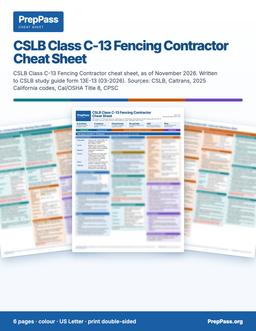
Sách này là phần giảng dạy, đọc trong nhiều tuần. Nếu bạn thi trong vòng hai tuần, bảng tra cứu màu in được là sản phẩm còn lại: các con số then chốt, xếp theo từng phần.
6 trang · US Letter · PDF in được · giữ vĩnh viễn
Có gì — và không có gì
Bao gồm
- Four chapters at CSLB's published weights: 16%, 18%, 50% and 16%
- Worked estimates: posts and spaces, fabric less gates, concrete volume and bags, markup and margin
Không bao gồm
- Không gửi bản in — đây là tệp bạn tải về và có thể tự in
- Sách không kèm khoá video, giảng viên hay kèm riêng — video miễn phí trên trang là phần khác
Toàn bộ phần bao gồm và không bao gồm
Bao gồm
- Caltrans chain-link and wire-fence numbers: gauge, fasteners, bracing, gates, pull posts, grounding
- Pool barrier, playground and tennis-court rules, plus ground-sleeve flagpole installation
- Cal/OSHA heat, wildfire smoke, excavation and utility-strike procedures
- 435 original practice questions: 66 chapter-quiz, a 100-question practice exam and 269 extra-practice
Không bao gồm
- Không bao gồm lệ phí đăng ký thi hay phí trung tâm khảo thí — bạn vẫn nộp cho cơ quan chính thức
Mục lục
Xem 15 phần và trang bắt đầu của từng phần
- Chapter 1 — Planning and Estimating (16%)tr. 14
- Chapter 2 — Preparation and Post Installation (18%)tr. 35
- Chapter 3 — Fence, Gate, and Rail Installation and Repair (50%)tr. 55
- Chapter 4 — Safety (16%)tr. 115
- Practice exam — 100 questionstr. 139
- Section 1 — Planning and Estimating (16 questions)tr. 139
- Section 2 — Preparation and Post Installation (18 questions)tr. 143
- Section 3 — Fence, Gate, and Rail Installation and Repair (50 questions)tr. 146
- Section 4 — Safety (16 questions)tr. 157
- Practice exam answer key and explanationstr. 161
- Appendix A — Formulas and quick referencetr. 172
- Appendix B — Terms the exam expects you to use preciselytr. 175
- Appendix C — Numbers with edition flagstr. 177
- Appendix D — Pairs the exam likes to confusetr. 180
- Appendix E — Extra practice setstr. 181
Lấy từ chính tệp PDF bạn tải về, kèm trang bắt đầu của từng phần — không phải gõ tay ở đây.
Đọc miễn phí trọn một chương
Trọn vẹn một chương, đúng như trong eBook. Cuộn cửa sổ để đọc ngay tại đây; không cần tải, không cần email.
Đọc chương 1 ngay tại đây, không rời trang
The Board gives Planning and Estimating about 16% of the C-13 examination and lists three knowledge statements under it: planning fencing projects, reading and interpreting plans, and estimating fencing projects.[1] This is the section where the arithmetic lives. The Board says some questions require mathematical computation and that a calculator is provided, so the keystrokes will not be the hard part.[1] The hard part is the set-up: measuring along the slope instead of along the map, counting posts for a run instead of a line, taking a gate opening out of the fabric footage, or reading a hole size as a diameter when the table gave a width. Most wrong answers on estimating questions are set-up mistakes, and this chapter spends its time there.
Sixteen percent is a small share of the exam, but it is the share that feeds every other chapter. A contractor who plans badly digs in the wrong place, sets the wrong post, and runs short of concrete on a Friday afternoon.
1.1 Planning fencing projects
What a C-13 contractor is licensed to build
Start with the license itself, because scope questions are planning questions. The Board's classification text says a fencing contractor "constructs, erects, alters, or repairs all types of fences, corrals, runs, railings, cribs, game court enclosures, guard rails and barriers, playground game equipment, backstops, posts, flagpoles, and gates, excluding masonry walls."[2]
Read that sentence as a list of things you may build, and notice how closely it matches the Board's outline. The eight bullets under the Fence, Gate, and Rail Installation and Repair section are chain-link, agricultural, wood, ornamental, vinyl, composite and laminate fences and gates, playgrounds, swimming pools and game courts, and flagpoles.[1] The license words "game court enclosures" and "backstops" are the tennis and sport-court material; "railings," "guard rails" and "barriers" are the rail work; "flagpoles" is its own bullet. The two limits worth remembering are the last three words, "excluding masonry walls," and the fact that the definition is about fences and their accessories, not about the grading, paving or electrical work that sometimes comes with a fence job.
The purpose comes first
Every plan for a fence starts with one question: what is this fence for? The answer changes almost every later choice. The federal conservation standard for fences defines a fence as "a constructed barrier to animals or people" and says its purpose is to "control the movement of animals, people, and vehicles."[3] Put that into trade terms:
- Containment of livestock, pets or children: height, no gaps a small animal or child can pass, a gate that closes and latches itself.
- Security against people or vehicles: height, top treatment such as barbed wire, a gate that locks, posts heavy enough to resist force.
- Privacy and screening: solid or slatted material, which catches wind and needs bigger footings. The Caltrans plan sizes slatted chain-link posts and footings larger than plain fabric of the same height.[4]
- Boundary marking where nothing needs to be stopped, only shown.
- Pool barriers, which are a legal safety device with fixed dimensions (Chapter 3, section 3.7).
- Sport enclosures, which keep balls in and uninvited traffic out and keep players from colliding with fixed objects.[5]
- Decoration and curb appeal, where the finish and the style are the product.
A fence built for the wrong purpose can be well built and still fail the customer. A plain 4-foot picket fence is a good boundary marker and a poor pool barrier; a 6-foot privacy fence is a good screen and, if its bottom rail leaves a wide gap, a poor dog run.
Who owns the line
A fence runs along a property line more often than not, so planning includes the legal question of whose fence it is. California's fence statute says adjoining landowners "are presumed to share an equal benefit from any fence dividing their properties" and, unless they agree otherwise in writing, are presumed "equally responsible for the reasonable costs of construction, maintenance, or necessary replacement of the fence."[6] The statute also tells a landowner who intends to incur those costs to give each affected neighbor "30 days' prior written notice," and lists what the notice must say: the problem, the proposed solution, the estimated costs, the proposed cost sharing and the timeline.[6] The presumption can be overcome, in court, if equal sharing "would be unjust."[6]
You are not the lawyer on the job, but you are the person standing at the property line with a quote in your hand. The practical rules are these:
- Ask who is paying and whether the neighbor has agreed, in writing, before you order material for a shared line.
- Do not guess where the line is. Locate the property markers; the manufacturer instructions for one installer's chain-link manual begin with "Locate the boundary lines to your property."[7]
- Set the footings inside the line. The same manual sets corner, end and gate posts "4" inside line so concrete footings do not encroach onto any adjoining property."[7]
- Remember that the law also limits a fence that is built to annoy: a fence "unnecessarily exceeding 10 feet in height maliciously erected or maintained for the purpose of annoying the owner or occupant of adjoining property is a private nuisance."[8]
Permits and local rules
The State sets the building code; the city or county sets height limits, setbacks and design review, and a homeowners association may add more. The 2025 California Building Code's administrative chapter lists work that is exempt from a building permit, and the list includes "Fences, other than swimming pool barriers, not over 7 feet (2134 mm) high."[9] Three points follow:
- The exemption is for fences not over 7 feet, so a taller fence needs a permit under that list.
- The exemption excludes swimming pool barriers. A pool barrier is a permit and inspection item. When a permit is issued for a new pool at a private single-family home, the local building official inspects the drowning-prevention features before final approval.[10]
- The same list says exemptions do not "grant authorization for any work to be done in any manner in violation of the provisions of this code or any other laws or ordinances of this jurisdiction."[9] A fence can be permit-exempt and still be too tall for the zoning rules.
Aluminum-fence instructions from one retailer put the same warning in a sentence: "Some HOAs require a setback from your property line, so be sure to follow all local codes and regulations."[11] The planning rule is to check the local height and setback rules, any HOA rules and the permit status before the contract is signed.
Underground utilities: the call comes before the dig
Digging is the largest hazard in fence planning, and the law gives you a process. The Board's study guide lists the Underground Service Alert guidelines among its references and names Government Code 4216.[1] The statute defines "excavation" to include digging and augering, which is what a post-hole auger does.[12] The steps in the order you meet them:
- Delineate. Before notifying the regional notification center, the excavator "shall delineate the area to be excavated."[13] Delineating means marking the area in white.[12]
- Notify. Except in an emergency, notify the regional notification center "at least two working days, and not more than 14 calendar days, before beginning that excavation," and "the date of the notification shall not count as part of the two-working-day notice."[13] The call is to 811.[13]
- Wait for the operators. An excavator may not begin until every operator on the ticket has located and marked, provided information or said it has nothing in the area, and until any required on-site meeting is complete.[13]
- Respect the tolerance zone. The "tolerance zone" is "24 inches on each side of the field marking."[12] Inside it, the excavator "shall determine the exact location of the subsurface installations in conflict with the excavation using hand tools before using any power-driven excavation or boring equipment."[14]
- Keep the ticket alive. A ticket is "valid for 28 days from the date of issuance," and if work continues the excavator renews it.[13]
Cal/OSHA says the same thing from the worker's side: excavation shall not commence until the area has been marked as the Government Code specifies and the excavator "has received a positive response from all known owner/operators of subsurface installations."[15] Chapter 4 returns to this as a safety rule; here it is a scheduling rule. If you need to dig on Monday, you called last week.
Site conditions
Walk the site before you price it. The conditions that move the price:
- Slope. Post spacing and fence length are measured along the ground, not along the map. The Caltrans specification says to "measure post spacing parallel to the ground slope," and it pays fence by the length measured "parallel to the ground slope" and "along the fence."[16]
- Obstructions. Trees, brush, boulders and old fence. The Caltrans fence section begins construction with "Remove earth, trees, brush, and other obstructions that interfere with fence construction."[16] The conservation standard adds that vegetation clearing should avoid the nesting and brood-rearing seasons for migratory and ground-nesting birds.[3]
- Soil. Rock and caliche slow the auger; sandy or soft soil may need larger holes. One flagpole maker says to increase the hole diameter "when installing the pole in soft or sandy soil to ensure a stable foundation."[17]
- Overhead lines. Look up. Cal/OSHA prohibits handling tools, materials or structures closer than the table clearances to energized overhead high-voltage lines, and the first row of the table is 6 feet for 600 to 50,000 volts.[18]
- Drainage and grade. Concrete footings are crowned to shed water and the Caltrans specification requires it.[16]
- Access. Can the truck reach the line, or is every bag going over the fence by hand?
Sequencing the job
A fence job has a natural order, and a good plan respects the curing time of the footings:
- Locate the line and the utilities; call 811 and wait out the notice period.
- Lay out and mark post positions (Chapter 2, section 2.1).
- Set the terminal posts (end, corner, gate, pull) in concrete.
- Let the footings harden. One chain-link manual says to wait until the footings have hardened enough for posts to remain plumb, "usually about 24 hours," before stringing the line posts.[7]
- Set line posts, hang rails or top rail.
- Hang fabric, panels or pickets, then hang and adjust the gates.
- Clean up, dispose of waste properly, and walk the owner through it.
Gates change the sequence in some systems. One vinyl manufacturer says gates "must be assembled prior to fence to accurately establish space between hinge and latch posts and height of fence."[19]
Worked example 1.1 — Planning the digging date
A crew wants to start digging on a Thursday morning. Working backward with the Government Code rule, when must the 811 call be made at the latest?
- The notice must be given "at least two working days" before the excavation begins, and the date of the call does not count.[13]
- Thursday is the start. Count back two working days that are not the day of the call: Wednesday is one, Tuesday is two.
- The call therefore has to be made no later than Monday, so that Tuesday and Wednesday are the two full working days.
- It must also be no more than 14 calendar days before the dig, so the window for the call is Monday back to the Thursday two weeks earlier.
The ticket itself states the legal excavation start date and time; if a holiday falls in the span, the working-day count moves with it, because a working day is a weekday and excludes federal and state holidays.[12] On the job you read the ticket, not the calendar.
Named traps — planning
- "The fence is under 7 feet, so no permit." Not if it is a swimming pool barrier. The exemption says "other than swimming pool barriers."[9]
- "The two days include the day I called." They do not.[13]
- "I called last month, so the ticket is fine." A ticket is valid 28 days, and the call must also be no more than 14 calendar days ahead of the dig.[13]
- "The neighbor said it was fine." The statute's cost-sharing notice is written.[6]
- "The fence goes right on the line." Terminal-post footings are set inside the line so the concrete does not cross it.[7]
Sources cited in this excerpt
- CSLB License Examination Study Guide: Fencing (C-13), form 13E-13 (03-2026), for examinations scheduled on or after October 1, 2023. Contractors State License Board (CSLB), 2026-03; read 2026-11-08. https://www.cslb.ca.gov/Resources/StudyGuides/C13StudyGuide.pdf
- C-13 - Fencing Contractor (classification description), CSLB web page. Contractors State License Board (CSLB), read 2026-11-08. https://www.cslb.ca.gov/About_Us/Library/Licensing_Classifications/Licensing_Classifications_Detail.aspx?Class=C-13
- Conservation Practice Standard, Fence, Code 382, California (September 2022). USDA Natural Resources Conservation Service, 2022-09; read 2026-11-08. https://efotg.sc.egov.usda.gov/api/CPSFile/38173/382_CA_CPS_Fence_2022
- Caltrans 2024 Standard Plans, sheets A85 and A86 (hand transcription of the printed tables and notes). California Department of Transportation (Caltrans), plans approval date 2024-09-20; read 2026-11-08. https://dot.ca.gov/-/media/dot-media/programs/design/documents/2024-standard-plans-locked-a11y.pdf
- F3684 Standard Guide for Tennis Court Fencing and Other Perimeter Enclosures (scope abstract). ASTM International (store page), read 2026-11-08. https://store.astm.org/f3684-24.html
- California Civil Code section 841 (adjoining landowners and fences), as published by California.Public.Law. State of California, via California.Public.Law, read 2026-11-08. https://california.public.law/codes/civil_code_section_841
- Eight Steps to Chain-Link Fence Installation (installation manual). Hoover Fence Co., read 2026-11-08. https://www.hooverfence.com/mas_assets/theme/hooverfence/pdfs/chain-link-fence-install-manual.pdf
- California Civil Code section 841.4 (spite fences), as published by California.Public.Law. State of California, via California.Public.Law, read 2026-11-08. https://california.public.law/codes/civil_code_section_841.4
- 2025 California Building Code, Chapter 1 Scope and Administration (UpCodes viewer). California Building Standards Commission, via UpCodes, 2025 edition, effective 2026-01-01; read 2026-11-08. https://up.codes/viewer/california/ca-building-code-2025/chapter/1/scope-and-administration
- California Health and Safety Code section 115922 (drowning prevention safety features), as published by California.Public.Law. State of California, via California.Public.Law, read 2026-11-08. https://california.public.law/codes/ca_health_and_safety_code_section_115922
- How to Install Aluminum Fencing and Gates (installation instructions). OnlineFenceStore.com, read 2026-11-08. https://onlinefencestore.com/content/Resources/Aluminum_Installation_Instruction.pdf
- California Government Code section 4216 (excavation definitions), as published by California.Public.Law. State of California, via California.Public.Law, read 2026-11-08. https://california.public.law/codes/ca_gov't_code_section_4216
- California Government Code section 4216.2 (excavator duties before excavation), as published by California.Public.Law. State of California, via California.Public.Law, read 2026-11-08. https://california.public.law/codes/ca_gov't_code_section_4216.2
- California Government Code section 4216.4 (excavator duties near subsurface installations), as published by California.Public.Law. State of California, via California.Public.Law, read 2026-11-08. https://california.public.law/codes/ca_gov't_code_section_4216.4
- California Code of Regulations, Title 8, section 1541. General Requirements (excavations). California Department of Industrial Relations (Cal/OSHA), read 2026-11-08. https://www.dir.ca.gov/title8/1541.html
- Caltrans 2024 Standard Specifications, Section 80 Fences. California Department of Transportation (Caltrans), 2024 edition; read 2026-11-08. https://dot.ca.gov/-/media/dot-media/programs/design/documents/2024_stdspecs-a11y.pdf
- Installation Instructions for Ground Sleeve Flagpoles. Flagpole Warehouse, 2024-09; read 2026-11-08. https://www.flagpolewarehouse.com/wp-content/uploads/2024/09/I01_Installation_instructions_ground_sleeve-1.pdf
- California Code of Regulations, Title 8, section 2946. Provisions for Preventing Accidents Due to Proximity to Overhead Lines. California Department of Industrial Relations (Cal/OSHA), read 2026-11-08. https://www.dir.ca.gov/title8/2946.html
- Bufftech Vinyl Fence Complete Installation Manual. Hoover Fence Co. (distributing the manufacturer's manual), read 2026-11-08. https://www.hooverfence.com/mas_assets/theme/hooverfence/pdfs/BufftechCompleteManual.pdf
Câu hỏi người mua thường hỏi
Nhận sách thế nào?
Thanh toán xong, mục tải xuống hiện ngay trên trang này. Liên kết cũng được gửi qua email. Không cần tài khoản.
Nếu sách không hợp thì sao?
Gửi email trong vòng 14 ngày để được hoàn tiền đầy đủ, không cần lý do.
Phần luyện tập miễn phí có bị bỏ không?
Không. Mọi câu hỏi luyện tập, bài thi thử tính giờ và các chương miễn phí trên trang vẫn miễn phí. Cuốn sách là nửa "học", không phải hàng rào quanh phần miễn phí.
Thêm câu hỏi (1)
Đọc trên điện thoại được không?
Được — EPUB cho điện thoại và máy đọc sách, PDF để in và dán tab. Bạn nhận cả hai.
Vì sao mua sách khi phần luyện tập miễn phí?
Câu hỏi luyện tập và bài thi thử tính giờ vẫn miễn phí — không có gì trên trang bị giấu sau cuốn sách này. Cuốn sách $24.99 là nửa "học": chính phần kiến thức, dạy theo trình tự, trong một tệp thuộc về bạn.
- Dạy có hệ thống — mọi phần thi giảng theo từng chương, từ đầu đến cuối, không chỉ là câu hỏi
- In ra & dán nhãn — PDF sẵn sàng để in, tô đậm, ghi chú và mang tới bàn học
- Học mọi nơi, ngoại tuyến — EPUB trên điện thoại hay máy đọc sách; không cần wifi, không cần tab trình duyệt
- Tất cả một chỗ — các chương và câu hỏi luyện tập trong một tệp
- Của bạn trọn đời — trả một lần $24.99, tải ngay, không thuê bao
Chi tiết
- Đối chiếu từ nguồn chính thức(CSLB C-13 study guide 13E-13 (03-2026) and the CSLB Examination FAQ, with the primary sources listed in the book's Sources chapter, read November 2026)
- 269 câu hỏi luyện tập miễn phí
Một CSLB exam prep course có giá $200–$800. Cuốn sách này dạy cùng một kỳ thi — cùng quy định, đối chiếu theo chuẩn hiện hành — chỉ với $24.99 trả một lần, thuộc về bạn trọn đời.
Mua một lần, truy cập tải về trọn đời. eBook là trọn bộ hướng dẫn ôn CSLB C-13 Fencing ở dạng PDF và EPUB. Bản tóm tắt mang tính giáo dục, không phải tư vấn chuyên môn hay pháp lý — luôn xác nhận quy định hiện hành với nguồn chính thức. Cập nhật lần cuối: November 2026.