CSLB C-39 Roofing · Ấn bản 2026
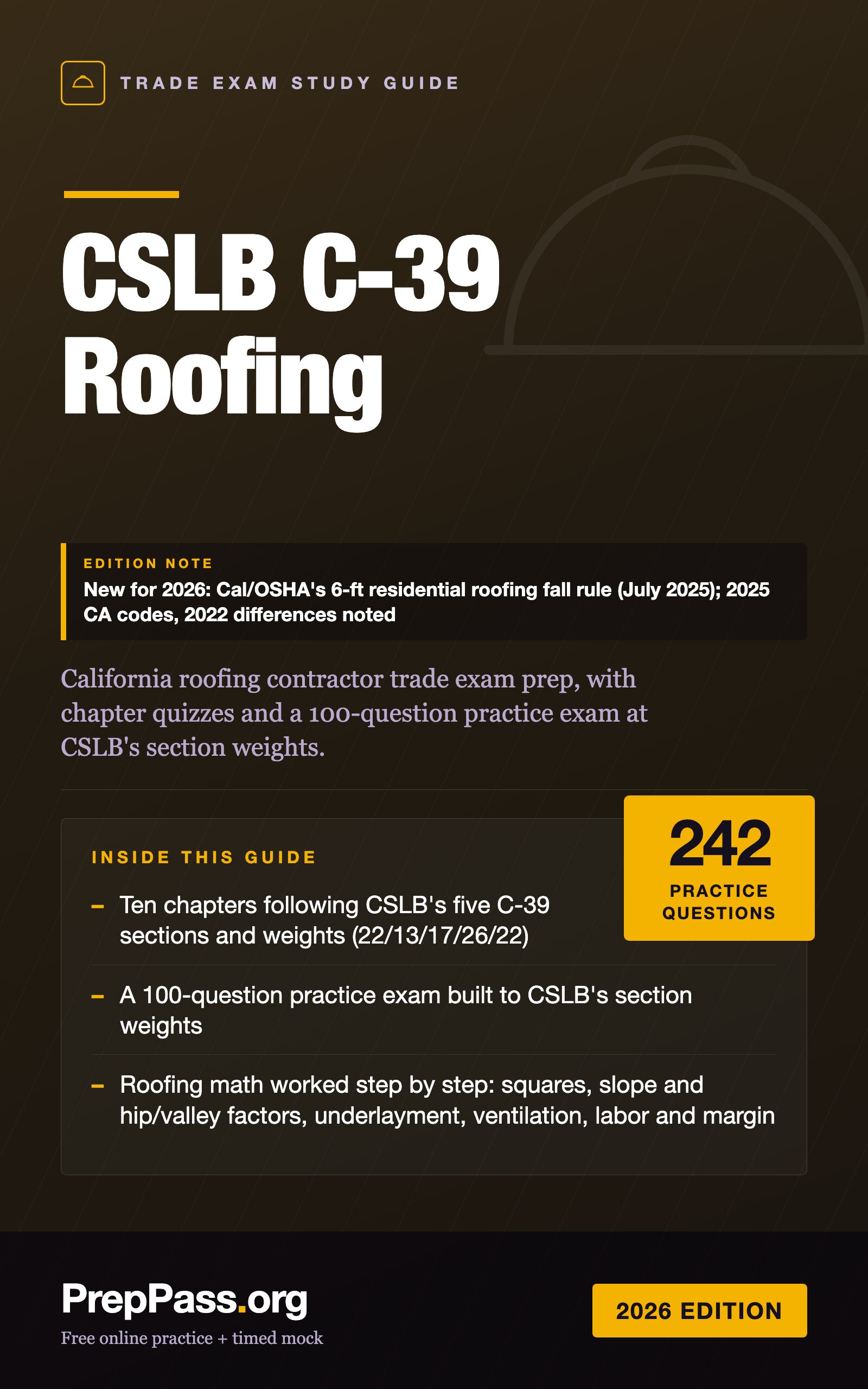
CSLB C-39 Roofing Trade Exam Study Guide (2026)
Ghi chú phiên bảnNew for 2026: Cal/OSHA's 6-ft residential roofing fall rule (July 2025); 2025 CA codes, 2022 differences noted
California roofing contractor trade exam prep, with chapter quizzes and a 100-question practice exam at CSLB's section weights.
- 242 câu hỏi luyện tập môn nghề lợp mái CSLB gốc, mỗi câu kèm lời giải, trong một bản PDF + EPUB bạn giữ
PDF + EPUB · tiếng Anh · 226 trang · $24.99 trả một lần
Sách này được viết bằng tiếng Anh — tệp PDF và EPUB bạn tải về đều bằng tiếng Anh.
Tải ngay sau khi thanh toán — không cần tài khoản, không thuê bao.
Đảm bảo hoàn tiền 14 ngày: không hài lòng vì bất kỳ lý do gì? Email support@preppass.org trong vòng 14 ngày kể từ khi mua để được hoàn tiền đầy đủ. Chính sách hoàn tiền
Đọc thử miễn phí một chương trước
Ôn nhiều hơn một môn? Có giá combo
- CSLB Law & Business — Complete Study Guide (2026)$24.99
- CSLB C-39 Roofing Trade Exam Study Guide (2026)$24.99
- CSLB Law & Business — Cram Sheet (2026)$9.99
Mua cả 3 phần: $30.99 — tiết kiệm $28.98 so với mua riêng
Mua riêng $59.97 · giảm 48% · Một lần thanh toán, cả 3 phần.
Đã mua CSLB Law & Business rồi? Đừng mua combo — combo có sẵn cuốn đó và bạn sẽ trả tiền hai lần. Mua riêng CSLB C-39 Roofing với giá $24.99. CSLB C-39 Roofing · Combo gồm gì →
Thử 10 câu trước — miễn phí
Trả lời hết 10 câu, nộp bài xong sẽ thấy lời giải từng câu — kèm phần trong sách này dạy nội dung đó. Khoảng 5 phút, không cần đăng ký.
Bắt đầu 10 câu miễn phíXem bên trong cuốn sách
Ba trang thật, kết xuất thẳng từ tệp PDF bạn sẽ tải — lần lượt là một trang tra cứu, một trang giảng giải, và một câu hỏi có lời giải. Không trang nào được vẽ lại cho đẹp.
- Trang tra cứu nhanhChapter 3; Section 3 (Low-Slope Roof Projects) is Chapters 4 and 5; Section 4 · Trang 6 của PDF
Một trang để lật lại: các con số, mốc thời hạn hoặc thuật ngữ gom về một chỗ.
- Cách giảng dạyChapter 4 — Low-Slope Roofs: Flashing, Ventilation, Underlayment and Drainage · Trang 70 của PDF
Trang giảng giải: kiến thức được trình bày bằng văn xuôi, theo trình tự kỳ thi kiểm tra.
- Một câu hỏi có lời giảiPart 6, the Energy Code, sets cool-roof and insulation requirements · Trang 19 của PDF
Một câu luyện tập kèm đáp án và lập luận đằng sau — không chỉ là đáp án.
Về chính kỳ thi này
| Cơ quan quản lý | Contractors State License Board (CSLB), California Department of Consumer Affairs — kỳ thi do PSI Services LLC tổ chức |
|---|---|
| Số câu hỏi | CSLB không công bố Những trang chúng tôi đã đọc và không tìm thấy: CSLB — Step 7: Studying for the Examination |
| Thời gian làm bài | 210 phút |
| Điểm đậu | CSLB không công bố Những trang chúng tôi đã đọc và không tìm thấy: CSLB — Step 7: Studying for the Examination |
| Lệ phí |
Nguồn: CSLB — List of All CSLB Fees |
| Ngôn ngữ thi | Tiếng Anh · Tiếng Tây Ban Nha |
Câu hỏi luyện tập và chương học miễn phí CSLB C-39 Roofing →
Có gì — và không có gì
Bao gồm
- Ten chapters following CSLB's five C-39 sections and weights (22/13/17/26/22)
- A 100-question practice exam built to CSLB's section weights
- Roofing math worked step by step: squares, slope and hip/valley factors, underlayment, ventilation, labor and margin
- Cal/OSHA fall protection as amended July 1, 2025, beside the commercial roofing rules
- Key-numbers appendix, math reference, glossary and a table of the pairs the exam confuses
- 242 original questions, each with a worked explanation citing its source
- PDF + EPUB you keep
Không bao gồm
- Không gửi bản in — đây là tệp bạn tải về và có thể tự in
- Sách không kèm khoá video, giảng viên hay kèm riêng — video miễn phí trên trang là phần khác
- Không bao gồm lệ phí đăng ký thi hay phí trung tâm khảo thí — bạn vẫn nộp cho cơ quan chính thức
Mục lục
Xem 22 phần và trang bắt đầu của từng phần
- Chapter 3; Section 3 (Low-Slope Roof Projects) is Chapters 4 and 5; Section 4tr. 5
- Chapter 1 — Planning Roof Projectstr. 10
- Part 6, the Energy Code, sets cool-roof and insulation requirementstr. 12
- Chapter 2 — Estimating Roof Projectstr. 30
- Chapter 3 — Job Site Preparation for Roof Projectstr. 47
- Chapter 4 — Low-Slope Roofs: Flashing, Ventilation, Underlayment and Drainagetr. 67
- Chapter 5 — Low-Slope Roof Systems and Repairstr. 82
- Chapter 6 — Steep-Slope Roofs: Flashing, Ventilation and Underlaymenttr. 99
- Chapter 7 — Steep-Slope Systems I: Asphalt Shingles, Metal and Roll Roofingtr. 114
- Chapter 8 — Steep-Slope Systems II: Tile, Slate and Wood; Steep-Slope Repairstr. 128
- Chapter 9 — Safety I: Personnel and Job Site Safetytr. 143
- Chapter 10 — Safety II: Fall Protectiontr. 158
- Practice Exam — 100 Questionstr. 177
- Section 1 — Planning and Estimating (22 questions)tr. 177
- Section 2 — Job Site Preparation for Roof Projects (13 questions)tr. 184
- Section 3 — Low-Slope Roof Projects (17 questions)tr. 188
- Section 4 — Steep-Slope Roof Projects (26 questions)tr. 194
- Section 5 — Safety (22 questions)tr. 202
- Appendix A — Key Numberstr. 209
- Appendix B — Roofing Math Quick Reference Area and squarestr. 213
- Appendix C — Glossarytr. 215
- Appendix D — Pairs the Examination Likes to Confusetr. 219
Lấy từ chính tệp PDF bạn tải về, kèm trang bắt đầu của từng phần — không phải gõ tay ở đây.
Đọc miễn phí trọn một chương
Trọn vẹn một chương, đúng như trong eBook. Cuộn cửa sổ để đọc ngay tại đây; không cần tải, không cần email.
Đọc chương 10 ngay tại đây, không rời trang
Chúng tôi không đưa phần mở đầu dễ dãi — chương miễn phí mở thẳng vào một trong những phần đậm đặc nhất của cuốn sách, để bạn đánh giá cách dạy ở đúng chỗ kỳ thi trở nên khó.
Falls are the defining hazard of the roofing trade, and California's fall protection rules for roofing are more detailed — and changed more recently — than any other part of this examination. The first question in every fall-protection problem is which rule applies: residential-type roofing (Section 1731) or other roofing (Section 1730). The second is the slope, and the third is the height. Get those three right and the answer follows.
10.1 Which rule applies
Section 1731 — residential-type roofing activities. Roofing work under 1731 "consists of roofing and re-roofing work, including roof removal performed on single-family homes, townhouses, duplexes and other structures covered by Section 1716.2"[1]. It also includes loading and installing roofing materials, related insulation, sheet metal integral to the roofing system and vapor barrier work — but not construction of the roof deck[1].
Section 1730 — roof hazards (other roofing). Section 1730 governs roofing operations generally and says expressly: "This section does not apply to residential-type roofing activities as defined in Section 1731."[2]
Both sit on top of the general program rules: roofing employers comply with the IIPP section and train employees per Section 1510[2].
10.2 Residential-type roofing (Section 1731) — the 2025 rule
Section 1731 was amended effective July 1, 2025[1, 3]. Its current text:
- Roof slopes 0:12 up to and including 7:12: employees must be protected from falling "when on a roof surface where the employee fall distance is 6 feet or more above the grade or level below"[1].
- Roof slopes greater than 7:12: employees must be protected "regardless of height"[1].
Methods (for both slope ranges): personal fall protection systems, scaffolding, safety nets or guardrails — or, only if the employer demonstrates that conventional methods are infeasible, a fall protection plan with safety monitors and controlled access zones under Sections 1671.1 and 1671.2[1].
Measuring height: the fall height is "the vertical distance from the employee's walking/working surface to the ground or level below," and "the height of parapets shall not be included"[1].
Training: in addition to the IIPP, each affected employee is trained in the specific fall hazards of roofing work, including work on or near gable ends, slipping hazards, roof holes and openings, skylights, ladders and scaffolds, roof access, placement of materials, impalement hazards, and the care and use of fall protection systems[1], with training documented per Section 3203[1].
What changed
The Standards Board's rulemaking notice describes the old rule: protection keyed to work at elevations above 15 feet[4], with an express exclusion for "custom-built homes, re-roofing operations, roofing replacements or additions on existing dwelling units"[4]. The amendment reduced the trigger to a fall distance of six feet or more[4] and brought re-roofing inside the rule.
Trap: using "15 feet" for residential roofing. That was the old rule. Since July 1, 2025, it is 6 feet for slopes through 7:12, and any height above 7:12.
Worked example — Residential decisions
| Situation | Rule | Protection required? |
|---|---|---|
| Reroof, single-story house, 5:12, fall distance 10 ft | 1731(c)(1) | Yes — 6 ft or more |
| Tear-off, townhouse, 3:12, fall distance 5 ft | 1731(c)(1) | Not by the 6-ft trigger |
| New roof, duplex, 8:12, fall distance 7 ft | 1731(c)(2) | Yes — regardless of height |
| House, 10:12 dormer roof, fall distance 4 ft | 1731(c)(2) | Yes — regardless of height |
| Parapet 30 in high, flat residential roof, fall distance 12 ft to ground | 1731(c)(1); parapet not counted in height | Yes |
10.3 Other roofing (Section 1730)
Section 1730 is organised by roof covering type and slope. "Single-unit (monolithic)" coverings are membranes such as built-up and single-ply; "multiple-unit" coverings are shingles, tile and the like.
Low-slope monolithic roofs, 0:12 to 4:12
Employees must be protected from falls from roofs more than 20 feet high by one or a combination of the section's methods[2] — and where felt-laying machines or other equipment pulled by an operator walking backwards are in use, regardless of height[2].
The section's default method is the warning line system:
- Rope, wire or similar lines flagged with highly visible material at about 6-foot intervals, 34 to 45 inches above the roof[2], with a minimum tensile strength of 500 pounds[2].
- Headers — sheets of roofing laid parallel to the edge — also, unless conditions prohibit[2].
- Warning lines and headers no closer than 5 feet from the roof edge[2].
- Where backwards-pulled equipment or ride-on equipment is used, headers no closer than 10 feet and warning lines no closer than 5 feet from edges perpendicular to the direction of travel[2].
- Access points, material handling areas and storage areas connected to the work area by a clear path formed by two warning lines[2].
- Employees instructed to stay inside the warning lines except for edge work[2]; application outside the lines closely supervised by a qualified person[2].
- A backwards-walking operator stays no closer than 3 feet to edges parallel to the direction of travel, and ride-on equipment is never used or stored between the warning line and the edge[2].
The warning-line rules do not apply when employees are protected instead by personal fall protection, catch platforms, scaffold platforms, eave barriers, standard railings and toeboards, or parapets at least 24 inches high (36 inches at edges facing moving equipment)[2].
Steep monolithic roofs, greater than 4:12
Roofs more than 20 feet high need parapets of 24 inches or more, personal fall protection, catch platforms, scaffold platforms, eave barriers, or standard railings and toeboards[2]. And equipment pulled by an operator walking backwards may not be used on roofs steeper than 4:12[2].
Multiple-unit coverings (shingles, tile)
- 0:12 through 5:12, more than 20 feet high: a roof jack system per Section 1724(a), a parapet at least 24 inches high, or equivalent protection[2].
- Greater than 5:12, more than 20 feet high: a 24-inch parapet, personal fall protection, catch platforms or scaffold platforms[2].
Trap: applying Section 1730's 20-foot trigger to a house. Section 1730 does not apply to residential-type roofing. On a single-family reroof, the 1731 rules (6 feet, or any height above 7:12) govern.
10.4 The roofing protection systems (Section 1724)
Section 1724 specifies the equipment that Sections 1730 and 1731 refer to:
- Roof jacks: spans between jacks not over 10 feet[5]; planks of at least 2 × 6 selected lumber[5]; rope supports of at least ¾-inch first-grade Manila[5].
- Crawling boards: at least 10 inches wide and 1 inch thick, with 1 × 1½-inch cleats spaced not more than 24 inches[5]; running ridge to eave where the building permits[5]; with a ¾-inch Manila handhold line beside each board[5]; secured by ridge hooks or other effective means[5].
- Catch platforms: close below the eaves, extending at least 2 feet horizontally beyond the eave projection, with standard railings and toeboards[5], fully planked[5].
- Eave barriers: anchored at eave level or tied back to substantial anchorages on the roof[5].
- Personal fall protection: installed per Article 24, with safety lines attached "in a secure manner to substantial anchorages on the roof"[5].
10.5 Personal fall arrest, restraint and positioning (Section 1670)
When personal fall protection is worn generally
Outside the roofing-specific sections, Section 1670 requires approved personal fall arrest, restraint or positioning systems for employees exposed to falling more than 7½ feet from the perimeter of a structure and from sloped roof surfaces steeper than 7:12 not otherwise protected[6].
Personal fall arrest system (PFAS) rules
- No body belts as part of a personal fall arrest system[6]; the harness attachment point is in the center of the back near shoulder level or above the head[6].
- Lanyards and vertical lifelines: minimum breaking strength 5,000 pounds[6]; one employee per vertical lifeline[6].
- Self-retracting lifelines that limit free fall to 2 feet or less: at least 3,000 pounds tensile[6].
- Horizontal lifelines: designed, installed and used under a qualified person, with a safety factor of at least two[6].
- Anchorages: capable of supporting 5,000 pounds per employee attached, or designed by a qualified person with a safety factor of two[6].
- Performance when a fall is arrested: maximum arresting force 1,800 pounds with a harness[6]; free fall not more than 6 feet, with no contact with a lower level[6]; deceleration distance not more than 3.5 feet[6].
- Rescue: the employer provides for prompt rescue, or ensures employees can rescue themselves[6].
- Inspection: before each use[6], and at least twice a year by a competent person, documented[6].
- Not to guardrails or hoists[6]; harnesses and lanyards are never used to hoist materials[6].
- After a fall: any component subjected to in-service loading is removed from service permanently[6].
Restraint and positioning
- Fall restraint keeps the worker from reaching the edge: rigged so the employee can move only as far as the sides of the working area[6], on anchorages capable of 4 times the intended load[6].
- Positioning devices limit free fall to 2 feet[6].
Worked example — Clearance under a lanyard
A roofer ties off with a 6-foot shock-absorbing lanyard to an anchor at foot level. Why is that a problem?
The rule is a free fall of not more than 6 feet with no contact with any lower level[6], and "where practicable, the anchor end of the lanyard shall be secured at a level not lower than the employee's waist"[6]. An anchor at foot level adds the distance from the harness D-ring down to the anchor to the free fall, pushing it past 6 feet, and then the deceleration distance (up to 3.5 feet) and the worker's own height are added below that. On a one-story roof, the worker can hit the ground before the system stops the fall. Use a higher anchor, a shorter lanyard, a self-retracting lifeline or fall restraint.
10.6 Nets, fall protection plans and controlled access zones
Safety nets
Where the elevation is 25 feet or more and personal fall arrest and more conventional protection are clearly impractical, safety nets are required at the perimeter[7].
Fall protection plan (Section 1671.1)
A fall protection plan is the last resort, not a choice:
- "There is a presumption that conventional fall protection is feasible and will not create a greater hazard."[8]
- The plan is prepared by a qualified person, specific to the site, and kept up to date[8]; a copy is kept at the job site[8]; implementation is supervised by a competent person[8].
- It documents why conventional systems — guardrails, personal fall arrest or safety nets — are infeasible or more hazardous[8].
- After a fall or a near miss, the employer investigates and changes the plan as needed[8].
Controlled access zones and safety monitors (Section 1671.2)
- Control lines are erected 6 to 25 feet from the unprotected edge[9], flagged at not more than 6-foot intervals[9], rigged so the lowest point is at least 39 inches and the highest not more than 45 inches above the working surface[9], with a minimum breaking strength of 200 pounds[9].
- The safety monitor is a competent person, within visual sighting distance of and in communication with the employees monitored[9], with no other responsibilities that could distract from monitoring[9].
Trap: the working foreman as safety monitor. A monitor who is also running the crew or laying shingles has other responsibilities; the rule forbids it.
Trap: warning lines versus control lines. Section 1730 warning lines: 34–45 inches high, 500-pound strength, at least 5 feet from the edge. Section 1671.2 control lines: 39–45 inches, 200-pound strength, 6 to 25 feet from the edge. The examination tests whether you keep them apart.
Sources cited in this excerpt
- Cal. Code Regs., tit. 8, sec. 1731: Residential-type Roofing Activities. California Department of Industrial Relations (Cal/OSHA), accessed 2026-09-24. https://www.dir.ca.gov/title8/1731.html
- Cal. Code Regs., tit. 8, sec. 1730: Roof Hazards. California Department of Industrial Relations (Cal/OSHA), accessed 2026-09-24. https://www.dir.ca.gov/title8/1730.html
- Fall Protection in Residential Construction — rulemaking status (Sections 1671.1, 1716.2, 1730 and 1731). Occupational Safety and Health Standards Board (DIR), accessed 2026-09-24. https://www.dir.ca.gov/OSHSB/Fall-Protection-in-Residential-Construction.html
- Notice of Proposed Rulemaking and Informative Digest: Fall Protection in Residential Construction. Occupational Safety and Health Standards Board (DIR), 2024-01-18 hearing. https://www.dir.ca.gov/oshsb/documents/noticeJan2024-Fall-Protection-in-Residential-Construction.pdf
- Cal. Code Regs., tit. 8, sec. 1724: Roofing--General. California Department of Industrial Relations (Cal/OSHA), accessed 2026-09-24. https://www.dir.ca.gov/title8/1724.html
- Cal. Code Regs., tit. 8, sec. 1670: Personal Fall Arrest Systems, Personal Fall Restraint Systems and Positioning Devices. California Department of Industrial Relations (Cal/OSHA), accessed 2026-09-24. https://www.dir.ca.gov/title8/1670.html
- Cal. Code Regs., tit. 8, sec. 1671: Safety Nets. California Department of Industrial Relations (Cal/OSHA), accessed 2026-09-24. https://www.dir.ca.gov/title8/1671.html
- Cal. Code Regs., tit. 8, sec. 1671.1: Fall Protection Plan. California Department of Industrial Relations (Cal/OSHA), accessed 2026-09-24. https://www.dir.ca.gov/title8/1671_1.html
- Cal. Code Regs., tit. 8, sec. 1671.2: Controlled Access Zones and Safety Monitoring Systems. California Department of Industrial Relations (Cal/OSHA), accessed 2026-09-24. https://www.dir.ca.gov/title8/1671_2.html
Trước khi mua
- Nhận sách thế nào?
- Thanh toán xong, mục tải xuống hiện ngay trên trang này. Liên kết cũng được gửi qua email. Không cần tài khoản.
- Nếu sách không hợp thì sao?
- Gửi email trong vòng 14 ngày để được hoàn tiền đầy đủ, không cần lý do.
- Phần luyện tập miễn phí có bị bỏ không?
- Không. Mọi câu hỏi luyện tập, bài thi thử tính giờ và các chương miễn phí trên trang vẫn miễn phí. Cuốn sách là nửa "học", không phải hàng rào quanh phần miễn phí.
- Đọc trên điện thoại được không?
- Được — EPUB cho điện thoại và máy đọc sách, PDF để in và dán tab. Bạn nhận cả hai.
Chi tiết
California roofing contractor trade exam prep, with chapter quizzes and a 100-question practice exam at CSLB's section weights.
- Format: PDF + EPUB download · 226 pages
- 242 practice questions in the book, with a full answer key
- 100 free practice questions for this exam on PrepPass, included at no cost
- $24.99 one-time — no subscription
- 14-day money-back guarantee · refund policy
- Cross-referenced against: CSLB Roofing (C-39) study guide 13E-39 (03-2026), the 2025 California Residential and Building Codes and Cal. Code Regs. tit. 8, read September 2026
- Đối chiếu từ nguồn chính thức(CSLB Roofing (C-39) study guide 13E-39 (03-2026), the 2025 California Residential and Building Codes and Cal. Code Regs. tit. 8, read September 2026)
- 100 câu hỏi luyện tập miễn phí
- Tải ngay, thuộc về bạn trọn đời
Một CSLB exam prep course có giá $200–$800. Cuốn sách này dạy cùng một kỳ thi — cùng quy định, đối chiếu theo chuẩn hiện hành — chỉ với $24.99 trả một lần, thuộc về bạn trọn đời.
Vì sao mua sách khi phần luyện tập miễn phí?
Câu hỏi luyện tập và bài thi thử tính giờ vẫn miễn phí — không có gì trên trang bị giấu sau cuốn sách này. Cuốn sách $24.99 là nửa "học": chính phần kiến thức, dạy theo trình tự, trong một tệp thuộc về bạn.
- Dạy có hệ thống — mọi phần thi giảng theo từng chương, từ đầu đến cuối, không chỉ là câu hỏi
- In ra & dán nhãn — PDF sẵn sàng để in, tô đậm, ghi chú và mang tới bàn học
- Học mọi nơi, ngoại tuyến — EPUB trên điện thoại hay máy đọc sách; không cần wifi, không cần tab trình duyệt
- Tất cả một chỗ — các chương và câu hỏi luyện tập trong một tệp
- Của bạn trọn đời — trả một lần $24.99, tải ngay, không thuê bao
Và không rủi ro: Đảm bảo hoàn tiền 14 ngày — không hài lòng? Email cho chúng tôi để hoàn tiền đầy đủ, không cần lý do. Xem chính sách hoàn tiền.
Đảm bảo hoàn tiền 14 ngày · hoàn tiền đầy đủ, không cần lý do.
Mua một lần, truy cập tải về trọn đời. eBook là trọn bộ hướng dẫn ôn CSLB C-39 Roofing ở dạng PDF và EPUB. Bản tóm tắt mang tính giáo dục, không phải tư vấn chuyên môn hay pháp lý — luôn xác nhận quy định hiện hành với nguồn chính thức.