CSLB C-46 Solar · Ấn bản 2026
CSLB C-46 Solar Trade Exam Study Guide (2026)
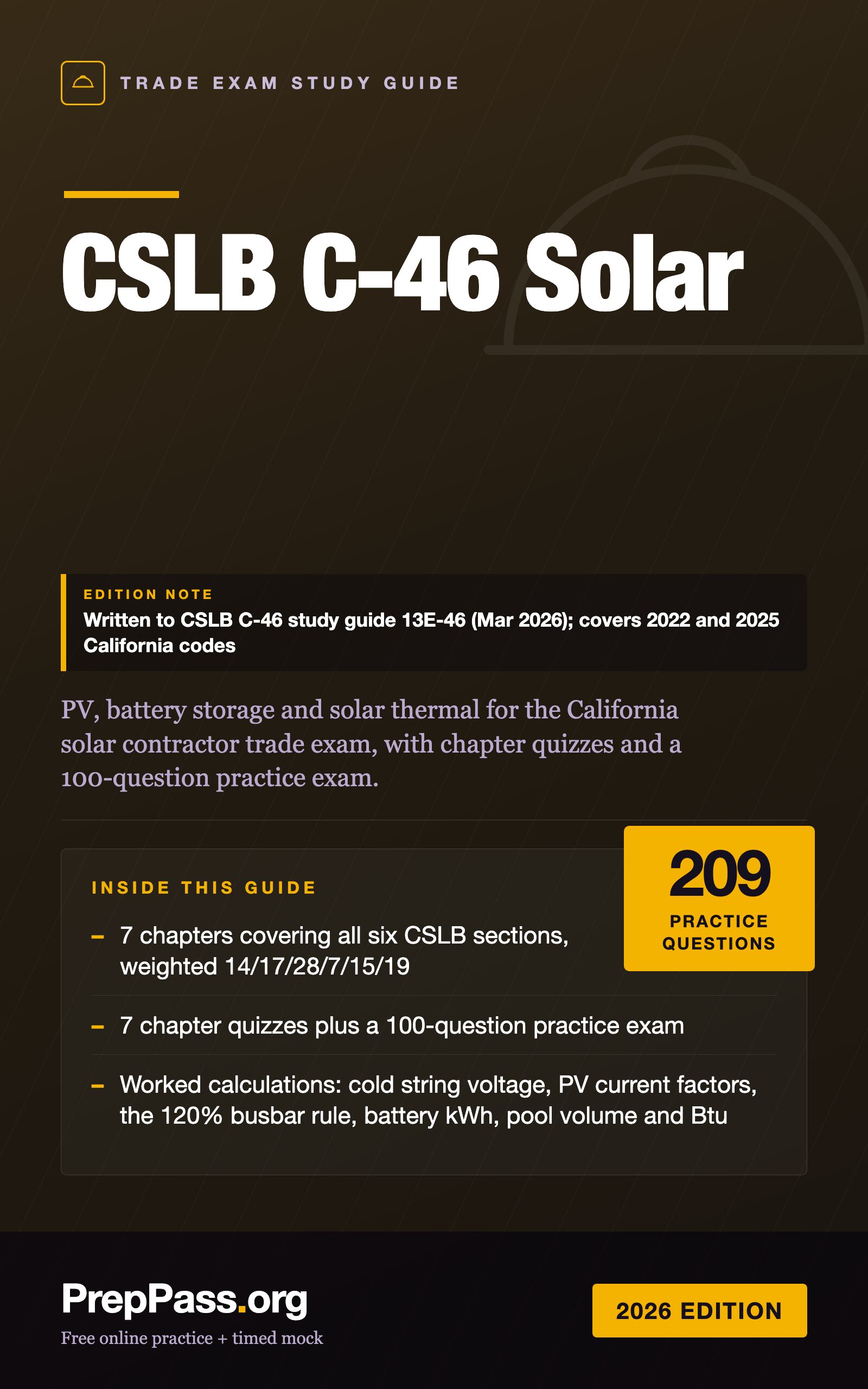
Ghi chú phiên bảnWritten to CSLB C-46 study guide 13E-46 (Mar 2026); covers 2022 and 2025 California codes
PV, battery storage and solar thermal for the California solar contractor trade exam, with chapter quizzes and a 100-question practice exam.
- 209 câu hỏi luyện tập môn nghề năng lượng mặt trời CSLB gốc, mỗi câu kèm lời giải, trong một bản PDF + EPUB bạn giữ
PDF + EPUB · tiếng Anh · 211 trang · $24.99 trả một lần
Sách này được viết bằng tiếng Anh — tệp PDF và EPUB bạn tải về đều bằng tiếng Anh.
Tải ngay sau khi thanh toán — không cần tài khoản, không thuê bao.
Đảm bảo hoàn tiền 14 ngày: không hài lòng vì bất kỳ lý do gì? Email support@preppass.org trong vòng 14 ngày kể từ khi mua để được hoàn tiền đầy đủ. Chính sách hoàn tiền
Đọc thử miễn phí một chương trước
Ôn nhiều hơn một môn? Có giá combo
- CSLB Law & Business — Complete Study Guide (2026)$24.99
- CSLB C-46 Solar Trade Exam Study Guide (2026)$24.99
- CSLB Law & Business — Cram Sheet (2026)$9.99
Mua cả 3 phần: $30.99 — tiết kiệm $28.98 so với mua riêng
Mua riêng $59.97 · giảm 48% · Một lần thanh toán, cả 3 phần.
Đã mua CSLB Law & Business rồi? Đừng mua combo — combo có sẵn cuốn đó và bạn sẽ trả tiền hai lần. Mua riêng CSLB C-46 Solar với giá $24.99. CSLB C-46 Solar · Combo gồm gì →
Thử 10 câu trước — miễn phí
Trả lời hết 10 câu, nộp bài xong sẽ thấy lời giải từng câu — kèm phần trong sách này dạy nội dung đó. Khoảng 5 phút, không cần đăng ký.
Bắt đầu 10 câu miễn phíXem bên trong cuốn sách
Ba trang thật, kết xuất thẳng từ tệp PDF bạn sẽ tải — lần lượt là một trang tra cứu, một trang giảng giải, và một câu hỏi có lời giải. Không trang nào được vẽ lại cho đẹp.
- Trang tra cứu nhanhSection 6 — Safety (19 questions) · Trang 185 của PDF
Một trang để lật lại: các con số, mốc thời hạn hoặc thuật ngữ gom về một chỗ.
- Cách giảng dạyChapter 1 — Planning and Estimating (CSLB Section 1, 14%) · Trang 38 của PDF
Trang giảng giải: kiến thức được trình bày bằng văn xuôi, theo trình tự kỳ thi kiểm tra.
- Một câu hỏi có lời giảiChapter 1 — Planning and Estimating (CSLB Section 1, 14%) · Trang 36 của PDF
Một câu luyện tập kèm đáp án và lập luận đằng sau — không chỉ là đáp án.
Về chính kỳ thi này
| Cơ quan quản lý | Contractors State License Board (CSLB), California Department of Consumer Affairs — kỳ thi do PSI Services LLC tổ chức |
|---|---|
| Số câu hỏi | CSLB không công bố Những trang chúng tôi đã đọc và không tìm thấy: CSLB — Step 7: Studying for the Examination |
| Thời gian làm bài | 210 phút |
| Điểm đậu | CSLB không công bố Những trang chúng tôi đã đọc và không tìm thấy: CSLB — Step 7: Studying for the Examination |
| Lệ phí |
Nguồn: CSLB — List of All CSLB Fees |
| Ngôn ngữ thi | Tiếng Anh |
Có gì — và không có gì
Bao gồm
- 7 chapters covering all six CSLB sections, weighted 14/17/28/7/15/19
- 7 chapter quizzes plus a 100-question practice exam
- Worked calculations: cold string voltage, PV current factors, the 120% busbar rule, battery kWh, pool volume and Btu
- A table of where the 2022 and 2025 California codes place each rule
- Six job walk-throughs plus formula and key-number appendices
- 209 original questions, each with a worked explanation citing its source
- PDF + EPUB you keep
Không bao gồm
- Không gửi bản in — đây là tệp bạn tải về và có thể tự in
- Sách không kèm khoá video, giảng viên hay kèm riêng — video miễn phí trên trang là phần khác
- Không bao gồm lệ phí đăng ký thi hay phí trung tâm khảo thí — bạn vẫn nộp cho cơ quan chính thức
Mục lục
Xem 15 phần và trang bắt đầu của từng phần
- Chapter 1 — Planning and Estimating (CSLB Section 1, 14%)tr. 15
- Chapter 2 — Solar Panel and Collector Installation (CSLB Section 2, 17%)tr. 40
- Chapter 3 — PV System Installation, Part 1: Basic PV Systems and Labeling (CSLB Section 3)tr. 57
- Chapter 4 — PV System Installation, Part 2: Storage, the Grid, Stand-Alone Systems and Commissioning (CSLB Section 3)tr. 76
- Chapter 5 — Solar Thermal Installation (CSLB Section 4, 7%)tr. 96
- Chapter 6 — Service, Operation, and Maintenance (CSLB Section 5, 15%)tr. 111
- Chapter 7 — Safety (CSLB Section 6, 19%)tr. 127
- Section 1 — Planning and Estimating (14 questions)tr. 159
- Section 2 — Solar Panel/Collector Installation (17 questions)tr. 162
- Section 3 — PV System Installation and Commissioning (28 questions)tr. 166
- Section 4 — Solar Thermal Installation (7 questions)tr. 172
- Section 5 — Service, Operation, and Maintenance (15 questions)tr. 174
- Section 6 — Safety (19 questions)tr. 177
- Appendix A — The exam at a glance, in one tabletr. 195
- Appendix B — Terms the examination expects you to use preciselytr. 197
Lấy từ chính tệp PDF bạn tải về, kèm trang bắt đầu của từng phần — không phải gõ tay ở đây.
Đọc miễn phí trọn một chương
Trọn vẹn một chương, đúng như trong eBook. Cuộn cửa sổ để đọc ngay tại đây; không cần tải, không cần email.
Đọc chương 3 ngay tại đây, không rời trang
Chúng tôi không đưa phần mở đầu dễ dãi — chương miễn phí mở thẳng vào một trong những phần đậm đặc nhất của cuốn sách, để bạn đánh giá cách dạy ở đúng chỗ kỳ thi trở nên khó.
Photovoltaic (PV) System Installation and Commissioning is the largest section of the C-46 examination at 28 percent[1] — more than a quarter of your score. The CSLB lists six topics: install basic PV systems, install energy storage systems (ESS), interface with the utility grid, install standalone PV systems, label PV components, and system testing, configuration and monitoring, including educating the client[1]. This chapter covers the first and the fifth: building a grid-tied PV system from the array to the point of interconnection, and labeling it. Chapter 4 covers storage, the utility interface, stand-alone systems and commissioning.
The code references here are to the California Electrical Code (CEC), which the C-46 study guide lists in its 2022 edition[1]. Where the 2025 edition that took effect on January 1, 2026[2] is reflected in a county checklist, we say so.
3.1 Install basic PV systems
The power path
A grid-tied PV system is a chain. Know the links in order, because the examination asks where things go:
- PV modules, wired in series into strings (source circuits).
- Module-level electronics where used: microinverters, DC-DC converters, or rapid shutdown devices.
- DC wiring from the array, through the roof, to the inverter — in metal where it runs inside the building[3].
- The inverter, which "converts direct current (DC) electricity, which is what a solar panel generates, to alternating current (AC) electricity, which the electrical grid uses"[4].
- AC disconnecting means and overcurrent protection.
- The point of interconnection with the building's electrical service.
- Grounding and bonding throughout.
Listed equipment, installed as listed
Everything in that chain must be listed for its use. San Diego County's 2025-code checklist: "All proposed equipment shall be listed or field labeled for PV application by a nationally recognized testing agency"[5]. The Guidebook's inspection list starts with the inverter: "Inverters are listed to UL 1741," and "grid-tied system inverters need to be identified for use in interactive power systems"[6]. State law says the same thing at the top level — an electric solar system must meet the California Electrical Code and the standards of accredited testing laboratories such as Underwriters Laboratories[7].
Installing as listed also protects what is already there. Berkeley's checklist requires the installer to "ensure that any alterations or additions to the existing system(s) shall not cause existing equipment or components to lose their listings"[3], and requires the equipment, wiring and interconnections to be "installed by a qualified person trained per NFPA 70E 2018"[3].
Conductors and connections
- Outdoors: "All exposed wiring shall be listed for wet location and sunlight resistant"[5].
- Inside the building: DC PV circuits in metal raceway, MC cable, or metal enclosures[3].
- Sizing: the two 1.25 factors on the DC side (Chapter 1)[8]; San Diego County also requires wire sizing and terminations "in conformance with the seventy-five-degree (75°) column" of the ampacity tables[5], because terminals are usually rated 75 °C.
- Heat: rooftop conductors can reach 65–75 °C near modules on still, hot days[8], which is why temperature correction matters.
- Terminations: "Crimp terminals are listed and installed using a listed tool specified for use in crimping those specific crimps," and "pressure terminals are listed for the environment and tightened to manufacturer recommended torque specifications"[6].
- Connectors: where a PV connector includes an equipment-grounding member, it "shall make first and break last"[8].
- DC overcurrent devices: "DC breakers shall be listed and rated for PV use"[5].
Named trap — AC ratings on DC equipment. A breaker or switch rated only for AC may not interrupt a DC arc. DC PV circuits need devices listed and rated for DC PV use.
Arc-fault protection
PV systems at higher DC voltages must detect and interrupt arcing faults. Berkeley's 2022-code checklist: "PV systems operating at a maximum system voltage of 80 volts or greater, shall be protected as specified in CEC 690.11"[3]. Most string inverters include DC arc-fault circuit protection; the Guidebook's standard plan asks directly whether the inverter has "Integrated DC Arc-Fault Circuit Protection?"[6].
Grounding and bonding
Grounding gives fault current a path and keeps metal parts at earth potential; bonding ties the metal parts together.
- System grounding configuration follows CEC 690.41, and the grounding electrode system follows 690.47, as San Diego County's checklist states[5].
- Interconnected sources "shall be grounded in accordance with CEC 250"[3].
- Module frames and racking are bonded per the module listing — through listed grounding devices named in the module instructions, or UL 2703-listed devices whose instructions name the module[5].
- Electrodes: a second ground rod at least 6 feet from the first[5]; a supplemental electrode where a metal water pipe is the only electrode[5]; and the service electrode "must be verified at the time of inspection"[5].
Disconnecting means
A PV system must be separable from everything it connects to. Berkeley's checklist: disconnecting means "shall be provided to disconnect the PV system from all wiring systems including power systems, energy storage systems, and utilization equipment and its associated premises wiring," and "the PV system disconnecting means shall be installed at a readily accessible location"[3]. For individual pieces of equipment such as an inverter, "isolating devices or equipment disconnecting means shall be installed in circuits connected to equipment at a location within the equipment, or within sight and within 10 feet of the equipment"[3].
The 2022 CEC's rules for a power source's disconnecting means (section 705.20) include that it must:
- "Simultaneously disconnect all ungrounded conductors of the circuit"[9];
- "Plainly indicate whether in the open (off) or closed (on) position"[9];
- carry a warning where the line and load terminals can both be energized when open[9].
That warning matters because "with interconnected power sources, some equipment, including switches and fuses, is likely to be energized from both directions"[9], and San Diego County reminds inspectors that "all terminals of the disconnecting means may be energized in the open position"[5]. Opening a PV disconnect does not make the array side dead: open-circuit voltage "would still be present on the array wiring and in the disconnect box"[8].
The Guidebook's inspection list adds that "listed AC and DC disconnects and overcurrent protection are grouped and identified"[6]. San Diego County requires microinverter and integrated systems to have a rooftop AC disconnect[5].
Rapid shutdown
Rapid shutdown exists for firefighters. When it is initiated, the PV conductors on and in the building must drop to low voltage quickly. Berkeley's summary of CEC 690.12 (2022 edition):
| Conductors | Limit after initiation |
|---|---|
| Outside the array boundary, or more than 3 feet from the point of entry inside a building | Not more than 30 volts within 30 seconds[3] |
| Inside the array boundary | Not more than 80 volts within 30 seconds[3] |
"Voltage and power shall be measured between any two conductors and between any conductor and ground"[3]. The requirements apply only to PV circuits supplied by the PV system[3].
The initiation device "shall be located at a readily accessible location outside the building"[3] and may be the service disconnecting means, the PV system disconnecting means, or a readily accessible switch that plainly shows whether it is "off" or "on"[3]. The Guidebook adds that the device's location "shall be shown on the site plan drawing"[6]. Equipment that performs the rapid shutdown function (other than the initiation device itself) "shall be listed for providing rapid shutdown protection"[3]; Poway's list requires the rapid shutdown system to be UL 1741 listed[10].
Named trap — rapid shutdown is not zero volts. Rapid shutdown reduces voltage to the limits above within 30 seconds. It does not de-energize the array. A DOE-hosted fire service presentation warns that "when RSS is initiated, firefighters may think system is de-energized to zero"[11] — the same misunderstanding the examination likes to test.
The point of interconnection
A grid-tied inverter's AC output joins the building's electrical system in one of two places.
Load-side connection. "The output of a utility-interactive inverter shall be permitted to be connected to the load side of the service disconnecting means of the other source(s) at any distribution equipment on the premises"[3]. The Guidebook's inspection list wants the connection "at a dedicated breaker or disconnect"[6], and "where a back-fed breaker is used as a utility interconnection means, the breaker is not marked 'line and load'"[6].
The busbar must not be overloaded by two sources feeding it. The rules, as the Guidebook and Berkeley state them:
- Use 125 percent of the inverter output circuit current in ampacity calculations for feeders, taps and busbars[3].
- If the PV breaker is at the opposite end of the busbar from the main breaker or feeder, "the sum of 125% of the inverter output circuit currents and the rating of the overcurrent device protecting the busbar shall not exceed 120% of the ampacity of the busbar"[6]. San Diego County requires the PV connection "at the opposite (load) end from the input feeder location or main circuit location"[5].
- If the PV breaker is not at the opposite end, the Guidebook's standard plan falls back to the 100 percent row of its table[6].
Worked example 3-1 (the 120 percent rule). A 200-amp busbar is protected by a 200-amp main breaker. The PV breaker will be at the opposite end. 120% of 200 A = 240 A. 240 − 200 = 40 A of PV breaker allowed. An inverter with a continuous output of 32 A needs 32 × 1.25 = 40 A — it just fits. An inverter of 35 A needs 43.75 A — it does not.
Worked example 3-2 (a bigger busbar). The panel has a 225-amp busbar and a 200-amp main. 120% × 225 = 270 A. 270 − 200 = 70 A allowed. The Guidebook's own table caps its standard plan at 60 A for a 225 A busbar with a 200 A main because the plan is limited to 10 kW[6].
Worked example 3-3 (de-rating the main). A 200 A busbar with a 200 A main cannot take a 50 A PV breaker. Replacing the main with a 175 A breaker gives 240 − 175 = 65 A allowed. Where approved plans de-rate the main breaker, San Diego County requires a placard at the panel reading "THIS PANEL HAS BEEN DE-RATED TO (insert amperage size). DO NOT INSTALL LARGER BREAKERS."[5] — and the building's loads must still be served by the smaller main.
Supply-side connection. An electric power production source may instead be "connected to the supply side of the service disconnecting means"[3]. Then "the sum of the ratings of all overcurrent devices connected to power production sources shall not exceed the rating of the service"[3]. In equipment under the utility's exclusive control, such as a meter socket, "only connections approved by the electric utility shall be permitted"[9].
Power control systems. The 2022 CEC allows a listed power control system (PCS) to limit current: "the setting of the PCS controller shall be considered the power-source output circuit current" in the load-side calculations[9]. San Diego County's 2025-code checklist describes a PCS that can "increase or decrease PV/ESS outputs based on the home's real-time demand, ensuring the outputs never exceed the main panel's busbar rating"[5].
Two more interconnection rules.
- "No multiwire branch circuits are installed where single 120-volt inverters are connected to 120/240- volt load centers"[6] — a shared neutral could be overloaded.
- Surge protection. In the 2022 CEC, "all services supplying dwelling units shall be provided with a surge-protective device (SPD)"[10], a Type 1 or Type 2 device[10], integral to or immediately adjacent to the service equipment[10]; "where service equipment is replaced, all of the requirements of this section shall apply"[10]. A PV job that replaces the main panel picks up this requirement.
Working space
Inverters, disconnects and panelboards need working space for operation and maintenance. The Guidebook's inspection list: "Access and working space for operation and maintenance of PV equipment such as inverters, disconnecting means and panelboards (not required for PV modules)"[6].
Sources cited in this excerpt
- Contractors State License Board License Examination Study Guide: Solar (C-46), form 13E-46 (03-2026), for examinations scheduled on or after July 1, 2023. Contractors State License Board (CSLB), 2026-03. https://www.cslb.ca.gov/Resources/StudyGuides/C46StudyGuide.pdf
- California Building Standards Code (Title 24) editions, Building Standards Commission web page retrieved 2026-09-24. California Building Standards Commission, 2026-09-24. https://www.dgs.ca.gov/BSC/Codes
- Code Compliance Checklist, Solar Photovoltaic (Form 166), citing the 2022 California codes, last revised 02/23/23. City of Berkeley, Building and Safety Division, 2023-02-23. https://berkeleyca.gov/sites/default/files/documents/166%20CCC%20-%20Solar%20Photovoltaic_1.pdf
- Solar Integration: Inverters and Grid Services Basics, U.S. Department of Energy web page retrieved 2026-09-24. 2026-09-24. https://www.energy.gov/cmei/systems/solar-integration-inverters-and-grid-services-basics
- Photovoltaic and energy storage checklist PDS 081S, citing the 2025 California codes, rev. 02/19/2026. County of San Diego, Planning & Development Services, 2026-02-19. https://www.sandiegocounty.gov/content/dam/sdc/pds/docs/pds081s.pdf
- California Solar Permitting Guidebook, 4th Edition (standard plans, checklists and inspection guides; written to the 2016 California codes). Governor's Office of Planning and Research, State of California, 2019-02. https://lci.ca.gov/wp-content/uploads/20190226-Solar_Permitting_Guidebook_4th_Edition.pdf
- California Government Code section 65850.5 (solar energy system permitting), leginfo text retrieved 2026-09-24. California Legislative Information, 2026-09-24. https://leginfo.legislature.ca.gov/faces/codes_displaySection.xhtml?lawCode=GOV§ionNum=65850.5
- Photovoltaic Power Systems and the National Electrical Code: Suggested Practices (SAND2001-0674), written to the 1999 NEC. Sandia National Laboratories, U.S. Department of Energy, 2001-03. https://www.osti.gov/servlets/purl/808812
- Changes for Solar in the California 2022 Codes (excerpts of the 2022 CRC, CEC, CFC and Energy Code as adopted). County of Lake, Community Development Department, Building Division, 2022-11-30. https://www.lakecountyca.gov/DocumentCenter/View/5644/Changes-for-Residential-Solar-California-2022-Codes
- City of Poway Solar Compliance List, citing the 2022 California codes, revised 03/2024. City of Poway, Development Services Department, Building Division, 2024-03. https://poway.org/DocumentCenter/View/11079/Poway-Solar-Compliance-List-PDF
- PV and Firefighter Operations (Manchester Fire Department presentation hosted by the U.S. Department of Energy). U.S. Department of Energy (host), 2016-10. https://www.energy.gov/sites/default/files/2016/10/f33/PV%20and%20Firefighter%20Operations%20-%20Manchester%20Fire.pdf
Trước khi mua
- Nhận sách thế nào?
- Thanh toán xong, mục tải xuống hiện ngay trên trang này. Liên kết cũng được gửi qua email. Không cần tài khoản.
- Nếu sách không hợp thì sao?
- Gửi email trong vòng 14 ngày để được hoàn tiền đầy đủ, không cần lý do.
- Phần luyện tập miễn phí có bị bỏ không?
- Không. Mọi câu hỏi luyện tập, bài thi thử tính giờ và các chương miễn phí trên trang vẫn miễn phí. Cuốn sách là nửa "học", không phải hàng rào quanh phần miễn phí.
- Đọc trên điện thoại được không?
- Được — EPUB cho điện thoại và máy đọc sách, PDF để in và dán tab. Bạn nhận cả hai.
Chi tiết
PV, battery storage and solar thermal for the California solar contractor trade exam, with chapter quizzes and a 100-question practice exam.
- Format: PDF + EPUB download · 211 pages
- 209 practice questions in the book, with a full answer key
- 100 free practice questions for this exam on PrepPass, included at no cost
- $24.99 one-time — no subscription
- 14-day money-back guarantee · refund policy
- Cross-referenced against: CSLB Solar (C-46) study guide 13E-46 (03-2026), California statutes, Cal/OSHA Title 8 and DOE/NREL publications, read September 2026
- Đối chiếu từ nguồn chính thức(CSLB Solar (C-46) study guide 13E-46 (03-2026), California statutes, Cal/OSHA Title 8 and DOE/NREL publications, read September 2026)
- 100 câu hỏi luyện tập miễn phí
- Tải ngay, thuộc về bạn trọn đời
Một CSLB exam prep course có giá $200–$800. Cuốn sách này dạy cùng một kỳ thi — cùng quy định, đối chiếu theo chuẩn hiện hành — chỉ với $24.99 trả một lần, thuộc về bạn trọn đời.
Vì sao mua sách khi phần luyện tập miễn phí?
Câu hỏi luyện tập và bài thi thử tính giờ vẫn miễn phí — không có gì trên trang bị giấu sau cuốn sách này. Cuốn sách $24.99 là nửa "học": chính phần kiến thức, dạy theo trình tự, trong một tệp thuộc về bạn.
- Dạy có hệ thống — mọi phần thi giảng theo từng chương, từ đầu đến cuối, không chỉ là câu hỏi
- In ra & dán nhãn — PDF sẵn sàng để in, tô đậm, ghi chú và mang tới bàn học
- Học mọi nơi, ngoại tuyến — EPUB trên điện thoại hay máy đọc sách; không cần wifi, không cần tab trình duyệt
- Tất cả một chỗ — các chương và câu hỏi luyện tập trong một tệp
- Của bạn trọn đời — trả một lần $24.99, tải ngay, không thuê bao
Và không rủi ro: Đảm bảo hoàn tiền 14 ngày — không hài lòng? Email cho chúng tôi để hoàn tiền đầy đủ, không cần lý do. Xem chính sách hoàn tiền.
Đảm bảo hoàn tiền 14 ngày · hoàn tiền đầy đủ, không cần lý do.
Mua một lần, truy cập tải về trọn đời. eBook là trọn bộ hướng dẫn ôn CSLB C-46 Solar ở dạng PDF và EPUB. Bản tóm tắt mang tính giáo dục, không phải tư vấn chuyên môn hay pháp lý — luôn xác nhận quy định hiện hành với nguồn chính thức.