ServSafe Manager Practice Test
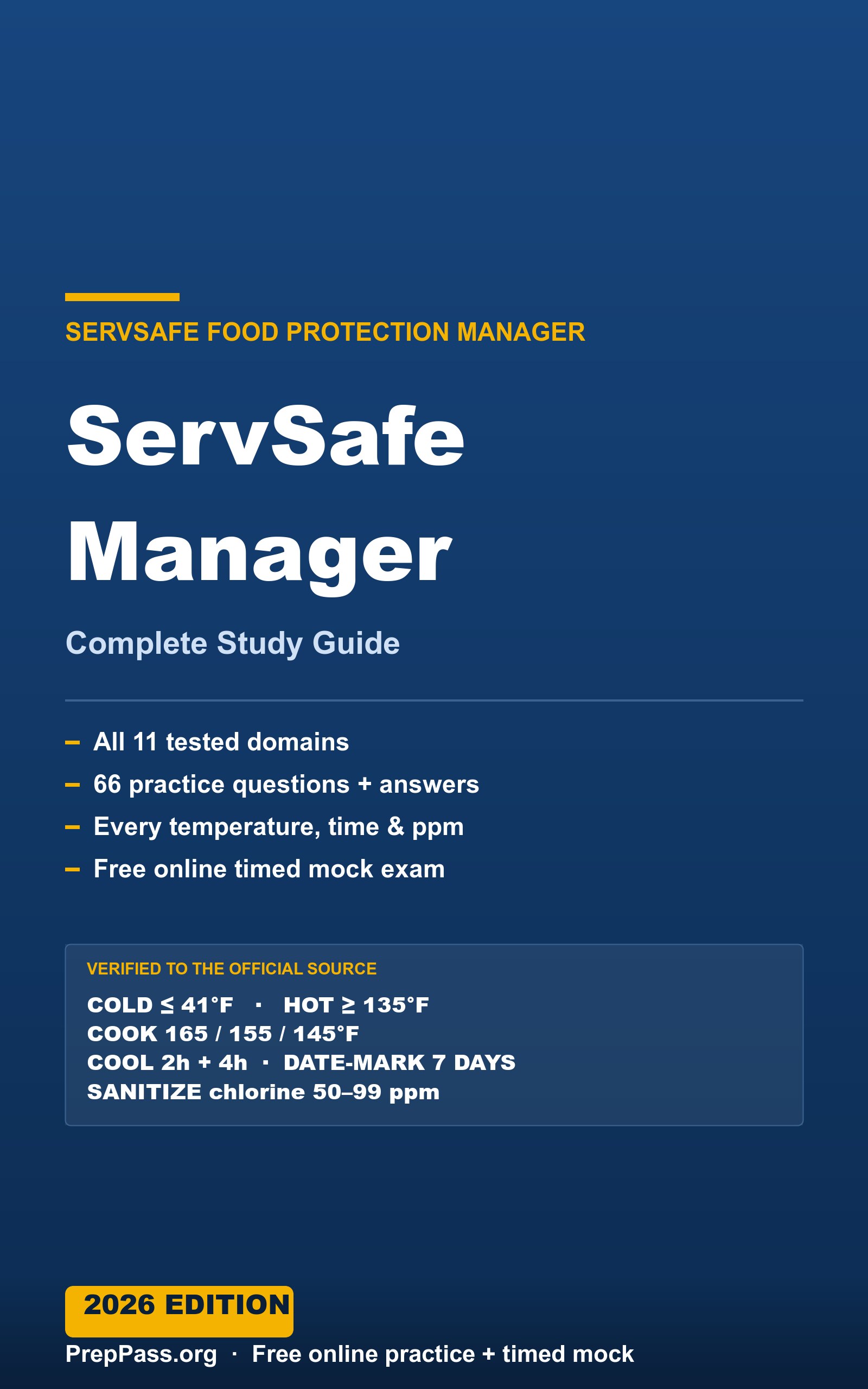
Trong sách hướng dẫn ServSafe Food Protection Manager: Mỗi chương trong 8 chương đều khép lại bằng một bài kiểm tra, kèm đáp án giải thích từng câu. Luyện tập ở đây vẫn miễn phí.
| Cơ quan quản lý | National Restaurant Association Educational Foundation (NRAEF) — kỳ thi do a registered ServSafe Instructor/Proctor, or ProctorU for online-proctored delivery tổ chức Nguồn: ServSafe — Food Protection Manager Certification Examinee Handbook (PDF, © 2020 NRAEF) |
|---|---|
| Số câu hỏi | 90 câu hỏi (80 câu tính điểm, 10 câu thử nghiệm không tính điểm) |
| Thời gian làm bài | 120 phút Nguồn: ServSafe — Manager Exam (Access Code), catalog product SSONLINEX |
| Điểm đậu | 70% (ít nhất 56 trong 80 câu tính điểm) Nguồn: ServSafe — FAQ: “What is the passing score for the ServSafe Food Protection Manager Examination?” |
| Lệ phí |
Nguồn: ServSafe — Manager Exam (Access Code), catalog product SSONLINEX |
| Ngôn ngữ thi | Tiếng Anh · Tiếng Tây Ban Nha · Tiếng Trung · Tiếng Hàn · Tiếng Pháp · Tiếng Nhật Nguồn: ServSafe — FAQ: “What languages is the ServSafe exam available in?” |
Câu hỏi thường gặp
How many ServSafe Manager practice questions are here?+
500 original practice questions across all 8 exam domains, in English and Español, with an FDA Food Code citation on 357 of the 500 answers.
Is this ServSafe Manager practice test free?+
Yes — completely free, no signup. Unlimited rounds, a full 90-question timed mock exam, and explanations all included.
Are these real ServSafe exam questions?+
No. All 500 questions are original prose written from the public-domain FDA Food Code 2022 and its 2024 Supplement.
How many questions is the real ServSafe Manager exam and what's the passing score?+
90 multiple-choice questions (80 scored), 2 hours, 70% to pass — at least 56 of 80 scored. Proctored and closed-book.
How long is the ServSafe Manager certification valid?+
5 years in most jurisdictions. ANAB-CFP accredited; satisfies the Certified Food Protection Manager (CFPM) requirement nationwide.
What languages is the ServSafe Manager exam available in?+
English, Spanish, French Canadian, and Simplified Chinese. PrepPass practice is in English and Español.
Có sách hướng dẫn học ServSafe Food Protection Manager không?+
Có — PrepPass bán ServSafe Manager Exam — Complete Study Guide (2026), bản tải về PDF + EPUB, $19.99 trả một lần; phần luyện tập trên trang này vẫn miễn phí mà không cần sách. Xem sách hướng dẫn học →
Câu hỏi luyện tập mẫu
Một vài câu hỏi thực tế từ ngân hàng miễn phí này, kèm giải thích đầy đủ. Dùng công cụ luyện tập ở trên cho toàn bộ.
- 1. Bệnh do Thực phẩm
A line cook at a taquería leaves a pan of cooked carnitas on the counter at room temperature during a slow afternoon. Which range describes the Temperature Danger Zone where bacteria grow most rapidly?
- a.50°F to 150°F
- b.70°F to 125°F
- c.32°F to 100°F
- d.41°F to 135°F
Đáp án: d
Giải thích: The Temperature Danger Zone is 41°F to 135°F; bacteria multiply fastest between these limits, and growth is most rapid from 70°F to 125°F. Cold holding must stay at or below 41°F and hot holding at or above 135°F to keep food out of the zone. The other ranges are incorrect because they do not match the Food Code limits.
- 2. Ô nhiễm & Chất gây dị ứng
The ALERT acronym helps operations reduce the risk of deliberate (intentional) food contamination. What does ALERT stand for?
- a.Assure, Look, Employees, Reports, Threat
- b.Alarm, Lockdown, Evacuate, Report, Testing
- c.Analyze, List, Evaluate, Record, Teach
- d.Assess, Label, Enforce, Report, Track
Đáp án: a
Giải thích: ALERT is the FDA food-defense tool: Assure (buy from safe, approved suppliers), Look (monitor the security of products and storage areas), Employees (know who is in the facility), Reports (keep security and receiving records), and Threat (know what to do and whom to contact if there is a threat). The other three expansions are invented. Alarm/Lockdown/Evacuate/Report/Testing describes a general emergency-response drill, not food defense; the analyze/list/evaluate and assess/label/enforce sets are generic management verbs with no food-defense meaning.
- 3. Vệ sinh Cá nhân
A cashier at a panadería handles money at the register, then is asked to bag fresh pan dulce with her hands. What is the food safety concern and correct step?
- a.She should wipe her hands on a fresh apron and keep bagging, since changing aprons replaces a hand wash
- b.She only needs to wash her hands at the start of the shift and after each scheduled break, then bag the bread bare-handed
- c.There is no concern, because the pan dulce was baked this morning and the oven heat (a kill step) covers the counter
- d.Money is dirty; she must wash her hands (and ideally use tissue or gloves) before touching the ready-to-eat bread
Đáp án: d
Giải thích: Handling money contaminates the hands, so a cashier must wash her hands, and use deli tissue, a utensil, or gloves, before handling ready-to-eat pan dulce, because bare-hand contact with ready-to-eat food is prohibited. The bread was baked earlier and will not be cooked again, so the oven heat this morning protects nothing that is added at the counter now. Changing or wiping on an apron is not a hand wash, and money is exactly the kind of contamination event that requires a fresh wash rather than one wash per shift.
Nguồn: FDA Food Code §2-301.14
- 4. Nhận hàng & Bảo quản
When storing raw meats above nothing but each other (no ready-to-eat food nearby), the ordering principle by minimum cooking temperature still means whole fish and whole beef cuts go:
- a.Below raw poultry, because poultry's 165°F minimum makes it the safest raw item to store on top
- b.Above ground beef and poultry, because they have lower minimum cooking temperatures (145°F)
- c.In any order among raw meats, since cooking later destroys the contamination
- d.Below ground beef, because its 155°F minimum (ground-meat line) outranks whole cuts
Đáp án: b
Giải thích: Whole fish and whole cuts of beef and pork have a minimum cooking temperature of 145°F, lower than ground meat (155°F) and poultry (165°F), so they are stored above ground beef and poultry. The shelf order runs by cook temperature, not by how safe an item is once cooked: poultry's 165°F requirement is exactly why raw poultry belongs on the bottom shelf, and ground beef's 155°F puts it below whole cuts, not above them. The order still matters among raw meats even with no ready-to-eat food nearby, because juices from a food that needs a higher cook temperature must never drip onto one that will be cooked less. A later cook does not license the drip: the item underneath is taken only to its own lower minimum, which is below what the contamination dripped onto it would require.
Nguồn: FDA Food Code §3-302.11
- 5. Giữ nóng/lạnh & Phục vụ
What is the minimum internal temperature for TCS food held on a steam table for service?
- a.145°F
- b.135°F
- c.155°F
- d.165°F
Đáp án: b
Giải thích: Hot TCS food must be held at 135°F or higher. Holding above this temperature keeps the food out of the danger zone, where pathogens that survived cooking or were reintroduced could multiply.
Nguồn: FDA Food Code §3-501.16
- 6. Quản lý & HACCP
A supplier issues a Class I recall for a brand of frozen ground beef the restaurant has in its walk-in. What is the correct handling of the recalled product?
- a.Remove it from inventory, label it 'Do Not Use / Do Not Discard', and store it separately until instructed
- b.Send it back with the delivery driver on the next order, leaving it unlabeled in the walk-in with the usable beef
- c.Donate the frozen cases to a local food bank, since the recalled beef is otherwise wasted
- d.Cook the ground beef to 155°F for 17 seconds, serve it, and avoid discarding the frozen cases
Đáp án: a
Giải thích: When a product is recalled, the operation should stop using it immediately, physically separate it from usable food, and mark it so no one uses it while the operation follows the vendor's or regulator's return or disposal instructions. Waiting for the next delivery while the cases sit unlabeled beside usable beef is exactly the segregation failure the recall procedure exists to prevent, donating it moves the hazard to another population rather than removing it, and cooking does not clear a recall: even at the correct 155°F for 17 seconds for ground meat, cooking does not remove a toxin, an allergen, or a physical contaminant.
- 7. Cơ sở, Vệ sinh & Côn trùng
Cutting boards and knives are used to prepare raw chicken and then, without cleaning, used for ready-to-eat salad greens. Beyond cross-contamination, what cleaning rule is violated?
- a.Food-contact surfaces need to be cleaned and sanitized just one time a day, in the wash-down at the end of the shift
- b.Food-contact surfaces must be cleaned and sanitized between working with raw TCS food and ready-to-eat food
- c.Knives can skip the sanitizing step, since a wash in hot soapy water and a rinse in clean water take off the germs
- d.Cutting boards go on the weekly deep-clean list, the same one used for storage shelving and the outside of the hood
Đáp án: b
Giải thích: Food-contact surfaces must be cleaned and sanitized before switching from raw animal food to ready-to-eat food, in addition to the every-4-hour continuous-use rule. Using the same unwashed board and knife transfers pathogens from raw chicken directly onto food that will not be cooked. A once-a-day wash-down, a soap-and-rinse-only knife, and a weekly board schedule each leave hours of contaminated use in between; the fix is to clean and sanitize at the switch, or use separate color-coded equipment.
Nguồn: FDA Food Code §4-602.11
- 8. Ô nhiễm & Chất gây dị ứng
Which ingredient does the Food Code's definition of a major food allergen specifically exclude?
- a.Wheat flour used to thicken a pan gravy
- b.Whey protein blended into a smoothie base
- c.Almond pieces toasted for a green salad
- d.Highly refined soybean oil used for frying
Đáp án: d
Giải thích: The definition excludes any highly refined oil derived from a major allergen food and ingredients derived from that oil, because the refining process removes the protein that triggers a reaction. Wheat flour, whey, and almonds all carry allergen protein and must be disclosed.
Nguồn: FDA Food Code §1-201.10
- 9. Nhận hàng & Bảo quản
Between rushes, where should the scoop for the ice machine be kept?
- a.Buried handle-down in the ice so it stays cold
- b.Resting on the top of the ice machine's lid
- c.Hanging from the apron string of the bar back
- d.In a clean, protected location outside the bin
Đáp án: d
Giải thích: An ice scoop is stored in a clean, protected location outside the bin, because a scoop left in the ice collects hand contact and dust and a handle buried in the ice contaminates every cube it touches. The machine lid and an apron are neither clean nor protected.
Nguồn: FDA Food Code §3-304.12
- 10. Giữ nóng/lạnh & Phục vụ
A catering crew loads hot chafing pans and cold salads for a venue 40 minutes away. What must the transport equipment do?
- a.Keep hot food at 135°F or above and cold food at 41°F or below
- b.Keep hot food at 120°F or above and cold food at 50°F or below
- c.Keep all food at any temperature for up to 2 hours in transit
- d.Keep all food covered, since transit time is under 1 hour
Đáp án: a
Giải thích: Transport does not suspend the holding rules: hot TCS food stays at 135°F or above and cold TCS food at 41°F or below unless the operation is running written time-as-a-control procedures. Insulated carriers must be preheated or prechilled, and the crew probes the food on arrival rather than assuming the trip was short enough.
Nguồn: FDA Food Code §3-501.16