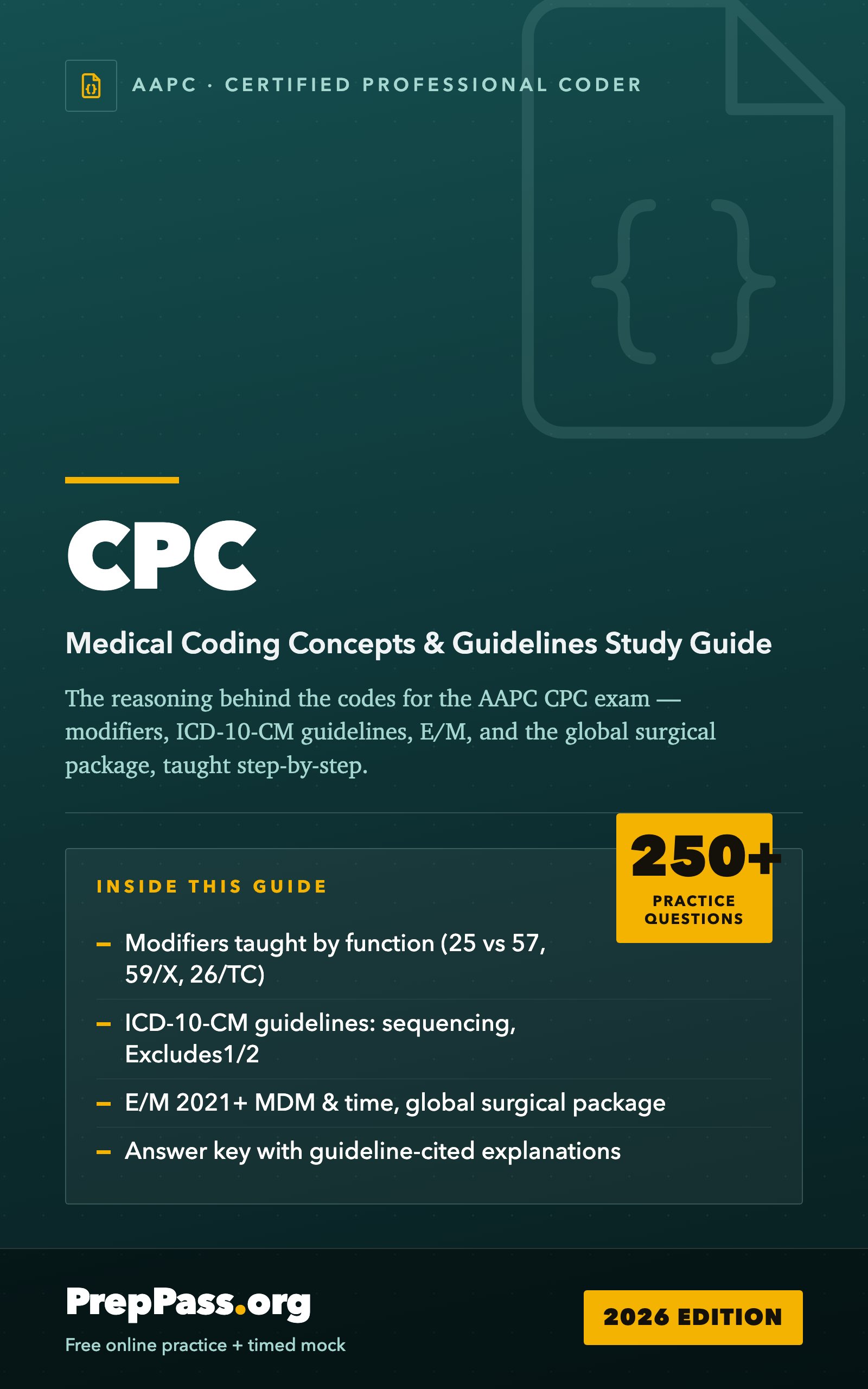
CPC — Medical Coding Concepts & Guidelines Study Guide (2026)
The reasoning behind the codes for the AAPC CPC exam — modifiers, ICD-10-CM guidelines, E/M, and the global surgical package, taught step-by-step. A concepts guide, not a code book.
AAPC CPC certification course 要 $1,500–$3,000。这本书讲的是同一门考试 —— 同样的规则、核对到最新标准 —— 只需一次性 $14.99,永久归你。
This is an independent study aid, not affiliated with or endorsed by the AAPC or the AMA. CPT® is a registered trademark of the AMA, used here only to identify the exam this guide helps you prepare for. This is a CONCEPTS guide, not a code book — it teaches the coding guidelines and logic; you still need the current-year CPT, ICD-10-CM, and HCPCS Level II manuals. Code sets and guidelines update every year; confirm the current-year codes and rules before you rely on any figure.
拥有整本书 — PDF + EPUB
练习题和计时模考永远免费。这本书是「学」的那一半:
- 逐章系统讲解——每个考试章节按顺序讲透,不只是刷题
- 可打印、贴标签——一本能划重点、做标记的纸质参考书
- 离线可用——PDF 用来打印,EPUB 放进手机或阅读器
- 全部在一个文件里——章节、速记卡和练习题都在一处
14 天退款保证——不满意?发邮件即可全额退款,无需理由。 退款政策
本页可免费阅读第 1 章——先读后买。一次付款解锁整本书(PDF + EPUB · 带解析练习题 · 每章速记卡)。
即时下载 PDF + EPUB · 一次买断,永久归你 · 无订阅 · 14 天退款保证 · 还没决定? 在下方免费阅读完整一章。
- 官方来源核验(ICD-10-CM Official Guidelines / NCCI / CPT & HCPCS conventions — independently source-checked)
- 299 道免费练习题
- 即时下载,永久拥有
完整的一章,与电子书正文一字不差。直接在此窗口滚动阅读;无需下载,无需邮箱。
Medical coding begins with reading. Before you can assign a single code, you must be able to read an operative note, a pathology report, or an office chart and understand what the physician actually did and why. That comprehension rests on two foundations: medical terminology (the word-building system that lets one term carry a diagnosis, a location, and a procedure all at once) and anatomy (where in the body the work happened). On the CPC exam, medical terminology and anatomy questions are woven through nearly every section — a surgery question you cannot answer is often really a terminology question in disguise. This chapter builds the reading skill first, because every later chapter depends on it.
1.1 How medical words are built
Almost every medical term is assembled from a small set of interchangeable parts. Learn the parts and you can decode thousands of words you have never seen. A term has up to four kinds of pieces:
- Root — the core meaning, usually a body part or system. Cardi (heart), nephr (kidney), oste (bone), hepat (liver), gastr (stomach), derm (skin), pneum/pneumon (lung/air), my (muscle), neur (nerve), arthr (joint).
- Combining vowel — usually an o, inserted to make a root pronounceable before another part. The root plus its combining vowel is a combining form, written cardi/o, nephr/o, oste/o.
- Prefix — attaches to the front and typically modifies number, direction, time, or negation. Hyper- (excessive), hypo- (deficient), brady- (slow), tachy- (fast), peri- (around), endo- (within), sub- (under), a-/an- (without).
- Suffix — attaches to the end and usually names the condition, the procedure, or the part of speech. -itis (inflammation), -ectomy (surgical removal), -otomy (incision into), -ostomy (create an opening), -plasty (surgical repair), -oma (tumor), -megaly (enlargement), -scopy (visual exam with a scope), -graphy (process of recording), -pathy (disease).
Read a term from the suffix backward. Take gastroenteritis: the suffix -itis (inflammation), then the roots gastr (stomach) and enter (intestine) → inflammation of the stomach and intestine. Nephrolithotomy: -otomy (incision into) + nephr (kidney) + lith (stone) → an incision into the kidney to remove a stone. Decode from the end, then fill in front to back.
Combining-vowel rule. Keep the combining vowel when the next part starts with a consonant (gastr/o/scopy); usually drop it when the suffix starts with a vowel (gastr/itis, not gastroitis). The vowel is always kept between two roots, even before a vowel (gastr/o/enter/itis), so the word stays pronounceable.
1.2 The surgical suffixes coders confuse most
Three suffixes decide whether an operative note describes a diagnostic look, an opening, or a removal — and mixing them up sends you to the wrong CPT family. Fix these cold:
- -otomy — a cut into an organ (a temporary incision), e.g., tracheotomy, cutting into the trachea.
- -ostomy — surgically creating a new permanent (or semi-permanent) opening, often to the outside or between two structures, e.g., colostomy, an opening from the colon to the abdominal wall.
- -ectomy — removal of an organ or part, e.g., appendectomy, cholecystectomy (gallbladder removal).
Two more procedure suffixes matter constantly in surgery and radiology: -plasty (surgical repair/reshaping, e.g., rhinoplasty) and -pexy (surgical fixation, e.g., orchiopexy, fixing an undescended testis). And distinguish the imaging pair: -graphy is the process of recording (angiography), -gram is the record/image produced (angiogram), and -scopy is looking directly through a scope (colonoscopy).
1.3 Directional and positional terms
Anatomic descriptions assume the anatomical position: standing, facing forward, palms turned forward. Every direction is described relative to that position, which is why a surgeon's "the lateral aspect of the right arm" is unambiguous.
- Anterior (ventral) = front; posterior (dorsal) = back.
- Superior (cephalad) = toward the head; inferior (caudad) = toward the feet.
- Medial = toward the midline; lateral = away from the midline.
- Proximal = nearer the trunk/point of origin; distal = farther from it. (The wrist is distal to the elbow.)
- Superficial = nearer the surface; deep = farther in.
- Supine = lying face up; prone = lying face down.
The three body planes: sagittal divides left/right, coronal (frontal) divides front/back, and transverse (axial) divides top/bottom — the last is the plane most CT "slices" are named for.
1.4 A quick tour of the body systems
You do not need a medical degree, but you must recognize the organs and word roots of each system well enough to route a code to the right chapter.
- Integumentary (skin): derm/o, dermat/o (skin), onych/o (nail), trich/o (hair). Lesions, biopsies, repairs, and grafts live here.
- Musculoskeletal: oste/o (bone), arthr/o (joint), my/o, myos/o (muscle), ten/o, tendin/o (tendon), chondr/o (cartilage). Fractures, dislocations, and casting cluster here.
- Cardiovascular: cardi/o (heart), angi/o, vas/o (vessel), ven/o, phleb/o (vein), arteri/o (artery). Know the four chambers (right/left atrium and ventricle) and the difference between arteries (away from the heart) and veins (toward it).
- Respiratory: pulmon/o, pneum/o (lung), bronch/o (bronchus), rhin/o, nas/o (nose), laryng/o (voice box), pharyng/o (throat).
- Digestive: gastr/o (stomach), enter/o (small intestine), col/o (colon), hepat/o (liver), chol/e (bile/gall), cholecyst/o (gallbladder), proct/o (rectum/anus).
- Urinary: nephr/o, ren/o (kidney), cyst/o (bladder), ureter/o (ureter), urethr/o (urethra). Do not confuse ureter (kidney→bladder) with urethra (bladder→outside).
- Reproductive: hyster/o, metr/o (uterus), oophor/o (ovary), salping/o (fallopian tube), orchi/o, orchid/o (testis), prostat/o (prostate).
- Nervous: neur/o (nerve), encephal/o (brain), myel/o (spinal cord or bone marrow — context decides), mening/o (meninges).
- Endocrine: thyr/o (thyroid), adren/o (adrenal), pancreat/o (pancreas). These glands drive many diagnosis codes for hormone disorders.
Two roots deserve a warning flag because they collide: myel/o means spinal cord in a neurology note but bone marrow in a hematology note, and -emia (blood condition) is not the same as -penia (deficiency) — leukopenia is too few white cells, leukemia is a malignant proliferation of them.
Key facts
- Decode a term from the suffix first, then read the roots front to back.
- Keep the combining vowel before a consonant and between two roots; drop it before a suffix that starts with a vowel.
- -otomy = cut into; -ostomy = create an opening; -ectomy = remove. Confusing these routes you to the wrong CPT family.
- -graphy = the process of recording; -gram = the image; -scopy = direct visual exam.
- Directions assume the anatomical position. Proximal/distal are relative to the trunk; the wrist is distal to the elbow.
- Planes: sagittal (L/R), coronal (front/back), transverse/axial (top/bottom).
- Watch collisions: myel/o (cord vs. marrow), ureter vs. urethra, -emia vs. -penia.
Worked example — decoding an operative title
Scenario. An operative report is titled "Laparoscopic salpingo-oophorectomy, left." The coder has never seen this exact phrase. What was done, and to what?
Work the parts. Start at the suffix: -ectomy = removal. Roots: salping/o = fallopian tube, oophor/o = ovary. Prefix/qualifier: laparo- = abdomen and -scopic = done through a scope; "left" is laterality. So the surgeon removed the left fallopian tube and left ovary through a laparoscope (minimally invasive), on the left side.
Why it matters for coding. That single decoded title tells you three coding-critical facts before you ever open a manual: the approach (laparoscopic, which selects a different CPT family than an open removal), the structures (tube + ovary, so you need a combined-procedure code, not two separate ones if a combined descriptor exists), and the laterality (left — which for ICD-10-CM diagnosis coding will require a left-sided code). Nothing here required memorizing a code number; it required reading.
Exam traps
- Reading a term front to back. Students see gastroenteritis and start with "stomach" as the main idea. The main idea is always the suffix (inflammation). Decode the suffix first or you will misjudge what the term describes.
- -otomy vs. -ostomy vs. -ectomy. One letter changes an incision into a new opening or a removal. Exam writers put all three in the answer choices on purpose.
- Ureter vs. urethra. Nearly identical spelling, different organs. A "ureter" code on a "urethra" procedure is an automatic miss.
- Proximal/distal reversed. "Proximal" is toward the trunk, not toward the fingertips. On extremity questions the exam rewards getting this right.
- Myel/o context. In a spine case it is the cord; in a leukemia/marrow case it is bone marrow. Let the surrounding terms decide, not a memorized single meaning.
- Combining-vowel spelling distractors. Options may offer gastroitis vs. gastritis. The vowel drops before a vowel-initial suffix; the correctly spelled term is gastritis.
电子书内容
练习免费,为什么还要买书?
我们的练习题和计时模考一直免费 —— 网站上的东西不会因为这本书而收起来。这本 $14.99 的书是「学」的那一半:知识本身,按顺序讲清楚,存成一份属于你的文件。
- 系统讲解 —— 每个考试部分按章节从头讲到尾,不只是题目
- 可打印可贴标签 —— 一份适合打印的 PDF,能划重点、做批注、带到书桌前
- 随处离线学 —— EPUB 放手机或电子书阅读器;不用 wifi,不用一堆浏览器标签
- 全在一处 —— 章节、每章速记卡、练习题都在同一份文件里
- 永久归你 —— 一次 $14.99,即时下载,无订阅
而且零风险:14 天退款保证 —— 不满意?发邮件即可全额退款,无需理由。 详见退款政策。
14 天退款保证 · 全额退款,无需理由。
一次购买,永久下载访问。此电子书是完整的 AAPC CPC (Medical Coding) 学习指南,含 PDF 与 EPUB。仅为教育性摘要,非专业或法律意见 —— 请始终以官方来源核实当前规定。最后更新:August 2026。