学习指南 · 2026 版
CompTIA Security+ (SY0-701) — Complete Study Guide (2026)
The whole SY0-701 blueprint — general security concepts, threats/vulnerabilities/mitigations, security architecture, security operations, and program management & oversight — taught at exam weight, with the risk math (SLE/ARO/ALE) and control types worked out.
- 篇幅
- 78 页
- 书内练习题
- 25
- PrepPass 在线计时模考
- 90 题 · 90 分钟
- 考试事实核对于
- 2026年9月
- 文件最后更新
- 2026年10月
- 交付
- PDF + EPUB · 英文 · 即时下载
关于本书
考试事实、适合谁与变化
关于这场考试本身
| 主管机构 | CompTIA 来源: CompTIA — Security+ V8 (SY0-801) certification page, Exam details |
|---|---|
| 题目数量 | 最多 90 道题 来源: CompTIA — Security+ V7 (SY0-701) certification page, Exam details |
| 考试时限 | 90 分钟 来源: CompTIA — Security+ V7 (SY0-701) certification page, Exam details |
| 及格标准 | 标准分 750(量表范围 100–900) 来源: CompTIA — Security+ V7 (SY0-701) certification page, Exam details |
| 费用 | 未核查 |
| 考试语言 | 英语 · 日语 · 葡萄牙语 · 西班牙语 · 泰语 来源: CompTIA — Security+ V7 (SY0-701) certification page, Exam details |
翻开这本书看看
三页真实内页,直接从你将下载的 PDF 渲染而来 —— 依次是一页速查、一页讲解、一道带解析的例题。没有任何一页是为了好看而重画的。
- 速查页Chapter 3 - Implementation: Cryptography, Identity, and Secure Protocols (20%) · PDF 第 44 页
一页可以随时翻回来的内容:把数字、期限或术语集中在一处。
- 怎么讲Chapter 3 - Implementation: Cryptography, Identity, and Secure Protocols (20%) · PDF 第 40 页
讲解页:用文字把知识讲清楚,顺序与考试考查的顺序一致。
- 一道题的完整解析Chapter 3 - Implementation: Cryptography, Identity, and Secure Protocols (20%) · PDF 第 45 页
一道练习题,连同答案和背后的推理 —— 不只是一个答案键。
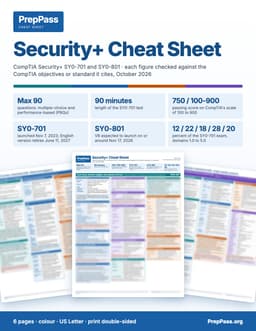
两周内就要考试?
这本指南是系统讲解,要花几周读。如果两周内就考,可打印的彩色速查表是另一款产品:考试涉及的关键数字,按章节排好。
6 页 · US Letter · 可打印 PDF · 永久保存
How this book compares
CompTIA publishes the Security+ (V7, SY0-701) objectives summary and exam details for free; SY0-701 retires in English on June 11, 2027, and V8 is expected around November 17, 2026. This book is written to SY0-701; Sybex sells a longer SY0-701 study guide.
| Resource | Price | What you get | Choose it if |
|---|---|---|---|
| This bookCompTIA Security+ (SY0-701) — Complete Study Guide (2026)PrepPass | $14.99 | Independent downloadable study guide for SY0-701
| Choose this book if you are sitting SY0-701 and want a compact guide to the domains, with the risk maths worked out. |
| From the exam bodySecurity+ (V7) exam page (opens the publisher's page in a new tab)CompTIA | Free (web page) | Exam objectives summary, exam details and retirement dates
| Read it in any case to confirm which version you will book. |
| AlternativeCompTIA Security+ Study Guide with over 500 Practice Test Questions: Exam SY0-701, 9th Edition (opens the publisher's page in a new tab)Sybex (Wiley) | $55.00 paperback; $33.00 e-book | Printed and eBook study guide by Mike Chapple and David Seidl
| Choose Sybex if you want a long, detailed reference with a large online test bank. |
This book
CompTIA Security+ (SY0-701) — Complete Study Guide (2026)
PrepPass
- Price
- $14.99
- What you get
Independent downloadable study guide for SY0-701
- 25 practice questions printed in the book, with explanations
- 78 pages, PDF + EPUB
- Choose it if
- Choose this book if you are sitting SY0-701 and want a compact guide to the domains, with the risk maths worked out.
From the exam body
Security+ (V7) exam page (opens the publisher's page in a new tab)
CompTIA
- Price
- Free (web page)
- What you get
Exam objectives summary, exam details and retirement dates
- SY0-701 English retirement: June 11, 2027
- Choose it if
- Read it in any case to confirm which version you will book.
Alternative
Sybex (Wiley)
- Price
- $55.00 paperback; $33.00 e-book
- What you get
Printed and eBook study guide by Mike Chapple and David Seidl
- 704 pages; online test bank with practice questions and flashcards
- Choose it if
- Choose Sybex if you want a long, detailed reference with a large online test bank.
Other resources' prices and contents are as listed on each publisher's or seller's own page, checked September 24, 2026. Prices change; confirm on the linked page before you buy. This book's price and contents come from our own catalog.
Sources (2)
- https://www.comptia.org/en-us/certifications/security/v7/ — read September 24, 2026
- https://www.wiley.com/en-us/CompTIA+Security%2B+Study+Guide+with+over+500+Practice+Test+Questions%3A+Exam+SY0-701%2C+9th+Edition-p-9781394211418 — read September 24, 2026
包含什么,不包含什么
包含
- All 5 domains at real weight, version-locked to SY0-701
- Risk math worked out: SLE × ARO = ALE (with examples)
不包含
- 不寄送纸质书 —— 这是一份你下载后可自行打印的文件
- 购书不含视频课程、讲师或一对一辅导 —— 站上的免费视频是另一回事
完整的包含项与不包含项
包含
- Control types vs functions + the zero-trust planes made clear
- The incident-response lifecycle in order + secure protocols
- 25 practice questions printed in the book, with explanations (400+ more free on the site)
- An acronym/port cheat-sheet + a 7-day study plan — PDF + EPUB
不包含
- 不含考试报名费与考点费用,这些仍需向官方机构缴纳
目录
查看 5 个部分及各部分起始页
- Chapter 1 - Threats, Attacks, and Social Engineering (24%)第 10 页
- Chapter 2 - Security Architecture and Design (18%)第 24 页
- Chapter 3 - Implementation: Cryptography, Identity, and Secure Protocols (20%)第 35 页
- Chapter 4 - Security Operations and Incident Response (24%)第 46 页
- Chapter 5 - Governance, Risk, and Compliance (14%)第 58 页
取自你将下载的那份 PDF,并标明各章起始页 —— 不是在此手工录入的。
免费读完整一章
完整的一章,与电子书正文一字不差。直接在此窗口滚动阅读;无需下载,无需邮箱。
在本页直接阅读第 5 章
我们没有拿轻松的绪论充数 —— 免费章节直接翻到书里最见功力的部分,让你在考试真正难的地方检验这本书讲得好不好。
The smallest domain, but often the easiest points on the exam if you read the chapter. Governance sets direction and authority; risk management decides where to spend; compliance keeps you legal. Together they align security with the business.
Teaching: Policies and Governance
Governance gives a security program structure, authority, and accountability. Know the hierarchy of documents:
- Policies - high-level statements of intent, approved by leadership.
- Standards - specific, mandatory requirements supporting policies (e.g., "passwords must be at least 14 characters").
- Procedures - step-by-step instructions.
- Guidelines - recommended, non-mandatory best practices.
Common policies: acceptable use policy (AUP) (permitted and prohibited use, acknowledged as a condition of access), information security policy, business continuity and disaster recovery policy, incident response policy, change management policy, and software development lifecycle policy.
Governance also defines who is in charge through boards and committees and through data roles:
- Data owner - overall accountability for a data set.
- Data controller - determines how and why data is processed.
- Data processor - acts on the controller's behalf.
- Data custodian - manages storage and technical protection.
- Data steward - oversees quality and appropriate use.
Security awareness training teaches users to recognize phishing and social engineering, handle data properly, and report incidents - reducing human risk that technology alone cannot. Effective programs run continuously, use simulated phishing, and tailor content by role.
Governance frameworks give proven structure. The NIST Cybersecurity Framework organizes activities into Identify, Protect, Detect, Respond, Recover. Other references: the ISO 27000 series, COBIT, NIST SP 800-53, and the CIS Controls.
Teaching: Risk Management
Risk management identifies, measures, and treats risk within the organization's tolerance.
It begins with risk identification and a risk assessment (ad hoc, recurring, one-time, or continuous), producing a risk register recording each risk with its owner, likelihood, impact, and treatment. Analysis is qualitative (high/medium/low) or quantitative (dollar figures).
The quantitative formulas are prime exam targets:
- SLE (Single Loss Expectancy) = Asset Value x Exposure Factor.
- ARO (Annualized Rate of Occurrence) = expected occurrences per year.
- ALE (Annualized Loss Expectancy) = SLE x ARO.
Example: a laptop worth $2,000 has a 50% chance of loss per incident, so SLE = $2,000 x 0.5 = $1,000. If such incidents happen twice a year (ARO = 2), then ALE = $1,000 x 2 = $2,000 per year. If a $500-per-year control would prevent it, spending on the control is justified because the ALE it removes ($2,000) exceeds its cost.
Risk appetite is the amount of risk leadership is willing to accept; key risk indicators track exposure. Once a risk is understood, choose a response:
- Mitigate - apply controls to reduce likelihood or impact.
- Transfer - shift financial impact to a third party (insurance, contract terms).
- Avoid - stop the risky activity entirely.
- Accept - acknowledge and take no further action (sometimes with a formal exception).
After controls, residual risk remains, and management must formally acknowledge and accept it. Business impact analysis (BIA) identifies critical functions and quantifies disruption impact, feeding recovery objectives.
Third-party and supply-chain risk deserves special attention: vendor due diligence, questionnaires, independent audits, ongoing monitoring, and managing risk from hardware suppliers, software providers, and managed service providers.
Teaching: Data Classification and Handling in Practice
Governance turns abstract policy into daily action largely through data classification, and the exam expects you to see how a classification scheme drives handling. Classification begins by labeling information according to sensitivity - common commercial tiers are public, internal/private, confidential, and restricted/critical, while government schemes run from unclassified through secret and top secret. The data owner assigns the classification, because only the business, not IT, can judge how damaging disclosure would be.
Each tier then dictates handling requirements: who may access it, whether it must be encrypted at rest and in transit, how it may be transmitted, where it may be stored, and how it must be destroyed. Restricted data might require encryption everywhere, multifactor access, and shredding or degaussing at disposal, while public data needs none of that. This is how classification connects to nearly every other domain - it tells the architecture which data to encrypt, tells operations which systems to monitor most closely, and tells compliance which regulations apply. Labeling and marking make the classification visible so users handle data correctly, and data loss prevention tools enforce the rules automatically by recognizing classified patterns. The recurring exam lesson is that you cannot protect data appropriately until you have classified it, so classification is the practical first step of a data-protection program, and applying controls proportionate to sensitivity - neither over- nor under-protecting - is the mark of a mature program.
Concrete Examples
A retailer calculates that a payment-system outage would cost $40,000 per event and is expected once every two years (ARO = 0.5), giving an ALE of $20,000. A redundant system costs $8,000 per year. Because $8,000 is less than the $20,000 annual expected loss, mitigation is financially rational. This is precisely how the exam frames a "should they buy the control" question - compute ALE, compare to control cost.
A company buys cyber-insurance to cover breach costs. It has not reduced the chance of a breach; it has transferred the financial impact. If instead it deployed EDR to reduce breach likelihood, that is mitigation. If it shut down the risky legacy service entirely, that is avoidance. If it decided the risk was small and did nothing, that is acceptance.
KEY CONCEPT: The four risk responses, and the ALE math. Mitigate (reduce), Transfer (insure/contract), Avoid (stop the activity), Accept (do nothing). Insurance is transfer, not mitigation - a favorite trap. And remember SLE = Asset Value x Exposure Factor, ALE = SLE x ARO. A control is worth buying when its annual cost is less than the ALE it eliminates.
Teaching: Regulations and Standards
Organizations operate under laws and standards governing sensitive data. Non-compliance brings fines, liability, and reputational harm.
- GDPR (General Data Protection Regulation) - protects EU residents' personal data; requires a lawful basis such as consent, grants data-subject rights (access, erasure), mandates breach notification, and applies to any organization handling EU residents' data regardless of location.
- HIPAA - safeguards protected health information (PHI) for US healthcare providers, plans, and business associates.
- PCI DSS - a contractual industry standard, not a law, mandating controls for anyone storing, processing, or transmitting payment card data; enforced by the card brands.
- Others: SOX (financial reporting integrity), GLBA (financial privacy), and regional privacy laws.
Compliance is ongoing: monitoring (internal and external), attestation, and consequences for non-compliance ranging from fines and sanctions to loss of license, plus reputational damage.
Underpinning compliance is data governance:
- Data classification labels information by sensitivity - public, private, sensitive, confidential, restricted, critical, or governmental levels (unclassified through top secret) - so appropriate handling applies to each tier.
- Data types: regulated data, PII (personally identifiable information), PHI, intellectual property, trade secrets, financial data.
- Data states: at rest, in transit, in use - each needing protective controls.
- Data sovereignty - data is subject to the laws of the country where it resides, shaping cloud region choices; geographic restrictions limit where data may travel.
- Data retention - keep data only as long as law and business need require, then dispose securely.
Teaching: Agreements and Continuity
Formal agreements set expectations with third parties. Know each by purpose:
- SLA (Service Level Agreement) - measurable commitments (uptime, response times) with consequences; the primary tool for holding vendors accountable.
- MOU (Memorandum of Understanding) - a non-binding statement of intent to cooperate.
- BPA (Business Partnership Agreement) - terms of a partnership, including responsibilities.
- MSA (Master Service Agreement) - overarching terms, under which a SOW (Statement of Work) describes specific deliverables.
- NDA (Non-Disclosure Agreement) - legally binds parties to keep confidential information secret.
- ISA (Interconnection Security Agreement) - governs the secure connection between two organizations' systems.
Continuity planning prepares for disruption:
- Business impact analysis (BIA) identifies critical functions and sets RTO and RPO.
- A business continuity plan (BCP) keeps essential operations running during a disruption.
- A disaster recovery plan (DRP) restores IT systems and data after an event.
- Plans must be documented, owned, communicated, and tested (tabletop, walkthrough, simulation, full failover) - an untested plan routinely fails when needed.
Teaching: Change Management as Governance
CompTIA treats change management as a governance and operations topic because uncontrolled change is a leading cause of both outages and security gaps. A formal change process requires that every change follow approval through a change advisory board, sit within an ownership and stakeholder structure, and carry an impact analysis that weighs what could go wrong. Changes are made inside a scheduled maintenance window, follow standard operating procedures, and always include a backout (rollback) plan so a failed change can be reversed. Test results validate the change before it reaches production.
The exam also lists technical implications of change that security professionals must anticipate: allow and deny lists that must be updated, restricted activities and downtime, the need to restart services or applications, legacy applications that break under change, and dependencies that ripple across systems. Finally, change must be documented - updating diagrams, policies, and procedures and maintaining version control - so the environment's true state is always known. When a scenario describes a change that caused an outage or a security hole, the intended lesson is nearly always that the change management process (approval, testing, or rollback planning) was skipped.
Teaching: Building a Security Awareness and Human-Risk Program
People are simultaneously the largest attack surface and the strongest sensor, so SY0-701 treats security awareness as a governance program, not a one-time video. An effective program runs continuously rather than annually, uses role-based content so developers, executives, and front-line staff each get relevant training, and measures its results. It covers recognizing phishing and social engineering, handling sensitive data correctly, following the acceptable use policy, spotting anomalous behavior, and reporting incidents quickly through a known channel.
The program's centerpiece is often simulated phishing: sending benign lures to staff, measuring click rates, and delivering just-in-time coaching to those who fall for them. Over time, click rates fall and reporting rates rise - a measurable reduction in human risk. Training also addresses insider threat awareness, secure remote and travel practices, password and MFA hygiene, and the risks of shadow IT. The exam frames awareness as a detective and preventive control on the human layer: it prevents some attacks outright and turns users into reporters who detect the ones that get through. When a scenario shows repeated successful phishing despite technical filters, the intended remediation is a stronger, ongoing awareness program combined with MFA - a reminder that technology and human controls work together, and that neither alone is sufficient.
Teaching: Third-Party and Supply-Chain Risk Management
A large share of breaches now arrive through trusted vendors, so SY0-701 gives real weight to third-party risk management. Before engaging a vendor, an organization performs due diligence: reviewing the vendor's security posture, requesting evidence such as audit reports and certifications, and completing a vendor security questionnaire. Penetration testing and the right-to-audit clauses written into contracts let the organization verify claims rather than take them on faith. Supply-chain analysis extends this scrutiny to hardware suppliers, software providers, and the vendor's own subcontractors, because you inherit weaknesses several links down the chain.
The relationship is governed by the agreements from earlier in this chapter - the SLA for service levels, the MSA and SOW for scope, the NDA for confidentiality, the BPA for partnership terms, and the ISA for secure system interconnection. Once a vendor is onboarded, risk management does not stop: ongoing monitoring watches for the vendor's own breaches, expiring certifications, or degraded performance, and periodic reassessment confirms controls still hold. Access granted to third parties follows least privilege and is promptly deprovisioned when the engagement ends. The exam frequently frames a scenario in which a breach originated at a supplier and asks what would have prevented or limited it; the intended answers are the vetting, contractual, and monitoring controls above - the recognition that trusting a partner still requires verifying and containing that trust.
购买者常问的问题
怎么拿到?
付款后下载入口立即出现在本页,链接同时发到你的邮箱。无需注册账号。
不合适怎么办?
14 天内发邮件即可全额退款,无需理由。
免费练习会取消吗?
不会。站上的每一道练习题、计时模考和免费章节都继续免费。这本书是「学」的那一半,不是把免费部分围起来的门。
更多问题 (1)
能在手机上看吗?
可以 —— EPUB 适合手机和电子书阅读器,PDF 适合打印和贴标签,两种都给你。
练习免费,为什么还要买书?
我们的练习题和计时模考一直免费 —— 网站上的东西不会因为这本书而收起来。这本 $14.99 的书是「学」的那一半:知识本身,按顺序讲清楚,存成一份属于你的文件。
- 系统讲解 —— 每个考试部分按章节从头讲到尾,不只是题目
- 可打印可贴标签 —— 一份适合打印的 PDF,能划重点、做批注、带到书桌前
- 随处离线学 —— EPUB 放手机或电子书阅读器;不用 wifi,不用一堆浏览器标签
- 全在一处 —— 章节和练习题都在同一份文件里
- 永久归你 —— 一次 $14.99,即时下载,无订阅
详细信息
- 官方来源核验(the public CompTIA Security+ SY0-701 objectives)
- 420 道免费练习题
Security+ bootcamp/course 要 $400–$2,000。这本书讲的是同一门考试 —— 同样的规则、核对到最新标准 —— 只需一次性 $14.99,永久归你。
一次购买,永久下载访问。此电子书是完整的 CompTIA Security+ (SY0-701) 学习指南,含 PDF 与 EPUB。仅为教育性摘要,非专业或法律意见 —— 请始终以官方来源核实当前规定。最后更新:October 2026。