CPA REG (Taxation and Regulation) · 2026 版
CPA REG Study Guide — 2026 Edition
版本说明New for 2026: written to the Jan 2026 REG blueprint and the H.R. 1 tax law tested from July 1, 2026
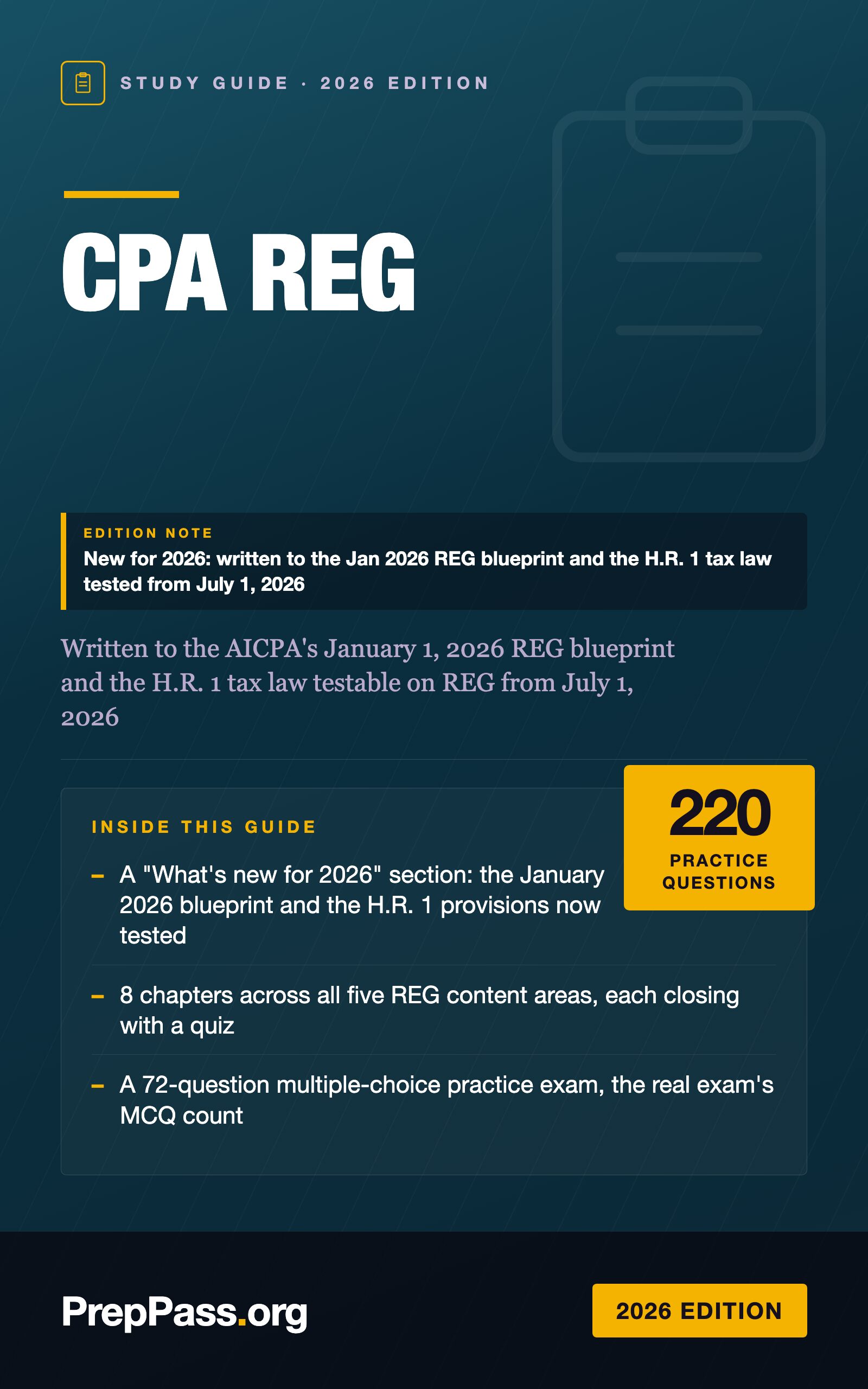
Written to the AICPA's January 1, 2026 REG blueprint and the H.R. 1 tax law testable on REG from July 1, 2026: 220 original questions, a 72-question practice exam and 5 worked simulation cases.
- 220 道原创 CPA REG 练习题,每题附解析,合成一本 PDF + EPUB 永久保存
PDF + EPUB · 英文 · 241 页 · $19.99 一次买断
本书为英文版,下载的 PDF 与 EPUB 均为英文。
付款后立即下载 —— 无需注册账号,无订阅。
14 天退款保证:任何原因不满意?购买后 14 天内发邮件至 support@preppass.org 即可全额退款。 退款政策
先做 10 题,看看讲解 —— 免费
先答完这 10 题,交卷后每题都有解析 —— 还会指出本指南里讲这一点的那一节。约 5 分钟,无需注册。
开始 10 道免费题翻开这本书看看
三页真实内页,直接从你将下载的 PDF 渲染而来 —— 依次是一页速查、一页讲解、一道带解析的例题。没有任何一页是为了好看而重画的。
- 速查页Chapter 1 — Ethics, Professional Responsibilities and Federal Tax Procedures (Area I) · PDF 第 22 页
一页可以随时翻回来的内容:把数字、期限或术语集中在一处。
- 怎么讲Chapter 2 — Business Law I: Agency and Contracts (Area II.A–II.B) · PDF 第 50 页
讲解页:用文字把知识讲清楚,顺序与考试考查的顺序一致。
- 一道题的完整解析Answer key — Area II · PDF 第 188 页
一道练习题,连同答案和背后的推理 —— 不只是一个答案键。
关于这场考试本身
| 主管机构 | American Institute of Certified Public Accountants (AICPA) —— 考试由 Prometric 承办 |
|---|---|
| 题目数量 | 72 道题 来源: AICPA — Uniform CPA Examination Blueprints (effective January 2026, PDF) |
| 考试时限 | 240 分钟 来源: AICPA — Uniform CPA Examination Blueprints (effective January 2026, PDF) |
| 及格标准 | 标准分 75(量表范围 0–99) 来源: AICPA & CIMA — Learn more about CPA Exam scoring and pass rates |
| 费用 | Boards of Accountancy / NASBA 未公布 我们查阅但未找到该数据的来源: NASBA — CPA Exam Candidate Guide (07162026, PDF) |
| 考试语言 | 英语 |
包含什么,不包含什么
包含
- A "What's new for 2026" section: the January 2026 blueprint and the H.R. 1 provisions now tested
- 8 chapters across all five REG content areas, each closing with a quiz
- A 72-question multiple-choice practice exam, the real exam's MCQ count
- 5 worked task-based simulation cases: return review, depreciation, S corporation basis, Schedule M-1, research
- 220 original questions, each with a worked explanation citing its source
- PDF + EPUB you keep
不包含
- 不寄送纸质书 —— 这是一份你下载后可自行打印的文件
- 购书不含视频课程、讲师或一对一辅导 —— 站上的免费视频是另一回事
- 不含考试报名费与考点费用,这些仍需向官方机构缴纳
目录
查看 13 个部分及各部分起始页
- Chapter 1 — Ethics, Professional Responsibilities and Federal Tax Procedures (Area I)第 10 页
- Chapter 2 — Business Law I: Agency and Contracts (Area II.A–II.B)第 33 页
- Chapter 3 — Business Law II: Debtor-Creditor Relationships, Federal Regulation and Business Structure (Area II.C–II.E)第 52 页
- Chapter 4 — Federal Taxation of Property Transactions: Basis and Cost Recovery (Area III)第 75 页
- Chapter 5 — Federal Taxation of Individuals I: Gross Income, Pass-Through Items, Adjustments and Deductions (Area IV.A–IV.C)第 91 页
- Chapter 6 — Federal Taxation of Individuals II: Loss Limitations, Filing Status, Tax and Credits (Area IV.D–IV.F)第 112 页
- Chapter 7 — Federal Taxation of Entities I: Book-Tax Differences, C Corporations and State and Local Taxes (Area V.A–V.B)第 132 页
- Chapter 8 — Federal Taxation of Entities II: S Corporations, Partnerships, LLCs and Tax-Exempt Organizations (Area V.C–V.F)第 152 页
- Answer key & explanations第 169 页
- Answer key — Area II第 180 页
- Appendix A — The exam at a glance第 211 页
- Appendix B — Terms to use precisely第 214 页
- Appendix C — Quick-reference sheet Procedure and penalties第 217 页
取自你将下载的那份 PDF,并标明各章起始页 —— 不是在此手工录入的。
免费读完整一章
完整的一章,与电子书正文一字不差。直接在此窗口滚动阅读;无需下载,无需邮箱。
在本页直接阅读第 8 章
我们没有拿轻松的绪论充数 —— 免费章节直接翻到书里最见功力的部分,让你在考试真正难的地方检验这本书讲得好不好。
Pass-through entities are tested in two ways. First, classification: can this corporation be an S corporation, and what is this LLC for tax purposes? Second, flow-through arithmetic: split the entity's items into ordinary business income and separately stated items, then roll each owner's basis forward. The basis roll-forward is where most candidates lose marks, so this chapter spends the most time on it.
V.C S corporations
V.C.1 Eligibility and election
A corporation can elect S status only if it is a small business corporation: a domestic corporation, not an ineligible corporation, that does not[1]
- have more than 100 shareholders (a husband and wife, and all members of a family, are treated as one shareholder[1]);
- have a shareholder that is not an individual, other than an estate, certain trusts and certain exempt organizations — so no corporations or partnerships as shareholders;
- have a nonresident alien shareholder; or
- have more than one class of stock. Differences in voting rights among common shares do not create a second class[1]; differences in rights to distributions or liquidation proceeds do.
Making the election. The corporation files Form 2553 with the consents of its shareholders — for an election filed before its effective date, every shareholder who owns stock on the day the election is made must consent[2]. An election is effective for a tax year if made during the preceding year or on or before the 15th day of the third month of the tax year[3]; a later election generally takes effect the following year. Relief for late elections is available.
Termination.
- Revocation — by shareholders holding more than one-half of the shares on the day of revocation[3].
- Ceasing to qualify — for example, a 101st shareholder, a corporate shareholder or a second class of stock; the termination is effective on the date of the terminating event.
- Excess passive investment income — the election terminates if the corporation has accumulated earnings and profits (from C corporation years) at the close of each of three consecutive years and passive investment income is more than 25% of gross receipts in each of those years[3].
After a termination, the corporation generally cannot re-elect until its fifth tax year after the year the termination took effect[3].
V.C.2 Ordinary business income and separately stated items
An S corporation generally pays no income tax. Each shareholder takes into account a pro rata share of the corporation's items of income (including tax-exempt income), loss, deduction and credit whose separate treatment could affect any shareholder's tax, and of its nonseparately computed income or loss[4].
| Ordinary business income (Form 1120-S page 1) | Separately stated (Schedule K / K-1) |
|---|---|
| Sales less cost of goods sold | Interest, dividends and royalties (portfolio income) |
| Salaries and wages, including reasonable compensation to shareholder-employees | Net rental real estate income or loss |
| Rent, taxes, repairs, depreciation (MACRS) | Capital gains and losses; §1231 gains and losses |
| Advertising, employee benefits | Charitable contributions |
| §179 deduction | |
| Tax-exempt interest (affects basis) | |
| Not deductible anywhere: fines, 50% of meals, federal income tax, entertainment | Nondeductible expenses (reduce basis) |
Pro rata share. Each item is assigned equally to each day of the year and then divided among the shares outstanding on that day[5] — so a shareholder who owned 40% for half the year is allocated 20% of the year's items.
The accumulated adjustments account (AAA)
The AAA tracks S corporation earnings that have been taxed to shareholders but not yet distributed. It is adjusted like stock basis, with two differences: no adjustment for tax-exempt income and its related expenses, and the AAA can go negative (the "but not below zero" limit in the basis rules is disregarded)[6]. Distributions reduce the AAA but cannot make it negative.
Distributions.
- S corporation with no accumulated E&P: a distribution is tax-free to the extent of the shareholder's stock basis; any excess is gain from the sale or exchange of property[6].
- S corporation with accumulated E&P from C years: distributions come first from the AAA (tax-free to the extent of basis), then as a dividend to the extent of accumulated E&P, then as a return of remaining basis and gain[6].
V.C.3 Shareholder's stock and debt basis
A shareholder's stock basis starts with the amount paid (or basis of property contributed). Each year it is[7]:
- increased by the shareholder's share of all income items — separately stated income, including tax-exempt income, and nonseparately computed income;
- decreased (not below zero) by non-taxable distributions, by losses and deductions, and by nondeductible, noncapital expenses[7].
Under the regulations the order is: increases, then distributions, then nondeductible expenses, then losses and deductions. Because distributions come before losses, a distribution is tested against basis before that year's losses reduce it.
Debt basis. A shareholder who lends money directly to the S corporation has basis in that debt. Losses that exceed stock basis reduce debt basis (not below zero)[7]. In later years, net increases restore debt basis first, before any increase to stock basis[7]. If the corporation repays a loan whose basis has been reduced, part of each repayment is income to the shareholder. Losses above combined stock and debt basis carry forward indefinitely[4].
A shareholder's guarantee of a bank loan to the corporation does not create debt basis; only a loan the shareholder actually made to the corporation does.
V.D Partnerships
V.D.1 Ordinary business income, separately stated items and guaranteed payments
A partnership files Form 1065 but pays no income tax. Its items flow to the partners on Schedule K-1 in the same two groups as an S corporation's: ordinary business income (loss) and separately stated items. The difference is guaranteed payments.
Guaranteed payments — payments to a partner for services or for the use of capital, determined without regard to the partnership's income — are treated as made to a non-partner for purposes of gross income and the deduction for business expenses[8]. So the partnership deducts them in computing ordinary business income, and the partner reports them as ordinary income in addition to his or her distributive share[9]. Guaranteed payments are not QBI (Chapter 5).
Contributions
No gain or loss is recognized by the partnership or the partner when property is contributed in exchange for a partnership interest[10]. The partner's initial basis in the interest (outside basis) is the money plus the adjusted basis of the property contributed[11]; the partnership's basis in the property (inside basis) is the partner's adjusted basis carried over[12].
V.D.2 Basis of a partner's interest
A partner's basis is[13]:
- increased by the distributive share of partnership taxable income, tax-exempt income and additional contributions;
- decreased (not below zero) by distributions, the distributive share of losses, and nondeductible expenditures not chargeable to capital[13].
Liabilities. An increase in a partner's share of partnership liabilities is treated as a contribution of money by the partner, increasing basis; a decrease is treated as a distribution of money, decreasing basis[14]. This is the key difference from an S corporation, where a shareholder gets no basis for the corporation's bank debt.
Distributions (non-liquidating).
- A partner recognizes gain only to the extent money distributed exceeds his or her basis immediately before the distribution; loss is not recognized in a current distribution[15].
- Property distributed takes the partnership's basis, but not more than the partner's outside basis reduced by any money distributed in the same transaction[16].
A partner's loss deduction is limited to outside basis at year-end (Chapter 6)[17].
Reviewing Form 1065 and Form 1120-S
The blueprint's review tasks ask you to classify items from a trial balance as ordinary, separately stated or nondeductible. Common errors: portfolio interest or dividends netted into ordinary income; charitable contributions deducted on page 1; §179 deducted on page 1 instead of passing through; guaranteed payments omitted from the deduction list (partnership) or treated as distributions; a shareholder's health insurance or a shareholder's salary misclassified; fines and the nondeductible part of meals deducted.
V.E Limited liability companies — classification
Under the "check-the-box" regulations, a domestic eligible entity that does not elect otherwise is a partnership if it has two or more members, or is disregarded as separate from its owner if it has a single owner[18]. Either kind of LLC may elect to be taxed as a corporation on Form 8832[19], and an LLC taxed as a corporation may then elect S status if it meets the S requirements. A disregarded single-member LLC is still treated as a separate entity for employment and certain excise taxes[19].
V.F Tax-exempt organizations
Section 501(c) lists the types of exempt organization. The ones REG expects you to recall:
| Section | Type |
|---|---|
| 501(c)(3) | Organized and operated exclusively for religious, charitable, scientific, literary or educational purposes (and certain others); no private inurement; no substantial lobbying; no political campaign activity[20] |
| 501(c)(4) | Civic leagues and social welfare organizations |
| 501(c)(5) | Labor, agricultural and horticultural organizations |
| 501(c)(6) | Business leagues (trade associations, chambers of commerce) |
| 501(c)(7) | Social and recreation clubs |
Source for (c)(4)–(c)(7):[21].
Only contributions to 501(c)(3)-type organizations (and certain others, such as government units) are generally deductible charitable contributions. A 501(c)(3) organization is either a public charity or a private foundation; private foundations face additional excise taxes.
Unrelated business income tax. An exempt organization pays tax at corporate rates on its unrelated business taxable income[22] — gross income from an unrelated trade or business regularly carried on, less directly connected deductions[23]. A trade or business is unrelated if its conduct is not substantially related (apart from the need for income) to the organization's exempt purpose[24]. A museum's gift shop selling reproductions of its collection is related; the same museum running a commercial car wash every weekend is not.
Worked example: a partner's year from K-1 to basis
Cedar Partners has three equal general partners. At January 1, Mia's outside basis is $50,000, which includes her one-third share ($20,000) of the partnership's $60,000 of recourse bank debt. During the year:
| Item | Partnership total | Mia's one-third |
|---|---|---|
| Ordinary business income (after a $36,000 guaranteed payment to Mia) | $90,000 | $30,000 |
| Guaranteed payment to Mia for services | $36,000 | $36,000 (hers alone) |
| Interest income | $6,000 | $2,000 |
| Tax-exempt interest | $3,000 | $1,000 |
| Charitable contributions | $9,000 | $3,000 |
| Nondeductible penalties | $1,500 | $500 |
| Bank debt at December 31 | $30,000 | $10,000 |
| Cash distribution to Mia | $25,000 |
Mia's return. Ordinary income $30,000 plus the $36,000 guaranteed payment, both reported as ordinary income[9]; interest $2,000; a $3,000 charitable contribution that she claims on her own return under the individual charitable rules (Chapter 5).
Mia's outside basis at December 31.
| Step | Amount |
|---|---|
| Beginning basis | $50,000 |
| + Distributive share of taxable income: ordinary $30,000 + interest $2,000 | $32,000 |
| + Tax-exempt interest | $1,000 |
| − Decrease in share of liabilities ($20,000 → $10,000), treated as a distribution of money | ($10,000) |
| − Cash distribution | ($25,000) |
| − Charitable contribution (a separately stated deduction item) | ($3,000) |
| − Nondeductible penalties | ($500) |
| Ending basis | $44,500 |
Sources: basis increases for taxable and tax-exempt income and decreases for distributions, losses and nondeductible expenditures[13]; a decrease in a partner's share of liabilities is a deemed distribution of money[14]. The guaranteed payment does not change basis: it is paid to Mia as if she were not a partner, and the partnership deducted it before computing the ordinary income she was allocated[8]. Because the total money distributed ($35,000 including the deemed distribution) never exceeds her basis, she recognizes no gain[15].
Choosing among entities — the tax comparison
| Feature | C corporation | S corporation | Partnership / multi-member LLC |
|---|---|---|---|
| Entity-level income tax | Yes, 21% | Generally no | No |
| Owners taxed on | Dividends when paid | Pro rata share of income, whether or not distributed | Distributive share, whether or not distributed |
| Allocation of items | Not applicable | Strictly per share, per day | By the partnership agreement |
| Owners' basis includes entity debt | No | No — only loans the shareholder makes | Yes — share of partnership liabilities |
| Ownership limits | None | ≤ 100 shareholders; eligible shareholders; one class of stock | None |
| Payments to owner-workers | Deductible salary | Reasonable salary, subject to payroll tax | Guaranteed payments |
| Losses | Stay in the corporation (NOL) | Pass through, limited by stock and debt basis | Pass through, limited by outside basis |
Worked example: an S corporation with C-corporation earnings and profits
Birch Inc. was a C corporation until 2023 and has $30,000 of accumulated E&P from those years. At the end of 2026, before distributions, its AAA is $50,000. Its sole shareholder, whose stock basis is $90,000, receives a $100,000 cash distribution.
- From AAA: $50,000 — tax-free to the extent of basis, reducing basis to $40,000[6].
- Then from accumulated E&P: $30,000 — a dividend[6].
- Remainder: $20,000 — applied against remaining basis ($40,000 → $20,000), tax-free[6].
Result: $30,000 dividend income; stock basis $20,000; AAA zero. Had Birch never been a C corporation, the whole $100,000 would have been measured only against basis: $90,000 tax-free and $10,000 capital gain.
Sources cited in this excerpt
- 26 U.S. Code § 1361 - S corporation defined. Legal Information Institute, Cornell Law School (U.S. Code), current text as retrieved. https://www.law.cornell.edu/uscode/text/26/1361
- Instructions for Form 2553, Election by a Small Business Corporation (Rev. December 2020). Internal Revenue Service, 2020-12. https://www.irs.gov/pub/irs-pdf/i2553.pdf
- 26 U.S. Code § 1362 - Election; revocation; termination. Legal Information Institute, Cornell Law School (U.S. Code), current text as retrieved. https://www.law.cornell.edu/uscode/text/26/1362
- 26 U.S. Code § 1366 - Pass-thru of items to shareholders. Legal Information Institute, Cornell Law School (U.S. Code), current text as retrieved. https://www.law.cornell.edu/uscode/text/26/1366
- 26 U.S. Code § 1377 - Definitions and special rule. Legal Information Institute, Cornell Law School (U.S. Code), current text as retrieved. https://www.law.cornell.edu/uscode/text/26/1377
- 26 U.S. Code § 1368 - Distributions. Legal Information Institute, Cornell Law School (U.S. Code), current text as retrieved. https://www.law.cornell.edu/uscode/text/26/1368
- 26 U.S. Code § 1367 - Adjustments to basis of stock of shareholders, etc. Legal Information Institute, Cornell Law School (U.S. Code), current text as retrieved. https://www.law.cornell.edu/uscode/text/26/1367
- 26 U.S. Code § 707 - Transactions between partner and partnership. Legal Information Institute, Cornell Law School (U.S. Code), current text as retrieved. https://www.law.cornell.edu/uscode/text/26/707
- Publication 541, Partnerships (Rev. December 2025). Internal Revenue Service, 2025-12. https://www.irs.gov/pub/irs-pdf/p541.pdf
- 26 U.S. Code § 721 - Nonrecognition of gain or loss on contribution. Legal Information Institute, Cornell Law School (U.S. Code), current text as retrieved. https://www.law.cornell.edu/uscode/text/26/721
- 26 U.S. Code § 722 - Basis of contributing partner’s interest. Legal Information Institute, Cornell Law School (U.S. Code), current text as retrieved. https://www.law.cornell.edu/uscode/text/26/722
- 26 U.S. Code § 723 - Basis of property contributed to partnership. Legal Information Institute, Cornell Law School (U.S. Code), current text as retrieved. https://www.law.cornell.edu/uscode/text/26/723
- 26 U.S. Code § 705 - Determination of basis of partner’s interest. Legal Information Institute, Cornell Law School (U.S. Code), current text as retrieved. https://www.law.cornell.edu/uscode/text/26/705
- 26 U.S. Code § 752 - Treatment of certain liabilities. Legal Information Institute, Cornell Law School (U.S. Code), current text as retrieved. https://www.law.cornell.edu/uscode/text/26/752
- 26 U.S. Code § 731 - Extent of recognition of gain or loss on distribution. Legal Information Institute, Cornell Law School (U.S. Code), current text as retrieved. https://www.law.cornell.edu/uscode/text/26/731
- 26 U.S. Code § 732 - Basis of distributed property other than money. Legal Information Institute, Cornell Law School (U.S. Code), current text as retrieved. https://www.law.cornell.edu/uscode/text/26/732
- 26 U.S. Code § 704 - Partner’s distributive share. Legal Information Institute, Cornell Law School (U.S. Code), current text as retrieved. https://www.law.cornell.edu/uscode/text/26/704
- 26 CFR § 301.7701-3 - Classification of certain business entities. Legal Information Institute, Cornell Law School (e-CFR), current text as retrieved. https://www.law.cornell.edu/cfr/text/26/301.7701-3
- Limited liability company (LLC). Internal Revenue Service, page as retrieved. https://www.irs.gov/businesses/small-businesses-self-employed/limited-liability-company-llc
- 26 U.S. Code § 501 - Exemption from tax on corporations, certain trusts, etc. Legal Information Institute, Cornell Law School (U.S. Code), current text as retrieved. https://www.law.cornell.edu/uscode/text/26/501
- Other tax-exempt organizations. Internal Revenue Service, page as retrieved. https://www.irs.gov/charities-non-profits/other-tax-exempt-organizations
- 26 U.S. Code § 511 - Imposition of tax on unrelated business income of charitable, etc., organizations. Legal Information Institute, Cornell Law School (U.S. Code), current text as retrieved. https://www.law.cornell.edu/uscode/text/26/511
- 26 U.S. Code § 512 - Unrelated business taxable income. Legal Information Institute, Cornell Law School (U.S. Code), current text as retrieved. https://www.law.cornell.edu/uscode/text/26/512
- 26 U.S. Code § 513 - Unrelated trade or business. Legal Information Institute, Cornell Law School (U.S. Code), current text as retrieved. https://www.law.cornell.edu/uscode/text/26/513
购买前
- 怎么拿到?
- 付款后下载入口立即出现在本页,链接同时发到你的邮箱。无需注册账号。
- 不合适怎么办?
- 14 天内发邮件即可全额退款,无需理由。
- 免费练习会取消吗?
- 不会。站上的每一道练习题、计时模考和免费章节都继续免费。这本书是「学」的那一半,不是把免费部分围起来的门。
- 能在手机上看吗?
- 可以 —— EPUB 适合手机和电子书阅读器,PDF 适合打印和贴标签,两种都给你。
详细信息
Written to the AICPA's January 1, 2026 REG blueprint and the H.R. 1 tax law testable on REG from July 1, 2026: 220 original questions, a 72-question practice exam and 5 worked simulation cases.
- Format: PDF + EPUB download · 241 pages
- 220 practice questions in the book, with a full answer key
- 112 free practice questions for this exam on PrepPass, included at no cost
- $19.99 one-time — no subscription
- 14-day money-back guarantee · refund policy
- Cross-referenced against: AICPA Uniform CPA Examination Blueprints (effective January 1, 2026), the AICPA's H.R. 1 testing statement, the Internal Revenue Code and Rev. Proc. 2025-32, read September 2026
- 官方来源核验(AICPA Uniform CPA Examination Blueprints (effective January 1, 2026), the AICPA's H.R. 1 testing statement, the Internal Revenue Code and Rev. Proc. 2025-32, read September 2026)
- 112 道免费练习题
- 即时下载,永久拥有
练习免费,为什么还要买书?
我们的练习题和计时模考一直免费 —— 网站上的东西不会因为这本书而收起来。这本 $19.99 的书是「学」的那一半:知识本身,按顺序讲清楚,存成一份属于你的文件。
- 系统讲解 —— 每个考试部分按章节从头讲到尾,不只是题目
- 可打印可贴标签 —— 一份适合打印的 PDF,能划重点、做批注、带到书桌前
- 随处离线学 —— EPUB 放手机或电子书阅读器;不用 wifi,不用一堆浏览器标签
- 全在一处 —— 章节和练习题都在同一份文件里
- 永久归你 —— 一次 $19.99,即时下载,无订阅
而且零风险:14 天退款保证 —— 不满意?发邮件即可全额退款,无需理由。 详见退款政策。
14 天退款保证 · 全额退款,无需理由。
一次购买,永久下载访问。此电子书是完整的 CPA REG (Taxation and Regulation) 学习指南,含 PDF 与 EPUB。仅为教育性摘要,非专业或法律意见 —— 请始终以官方来源核实当前规定。