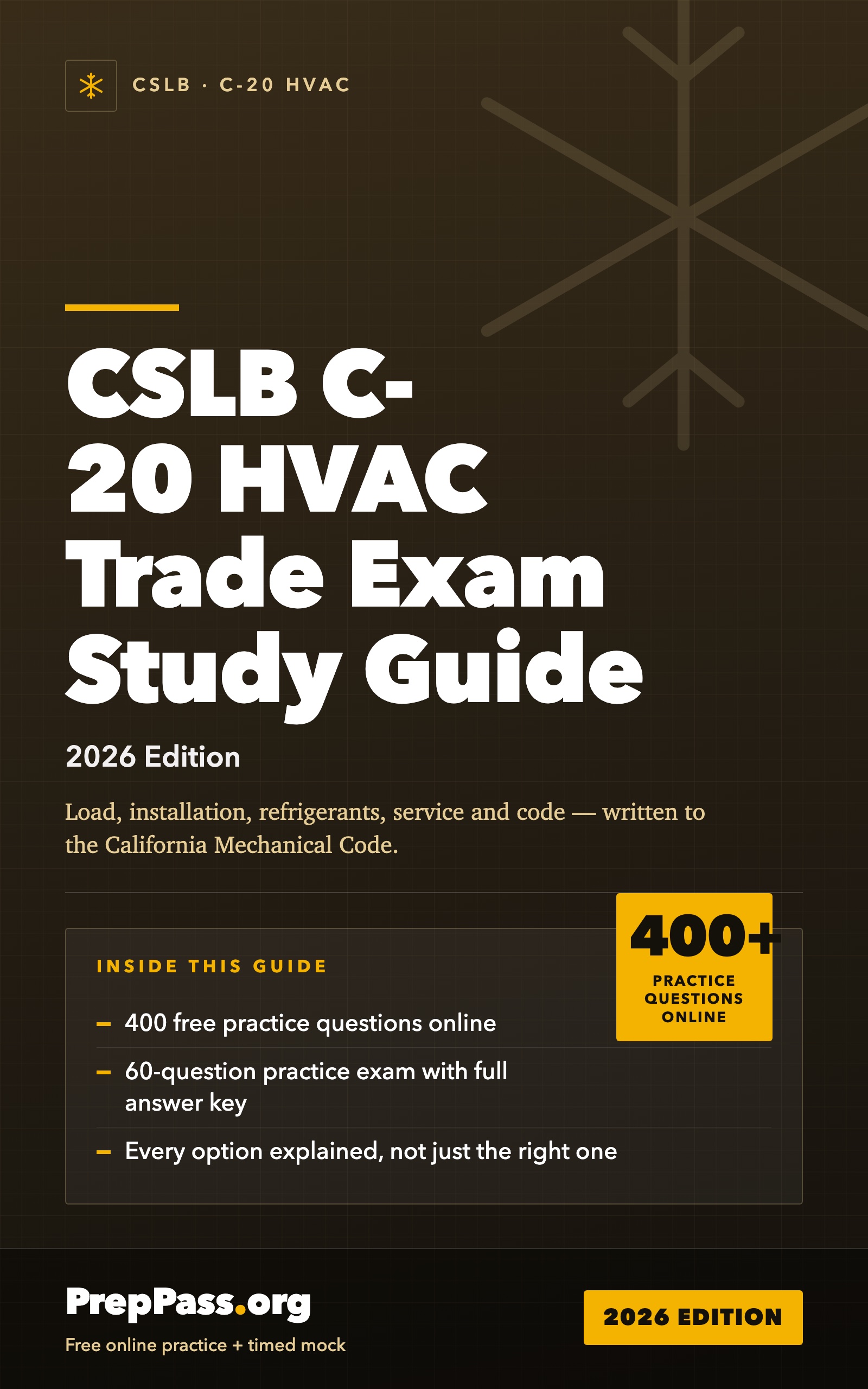
CSLB C-20 HVAC · 2026 版
CSLB C-20 HVAC Trade Exam Study Guide (2026)
Load calculation, installation, refrigerants, service and code — written to the California Mechanical Code and the A2L transition, not to an R-22 era textbook.
- 书内 60 道练习题,配完整答案解析
- 100 页逐章讲解 —— 不是一堆题目的堆砌
- 已与California Mechanical Code · Title 24 · EPA 608 · Cal/OSHA Title 8 · 16 CCR §832.20逐条核对
PDF + EPUB · 英文 · 100 页 · $14.99 一次买断
本书为英文版,下载的 PDF 与 EPUB 均为英文。
付款后立即下载 —— 无需注册账号,无订阅。 退款政策
两门都要考?有套装价
- CSLB C-20 HVAC Trade Exam Study Guide (2026)$14.99
- CSLB Law & Business — Complete Study Guide (2026)$24.99
省下 $9.99。一次结账,两本书,每本都含 PDF 与 EPUB。
已经买过《CSLB Law & Business》了?那就别买套装——套装里含这本,你会重复付费。单独购买《CSLB C-20 HVAC》只要 $14.99。 CSLB C-20 HVAC · 套装内容 →
翻开这本书看看
三页真实内页,直接从你将下载的 PDF 渲染而来 —— 一页讲解、一道带解析的例题、一页速查。没有任何一页是为了好看而重画的。
- 速查页Chapter 2 — Installation of Warm-Air Heating and Cooling Systems · PDF 第 23 页
一页可以随时翻回来的内容:把数字、期限或术语集中在一处。
- 怎么讲Chapter 2 — Installation of Warm-Air Heating and Cooling Systems · PDF 第 28 页
讲解页:用文字把知识讲清楚,顺序与考试考查的顺序一致。
- 一道题的完整解析Chapter 4 — Service and Troubleshooting · PDF 第 50 页
一道练习题,连同答案和背后的推理 —— 不只是一个答案键。
包含什么,不包含什么
包含
- Written to the current California Mechanical and Energy Codes, with cycle-dependent figures flagged
- The refrigerant transition as it stands now — R-454B and R-32 charge limits, leak detection, POE oil
- A 60-question practice exam drawn from the same bank you drill online
- Every answer explains all four options — why the key is right and why each of the other three loses
- A worked example at the end of every chapter
- Quick-reference cheat sheet, glossary, and exam-day strategy appendices
- PDF (print & tab it) + EPUB (phone / e-reader)
不包含
- 不寄送纸质书 —— 这是一份你下载后可自行打印的文件
- 购书不含视频课程、讲师或一对一辅导 —— 站上的免费视频是另一回事
- 不含考试报名费与考点费用,这些仍需向官方机构缴纳
目录
查看 12 章及各章起始页
- Chapter 1 — Load Calculation and System Design第 7 页
- Part 6 — the Energy Code — sets minimum equipment efficiency, duct第 14 页
- Part 6 = Energy Code; Part 4 = Mechanical; 3 = Electrical; 5 =第 15 页
- Chapter 2 — Installation of Warm-Air Heating and Cooling Systems第 18 页
- Chapter 3 — The Refrigeration Cycle and Refrigerants第 33 页
- Chapter 4 — Service and Troubleshooting第 43 页
- Chapter 5 — Safety, Codes, and the C-20 Scope第 52 页
- Practice Exam — 60 Questions第 62 页
- Answer Key and Explanations第 76 页
- Appendix A — Quick-Reference Cheat Sheet第 89 页
- Appendix B — Glossary of Key Terms第 94 页
- Appendix C — Exam-Day Strategy第 98 页
取自你将下载的那份 PDF,并标明各章起始页 —— 不是在此手工录入的。
免费读完整一章
完整的一章,与电子书正文一字不差。直接在此窗口滚动阅读;无需下载,无需邮箱。
在本页直接阅读第 2 章
我们没有拿轻松的绪论充数 —— 免费章节直接翻到书里最见功力的部分,让你在考试真正难的地方检验这本书讲得好不好。
This is the biggest chapter because it is the biggest block on the exam, and because it is where the code has the most to say about what you do with your hands. A furnace that fires beautifully in a closet with no combustion air is a carbon monoxide event waiting for a cold snap. A line set brazed without nitrogen runs fine for a season and then plugs a TXV.
2.1 Combustion Air
The purpose of combustion air is to supply oxygen for complete, safe combustion — not to cool the control board, not to raise supply temperature. Starve it and combustion goes incomplete, producing soot and carbon monoxide.
The code method sizes required air on the total BTU/hr input of the appliances in the space and the volume of the space, and on whether air comes from indoors or outdoors. Put a 100,000 BTU/hr furnace in a closet inside a tight modern house and the interior volume may simply not contain enough air to support combustion, no matter how good the flame looks when you light it. The remedy is engineered openings sized by the code method. This applies in existing work as much as new, and interior air being "dry" has nothing to do with it — the issue is oxygen quantity.
When the two-opening method brings combustion air from outdoors, the geometry is fixed: one opening within 12 inches of the top of the enclosure and one within 12 inches of the bottom. The high opening relieves warm buoyant air; the low opening supplies denser cool air. Two high openings leave the bottom without supply; two low openings give the buoyant air no path. A bedroom or bathroom is not an acceptable source.
The 12-inch dimension, the required opening areas, and the volume method are CMC values (the combustion-air chapter — Chapter 7 in the UMC/CMC organization) and are cycle-dependent. Verify in the adopted edition.
Direct-vent sealed-combustion appliances pipe their own air from outdoors, which is why one is well suited to a garage workshop: the burner never breathes garage air, which may carry gasoline or solvent vapors. It still condenses in most cases, still needs a drain, and still needs a disconnect. And it never licenses you to take return air from a garage.
2.2 Venting
Type B gas vent is double-wall metal vent listed for listed Category I gas appliances — natural-draft equipment with draft hoods producing relatively low-temperature, non-condensing flue gas. Not for oil appliances with barometric dampers, not for solid fuel, not for high-temperature incinerators.
Category IV condensing appliances are vented with listed plastic pipe such as PVC or CPVC. The reason is chemistry, not convenience: a condensing appliance cools flue gas below its dew point, and the acidic condensate that forms would destroy metal vent. Its flue temperature is low, not high — which is exactly why it condenses — and it vents under positive pressure, which Type B is not rated for.
Vent connectors on natural-draft equipment slope up. A single-wall connector running horizontally to the vertical vent must slope upward toward the vent, commonly at least 1/4 inch per foot (CMC figure — cycle-dependent). Buoyant flue gas needs continuous rise or it stalls and spills at the draft hood. A level run offers no rise; sloping toward the appliance sends flue gas and moisture back into the equipment; a "trap" in a connector would just pocket soot.
All flues and vents terminate outdoors, at listed heights and clearances from windows, doors, and air intakes. Never into an attic, a crawl space, or a return duct. On a sidewall-vented condensing furnace, the governing concern is exactly that separation. Concentric and two-pipe terminations follow the manufacturer's spacing, not a rule that both pipes sit at the same height; the vent slopes back toward the furnace so condensate drains to the appliance; and terminating below grade invites blockage by leaves, snow, and standing water.
The orphaned water heater. This scenario separates candidates who have thought about it from those who have not. You replace an 80% furnace with a condensing model. The old furnace shared a Type B vent with a natural-draft water heater. The condensing furnace leaves that vent entirely. What must be evaluated is whether the water heater alone can still vent safely in a vent sized for two appliances. A vent now grossly oversized for one small appliance may never establish draft, and the water heater spills flue gas into the building. That is the open question — not whether the B-vent can serve the condensing furnace, which it plainly cannot.
Key Numbers & Facts — Combustion Air and Venting - Combustion air sized on appliance input + space volume + indoor vs. outdoor source. - Two-opening outdoor method: one within 12 in of the top, one within 12 in of the bottom (cycle-dependent). Bedrooms/bathrooms are not acceptable sources. - Type B = Category I. Category IV condensing = listed PVC/CPVC (acidic condensate, low flue temperature, positive pressure). - Natural-draft connector slopes UP toward the vent (commonly ≥ 1/4 in per foot). - Terminate outdoors at listed clearances from openings and intakes. - Pulling a furnace off a common vent orphans the water heater — re-evaluate its draft.
2.3 Refrigerant Line Sets
Size the line set from the manufacturer's tables — system capacity, total line length, vertical rise — not by matching what was there, not by insulation color, not by breaker size. Undersizing the suction line is the classic long-run mistake: it adds pressure drop over the whole run, lowering pressure at the compressor and cutting mass flow and capacity.
Insulate the suction line; usually leave the liquid line bare. The suction line carries cold vapor below the dew point of surrounding air, so bare tubing sweats onto the building and picks up heat that raises superheat at the compressor. Insulation does not change velocity and does not "hold in" pressure.
Support horizontal runs at regular intervals with hangers that do not crush the insulation. Supporting only the ends allows sag, vibration fatigue and joint failure; resting tubing on framing lets it chafe and work-harden; taping it to the drain line supports nothing.
Vertical lift changes the problem. Condenser 20 feet above the evaporator: lifting liquid costs static head, and that pressure drop consumes subcooling — enough of it and you get flash gas at the metering device. Evaporator above the condenser with a 25-foot suction riser: now the concern is oil, which must be carried up by vapor velocity. A properly formed trap at the base of the riser collects oil until velocity carries it up as a slug. Oversizing the riser lowers velocity and makes oil return worse.
Brazing. Flow dry nitrogen through the tubing at a low, steady trickle just sufficient to displace the air — not a high-pressure blast (which chills the joint and blows the filler out), not unregulated cylinder pressure (which can rupture thin-wall tubing), and not a purge afterward (by then the scale has formed). Without it, oxygen forms copper oxide scale inside the tube, and flakes break loose, plug the metering device and load the drier.
Pressure test, then evacuate — in that order. Leaks are found with pressure, because a vacuum cannot push anything out for a detector to find. Test with dry nitrogen through a regulator with a relief device — never shop air (moisture and oil even through a dryer), never oxygen (with oil residue it can ignite violently), never refrigerant mixed with air (unrecoverable and potentially combustible). Then pull the vacuum.
Evacuation target: 500 microns or lower, verified by isolating the pump and watching the gauge. Readings of 2,000 or 5,000 microns still leave water vapor; short hold times prove nothing; a compound manifold gauge cannot distinguish 29 inches of mercury from a genuinely deep vacuum. Follow the manufacturer's stated procedure.
Read the decay test, because it is a diagnosis in itself:
- Rises then levels off → moisture still boiling off and reaching equilibrium. Keep pumping; break the vacuum with nitrogen and pump again.
- Rises steadily toward atmospheric without leveling → a leak, in the system or at your connections.
- Barely moves → dry and tight. Charge it.
Use large-diameter hoses with both ports open and remove valve cores where permitted: at deep vacuum the gas is extremely thin, and small hoses and cores choke the flow badly enough to prevent reaching target at all. Put the micron gauge at the system, not at the pump.
Then open both service valves fully so the factory charge fills the circuit. Starting a compressor with the valves closed runs it into a vacuum and can damage the motor; opening only the liquid valve starves the compressor while flooding the low side.
Filter drier direction matters. The screen and media are arranged for one flow direction. Installed backwards on a cooling-only system, debris the drier already trapped washes off the outlet screen toward the metering device. The desiccant still adsorbs moisture either way — the failure is mechanical.
Flare connections on mini-splits: deburr, form a clean flare, and torque the nut to specification. Overtightening splits or extrudes the flare into a leak that shows up months later. Pipe dope is not a flare sealant. A previously compressed flare has work-hardened and will not reseal.
Refrigerant class changes the job. A system using R-454B — an A2L refrigerant — is mildly flammable, so the listed equipment carries charge limits, leak detection and mitigation provisions the installer must not defeat. (There is no blanket "ten feet from a window" setback, and brazing alloy is chosen for the joint and base metals, not the safety class.) More on A2Ls in Chapter 3.
Key Numbers & Facts — Line Sets - Size from manufacturer tables (capacity, length, rise). Insulate the suction line. Support at intervals. - Condenser above evaporator → static lift consumes subcooling. Evaporator above condenser → trap at the base of the suction riser. - Braze with a low, steady dry-nitrogen trickle or get copper oxide scale. - Pressure test FIRST (regulated dry nitrogen with relief), THEN evacuate. Never air, oxygen, or refrigerant-plus-air. - Evacuate to ≈ 500 microns, verified with the pump isolated. Decay: rise-then-level = moisture; steady climb = leak. - Open both service valves fully. Install the drier in the marked direction. - A2L: follow listed charge limits and mitigation features.
2.4 Condensate
Route condensate to an approved point of disposal — treated under the plumbing code as indirect waste to an approved receptor. Not into a plumbing vent (which obstructs it), not onto the ground under the unit, not into a crawl space (vapor barrier or no), not onto a roof.
Secondary protection where a leak would do damage. An air handler in an attic above a finished ceiling requires an auxiliary drain pan with its own drain, or a water-level shutoff device (float switch). A condensate pump can serve the primary drain but does not by itself satisfy the secondary requirement, and a single primary drain provides no backup when it clogs. (CMC requirements — verify the adopted edition.)
Draw-through coils need a trap. The pan sits on the suction side of the blower, so the drain outlet is under negative pressure and, without a water seal, the blower pulls air in through the drain instead of letting water out. The trap does not make the pan drain faster; it makes it drain at all. Depth is based on the unit's static pressure. (Refrigerant never reaches the condensate pan — it is inside sealed tubing.)
Slope and support the line. Sags across an attic hold water, restrict flow, and back water into the pan until the float switch trips. That symptom is the drain telling you something: clear the blockage and verify the trap and slope — do not remove the switch, wire it to an alarm, or fit one that lets water climb higher.
Condensing furnace condensate is acidic. A neutralizer raises its pH so it does not attack metallic drain piping. It does not filter particulate, reduce volume, or prevent freezing.
Key Numbers & Facts — Condensate - Indirect waste to an approved receptor. Never a plumbing vent, crawl space, roof, or the ground under the unit. - Attic above a finished ceiling → auxiliary pan with its own drain OR a water-level shutoff. - Draw-through coil → trap required (drain under negative pressure). Continuous fall, no sags. - Repeat float-switch trips = clear the drain, never defeat the switch. - Condensing-furnace condensate is acidic → neutralizer.
购买前
- 怎么拿到?
- 付款后下载入口立即出现在本页,链接同时发到你的邮箱。无需注册账号。
- 不合适怎么办?
- 14 天内发邮件即可全额退款,无需理由。
- 免费练习会取消吗?
- 不会。站上的每一道练习题、计时模考和免费章节都继续免费。这本书是「学」的那一半,不是把免费部分围起来的门。
- 能在手机上看吗?
- 可以 —— EPUB 适合手机和电子书阅读器,PDF 适合打印和贴标签,两种都给你。
详细信息
Load calculation, installation, refrigerants, service and code — written to the California Mechanical Code and the A2L transition, not to an R-22 era textbook.
- Format: PDF + EPUB download · 100 pages
- 60 practice questions in the book, with a full answer key
- 400 free practice questions for this exam on PrepPass, included at no cost
- $14.99 one-time — no subscription
- 14-day money-back guarantee · refund policy
- Cross-referenced against: California Mechanical Code · Title 24 · EPA 608 · Cal/OSHA Title 8 · 16 CCR §832.20
- Last updated: September 2026
- 官方来源核验(California Mechanical Code · Title 24 · EPA 608 · Cal/OSHA Title 8 · 16 CCR §832.20)
- 400 道免费练习题
- 即时下载,永久拥有
CSLB exam prep course 要 $200–$800。这本书讲的是同一门考试 —— 同样的规则、核对到最新标准 —— 只需一次性 $14.99,永久归你。
练习免费,为什么还要买书?
我们的练习题和计时模考一直免费 —— 网站上的东西不会因为这本书而收起来。这本 $14.99 的书是「学」的那一半:知识本身,按顺序讲清楚,存成一份属于你的文件。
- 系统讲解 —— 每个考试部分按章节从头讲到尾,不只是题目
- 可打印可贴标签 —— 一份适合打印的 PDF,能划重点、做批注、带到书桌前
- 随处离线学 —— EPUB 放手机或电子书阅读器;不用 wifi,不用一堆浏览器标签
- 全在一处 —— 章节、每章速记卡、练习题都在同一份文件里
- 永久归你 —— 一次 $14.99,即时下载,无订阅
而且零风险:14 天退款保证 —— 不满意?发邮件即可全额退款,无需理由。 详见退款政策。
14 天退款保证 · 全额退款,无需理由。
一次购买,永久下载访问。此电子书是完整的 CSLB C-20 HVAC 学习指南,含 PDF 与 EPUB。仅为教育性摘要,非专业或法律意见 —— 请始终以官方来源核实当前规定。最后更新:September 2026。