CSLB C-46 Solar · 2026 版
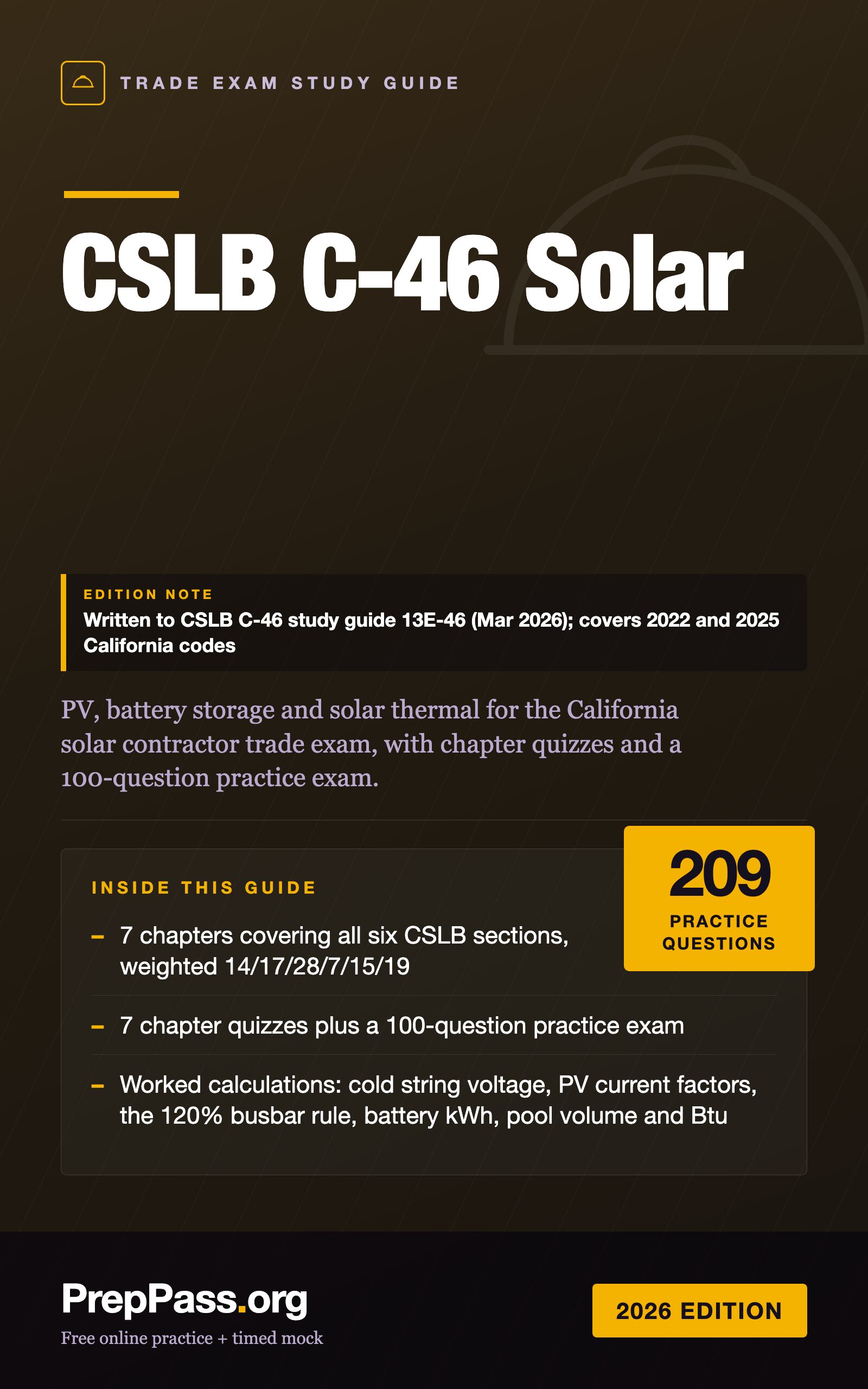
CSLB C-46 Solar Trade Exam Study Guide (2026)
版本说明Written to CSLB C-46 study guide 13E-46 (Mar 2026); covers 2022 and 2025 California codes
PV, battery storage and solar thermal for the California solar contractor trade exam, with chapter quizzes and a 100-question practice exam.
- 209 道原创CSLB 太阳能技术科目练习题,每题附解析,合成一本 PDF + EPUB 永久保存
PDF + EPUB · 英文 · 211 页 · $24.99 一次买断
本书为英文版,下载的 PDF 与 EPUB 均为英文。
付款后立即下载 —— 无需注册账号,无订阅。
14 天退款保证:任何原因不满意?购买后 14 天内发邮件至 support@preppass.org 即可全额退款。 退款政策
不止考一门?有套装价
- CSLB Law & Business — Complete Study Guide (2026)$24.99
- CSLB C-46 Solar Trade Exam Study Guide (2026)$24.99
- CSLB Law & Business — Cram Sheet (2026)$9.99
3 件一起买:$30.99 —— 比分开买省 $28.98
分开买 $59.97 · 立减 48% · 一次结账,共 3 件。
已经买过《CSLB Law & Business》了?那就别买套装——套装里含这本,你会重复付费。单独购买《CSLB C-46 Solar》只要 $24.99。 CSLB C-46 Solar · 套装内容 →
先做 10 题,看看讲解 —— 免费
先答完这 10 题,交卷后每题都有解析 —— 还会指出本指南里讲这一点的那一节。约 5 分钟,无需注册。
开始 10 道免费题翻开这本书看看
三页真实内页,直接从你将下载的 PDF 渲染而来 —— 依次是一页速查、一页讲解、一道带解析的例题。没有任何一页是为了好看而重画的。
- 速查页Section 6 — Safety (19 questions) · PDF 第 185 页
一页可以随时翻回来的内容:把数字、期限或术语集中在一处。
- 怎么讲Chapter 1 — Planning and Estimating (CSLB Section 1, 14%) · PDF 第 38 页
讲解页:用文字把知识讲清楚,顺序与考试考查的顺序一致。
- 一道题的完整解析Chapter 1 — Planning and Estimating (CSLB Section 1, 14%) · PDF 第 36 页
一道练习题,连同答案和背后的推理 —— 不只是一个答案键。
关于这场考试本身
| 主管机构 | Contractors State License Board (CSLB), California Department of Consumer Affairs —— 考试由 PSI Services LLC 承办 |
|---|---|
| 题目数量 | CSLB 未公布 我们查阅但未找到该数据的来源: CSLB — Step 7: Studying for the Examination |
| 考试时限 | 210 分钟 |
| 及格标准 | CSLB 未公布 我们查阅但未找到该数据的来源: CSLB — Step 7: Studying for the Examination |
| 费用 |
|
| 考试语言 | 英语 |
包含什么,不包含什么
包含
- 7 chapters covering all six CSLB sections, weighted 14/17/28/7/15/19
- 7 chapter quizzes plus a 100-question practice exam
- Worked calculations: cold string voltage, PV current factors, the 120% busbar rule, battery kWh, pool volume and Btu
- A table of where the 2022 and 2025 California codes place each rule
- Six job walk-throughs plus formula and key-number appendices
- 209 original questions, each with a worked explanation citing its source
- PDF + EPUB you keep
不包含
- 不寄送纸质书 —— 这是一份你下载后可自行打印的文件
- 购书不含视频课程、讲师或一对一辅导 —— 站上的免费视频是另一回事
- 不含考试报名费与考点费用,这些仍需向官方机构缴纳
目录
查看 15 个部分及各部分起始页
- Chapter 1 — Planning and Estimating (CSLB Section 1, 14%)第 15 页
- Chapter 2 — Solar Panel and Collector Installation (CSLB Section 2, 17%)第 40 页
- Chapter 3 — PV System Installation, Part 1: Basic PV Systems and Labeling (CSLB Section 3)第 57 页
- Chapter 4 — PV System Installation, Part 2: Storage, the Grid, Stand-Alone Systems and Commissioning (CSLB Section 3)第 76 页
- Chapter 5 — Solar Thermal Installation (CSLB Section 4, 7%)第 96 页
- Chapter 6 — Service, Operation, and Maintenance (CSLB Section 5, 15%)第 111 页
- Chapter 7 — Safety (CSLB Section 6, 19%)第 127 页
- Section 1 — Planning and Estimating (14 questions)第 159 页
- Section 2 — Solar Panel/Collector Installation (17 questions)第 162 页
- Section 3 — PV System Installation and Commissioning (28 questions)第 166 页
- Section 4 — Solar Thermal Installation (7 questions)第 172 页
- Section 5 — Service, Operation, and Maintenance (15 questions)第 174 页
- Section 6 — Safety (19 questions)第 177 页
- Appendix A — The exam at a glance, in one table第 195 页
- Appendix B — Terms the examination expects you to use precisely第 197 页
取自你将下载的那份 PDF,并标明各章起始页 —— 不是在此手工录入的。
免费读完整一章
完整的一章,与电子书正文一字不差。直接在此窗口滚动阅读;无需下载,无需邮箱。
在本页直接阅读第 3 章
我们没有拿轻松的绪论充数 —— 免费章节直接翻到书里最见功力的部分,让你在考试真正难的地方检验这本书讲得好不好。
Photovoltaic (PV) System Installation and Commissioning is the largest section of the C-46 examination at 28 percent[1] — more than a quarter of your score. The CSLB lists six topics: install basic PV systems, install energy storage systems (ESS), interface with the utility grid, install standalone PV systems, label PV components, and system testing, configuration and monitoring, including educating the client[1]. This chapter covers the first and the fifth: building a grid-tied PV system from the array to the point of interconnection, and labeling it. Chapter 4 covers storage, the utility interface, stand-alone systems and commissioning.
The code references here are to the California Electrical Code (CEC), which the C-46 study guide lists in its 2022 edition[1]. Where the 2025 edition that took effect on January 1, 2026[2] is reflected in a county checklist, we say so.
3.1 Install basic PV systems
The power path
A grid-tied PV system is a chain. Know the links in order, because the examination asks where things go:
- PV modules, wired in series into strings (source circuits).
- Module-level electronics where used: microinverters, DC-DC converters, or rapid shutdown devices.
- DC wiring from the array, through the roof, to the inverter — in metal where it runs inside the building[3].
- The inverter, which "converts direct current (DC) electricity, which is what a solar panel generates, to alternating current (AC) electricity, which the electrical grid uses"[4].
- AC disconnecting means and overcurrent protection.
- The point of interconnection with the building's electrical service.
- Grounding and bonding throughout.
Listed equipment, installed as listed
Everything in that chain must be listed for its use. San Diego County's 2025-code checklist: "All proposed equipment shall be listed or field labeled for PV application by a nationally recognized testing agency"[5]. The Guidebook's inspection list starts with the inverter: "Inverters are listed to UL 1741," and "grid-tied system inverters need to be identified for use in interactive power systems"[6]. State law says the same thing at the top level — an electric solar system must meet the California Electrical Code and the standards of accredited testing laboratories such as Underwriters Laboratories[7].
Installing as listed also protects what is already there. Berkeley's checklist requires the installer to "ensure that any alterations or additions to the existing system(s) shall not cause existing equipment or components to lose their listings"[3], and requires the equipment, wiring and interconnections to be "installed by a qualified person trained per NFPA 70E 2018"[3].
Conductors and connections
- Outdoors: "All exposed wiring shall be listed for wet location and sunlight resistant"[5].
- Inside the building: DC PV circuits in metal raceway, MC cable, or metal enclosures[3].
- Sizing: the two 1.25 factors on the DC side (Chapter 1)[8]; San Diego County also requires wire sizing and terminations "in conformance with the seventy-five-degree (75°) column" of the ampacity tables[5], because terminals are usually rated 75 °C.
- Heat: rooftop conductors can reach 65–75 °C near modules on still, hot days[8], which is why temperature correction matters.
- Terminations: "Crimp terminals are listed and installed using a listed tool specified for use in crimping those specific crimps," and "pressure terminals are listed for the environment and tightened to manufacturer recommended torque specifications"[6].
- Connectors: where a PV connector includes an equipment-grounding member, it "shall make first and break last"[8].
- DC overcurrent devices: "DC breakers shall be listed and rated for PV use"[5].
Named trap — AC ratings on DC equipment. A breaker or switch rated only for AC may not interrupt a DC arc. DC PV circuits need devices listed and rated for DC PV use.
Arc-fault protection
PV systems at higher DC voltages must detect and interrupt arcing faults. Berkeley's 2022-code checklist: "PV systems operating at a maximum system voltage of 80 volts or greater, shall be protected as specified in CEC 690.11"[3]. Most string inverters include DC arc-fault circuit protection; the Guidebook's standard plan asks directly whether the inverter has "Integrated DC Arc-Fault Circuit Protection?"[6].
Grounding and bonding
Grounding gives fault current a path and keeps metal parts at earth potential; bonding ties the metal parts together.
- System grounding configuration follows CEC 690.41, and the grounding electrode system follows 690.47, as San Diego County's checklist states[5].
- Interconnected sources "shall be grounded in accordance with CEC 250"[3].
- Module frames and racking are bonded per the module listing — through listed grounding devices named in the module instructions, or UL 2703-listed devices whose instructions name the module[5].
- Electrodes: a second ground rod at least 6 feet from the first[5]; a supplemental electrode where a metal water pipe is the only electrode[5]; and the service electrode "must be verified at the time of inspection"[5].
Disconnecting means
A PV system must be separable from everything it connects to. Berkeley's checklist: disconnecting means "shall be provided to disconnect the PV system from all wiring systems including power systems, energy storage systems, and utilization equipment and its associated premises wiring," and "the PV system disconnecting means shall be installed at a readily accessible location"[3]. For individual pieces of equipment such as an inverter, "isolating devices or equipment disconnecting means shall be installed in circuits connected to equipment at a location within the equipment, or within sight and within 10 feet of the equipment"[3].
The 2022 CEC's rules for a power source's disconnecting means (section 705.20) include that it must:
- "Simultaneously disconnect all ungrounded conductors of the circuit"[9];
- "Plainly indicate whether in the open (off) or closed (on) position"[9];
- carry a warning where the line and load terminals can both be energized when open[9].
That warning matters because "with interconnected power sources, some equipment, including switches and fuses, is likely to be energized from both directions"[9], and San Diego County reminds inspectors that "all terminals of the disconnecting means may be energized in the open position"[5]. Opening a PV disconnect does not make the array side dead: open-circuit voltage "would still be present on the array wiring and in the disconnect box"[8].
The Guidebook's inspection list adds that "listed AC and DC disconnects and overcurrent protection are grouped and identified"[6]. San Diego County requires microinverter and integrated systems to have a rooftop AC disconnect[5].
Rapid shutdown
Rapid shutdown exists for firefighters. When it is initiated, the PV conductors on and in the building must drop to low voltage quickly. Berkeley's summary of CEC 690.12 (2022 edition):
| Conductors | Limit after initiation |
|---|---|
| Outside the array boundary, or more than 3 feet from the point of entry inside a building | Not more than 30 volts within 30 seconds[3] |
| Inside the array boundary | Not more than 80 volts within 30 seconds[3] |
"Voltage and power shall be measured between any two conductors and between any conductor and ground"[3]. The requirements apply only to PV circuits supplied by the PV system[3].
The initiation device "shall be located at a readily accessible location outside the building"[3] and may be the service disconnecting means, the PV system disconnecting means, or a readily accessible switch that plainly shows whether it is "off" or "on"[3]. The Guidebook adds that the device's location "shall be shown on the site plan drawing"[6]. Equipment that performs the rapid shutdown function (other than the initiation device itself) "shall be listed for providing rapid shutdown protection"[3]; Poway's list requires the rapid shutdown system to be UL 1741 listed[10].
Named trap — rapid shutdown is not zero volts. Rapid shutdown reduces voltage to the limits above within 30 seconds. It does not de-energize the array. A DOE-hosted fire service presentation warns that "when RSS is initiated, firefighters may think system is de-energized to zero"[11] — the same misunderstanding the examination likes to test.
The point of interconnection
A grid-tied inverter's AC output joins the building's electrical system in one of two places.
Load-side connection. "The output of a utility-interactive inverter shall be permitted to be connected to the load side of the service disconnecting means of the other source(s) at any distribution equipment on the premises"[3]. The Guidebook's inspection list wants the connection "at a dedicated breaker or disconnect"[6], and "where a back-fed breaker is used as a utility interconnection means, the breaker is not marked 'line and load'"[6].
The busbar must not be overloaded by two sources feeding it. The rules, as the Guidebook and Berkeley state them:
- Use 125 percent of the inverter output circuit current in ampacity calculations for feeders, taps and busbars[3].
- If the PV breaker is at the opposite end of the busbar from the main breaker or feeder, "the sum of 125% of the inverter output circuit currents and the rating of the overcurrent device protecting the busbar shall not exceed 120% of the ampacity of the busbar"[6]. San Diego County requires the PV connection "at the opposite (load) end from the input feeder location or main circuit location"[5].
- If the PV breaker is not at the opposite end, the Guidebook's standard plan falls back to the 100 percent row of its table[6].
Worked example 3-1 (the 120 percent rule). A 200-amp busbar is protected by a 200-amp main breaker. The PV breaker will be at the opposite end. 120% of 200 A = 240 A. 240 − 200 = 40 A of PV breaker allowed. An inverter with a continuous output of 32 A needs 32 × 1.25 = 40 A — it just fits. An inverter of 35 A needs 43.75 A — it does not.
Worked example 3-2 (a bigger busbar). The panel has a 225-amp busbar and a 200-amp main. 120% × 225 = 270 A. 270 − 200 = 70 A allowed. The Guidebook's own table caps its standard plan at 60 A for a 225 A busbar with a 200 A main because the plan is limited to 10 kW[6].
Worked example 3-3 (de-rating the main). A 200 A busbar with a 200 A main cannot take a 50 A PV breaker. Replacing the main with a 175 A breaker gives 240 − 175 = 65 A allowed. Where approved plans de-rate the main breaker, San Diego County requires a placard at the panel reading "THIS PANEL HAS BEEN DE-RATED TO (insert amperage size). DO NOT INSTALL LARGER BREAKERS."[5] — and the building's loads must still be served by the smaller main.
Supply-side connection. An electric power production source may instead be "connected to the supply side of the service disconnecting means"[3]. Then "the sum of the ratings of all overcurrent devices connected to power production sources shall not exceed the rating of the service"[3]. In equipment under the utility's exclusive control, such as a meter socket, "only connections approved by the electric utility shall be permitted"[9].
Power control systems. The 2022 CEC allows a listed power control system (PCS) to limit current: "the setting of the PCS controller shall be considered the power-source output circuit current" in the load-side calculations[9]. San Diego County's 2025-code checklist describes a PCS that can "increase or decrease PV/ESS outputs based on the home's real-time demand, ensuring the outputs never exceed the main panel's busbar rating"[5].
Two more interconnection rules.
- "No multiwire branch circuits are installed where single 120-volt inverters are connected to 120/240- volt load centers"[6] — a shared neutral could be overloaded.
- Surge protection. In the 2022 CEC, "all services supplying dwelling units shall be provided with a surge-protective device (SPD)"[10], a Type 1 or Type 2 device[10], integral to or immediately adjacent to the service equipment[10]; "where service equipment is replaced, all of the requirements of this section shall apply"[10]. A PV job that replaces the main panel picks up this requirement.
Working space
Inverters, disconnects and panelboards need working space for operation and maintenance. The Guidebook's inspection list: "Access and working space for operation and maintenance of PV equipment such as inverters, disconnecting means and panelboards (not required for PV modules)"[6].
Sources cited in this excerpt
- Contractors State License Board License Examination Study Guide: Solar (C-46), form 13E-46 (03-2026), for examinations scheduled on or after July 1, 2023. Contractors State License Board (CSLB), 2026-03. https://www.cslb.ca.gov/Resources/StudyGuides/C46StudyGuide.pdf
- California Building Standards Code (Title 24) editions, Building Standards Commission web page retrieved 2026-09-24. California Building Standards Commission, 2026-09-24. https://www.dgs.ca.gov/BSC/Codes
- Code Compliance Checklist, Solar Photovoltaic (Form 166), citing the 2022 California codes, last revised 02/23/23. City of Berkeley, Building and Safety Division, 2023-02-23. https://berkeleyca.gov/sites/default/files/documents/166%20CCC%20-%20Solar%20Photovoltaic_1.pdf
- Solar Integration: Inverters and Grid Services Basics, U.S. Department of Energy web page retrieved 2026-09-24. 2026-09-24. https://www.energy.gov/cmei/systems/solar-integration-inverters-and-grid-services-basics
- Photovoltaic and energy storage checklist PDS 081S, citing the 2025 California codes, rev. 02/19/2026. County of San Diego, Planning & Development Services, 2026-02-19. https://www.sandiegocounty.gov/content/dam/sdc/pds/docs/pds081s.pdf
- California Solar Permitting Guidebook, 4th Edition (standard plans, checklists and inspection guides; written to the 2016 California codes). Governor's Office of Planning and Research, State of California, 2019-02. https://lci.ca.gov/wp-content/uploads/20190226-Solar_Permitting_Guidebook_4th_Edition.pdf
- California Government Code section 65850.5 (solar energy system permitting), leginfo text retrieved 2026-09-24. California Legislative Information, 2026-09-24. https://leginfo.legislature.ca.gov/faces/codes_displaySection.xhtml?lawCode=GOV§ionNum=65850.5
- Photovoltaic Power Systems and the National Electrical Code: Suggested Practices (SAND2001-0674), written to the 1999 NEC. Sandia National Laboratories, U.S. Department of Energy, 2001-03. https://www.osti.gov/servlets/purl/808812
- Changes for Solar in the California 2022 Codes (excerpts of the 2022 CRC, CEC, CFC and Energy Code as adopted). County of Lake, Community Development Department, Building Division, 2022-11-30. https://www.lakecountyca.gov/DocumentCenter/View/5644/Changes-for-Residential-Solar-California-2022-Codes
- City of Poway Solar Compliance List, citing the 2022 California codes, revised 03/2024. City of Poway, Development Services Department, Building Division, 2024-03. https://poway.org/DocumentCenter/View/11079/Poway-Solar-Compliance-List-PDF
- PV and Firefighter Operations (Manchester Fire Department presentation hosted by the U.S. Department of Energy). U.S. Department of Energy (host), 2016-10. https://www.energy.gov/sites/default/files/2016/10/f33/PV%20and%20Firefighter%20Operations%20-%20Manchester%20Fire.pdf
购买前
- 怎么拿到?
- 付款后下载入口立即出现在本页,链接同时发到你的邮箱。无需注册账号。
- 不合适怎么办?
- 14 天内发邮件即可全额退款,无需理由。
- 免费练习会取消吗?
- 不会。站上的每一道练习题、计时模考和免费章节都继续免费。这本书是「学」的那一半,不是把免费部分围起来的门。
- 能在手机上看吗?
- 可以 —— EPUB 适合手机和电子书阅读器,PDF 适合打印和贴标签,两种都给你。
详细信息
PV, battery storage and solar thermal for the California solar contractor trade exam, with chapter quizzes and a 100-question practice exam.
- Format: PDF + EPUB download · 211 pages
- 209 practice questions in the book, with a full answer key
- 100 free practice questions for this exam on PrepPass, included at no cost
- $24.99 one-time — no subscription
- 14-day money-back guarantee · refund policy
- Cross-referenced against: CSLB Solar (C-46) study guide 13E-46 (03-2026), California statutes, Cal/OSHA Title 8 and DOE/NREL publications, read September 2026
- 官方来源核验(CSLB Solar (C-46) study guide 13E-46 (03-2026), California statutes, Cal/OSHA Title 8 and DOE/NREL publications, read September 2026)
- 100 道免费练习题
- 即时下载,永久拥有
CSLB exam prep course 要 $200–$800。这本书讲的是同一门考试 —— 同样的规则、核对到最新标准 —— 只需一次性 $24.99,永久归你。
练习免费,为什么还要买书?
我们的练习题和计时模考一直免费 —— 网站上的东西不会因为这本书而收起来。这本 $24.99 的书是「学」的那一半:知识本身,按顺序讲清楚,存成一份属于你的文件。
- 系统讲解 —— 每个考试部分按章节从头讲到尾,不只是题目
- 可打印可贴标签 —— 一份适合打印的 PDF,能划重点、做批注、带到书桌前
- 随处离线学 —— EPUB 放手机或电子书阅读器;不用 wifi,不用一堆浏览器标签
- 全在一处 —— 章节和练习题都在同一份文件里
- 永久归你 —— 一次 $24.99,即时下载,无订阅
而且零风险:14 天退款保证 —— 不满意?发邮件即可全额退款,无需理由。 详见退款政策。
14 天退款保证 · 全额退款,无需理由。
一次购买,永久下载访问。此电子书是完整的 CSLB C-46 Solar 学习指南,含 PDF 与 EPUB。仅为教育性摘要,非专业或法律意见 —— 请始终以官方来源核实当前规定。