学习指南 · 2026 版
Medication Aide Exam — Complete Study Guide (2026)
For the national MACE and state certified medication aide exams.
版本: Written to the national MACE content outline read October 2026: three areas at 16%, 60% and 24%.
- 篇幅
- 112 页
- 书内练习题
- 63
- PrepPass 在线计时模考
- 100 题 · 120 分钟
- 文件最后更新
- 2026年11月
- 交付
- PDF + EPUB · 英文 · 即时下载
购买前请阅读: An independent study guide, not affiliated with or endorsed by NCSBN, Credentia, any state board of nursing or any testing vendor.
阅读本声明的其余部分
Medication aide rules are set by each state: what you may give, by which routes, and which exam you sit. This book teaches the common core and marks where states differ; it is not a dosing reference. Confirm every rule with your state board, your training program and your facility before you rely on it.
关于本书
For the national MACE and state certified medication aide exams: authorized duties, the rights and a safe medication pass, routes, storage and controlled substances, drug classes by body system, errors and reporting, abbreviations and measurements.
考试事实、适合谁与变化
翻开这本书看看
三页真实内页,直接从你将下载的 PDF 渲染而来 —— 依次是一页速查、一页讲解、一道带解析的例题。没有任何一页是为了好看而重画的。
- 速查页Chapter 7: Medication Categories by Body System · PDF 第 46 页
一页可以随时翻回来的内容:把数字、期限或术语集中在一处。
- 怎么讲Answer Key and Explanations · PDF 第 100 页
讲解页:用文字把知识讲清楚,顺序与考试考查的顺序一致。
- 一道题的完整解析Chapter 3: The Rights and a Safe Medication Pass · PDF 第 28 页
一道练习题,连同答案和背后的推理 —— 不只是一个答案键。
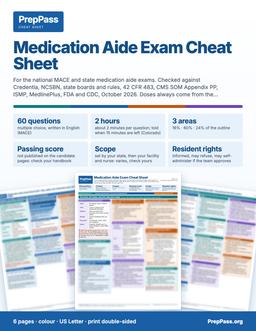
两周内就要考试?
这本指南是系统讲解,要花几周读。如果两周内就考,可打印的彩色速查表是另一款产品:考试涉及的关键数字,按章节排好。
6 页 · US Letter · 可打印 PDF · 永久保存
包含什么,不包含什么
包含
- Twelve chapters in the order of the MACE content areas, each with a Key facts box, a worked example and the exam traps
- The rights, a step-by-step safe medication pass, PRN rules and refusals
不包含
- 不寄送纸质书 —— 这是一份你下载后可自行打印的文件
- 购书不含视频课程、讲师或一对一辅导 —— 站上的免费视频是另一回事
完整的包含项与不包含项
包含
- Routes, storage, controlled substance schedules, counts and disposal
- Drug classes by body system, with the side effects to report
- Abbreviations to avoid, measurements, conversions and the 24-hour clock
- A chapter on the rules that vary by state, with state examples and a checklist for your own state
- A 63-question practice exam with an answer key and explanations
- PDF (print it) + EPUB (phone / e-reader)
不包含
- 不含考试报名费与考点费用,这些仍需向官方机构缴纳
目录
查看 18 个部分及各部分起始页
- Part 1 — Authorized Duties第 9 页
- Chapter 1: Your Role, Delegation and the Limits of the Job第 10 页
- Part 2 — Medication Administration, Observation and Reporting第 17 页
- Chapter 2: Orders, the MAR and Documentation第 18 页
- Chapter 3: The Rights and a Safe Medication Pass第 23 页
- Chapter 4: Routes of Administration第 29 页
- Chapter 5: Storage, Controlled Substances and Disposal第 36 页
- Chapter 6: How the Body Handles Medicine第 41 页
- Chapter 7: Medication Categories by Body System第 45 页
- Chapter 8: Resident Rights, Medication Errors, Observing and Reporting第 54 页
- Part 3 — Medication Concepts and Measurements第 59 页
- Chapter 9: Terminology, Abbreviations and Forms of Medication第 60 页
- Chapter 10: Measurements and Simple Dose Arithmetic第 67 页
- Chapter 11: Actions, Side Effects, Precautions and Interactions第 72 页
- Chapter 12: Rules Differ by State — Your Checklist and Exam-Day Strategy第 76 页
- Practice Exam: 63 Questions第 83 页
- Answer Key and Explanations第 97 页
- Glossary第 106 页
取自你将下载的那份 PDF,并标明各章起始页 —— 不是在此手工录入的。
免费读完整一章
完整的一章,与电子书正文一字不差。直接在此窗口滚动阅读;无需下载,无需邮箱。
在本页直接阅读第 3 章
The free chapter is The Rights and a Safe Medication Pass, the core of the largest content area, so you can judge the teaching where it matters most.
The rights of medication administration are the checklist you run for every dose. They are not a slogan: each one blocks a specific kind of error that has harmed residents.
3.1 The rights
Training programs list five, six or more rights. Ohio's rule for certified medication aide training (Ohio Administrative Code 4723-27-08), for example, lists six: the right person, drug, dose, time, route and documentation. The first five appear in every list:
- Right resident. The dose goes to the person whose name is on the order.
- Right drug (medication). The medication matches the order and the label.
- Right dose. The amount matches the order.
- Right route. The medication is given the way the order says (by mouth, under the tongue, in the eye, and so on).
- Right time. The dose is given at the ordered time, within the window your facility's policy allows, and PRN doses respect the minimum interval.
Most lists add:
- Right documentation. The dose is charted correctly, after it is given.
Some programs and states add more, for example right reason (the medication is being given for the condition it was ordered for), right response (you observe and report what the medication does) and the right to refuse. Learn the list your training program uses; knowing extra rights does no harm, but make sure you know the first six well.
What the rights are not. The Institute for Safe Medication Practices has pointed out that the rights are broadly stated goals that do not tell you how to reach them. You reach them by doing the checks every time, in the same order, without shortcuts.
3.2 Right resident: identification
Use at least two identifiers that your facility approves, such as the resident's name and date of birth, a photo on the MAR, or a wristband, and match them to the MAR. Ask the resident to say their name and date of birth when they can; do not ask "Are you Mrs. Lee?", because a confused or hard-of-hearing resident may say yes to any name.
Never identify a resident by room number, bed position or where they are sitting. Residents move, swap seats and visit each other's rooms.
3.3 Right time
The order sets the time; your facility's policy sets how early or late a dose may be given and still count as on time. For reference, federal nursing-home surveyors count a wrong-time error when a dose is given 60 or more minutes earlier or later than scheduled and the timing could cause the resident discomfort or harm (CMS State Operations Manual, Appendix PP). Some medications are time-sensitive: for example, some must be given before meals or on an empty stomach, and some must be spaced evenly. A dose given outside the allowed window, or a dose missed, is a medication error that must be reported.
For PRN medications, check the MAR for when the last dose was given before you give another. Giving a PRN dose before the minimum interval has passed is a wrong-time error and can be an overdose.
3.4 Before the pass
- Wash or sanitize your hands. CDC guidance for healthcare settings: use an alcohol-based hand rub for most hand hygiene, and wash with soap and water when hands are visibly soiled.
- Check the cart: locked, clean, stocked with cups, water, straws, applesauce or pudding if ordered as a vehicle, gloves and the supplies you need.
- Know your residents' allergies, and check them on the MAR before each new medication.
- Never leave the cart unlocked or out of your sight when you step away. Medications left at a bedside or on top of the cart can be taken by the wrong person.
3.5 The steps for each resident
- Read the MAR for the resident and note the medications due now, any parameters (such as a pulse or blood pressure check ordered before a dose) and any special instructions.
- Take each container from storage and compare the label with the MAR (first check).
- Prepare the dose without touching tablets with your hands: pour from the bottle into the cap and then into the cup, or keep unit-dose packages sealed until you are at the bedside. Compare again (second check).
- Compare a third time before you put the container back, or at the bedside before you open the unit-dose package.
- Identify the resident with two identifiers.
- Explain what you are giving and why, in words the resident understands.
- Check anything the order requires first, such as a pulse, a blood pressure or a blood glucose result, if your state and facility allow you to take or read it. If a value is outside the order's parameters, hold the medication and tell the nurse.
- Position the resident upright (sitting as upright as possible for oral medications) to make swallowing safe.
- Give the medication and stay until it is swallowed. Never leave medications at the bedside unless there is an order and a facility assessment allowing the resident to keep them.
- Offer water or other fluid unless the resident is on a fluid restriction or the medication should not be taken with water (sublingual tablets, for example). Use only the liquid consistency in the resident's diet order or care plan: if thickened liquids are ordered, do not give thin water with medications. If the resident coughs or chokes, stop and tell the nurse.
- Document on the MAR right away.
- Observe and report effects and side effects.
3.6 Preparing oral medications
- Do not crush or split a tablet unless the order or the pharmacist allows it, and never crush a product whose manufacturer says "do not crush". Extended-release, delayed-release and enteric-coated products are generally in that group. MedlinePlus warns, for example, that crushing or chewing extended-release oxycodone tablets can release too much drug at once, and tells patients to swallow bisacodyl tablets and omeprazole delayed-release tablets whole, without crushing or chewing them. The ISMP publishes a list of oral dosage forms that should not be crushed, and federal surveyors treat crushing a "do not crush" product as a possible medication error. Chapter 9 explains the letters that mark these products.
- Do not open capsules unless the pharmacist says it is safe.
- If a resident cannot swallow a medication, do not improvise. Tell the nurse, who may get a different form ordered.
- Mixing with food (applesauce, pudding) needs an order or facility approval, and the resident must know the medication is in it. Hiding medication in food without the resident's knowledge is not allowed.
- A tablet that falls on the floor is discarded following your facility's waste procedure, documented, and replaced. Controlled substances that are dropped or refused are wasted with a witness as your state and facility require.
3.7 PRN medications
Before giving a PRN dose, check, in this order:
- first, your state's and facility's rule: whether medication aides may give PRN doses at all, and whether the nurse must assess the resident or authorize each dose (Washington's rule treats PRN doses as nursing judgment that its medication assistants may not exercise; Texas requires the licensed nurse's authorization each time the symptoms occur). If a nurse's assessment or authorization is required, get it before anything else;
- that the resident has the condition named in the order (for example, the resident tells you about pain, and the order says "for pain");
- that the interval since the last dose has passed;
- that the maximum allowed in 24 hours, if the order or label sets one, will not be exceeded.
Afterward, document the reason, the time and, later, the result.
3.8 When a resident refuses
A resident has the right to refuse a medication (42 CFR 483.10(c)(6) gives nursing-home residents the right to request, refuse or discontinue treatment). Your job is to:
- Find out why, calmly. The reason may be a side effect, difficulty swallowing, a taste, confusion, or a belief that it is the wrong pill (which may be correct).
- Explain what the medication is for, without pressure or threats.
- Never force, trick or hide a medication in food or drink.
- Offer again later if your facility's policy allows it and the time window permits. A later offer is a freshly prepared dose, never the tablet that was poured and refused.
- Document the refusal and tell the nurse. A refused dose is disposed of or returned exactly as your facility's policy says, never kept loose and given later.
Key facts: Chapter 3
- The first six rights: resident, drug, dose, route, time, documentation. Some programs add reason, response and the right to refuse.
- Two identifiers, never the room number or seat.
- Three label checks against the MAR.
- Hand hygiene: alcohol-based hand rub for most situations; **soap and water when hands are visibly soiled** (CDC).
- Never crush or chew extended-release or enteric-coated products. If the resident cannot swallow one, tell the nurse; a different form may be ordered. Do not open capsules unless the pharmacist says it is safe.
- Stay until the medication is swallowed.
- Refusal: find out why, explain, never force or hide it, document, tell the nurse.
Worked example
Mr. Haddad's MAR shows a PRN order for acetaminophen for pain, every 6 hours as needed. At 14:00 he tells you his knee hurts. The MAR shows the last PRN dose was charted at 10:30.
What you do: Do not give it yet. Only three and a half hours have passed and the order requires at least six. Tell Mr. Haddad when the next dose may be given, tell the nurse about the pain so it can be assessed, and document per facility policy.
Why: Giving it now is a wrong-time error that also risks exceeding the safe daily total.
Exam traps
- "Are you Mr. Haddad?" Asking a yes/no identification question is wrong; ask the resident to state their name, and use two identifiers.
- Leaving the cup on the tray to "let the resident take it after breakfast". You stay until it is swallowed.
- Crushing everything for a resident with swallowing trouble. Check whether each product can be crushed, and go to the nurse.
- Saving a refused dose to try again at the next pass. Refused doses are disposed of or returned exactly as policy says.
购买者常问的问题
怎么拿到?
付款后下载入口立即出现在本页,链接同时发到你的邮箱。无需注册账号。
不合适怎么办?
14 天内发邮件即可全额退款,无需理由。
免费练习会取消吗?
不会。站上的每一道练习题、计时模考和免费章节都继续免费。这本书是「学」的那一半,不是把免费部分围起来的门。
更多问题 (1)
能在手机上看吗?
可以 —— EPUB 适合手机和电子书阅读器,PDF 适合打印和贴标签,两种都给你。
练习免费,为什么还要买书?
我们的练习题和计时模考一直免费 —— 网站上的东西不会因为这本书而收起来。这本 $14.99 的书是「学」的那一半:知识本身,按顺序讲清楚,存成一份属于你的文件。
- 系统讲解 —— 每个考试部分按章节从头讲到尾,不只是题目
- 可打印可贴标签 —— 一份适合打印的 PDF,能划重点、做批注、带到书桌前
- 随处离线学 —— EPUB 放手机或电子书阅读器;不用 wifi,不用一堆浏览器标签
- 全在一处 —— 章节和练习题都在同一份文件里
- 永久归你 —— 一次 $14.99,即时下载,无订阅
详细信息
- 官方来源核验(Credentia MACE content outline, 42 CFR 483.10 and 483.45, CMS State Operations Manual Appendix PP, ISMP, MedlinePlus, FDA, CDC and state agency pages)
- 250 道免费练习题
一次购买,永久下载访问。此电子书是完整的 Medication Aide (CMA / MACE) 学习指南,含 PDF 与 EPUB。仅为教育性摘要,非专业或法律意见 —— 请始终以官方来源核实当前规定。最后更新:November 2026。