NMLS SAFE MLO (Mortgage Loan Originator) · 2026 版
NMLS SAFE MLO — Complete Study Guide (2026)
Federal mortgage law (TRID, RESPA, TILA, ECOA, HOEPA/QM), general mortgage knowledge, origination, ethics, and the SAFE Act — the national test — with a full-length 120-question practice exam.
- 书内 195 道练习题,配完整答案解析
- 639 页逐章讲解 —— 不是一堆题目的堆砌
- 已与SAFE Act / Reg Z, X, B, C / CFPB / NMLS outline逐条核对
SAFE MLO 考试报名费(全国统考部分),不可退款:每次 $110,缴给 NMLS (State Regulatory Registry LLC)。补考要再交一次。本指南:$29.99,一次买断。
$29.99一次买断 · 永久下载 · 无订阅
PDF + EPUB · 英文 · 639 页 · $29.99 一次买断
本书为英文版,下载的 PDF 与 EPUB 均为英文。
付款后立即下载 —— 无需注册账号,无订阅。
14 天退款保证:任何原因不满意?购买后 14 天内发邮件至 support@preppass.org 即可全额退款。 这是电子下载,无需寄回任何东西。 退款政策
考试事实最近一次对照官方资料核对:2026年9月。
先做 10 题,看看讲解 —— 免费
先答完这 10 题,交卷后每题都有解析 —— 还会指出本指南里讲这一点的那一节。约 5 分钟,无需注册。
开始 10 道免费题翻开这本书看看
三页真实内页,直接从你将下载的 PDF 渲染而来 —— 依次是一页速查、一页讲解、一道带解析的例题。没有任何一页是为了好看而重画的。
- 速查页Part I — Higher-priced mortgage loans · PDF 第 72 页
一页可以随时翻回来的内容:把数字、期限或术语集中在一处。
- 怎么讲Part X — The Loan Estimate and the Closing Disclosure, page by page · PDF 第 147 页
讲解页:用文字把知识讲清楚,顺序与考试考查的顺序一致。
- 怎么讲Part I — Adjustable-rate mortgages · PDF 第 257 页
讲解页:用文字把知识讲清楚,顺序与考试考查的顺序一致。
不止考一门?有套装价
- California Real Estate Salesperson Exam — Complete Study Guide (2026)$14.99
- NMLS SAFE MLO — Complete Study Guide (2026)$29.99
- California Real Estate Salesperson Exam — Cheat Sheet (2026)$9.99
- NMLS SAFE MLO — Cheat Sheet (2026)$9.99
4 件一起买:$32.99 —— 比分开买省 $31.97
分开买 $64.96 · 立减 49% · 一次结账,共 4 件。
已经买过《California Real Estate Salesperson Exam》了?那就别买套装——套装里含这本,你会重复付费。单独购买《NMLS SAFE MLO (Mortgage Loan Originator)》只要 $29.99。 NMLS SAFE MLO (Mortgage Loan Originator) · 套装内容 →
想搭配其他工种考试?
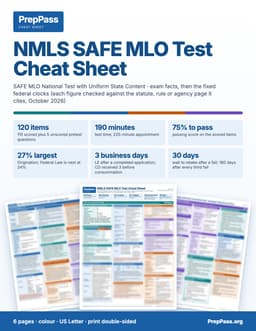
两周内就要考试?
这本指南是系统讲解,要花几周读。如果两周内就考,可打印的彩色速查表是另一款产品:考试涉及的关键数字,按章节排好。
6 页 · US Letter · 可打印 PDF · 永久保存
关于这场考试本身
| 主管机构 | Nationwide Multistate Licensing System (NMLS), operated by the State Regulatory Registry LLC for the Conference of State Bank Supervisors —— 考试由 Prometric 承办 |
|---|---|
| 题目数量 | 120 道题 (115 道计分,5 道不计分预试题) 来源: NMLS — MLO Testing Handbook, 1.0 Overview and Test Specifications |
| 考试时限 | 190 分钟 |
| 及格标准 | 75% |
| 费用 |
|
| 考试语言 | NMLS 未公布 我们查阅但未找到该数据的来源: NMLS — SAFE MLO Testing Frequently Asked Questions |
How this book compares
NMLS publishes the SAFE MLO test content outline for free. This book teaches that outline with a full practice exam. Neither replaces the pre-licensing education your state requires.
| Resource | Price | What you get | Choose it if |
|---|---|---|---|
| This bookNMLS SAFE MLO — Complete Study Guide (2026)PrepPass | $29.99 | Downloadable study guide for the SAFE MLO test
| Choose this book if you are taking, or have finished, your required pre-licensing course and want a written review before the test. It does not count toward that education. |
| From the exam bodySAFE MLO National Test with Uniform State Test Content Outline (opens the publisher's page in a new tab)Nationwide Multistate Licensing System (NMLS) | Free (web page) | The official outline of every topic on the test | Read it in any case to check every topic the test can ask about. |
| AlternativeNMLS Test Secrets (opens the publisher's page in a new tab)Mometrix Test Preparation | $28.99 ebook; $33.99 printed book | Study guide with practice tests
| Choose Mometrix if you mainly want several full-length practice tests, or a printed copy. |
This book
NMLS SAFE MLO — Complete Study Guide (2026)
PrepPass
- Price
- $29.99
- What you get
Downloadable study guide for the SAFE MLO test
- 195 practice questions, each explained with its statute or regulation
- 639 pages, PDF + EPUB
- Choose it if
- Choose this book if you are taking, or have finished, your required pre-licensing course and want a written review before the test. It does not count toward that education.
From the exam body
Nationwide Multistate Licensing System (NMLS)
- Price
- Free (web page)
- What you get
The official outline of every topic on the test
- Choose it if
- Read it in any case to check every topic the test can ask about.
Alternative
NMLS Test Secrets (opens the publisher's page in a new tab)
Mometrix Test Preparation
- Price
- $28.99 ebook; $33.99 printed book
- What you get
Study guide with practice tests
- Five full-length practice tests (per the product title), 4th edition
- Choose it if
- Choose Mometrix if you mainly want several full-length practice tests, or a printed copy.
Other resources' prices and contents are as listed on each publisher's or seller's own page, checked September 24, 2026. Prices change; confirm on the linked page before you buy. This book's price and contents come from our own catalog.
Sources (2)
- https://mortgage.nationwidelicensingsystem.org/knowledge/products/nmls/pubs/testingHbk/education/mlo_testing/mlo_test_faq/mlo_testing_hbk_testOutline.html — read September 24, 2026
- https://www.mometrix.com/studyguides/nmls/ — read September 24, 2026
包含什么,不包含什么
包含
- Learning objectives up front and key numbers & deadlines at the end of every chapter
- TRID timing (LE/CD clocks + the 3 CD-restart triggers), rescission
- RESPA, TILA/Reg Z (APR vs finance charge), ECOA vs Fair Housing
- HOEPA/QM (the price-based test that replaced the 43% DTI cap)
- SAFE Act licensing: 20-hr PE, 8-hr CE, 75%, and Temporary Authority
- A full-length 120-question practice exam (24/20/27/18/11 weighting) plus 75 chapter questions — every answer explained with its CFR or statute citation
- PDF (print & tab it) + EPUB (phone / e-reader)
不包含
- 不寄送纸质书 —— 这是一份你下载后可自行打印的文件
- 购书不含视频课程、讲师或一对一辅导 —— 站上的免费视频是另一回事
- 不含考试报名费与考点费用,这些仍需向官方机构缴纳
目录
查看 23 个部分及各部分起始页
- Part I — Higher-priced mortgage loans第 56 页
- Part V — The Homeowners Protection Act第 108 页
- Part X — The Loan Estimate and the Closing Disclosure, page by page第 114 页
- Part I — Adjustable-rate mortgages第 195 页
- Part I — The Closing Disclosure in practice第 299 页
- Part V — The closing documents and the fees第 365 页
- Part X — The math第 374 页
- Section 9 — seller-required title insurance: a seller may not第 408 页
- Part I — Sales contract and application red flags第 431 页
- Part V — Relationships with consumers第 471 页
- Part I — The test, retakes, and the five-year lapse第 518 页
- Part V — General loan origination scenarios第 546 页
- Part II — Practice Questions第 551 页
- Chapter 1 — Federal Mortgage Laws (Questions 1– 18)第 551 页
- Chapter 2 — General Mortgage Knowledge (Questions 19–33)第 555 页
- Chapter 3 — Mortgage Origination Activities (Questions 34–53)第 559 页
- Chapter 4 — Ethics (Questions 54–67)第 563 页
- Chapter 5 — Uniform State Content: The SAFE Act (Questions 68–75)第 566 页
- Answer Key & Explanations第 569 页
- Part III — Full-Length Practice Exam (120 Questions)第 579 页
- Answer Key & Explanations — Part III Full-Length Exam第 605 页
- Appendix A — Federal timing & threshold quick reference第 624 页
- Appendix B — Glossary of key terms第 627 页
取自你将下载的那份 PDF,并标明各章起始页 —— 不是在此手工录入的。
免费读完整一章
完整的一章,与电子书正文一字不差。直接在此窗口滚动阅读;无需下载,无需邮箱。
在本页直接阅读第 1 章
Introduction
Federal law governs nearly every step of a residential mortgage, from the first disclosure a borrower receives to the money that changes hands at the closing table. It is the second-heaviest area on the SAFE MLO test — roughly 24% of your score — and it overlaps so heavily with Origination (Chapter 3) and Ethics (Chapter 4) that the points you earn here are earned three times over.
The reason this material is so testable is that it is almost entirely rules with triggers and clocks. A specific event starts a specific countdown, and a specific document must reach the borrower by a specific deadline. Learn the trigger, learn the deadline, and you have the point. The catch is that the exam is written precisely to separate the two disclosures everyone confuses — the Loan Estimate and the Closing Disclosure — and to separate the finance charge and APR world of the Truth in Lending Act from the settlement-cost world of the Real Estate Settlement Procedures Act.
There is a second reason this chapter repays close reading. Almost every number in it falls into one of two categories, and the exam punishes candidates who cannot tell them apart. The timing rules are fixed: the three-business-day Loan Estimate, the seven-business-day waiting period, the three-business-day Closing Disclosure receipt rule, the three-day right of rescission, the thirty-day adverse-action notice. Those have not moved in years and you should memorize them cold. The dollar thresholds are not fixed: the HOEPA points-and-fees cutoffs, the Qualified Mortgage points-and-fees caps, the HMDA asset threshold, the conforming and FHA loan limits. The regulations themselves say those figures are "adjusted annually on January 1." A study aid that prints one of them as gospel is telling you something that will be false next January, and this book will not do that. Where a figure moves, you will see subject to change and a pointer to the agency that publishes it.
A note on who runs all of this. Since the Dodd-Frank Wall Street Reform and Consumer Protection Act of 2010, rulemaking authority for almost every consumer mortgage statute in this chapter — TILA, RESPA, ECOA, HMDA, FCRA's mortgage-relevant provisions, GLBA privacy — was consolidated in the Consumer Financial Protection Bureau. That is why the regulations you will cite live in Title 12, Chapter X of the Code of Federal Regulations: Regulation X at 12 CFR part 1024, Regulation Z at 12 CFR part 1026, Regulation B at 12 CFR part 1002, Regulation C at 12 CFR part 1003, Regulation V at 12 CFR part 1022, Regulation P at 12 CFR part 1016, Regulation N at 12 CFR part 1014, and Regulation H at 12 CFR part 1008. When you see "Regulation Z," think "the CFPB's rule implementing the Truth in Lending Act." The statute is the authority; the regulation is the operating manual; and the exam quotes the operating manual.
This chapter walks the statutes in the order the exam frames them. Part A and Part B cover RESPA and Regulation X — the settlement-service world, the anti-kickback rule, escrow accounts, and servicing. Parts C, D and E cover ECOA and Regulation B — the nine prohibited bases, the thirty-day adverse-action clock, and the government-monitoring questions you must ask. Parts F and G cover TILA and Regulation Z at its foundations — the finance charge, the APR, and the right of rescission. Parts H, I and J cover the three Regulation Z rules that most often decide a borrower's price: HOEPA high-cost mortgages, higher-priced mortgage loans, and the loan originator compensation rule. Parts K, L, M and N cover TRID — the Loan Estimate, the Closing Disclosure, the tolerance buckets, and the record-retention rules that trip up almost everyone. Parts O through W cover the remaining federal laws the outline names: HMDA, FCRA and FACTA, the Red Flags Rule, BSA/AML and the USA PATRIOT Act, GLBA privacy and the Safeguards Rule, Regulation N advertising, the E-Sign Act, the Homeowners Protection Act, and finally Dodd-Frank itself and the two agencies the outline asks you to know — the CFPB and HUD.
Learning objectives
After working through this chapter you should be able to:
- Distinguish RESPA/Regulation X (settlement-service abuses, kickbacks, escrow, servicing — 12 CFR part 1024) from TILA/Regulation Z (the true cost of credit — 12 CFR part 1026), and explain how TRID integrates their disclosures.
- State the RESPA Section 8 prohibition precisely: no fee, kickback or thing of value for a referral of settlement-service business (12 CFR §1024.14(b)), and no split of a charge except for services actually performed (§1024.14(c)).
- Recite the six items that make a mortgage application complete and start the Loan Estimate clock (12 CFR §1026.2(a)(3)(ii)), and explain why an originator may not withhold the sixth to stall the clock.
- State the two central TRID clocks cold: the Loan Estimate delivered or mailed within 3 business days of a completed application and no later than 7 business days before consummation (§1026.19(e)(1)(iii)); the Closing Disclosure received by the borrower at least 3 business days before consummation (§1026.19(f)(1)(ii)(A)).
- Apply the two different definitions of "business day" in §1026.2(a)(6), and say which TRID paragraph takes which.
- Explain the three tolerance categories under §1026.19(e)(3) — zero tolerance, the 10 percent cumulative bucket, and the charges for which variation is permitted — and what a valid changed circumstance under §1026.19(e)(3)(iv) does to them.
- List the nine prohibited bases under ECOA/Regulation B §1002.2(z) and distinguish them from the seven protected classes of the Fair Housing Act at 42 U.S.C. §3605(a).
- State the adverse-action timing rules of §1002.9(a)(1) and the content requirements of §1002.9(a)(2), and the ECOA valuations rule of §1002.14(a)(1).
- Describe HMDA/Regulation C reporting — the loan/application register, the March 1 deadline (§1003.5(a)(1)(i)), and the indexed asset threshold — and the FCRA rules on permissible purpose, adverse action, and risk-based pricing.
- Explain the GLBA privacy notice and Safeguards duty, and the BSA/AML written-program and suspicious activity report obligations for non-bank mortgage lenders (31 CFR §§1029.210, 1029.320).
- Apply the LO Compensation Rule (§1026.36(d)) — no compensation based on a term of the transaction, no proxies, no dual compensation, no steering — and the NMLSR ID requirement of §1026.36(g).
- Identify a HOEPA high-cost mortgage by its three triggers (§1026.32(a)(1)), distinguish it from a higher-priced mortgage loan under §1026.35, and say which figures in each are indexed.
- State the Homeowners Protection Act equity points — 80 percent on borrower request, 78 percent automatically, and the amortization midpoint as a final backstop (12 U.S.C. §§4901, 4902).
- Apply the right of rescission (§1026.23): which transactions carry it, the three-business-day clock, the three-year backstop, and the twenty-calendar-day mechanics.
- Reproduce the four-way record-retention split: Regulation Z generally two years, TRID records three years, the Closing Disclosure itself five years, Regulation B twenty-five months.
### Key numbers & deadlines — the federal clocks Loan Estimate, delivery: delivered or placed in the mail no later than the 3rd business day after the creditor receives the consumer's application (12 CFR §1026.19(e)(1)(iii)(A)). Fixed. Loan Estimate, waiting period: also no later than the 7th business day before consummation (§1026.19(e)(1)(iii)(B)). Fixed. Closing Disclosure: the consumer must receive it no later than 3 business days before consummation (§1026.19(f)(1)(ii)(A)). Fixed. Mailbox rule: a disclosure not handed over in person is deemed received 3 business days after it is delivered or placed in the mail (§1026.19(e)(1)(iv) for the LE; §1026.19(f)(1)(iii) for the CD). Fixed. The six items of a complete application: name, income, Social Security number to obtain a credit report, property address, estimate of the value of the property, and the mortgage loan amount sought (§1026.2(a)(3)(ii)). Fixed. Two "business day" definitions: the general one is any day the creditor is open to the public for substantially all of its business functions; the precise one is all calendar days except Sundays and the legal public holidays in 5 U.S.C. 6103(a) (§1026.2(a)(6)). Fixed. Right of rescission: until midnight of the third business day after the latest of consummation, delivery of the notice, or delivery of all material disclosures; 3 years if the notice or material disclosures were never delivered (§1026.23(a)(3)(i)). Fixed. Rescission mechanics: the creditor has 20 calendar days after receiving the notice to return money and release the security interest (§1026.23(d)(2)); the consumer may keep tendered property the creditor does not collect within 20 calendar days (§1026.23(d)(3)). Fixed. ECOA adverse action: notify within 30 days of a completed application, of adverse action on an incomplete application, or of adverse action on an existing account; 90 days after an unaccepted counteroffer (12 CFR §1002.9(a)(1)). Fixed. ECOA valuations: copies of all appraisals and written valuations on a first-lien dwelling loan, promptly upon completion or 3 business days before consummation, whichever is earlier; the right-to-receive notice within 3 business days of application (§1002.14(a)(1)–(2)). Fixed. Record retention, the four-way split: Regulation Z generally 2 years (§1026.25(a)); TRID §1026.19(e) and (f) records 3 years (§1026.25(c)(1)(i)); the Closing Disclosure itself 5 years (§1026.25(c)(1)(ii)(A)); Regulation B 25 months (§1002.12(b)(1)). Fixed. BSA/AML: file a suspicious activity report within 30 calendar days of initial detection, extendable to 60 only where no suspect has been identified (31 CFR §1029.320(a)(3)). Fixed.
Part A — RESPA: origins, coverage, and the settlement-service world
Why RESPA exists, and what a "federally related mortgage loan" is
The Real Estate Settlement Procedures Act, enacted in 1974 and now implemented by the CFPB's Regulation X at 12 CFR part 1024, was written against a specific abuse. In the settlement industry of the early 1970s, the people who steered consumers toward title companies, escrow agents, appraisers, and insurers were routinely paid for the steering. The consumer never saw the payment, could not shop it, and paid for it inside a settlement charge that looked like the price of a service. RESPA's answer was two-sided: make the costs visible through mandated disclosures, and make the hidden payments illegal.
Coverage runs through a defined term. RESPA applies to a federally related mortgage loan — broadly, a loan secured by a first or subordinate lien on residential real property designed principally for the occupancy of one to four families, where the lender is federally regulated or insured, the loan is insured or guaranteed by a federal agency, the loan is intended for sale to Fannie Mae, Freddie Mac or Ginnie Mae, or the lender makes mortgage loans above a de minimis annual volume. The practical consequence is that nearly every residential mortgage an originator will ever touch is covered. What is not covered is the transaction that is not residential and not consumer-purpose: a loan on a twelve-unit apartment building, a loan primarily for a business or agricultural purpose, and — historically — certain vacant-land and construction-only loans.
The reason to learn the definition rather than the shorthand is that the exam builds items around the edges of it. A candidate who has memorized "RESPA covers mortgages" will answer a question about a loan on a 25-unit apartment complex the same way as a question about a duplex, and only one of those is a federally related mortgage loan. The one-to-four-family limit is the line that does most of the work.
Do not fall for the idea that RESPA is a pricing statute. It does not tell a lender what it may charge. It tells the lender what it must disclose, and it tells everyone in the settlement chain what they may not pay each other (12 CFR §1024.14). A question that asks whether RESPA caps a title fee is testing whether you know the difference between a disclosure statute and a rate regulation.
Example. A borrower in Toledo is buying a four-unit building, intending to live in one unit and rent the other three. The lender is a federally insured bank. This is a loan secured by a lien on residential property designed principally for the occupancy of one to four families, made by a federally insured lender — a federally related mortgage loan, and Regulation X applies in full. Change the building to five units and the same loan falls outside RESPA's residential coverage, even though nothing about the borrower changed.
"Settlement service" and "mortgage broker" — the two definitions the exam leans on
A settlement service is any service provided in connection with a real estate settlement. Regulation X's own list is long and deliberately so: title searches, title examinations, the provision of title certificates, title insurance, services rendered by an attorney, the preparation of documents, property surveys, the rendering of credit reports or appraisals, pest and fungus inspections, services rendered by a real estate agent or broker, the origination of a federally related mortgage loan, and the handling of the processing and closing. The breadth is the point. If it is a service someone is paid for in order to make a closing happen, it is almost certainly a settlement service, and the anti-kickback rule of §1024.14 reaches it.
A mortgage broker, for RESPA purposes, is a person or entity that, for compensation or in expectation of compensation, brings a borrower and a lender together — a person who renders origination services and serves as an intermediary between a borrower and a lender, without using its own funds to close the loan. The contrast the exam wants is with a lender, which funds the loan, and with a table-funded transaction, in which a broker closes a loan in its own name with funds advanced at settlement by an assignee. Regulation X treats table funding as a secondary-market transaction only in form; in substance the funding party is the lender, and RESPA looks through the paperwork.
Why does that matter to an originator? Because the answer to "who owes the disclosure" and "who may be paid" depends on which role a person occupies. A broker's compensation is a settlement charge disclosed on the consumer's forms. A lender's yield on the loan is not. Blurring the two is exactly how the pre-2010 yield-spread-premium abuses worked, and it is why the Regulation Z compensation rule (Part J of this chapter) now supplements RESPA rather than duplicating it.
Two misconceptions to bury. First, a real estate agent is providing a settlement service, even though the agent is not in the lending business: the agent's commission is a settlement charge, and the agent is squarely inside the anti-referral rule. Second, an attorney is not exempt from Section 8; §1024.14(g)(1)(i) permits payment "to an attorney at law for services actually rendered," which is a permission to pay for work, not a permission to pay for referrals.
Example. A mortgage broker takes an application, orders the appraisal and title work, and arranges the loan, which closes in the broker's name using funds wired by the eventual investor at settlement. The broker never risks its own money. This is table funding; the broker is rendering origination services as an intermediary, and its compensation is a settlement charge to be disclosed, not an invisible spread.
RESPA's prohibitions, limitations, and exemptions
Regulation X's prohibitions cluster into four groups, and the exam draws from all four.
Section 8(a) — referral fees. "No person shall give and no person shall accept any fee, kickback or other thing of value pursuant to any agreement or understanding, oral or otherwise, that business incident to or part of a settlement service involving a federally related mortgage loan shall be referred to any person" (12 CFR §1024.14(b)). The regulation then closes the obvious escape route: "Any referral of a settlement service is not a compensable service." You cannot characterize a referral as work and pay for it.
Section 8(b) — unearned fees and fee splits. "No person shall give and no person shall accept any portion, split, or percentage of any charge made or received for the rendering of a settlement service … other than for services actually performed" (§1024.14(c)). A charge for no or nominal services, or a duplicative fee, is an unearned fee and violates the section. Note the sentence the exam likes: "The source of the payment does not determine whether or not a service is compensable." It does not matter whether the money comes from the borrower, the lender, or a third party.
Section 9 — required use of a title company. A seller may not require, as a condition of selling the property, that the buyer purchase title insurance from any particular company.
Section 10 — escrow limits. A lender may not require escrow deposits beyond the amounts Regulation X permits, including the cushion limit discussed in Part B.
The limitations and exemptions matter as much as the prohibitions. Section 8 does not prohibit a payment to an attorney for services actually rendered, a payment by a title company to its duly appointed agent for services actually performed in the issuance of a title policy, a payment by a lender to its duly appointed agent for services actually performed in the making of a loan, a payment to any person of a bona fide salary or compensation for goods or facilities actually furnished or services actually performed, or an employer's payment to its own employees for generating business for the employer (§1024.14(g)(1)). It also does not prohibit normal promotional and educational activities that are not conditioned on referrals and do not defray expenses the recipient would otherwise incur.
The unifying idea, and the one that answers most exam items: you may pay for a thing of value received; you may not pay for a stream of business. Ask what the payer got. If the honest answer is "customers," it is a referral fee.
Example. A lender hosts a continuing-education class for local real estate agents, provides coffee and materials, and does not condition attendance on any agent sending it loans. That is normal promotional and educational activity. The same lender then offers each agent a $300 payment for every buyer who closes a loan with it. That is a referral fee under §1024.14(b), and the fact that the agent also performed genuine real estate work for the buyer does not save it — the $300 is not payment for that work.
购买前
- 怎么拿到?
- 付款后下载入口立即出现在本页,链接同时发到你的邮箱。无需注册账号。
- 不合适怎么办?
- 14 天内发邮件即可全额退款,无需理由。
- 免费练习会取消吗?
- 不会。站上的每一道练习题、计时模考和免费章节都继续免费。这本书是「学」的那一半,不是把免费部分围起来的门。
- 能在手机上看吗?
- 可以 —— EPUB 适合手机和电子书阅读器,PDF 适合打印和贴标签,两种都给你。
详细信息
Federal mortgage law (TRID, RESPA, TILA, ECOA, HOEPA/QM), general mortgage knowledge, origination, ethics, and the SAFE Act — the national test — with a full-length 120-question practice exam.
- Format: PDF + EPUB download · 639 pages
- 195 practice questions in the book, with a full answer key
- 400 free practice questions for this exam on PrepPass, included at no cost
- $29.99 one-time — no subscription
- 14-day money-back guarantee · refund policy
- Cross-referenced against: SAFE Act / Reg Z, X, B, C / CFPB / NMLS outline
- Last updated: September 2026
- 官方来源核验(SAFE Act / Reg Z, X, B, C / CFPB / NMLS outline)
- 400 道免费练习题
- 即时下载,永久拥有
“I didn't read every page cover to cover. Mostly used the guide for the areas I was weak on and then kept doing questions.”
均为学员本人授权分享的个人经历,不代表通过率。
NMLS 20-hour SAFE pre-license course 要 $250–$599。这本书讲的是同一门考试 —— 同样的规则、核对到最新标准 —— 只需一次性 $29.99,永久归你。
练习免费,为什么还要买书?
我们的练习题和计时模考一直免费 —— 网站上的东西不会因为这本书而收起来。这本 $29.99 的书是「学」的那一半:知识本身,按顺序讲清楚,存成一份属于你的文件。
- 系统讲解 —— 每个考试部分按章节从头讲到尾,不只是题目
- 可打印可贴标签 —— 一份适合打印的 PDF,能划重点、做批注、带到书桌前
- 随处离线学 —— EPUB 放手机或电子书阅读器;不用 wifi,不用一堆浏览器标签
- 全在一处 —— 章节和练习题都在同一份文件里
- 永久归你 —— 一次 $29.99,即时下载,无订阅
而且零风险:14 天退款保证 —— 不满意?发邮件即可全额退款,无需理由。 详见退款政策。
14 天退款保证 · 全额退款,无需理由。
一次购买,永久下载访问。此电子书是完整的 NMLS SAFE MLO (Mortgage Loan Originator) 学习指南,含 PDF 与 EPUB。仅为教育性摘要,非专业或法律意见 —— 请始终以官方来源核实当前规定。最后更新:September 2026。