学习指南 · 2026 版
Series 3 Study Guide — 2026 Edition
Market knowledge and regulations for the NFA National Commodity Futures Examination, written to NFA's study outline, with worked calculations and two full 120-question practice exams.
版本: Rebuilt Oct 2026 on NFA's study outline · Rules 2-8/2-9 amended Mar 18, 2026 · 120 Q, 150 min, 70% each part
- 篇幅
- 414 页
- 书内练习题
- 421
- PrepPass 在线计时模考
- 100 题 · 125 分钟
- 考试事实核对与文件更新
- 2026年10月
- 交付
- PDF + EPUB · 英文 · 即时下载
关于本书
考试费:每次 $140,缴给 FINRA。补考要再交一次。本指南:$24.99,一次买断。
考试事实、适合谁与变化
关于这场考试本身
| 主管机构 | National Futures Association (NFA) |
|---|---|
| 题目数量 | 125 道题 (120 道计分,5 道不计分预试题) 来源: NFA — Study Outline for Futures Industry Exams (Series 3 section and exam table) |
| 考试时限 | 150 分钟 来源: NFA — Study Outline for Futures Industry Exams (Series 3 section and exam table) |
| 及格标准 | 70% 来源: NFA — Study Outline for Futures Industry Exams (Series 3 section and exam table) |
| 费用 |
来源: NFA — Study Outline for Futures Industry Exams (Series 3 section and exam table) |
| 考试语言 | NFA and FINRA 未公布 我们查阅但未找到该数据的来源: NFA — Study Outline for Futures Industry Exams (Series 3 section and exam table) |
翻开这本书看看
三页真实内页,直接从你将下载的 PDF 渲染而来 —— 依次是一页速查、一页讲解、一道带解析的例题。没有任何一页是为了好看而重画的。
- 速查页Chapter 1 — Futures Trading Theory and the Structure of Futures Markets · PDF 第 29 页
一页可以随时翻回来的内容:把数字、期限或术语集中在一处。
- 怎么讲Section I — FCMs and introducing brokers (9 questions) · PDF 第 402 页
讲解页:用文字把知识讲清楚,顺序与考试考查的顺序一致。
- 一道题的完整解析Part 1 — Market Knowledge (85 questions) · PDF 第 323 页
一道练习题,连同答案和背后的推理 —— 不只是一个答案键。
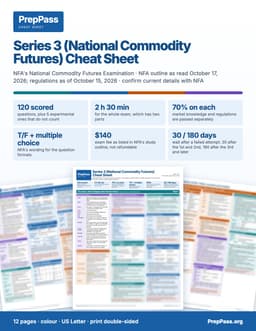
两周内就要考试?
这本指南是系统讲解,要花几周读。如果两周内就考,可打印的彩色速查表是另一款产品:考试涉及的关键数字,按章节排好。
12 页 · US Letter · 可打印 PDF · 永久保存
包含什么,不包含什么
包含
- An exam-review guide for candidates entering or working in the futures industry: terms are defined as they appear, but it assumes everyday market vocabulary and basic arithmetic, not a first course in trading
- 12 chapters in the order of NFA's Series 3 study outline as read on October 17, 2026
不包含
- 不寄送纸质书 —— 这是一份你下载后可自行打印的文件
- 购书不含视频课程、讲师或一对一辅导 —— 站上的免费视频是另一回事
完整的包含项与不包含项
包含
- Two full 120-question practice exams, each split 85 market knowledge / 35 regulations (PrepPass's split; NFA publishes none), scored part by part
- Step-by-step worked calculations: margin and variation, basis and hedges in the markets the outline names, spreads, speculative profit and return, option strategies and option spreads
- Current NFA and CFTC rules, including Rules 2-8, 2-9 and 3-1 as amended March 18, 2026, and the pending small-pool exemption proposal
- A common-mistakes list in every chapter, a formula and numbers sheet, a key-terms table and an exam-facts table
- 421 original questions, each with a worked explanation citing its source
- PDF + EPUB you keep
不包含
- 不含考试报名费与考点费用,这些仍需向官方机构缴纳
目录
查看 28 个部分及各部分起始页
- Chapter 1 — Futures Trading Theory and the Structure of Futures Markets第 11 页
- Chapter 2 — Futures and Options Terminology第 37 页
- Chapter 3 — Margins, Option Premiums, Price Limits, Settlement, Delivery, Exercise and Assignment第 57 页
- Chapter 4 — Orders, Customer Accounts and Price Analysis第 87 页
- Chapter 5 — Hedging and Basis Calculations第 116 页
- Chapter 6 — Spreading第 144 页
- Chapter 7 — Speculating in Futures: Profit, Loss and Return第 160 页
- Chapter 8 — Options: Hedging, Speculating and Spreading第 176 页
- Chapter 9 — Registration, NFA Membership and Opening Customer Accounts第 204 页
- Chapter 10 — FCMs and Introducing Brokers第 231 页
- Chapter 11 — Commodity Pool Operators, Commodity Trading Advisors and Promotional Material第 257 页
- Chapter 12 — Arbitration, NFA Discipline and CFTC Enforcement第 281 页
- Part 1, A: futures theory, 1-18 Chapters 1 and 2 market structure, terminology第 304 页
- Part 1, B: margins, limits, 19-30 Chapter 3 delivery, exercise第 304 页
- Part 1, C: orders and price 31-40 Chapter 4 analysis第 304 页
- Part 1, D: hedging and basis 41-55 Chapter 5第 304 页
- Part 1, E: spreading 56-64 Chapter 6第 304 页
- Part 1, F: speculation, profit, 65-72 Chapter 7 loss and return第 304 页
- Part 1, G: options strategies 73-85 Chapter 8第 304 页
- Part 2, H: registration, NFA 1-11 Chapter 9 membership, customer accounts第 304 页
- Part 2, I: FCMs and 12-20 Chapter 10 introducing brokers第 304 页
- Part 2, J: CPOs, CTAs, 21-28 Chapter 11 promotional material第 304 页
- Part 2, K: arbitration, 29-35 Chapter 12 discipline, enforcement第 304 页
- Part 1 — Market Knowledge (85 questions)第 304 页
- Part 2 — Regulations (35 questions)第 334 页
- Section I — FCMs and introducing brokers (9 questions)第 336 页
- Appendix A — The exam at a glance, in one table第 404 页
- Appendix B — Terms the exam expects you to use precisely第 405 页
取自你将下载的那份 PDF,并标明各章起始页 —— 不是在此手工录入的。
免费读完整一章
完整的一章,与电子书正文一字不差。直接在此窗口滚动阅读;无需下载,无需邮箱。
在本页直接阅读第 5 章
The free chapter is Chapter 5, hedging and basis calculations: worked examples at the pace of the whole book, which defines its terms in Chapters 1 and 2 and assumes everyday market vocabulary and basic arithmetic.
This is the chapter the market-knowledge part is built around. NFA's outline gives it three headings — short and long hedging, the basis, and hedging calculations — and then lists examples in grains, livestock, foodstuffs, metals, energy, lumber, Treasury notes and bonds, T-bills and 3-month SOFR, municipals, currencies and stock indices[1]. Every one of those examples is solved with the same small set of rules. Learn the rules, then practice until the sign of the basis never trips you.
The basis
Definition and sign
Basis is the difference between the cash (spot) price of a commodity and the price of the nearest futures contract for the same or a related commodity, typically calculated as cash minus futures[2].
Basis = cash price − futures price
If cash is $4.10 and futures are $4.35, the basis is −$0.25, spoken "25 under." If cash is $4.50 and futures $4.35, the basis is +$0.15, "15 over." Merchants quote cash prices this way: a basis quote is an offer or sale of a cash commodity in terms of the difference above or below a futures price, such as "10 cents over December corn"[2].
How the basis is determined
The CFTC notes that the basis is usually computed against the futures contract next to expire and may reflect differences in time, product form, grade or location[2]. In practice, four things set a local basis:
- Transportation costs. A futures contract prices the commodity at its delivery points[2]. A grain elevator far from a delivery point pays less for grain than the futures price, because someone must pay to ship it to where the contract is priced. Farther away, weaker basis; closer to demand, stronger basis.
- Variation in grades. Futures price the par grade[2]. A cash lot of better quality commands a premium; a lower grade, a discount[2]. That difference shows up in the basis.
- Time and carrying charges. A cash price today compared with a futures price for a later month reflects the cost of carrying the commodity until then[2]. That is why the basis in a normal market tends to strengthen (move toward zero) as delivery approaches: the remaining carrying cost shrinks.
- Local supply and demand. A local shortage strengthens the basis; a local glut weakens it.
Strengthening and weakening
Because the basis is a signed number, describe changes by direction rather than by "wider" or "narrower," which are ambiguous when the basis crosses zero:
- Strengthening — the basis becomes more positive (or less negative): −30 to −10, or +5 to +20. Cash is gaining on futures.
- Weakening — the basis becomes more negative (or less positive): −10 to −30, or +20 to +5. Cash is losing ground to futures.
NFA's outline also uses "narrowing or widening basis" in the spread section[1]. When you meet those words, translate them into strengthening or weakening by writing out the numbers.
Basis risk
Basis risk is the risk of an unexpected widening or narrowing of the basis between the time a hedge is placed and the time it is lifted[2]. A hedge converts price risk into basis risk. Price risk is large and unpredictable; basis risk is usually smaller and more predictable, because transportation, grade and carrying costs change slowly. That trade is the whole economic reason to hedge.
Long the basis, short the basis
The CFTC's definitions give the two positions their names:
- Long the basis — a person who has bought the spot commodity and hedged with a sale of futures[2]. This is the short hedger: long cash, short futures.
- Short the basis — the purchase of futures as a hedge against a commitment to sell in the cash market[2]. This is the long hedger, who is effectively short cash (committed to deliver, or needing to buy) and long futures.
The names tell you who benefits from a basis change, exactly as "long" and "short" do for prices:
Long the basis (short hedger) gains when the basis strengthens. Short the basis (long hedger) gains when the basis weakens.
Prove it once, then trust it. The short hedger owns cash and is short futures. If the basis strengthens, cash has risen relative to futures: the cash side gained more (or lost less) than the futures side lost (or gained). The hedger is long the thing that outperformed.
Short hedging
A short (selling) hedge sells futures to protect against falling prices[2]. Typical short hedgers are farmers, producers and holders of inventory[1].
Net price received
For a short hedger who sells the cash commodity and buys back the futures on the same day:
Net sale price = cash price received + futures gain (or − futures loss) = futures price when the hedge was placed + basis when the hedge is lifted
The second line is the shortcut: the hedge locks in the original futures price, and the basis at the end is added to it.
Worked example — basis strengthens. In June a farmer expects to harvest 30,000 bushels and sells six 5,000-bushel December futures at $4.80. Her local basis for harvest delivery has typically been 40 under.
In October she sells the cash corn at $4.15 when December futures are $4.45.
- Basis at lift: $4.15 − $4.45 = −$0.30 (30 under), stronger than the −$0.40 she expected.
- Futures gain: $4.80 − $4.45 = $0.35.
- Net price: $4.15 + $0.35 = $4.50 — which equals $4.80 + (−$0.30).
- The 10-cent basis improvement adds $0.10 × 30,000 = $3,000 compared with the $4.40 she had planned on.
Worked example — basis weakens. Same hedge, but at harvest cash is $3.95 and futures $4.45 (basis 50 under). Net price = $3.95 + $0.35 = $4.30 = $4.80 − $0.50. The weaker basis cost her 10 cents compared with the expected $4.40.
Holders of inventory
An elevator that buys grain and stores it is long the basis while it carries the grain. Worked example. In October an elevator buys corn at $4.05 when March futures are $4.55 (basis −50) and sells March futures to hedge. In February it sells the corn at $4.60 when March futures are $4.70 (basis −10).
- Cash gain: $4.60 − $4.05 = +$0.55.
- Futures loss: $4.55 − $4.70 = −$0.15.
- Net result: +$0.40 per bushel — exactly the 40-cent strengthening of the basis, from −50 to −10.
A storage hedger does not care where prices go; it earns the basis change, which is its payment for storing.
Long hedging
A long (buying) hedge buys futures to protect against increases in the cost of commodities[2]. Typical long hedgers are processors, manufacturers and exporters[1].
Net price paid
Net purchase price = cash price paid − futures gain (or + futures loss) = futures price when the hedge was placed + basis when the hedge is lifted
It is the same shortcut. A long hedger, being short the basis, wants that closing basis to be as weak (as negative) as possible.
Worked example. In March a feed manufacturer knows it will buy 50,000 bushels of soybeans in July. It buys July futures at $11.60 when its expected July basis is +$0.20. In July it buys cash at $12.30 when futures are $12.00.
- Basis at lift: $12.30 − $12.00 = +$0.30 (stronger than the expected +$0.20).
- Futures gain: $12.00 − $11.60 = +$0.40.
- Net purchase price: $12.30 − $0.40 = $11.90 = $11.60 + $0.30.
- The long hedger expected $11.80 and paid 10 cents more, because the basis strengthened against it.
Anticipatory hedges
A hedge placed before the hedger has the cash position — a processor buying futures for next quarter's needs, or a farmer selling futures before planting — is an anticipatory hedge. The CFTC's definition of a hedger covers someone who buys or sells futures "as a temporary substitute for a cash transaction that will occur later"[2]. An exporter that has agreed to sell grain abroad at a fixed price but has not yet bought it is short the cash commodity and hedges by buying futures.
Effect of the basis on the commodity actually delivered or purchased
Hedgers rarely deliver on futures; they buy and sell in their local cash market and offset their futures. That is why the local basis, not the futures price alone, determines the outcome. If a hedger does deliver against futures, the price received is the futures invoice price[2] adjusted for any grade premium or discount[2] — and the hedger bears the cost of getting the commodity to a delivery point[2]. A hedger far from a delivery point usually does better selling locally and buying back futures.
Hedging calculations: a method that never fails
For any hedge question, write four lines:
| Cash | Futures | Basis | |
|---|---|---|---|
| Start | price | price | cash − futures |
| End | price | price | cash − futures |
| Change | ± | ± | ± |
Then:
- Mark which side the hedger is long and which short.
- Gain or loss on each side = change × (+1 if long, −1 if short).
- Net result = sum of the two sides = basis change × (+1 if long the basis, −1 if short the basis).
- Net price = the actual cash price ± the futures result.
Worked example — the full table. A cattle feeder will sell 40,000 pounds of cattle in four months. She sells one 40,000-pound futures contract at $1.92 per pound when cash is $1.86.
| Cash | Futures | Basis | |
|---|---|---|---|
| Start | $1.86 | $1.92 short | −$0.06 |
| End | $1.78 | $1.81 buy back | −$0.03 |
| Change | −$0.08 | +$0.11 gain | +$0.03 (stronger) |
She is long the basis (long cattle, short futures), so she gains the 3-cent strengthening. Net price = $1.78 + $0.11 = $1.89 per pound = $1.92 + (−$0.03). In dollars: 40,000 × $1.89 = $75,600.
The basis in financial markets
Financial futures have a basis too, and the same arithmetic applies. What differs is what drives it.
Carry: short-term versus long-term rates
For a financial instrument, carrying costs are the cost of financing — the short-term rate — and the "income" of carrying is the instrument's own return. When financing costs less than the instrument earns, the CFTC calls it positive carry; when it costs more, negative carry[2]. With a positive yield curve (long-term rates above short-term)[2], holding a long-term bond financed at short-term rates earns positive carry, so deferred bond futures can trade below nearby futures and below cash. This is why financial markets often look "inverted" without any shortage — the outline's "short-term rates vs. long-term rates"[1].
Interest-rate hedges
Debt prices fall when yields rise[3], so:
- An investor holding Treasury notes or bonds (long cash) fears rising rates and sells note or bond futures — a short hedge.
- A borrower planning to issue debt or take a floating-rate loan fears rising rates and sells interest-rate futures (T-bill, SOFR, note or bond futures, depending on the maturity) — an anticipatory short hedge.
- An investor who will receive cash later and fears falling rates buys interest-rate futures — an anticipatory long hedge.
Treasury bills are short-term zero-coupon obligations of up to one year; notes run more than one and up to ten years; bonds more than ten[2]. Match the hedge to the maturity of the risk: short-term borrowing costs are hedged with short-term-rate contracts, long-term bond holdings with bond futures. Rates are measured in basis points; one basis point is 1/100 of one percent[2]. Don't confuse this with "the basis."
Cross-hedging: municipals and other close substitutes
A cross-hedge hedges a cash position with futures on a different but price-related commodity[2]. A dealer holding municipal bonds, for example, may hedge with Treasury futures or a municipal-bond-index contract because the prices tend to move together. Cross-hedges carry extra basis risk: the two prices can diverge for reasons that have nothing to do with the general level of rates. The hedge ratio — the value of futures bought or sold relative to the value of the cash position — is computed to minimize that basis risk[2].
Currencies
An exchange rate is the price of one currency in terms of another[2]. Currency hedges follow the ordinary rules once you ask "who is long the foreign currency?"
- A U.S. exporter that will receive euros in three months is long euros and fears the euro will fall; it sells euro futures.
- A U.S. importer that must pay yen in three months is short yen and fears the yen will rise; it buys yen futures.
Worked example. An importer owes ¥50,000,000 in 90 days. Today the spot rate and the futures price are both $0.006800 per yen (basis zero), so the bill would cost $340,000 at today's rate. The importer buys yen futures at $0.006800. At payment the spot rate is $0.007050 and futures are $0.007070, a basis of −$0.000020.
- Cash cost rose by $0.000250 × 50,000,000 = $12,500, to $352,500.
- Futures gained $0.000270 × 50,000,000 = $13,500.
- Net cost: $352,500 − $13,500 = $339,000 — slightly better than $340,000, because the basis weakened and the importer, a long hedger, is short the basis. Check: $0.006800 + (−$0.000020) = $0.006780 × 50,000,000 = $339,000.
Stock indices
Portfolio insurance is the CFTC's name for using stock index futures or options to protect a stock portfolio against market declines[2]. A manager holding stocks sells stock index futures (a short hedge); a manager expecting cash to invest who fears a rally buys them (an anticipatory long hedge). The number of contracts is set by the hedge ratio: portfolio value divided by the value of one futures contract, adjusted for how closely the portfolio tracks the index[2].
Worked example. A $6,000,000 portfolio moves in line with an index whose futures trade at 4,800 with a $50 multiplier. One contract is worth 4,800 × $50 = $240,000. Contracts to sell: $6,000,000 ÷ $240,000 = 25.
Sources cited in this excerpt
- Study Outline for Futures Industry Exams (Series 3 – National Commodity Futures Examination). National Futures Association, 2026-10-17. https://www.nfa.futures.org/registration-membership/study-outlines/index.html
- CFTC Glossary. U.S. Commodity Futures Trading Commission, 2026-10-17. https://www.cftc.gov/LearnAndProtect/EducationCenter/CFTCGlossary/index.htm
- Understanding Pricing and Interest Rates. U.S. Department of the Treasury, Bureau of the Fiscal Service (TreasuryDirect), 2026-10-17. https://www.treasurydirect.gov/marketable-securities/understanding-pricing/
购买者常问的问题
怎么拿到?
付款后下载入口立即出现在本页,链接同时发到你的邮箱。无需注册账号。
不合适怎么办?
14 天内发邮件即可全额退款,无需理由。
免费练习会取消吗?
不会。站上的每一道练习题、计时模考和免费章节都继续免费。这本书是「学」的那一半,不是把免费部分围起来的门。
更多问题 (1)
能在手机上看吗?
可以 —— EPUB 适合手机和电子书阅读器,PDF 适合打印和贴标签,两种都给你。
练习免费,为什么还要买书?
我们的练习题和计时模考一直免费 —— 网站上的东西不会因为这本书而收起来。这本 $24.99 的书是「学」的那一半:知识本身,按顺序讲清楚,存成一份属于你的文件。
- 系统讲解 —— 每个考试部分按章节从头讲到尾,不只是题目
- 可打印可贴标签 —— 一份适合打印的 PDF,能划重点、做批注、带到书桌前
- 随处离线学 —— EPUB 放手机或电子书阅读器;不用 wifi,不用一堆浏览器标签
- 全在一处 —— 章节和练习题都在同一份文件里
- 永久归你 —— 一次 $24.99,即时下载,无订阅
详细信息
- 官方来源核验(NFA Study Outline for Futures Industry Exams and NFA Rulebook, FINRA Series 3 exam page, CFTC regulations (eCFR) and the Commodity Exchange Act, read October 2026)
- 102 道免费练习题
Series 3 exam prep course 要 $150–$500。这本书讲的是同一门考试 —— 同样的规则、核对到最新标准 —— 只需一次性 $24.99,永久归你。
一次购买,永久下载访问。此电子书是完整的 Series 3 — National Commodity Futures Exam 学习指南,含 PDF 与 EPUB。仅为教育性摘要,非专业或法律意见 —— 请始终以官方来源核实当前规定。最后更新:October 2026。