学习指南 · 2026 版
Series 7 — General Securities Representative Study Guide (2026)
Thirty-three chapters written to FINRA's Series 7 content outline.
- 篇幅
- 1,031 页(讲解 528 页 + 题库)
- 书内练习题
- 1,176
- PrepPass 在线计时模考
- 125 题 · 225 分钟
- 考试事实核对与文件更新
- 2026年10月
- 交付
- PDF + EPUB · 英文 · 即时下载
购买前请阅读: This is an independent study aid, not affiliated with or endorsed by FINRA, the SEC, MSRB, the OCC, or any test-delivery vendor (including Prometric).
阅读本声明的其余部分
Securities rules change and many figures (contribution limits, gift limits) are indexed or were recently updated; confirm the current rules before you rely on any figure.
关于本书
Thirty-three chapters written to FINRA's Series 7 content outline: options, margin, municipals, bonds and every product a representative recommends, with the math worked step by step.
考试费:每次 $395,缴给 FINRA。补考要再交一次。本指南:$24.99,一次买断。
考试事实、适合谁与变化
关于这场考试本身
| 主管机构 | Financial Industry Regulatory Authority (FINRA) 来源: FINRA — Series 7 – General Securities Representative Exam (GS) |
|---|---|
| 题目数量 | 130 道题 (125 道计分,5 道不计分预试题) |
| 考试时限 | 225 分钟 |
| 及格标准 | FINRA (scale range) 未公布 我们查阅但未找到该数据的来源: FINRA — Series 7 – General Securities Representative Exam (GS) |
| 费用 |
来源: FINRA — Series 7 – General Securities Representative Exam (GS) |
| 考试语言 | FINRA 未公布 我们查阅但未找到该数据的来源: FINRA — Series 7 – General Securities Representative Exam (GS) |
翻开这本书看看
三页真实内页,直接从你将下载的 PDF 渲染而来 —— 依次是一页速查、一页讲解、一道带解析的例题。没有任何一页是为了好看而重画的。
- 速查页Section 7 — Government securities, CMOs and CDs · PDF 第 29 页
一页可以随时翻回来的内容:把数字、期限或术语集中在一处。
- 怎么讲Chapter 8 — Margin Accounts and Margin Calculations · PDF 第 240 页
讲解页:用文字把知识讲清楚,顺序与考试考查的顺序一致。
- 一道题的完整解析Section 1 — FINRA Rule 2210: the master rule for communications · PDF 第 16 页
一道练习题,连同答案和背后的推理 —— 不只是一个答案键。
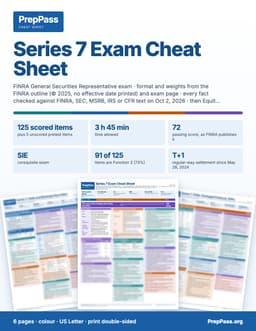
两周内就要考试?
这本指南是系统讲解,要花几周读。如果两周内就考,可打印的彩色速查表是另一款产品:考试涉及的关键数字,按章节排好。
6 页 · US Letter · 可打印 PDF · 永久保存
包含什么,不包含什么
包含
- Thirty-three chapters organised by topic, with a table mapping them to FINRA's four outline functions; most of the book is the recommendation and product knowledge that is most of the exam
- Key-facts boxes and named exam-traps lists inside the chapters
不包含
- 不寄送纸质书 —— 这是一份你下载后可自行打印的文件
- 购书不含视频课程、讲师或一对一辅导 —— 站上的免费视频是另一回事
完整的包含项与不包含项
包含
- The options math worked step by step: breakeven, maximum gain and loss, spreads, straddles, hedging
- Margin and Regulation T, bond and municipal math, MSRB rules, packaged products and customer accounts
- Dated 2026 changes called out: the $300 gift limit, the new intraday margin standards, FINRA Rule 3290 (approved, no effective date yet)
- 528 pages of teaching, then a question bank of 1176 practice questions, grouped by topic, with answers and explanations
- PDF (print & tab it) + EPUB (phone / e-reader)
不包含
- 不含考试报名费与考点费用,这些仍需向官方机构缴纳
目录
查看 60 个部分及各部分起始页
- Chapter 1 — Communications, Contact Rules and Protecting Customers From Fraud第 12 页
- Section 1 — FINRA Rule 2210: the master rule for communications第 12 页
- Section 2 — Seminars, lectures and other group forums第 19 页
- Section 3 — Investment company and variable contract communications第 21 页
- Section 4 — Options communications and the Options Disclosure Document第 23 页
- Section 5 — Municipal securities advertising: MSRB Rule G-21第 26 页
- Section 6 — Research reports and quiet periods第 27 页
- Section 7 — Government securities, CMOs and CDs第 29 页
- Section 9 — Identity theft (Regulation S-ID), AML red flags and senior investors第 35 页
- Chapter 2 — How New Securities Reach the Market第 39 页
- Section 2.1 The sequence of a registered corporate offering第 39 页
- Section 2.2 IPO communications and the anti- abuse rules第 47 页
- Section 2.3 Underwriters, syndicates and the spread第 51 页
- Section 2.4 Municipal primary offerings第 56 页
- Section 2.5 Other statutes touching an offering第 60 页
- Section 2.6 FINRA rules for offerings and firm arrangements第 63 页
- Section 2.7 — Exempt Offerings, Private Placements and Resales第 66 页
- Chapter 3 — Opening and Maintaining Customer Accounts第 83 页
- Section 3.1 — Account types: day trading, prime brokerage, DVP/RVP, advisory第 83 页
- Section 3.2 — Account registration types第 87 页
- Section 3.3 — Opening an account: FINRA Rule 4512 and the new account form第 91 页
- Section 3.4 — Retirement plans: IRAs第 94 页
- Section 3.5 — Employer plans, ERISA, and equity compensation第 98 页
- Section 3.6 — Education savings: 529 plans and Coverdell ESAs第 104 页
- Section 3.7 — Wealth events, decedent accounts, and changes in registration第 107 页
- Section 3.8 — Customer screening: CIP, KYC, residency, insiders and industry employees第 109 页
- Section 3.9 — Privacy and information security: Regulation S-P第 113 页
- Section 3.10 — Authority to act: POA, trading authorization, discretion, entity documents第 116 页
- Section 3.11 — Putting it together: the account- opening sequence第 119 页
- Chapter 4 — Knowing the Customer, Recommending, and Supervising the Account第 120 页
- Section 1 — The essential facts about every customer第 120 页
- Section 2 — The financial factors and how each steers a recommendation第 123 页
- Section 3 — Investment objectives第 128 页
- Section 4 — Suitability under Rule 2111, and what Reg BI replaced第 129 页
- Section 5 — Strategies, “hold” recommendations, and verifying accreditation and sophistication第 132 页
- Section 6 — Regulation Best Interest, Form CRS, and Rule 2214第 135 页
- Section 7 — Principal review, approvals and documentation第 141 页
- Section 8 — Receipt, delivery and safeguarding of cash, checks and securities第 144 页
- Section 9 — Refusing, restricting and closing accounts第 148 页
- Chapter 5 — Trading, Orders and Market Structure第 153 页
- Section 1 — Taking the order: solicited, unsolicited, and the order ticket第 153 页
- Section 2 — Quotes: what a price on the screen means第 156 页
- Section 3 — Basic order types, and what triggers what第 158 页
- Section 4 — Special orders and instructions Instruction What it does第 162 页
- Section 5 — Short sales第 164 页
- Section 6 — Securities lending, hard-to-borrow stocks, and fails第 167 页
- Section 7 — Best execution, interpositioning and order handling第 169 页
- Section 8 — Execution mechanics: priority, precedence, crossing, auctions第 171 页
- Section 9 — Market makers, principal vs agency, riskless principal, and markups第 173 页
- Section 10 — Halts, limit up-limit down, and circuit breakers第 176 页
- Section 11 — Alternative trading systems, OTC quotations, and automated execution第 179 页
- Chapter 6 — Delivery, Settlement and Trade Reporting第 182 页
- Chapter 7 — Errors, Complaints, Disputes and Discipline第 196 页
- Chapter 8 — Margin Accounts and Margin Calculations第 208 页
- Chapter 9 — Conduct, Registration, Customer Protection and the Tax and Economic Backdrop第 237 页
- Chapter 10 — Matching Securities to the Customer, and Portfolio Theory第 266 页
- Chapter 11 — Annual Reports, Corporate Actions and Tender- Offer Information第 274 页
- Chapter 12 — Reading Financial Statements: Statements, Inventory, Depreciation and Ratios第 283 页
- Chapter 13 — Debt Instruments: Money Market, Corporate Bonds, Structured Products, Foreign Debt, Ratings and Convertibles第 296 页
- Chapter 14 — Bond Yields, Price Behavior, Accrued Interest and the Tax Treatment of Taxable Debt第 312 页
取自你将下载的那份 PDF,并标明各章起始页 —— 不是在此手工录入的。 此处列出的是文件中 101 个标题的前一部分。
免费读完整一章
完整的一章,与电子书正文一字不差。直接在此窗口滚动阅读;无需下载,无需邮箱。
在本页直接阅读第 22 章
The free chapter is Options, the hardest and highest-yield part of the Series 7, so you can judge the teaching exactly where the exam decides pass or fail.
The Series 7 asks you for three numbers on every strategy: maximum gain, maximum loss and breakeven. If you can produce them for the positions in this chapter, with the arithmetic, you have the option questions that account for a large share of the exam. All examples use standard 100-share contracts and ignore commissions. Premiums are per share; multiply by 100 for dollars.
Start with the four basic positions
| Position | Outlook | Maximum gain | Maximum loss | Breakeven |
|---|---|---|---|---|
| Long call | Bullish | Unlimited | Premium paid | Strike + premium |
| Short call (uncovered) | Neutral to bearish | Premium received | Unlimited | Strike + premium |
| Long put | Bearish | (Strike − premium) × 100: stock to zero | Premium paid | Strike − premium |
| Short put | Neutral to bullish | Premium received | (Strike − premium) × 100: stock to zero | Strike − premium |
Two reflexes make the rest easy. First, the breakeven for any single option is strike ± premium (plus for calls, minus for puts), whether you bought or sold it. Second, the buyer's maximum loss is the writer's maximum gain, and the reverse.
Covered call writing (and the covered put)
A covered call is long 100 shares plus a short call on the same shares. The stock covers the call: if the call is assigned, the customer delivers shares already owned.
The purpose is income and a small cushion against loss. The cost is that upside is capped at the strike.
Worked example. A customer buys 100 XYZ at 48 and sells one XYZ 50 call for 3.
| Item | Calculation | Result |
|---|---|---|
| Breakeven | Stock cost − premium = 48 − 3 | $45 |
| Maximum gain | (Strike − cost + premium) × 100 = (50 − 48 + 3) × 100 | $500 |
| Maximum loss | (Cost − premium) × 100 = (48 − 3) × 100 | $4,500 (stock goes to zero) |
If XYZ finishes at 52 the call is assigned: the customer sells at 50 and keeps the 3. The gain is $500, not the $700 the stock alone would have produced. If XYZ finishes at 47, the call expires, the customer keeps the $300, and the stock has lost $100: net +$200. Maximum gain occurs at any price from 50 up.
A covered call is considered a conservative strategy but not a risk-free one. The loss on the stock is cushioned only by the premium. The risk the exam wants named is opportunity cost: giving up gains above the strike.
A covered put is the mirror image: short 100 shares plus a short put. The short put is "covered" in the sense that if it is assigned, the customer buys the stock at the strike and uses it to close the short position. The short stock is unprotected on the upside, so the loss is unlimited if the stock rises. The gain is limited to the premium plus any gap between the short-sale price and the strike: maximum gain = premium + (short price − strike) × 100.
Example. Short 100 at 40, sell one 40 put at 2. Breakeven = 40 + 2 = 42. Maximum gain = $200 (the premium) if the stock falls: the put is assigned at 40, the customer buys 100 at 40 and uses them to close the short position, which was opened at 40, leaving only the premium. Maximum loss is unlimited above 42.
A cash-secured put (short put with cash set aside to buy the stock) is not a "covered put" in the exam's sense, but its numbers equal those of a short put.
Protective put and protective call (hedging with options)
A protective put is long stock plus long put. It sets a floor under a position: the customer can sell at the strike no matter how far the stock falls. Think of it as insurance: the premium is the price of the policy.
Example. A customer owns 100 XYZ bought at 60 and buys a 55 put for 2.50.
- Breakeven = 60 + 2.50 = 62.50.
- Maximum loss = (60 − 55 + 2.50) × 100 = $750, no matter how low the stock goes.
- Maximum gain: unlimited (stock rises, put expires).
Compare with a covered call: the covered call pays the customer premium and limits gains; the protective put costs the customer premium and limits losses.
A protective call is short stock plus long call. It caps the loss on a short sale. Example: short 100 at 40, buy a 45 call for 1.50. Breakeven = 40 − 1.50 = 38.50. Maximum loss = (45 − 40 + 1.50) × 100 = $650. Maximum gain = (40 − 1.50) × 100 = $3,850 if the stock goes to zero.
Hedging a portfolio with index options
Index puts hedge a diversified portfolio because the index moves with it. The number of contracts is:
Contracts = portfolio value ÷ (index level × multiplier), then adjusted for the portfolio's beta.
Illustration (hypothetical index level). A $1,000,000 portfolio that tracks the broad market, with a broad-based index at 5,000 and a $100 multiplier. Each contract covers 5,000 × 100 = $500,000 of index value, so 2 puts hedge the portfolio. If the portfolio's beta against the index is 1.2, the hedge ratio is 1,000,000 × 1.2 ÷ 500,000 = 2.4, or about 2 or 3 contracts. The hedge is imperfect (basis risk): the portfolio may fall by more or less than the index. Index options are cash-settled, which is convenient, and if the market rises the portfolio profits while the puts lose their premium.
Collars
A collar is long stock, long put (below the market), short call (above the market). The short call premium pays for all or part of the put. The customer gives up upside above the call strike in return for a floor under the put strike.
Example. A customer buys 100 XYZ at 50, buys one 45 put for 1.50, and sells one 55 call for 2.
- Net option cost = 1.50 − 2.00 = a 0.50 credit. Effective cost per share = 50 − 0.50 = 49.50.
- Maximum gain = 55 − 49.50 = 5.50, or $550.
- Maximum loss = 49.50 − 45 = 4.50, or $450.
- Breakeven = $49.50.
When the premiums are equal, the collar costs nothing: a "zero-cost" collar. Collars are used for concentrated stock positions where the customer wants protection without cash outlay. Note that a collar is a hedge, not a speculation: both gain and loss are capped.
Spreads
A spread is the purchase of one option and sale of another of the same type (both calls or both puts) on the same underlying stock. The classification:
| Type | What differs | Also called |
|---|---|---|
| Vertical | Different strikes, same expiration | Price spread |
| Horizontal | Same strike, different expirations | Calendar or time spread |
| Diagonal | Different strikes and different expirations | Combination of the above |
A debit spread costs money to open (the long option is the more expensive). A credit spread receives money (the short option is the more expensive). A trader with a debit spread wants the spread to widen; a trader with a credit spread wants it to narrow.
For a vertical spread, maximum gain + maximum loss = difference between the strikes (× 100). Use this to check your work.
Debit spreads
Bull call spread. Buy the lower-strike call, sell the higher-strike call. Example: buy 50 call at 6, sell 55 call at 3.
- Net debit = 6 − 3 = 3, or $300. This is the maximum loss, reached if the stock is at or below 50 at expiration.
- Maximum gain = (55 − 50 − 3) × 100 = $200, reached at or above 55.
- Breakeven = 50 + 3 = 53.
- Check: 300 + 200 = 500 = 5 points × 100.
Bear put spread. Buy the higher-strike put, sell the lower-strike put. Example: buy 55 put at 4, sell 50 put at 1.50.
- Net debit = 2.50, or $250 (maximum loss, at or above 55).
- Maximum gain = (55 − 50 − 2.50) × 100 = $250, at or below 50.
- Breakeven = 55 − 2.50 = 52.50.
Credit spreads
Bear call spread. Sell the lower-strike call, buy the higher-strike call. Example: sell 50 call at 5, buy 55 call at 2.
- Net credit = 3, or $300 (maximum gain, if the stock is at or below 50).
- Maximum loss = (55 − 50 − 3) × 100 = $200, at or above 55.
- Breakeven = 50 + 3 = 53.
Bull put spread. Sell the higher-strike put, buy the lower-strike put. Example: sell 50 put at 3, buy 45 put at 1.
- Net credit = 2, or $200 (maximum gain, stock at or above 50).
- Maximum loss = (50 − 45 − 2) × 100 = $300, at or below 45.
- Breakeven = 50 − 2 = 48.
A quick way to classify. For calls, buying the lower strike is a debit and bullish; selling the lower strike is a credit and bearish. For puts, buying the higher strike is a debit and bearish; selling the higher strike is a credit and bullish. The exam tests this by giving you positions and asking whether the spread is a debit or credit and bullish or bearish.
Margin. A debit spread requires the customer to pay the net debit in full. A credit spread requires a deposit of the difference between the strikes less the credit, which equals the maximum loss: the bear call spread above needs ($500 − $300) = $200 in addition to the credit received.
Calendar and diagonal spreads
A calendar (time or horizontal) spread sells a near-term option and buys a longer-dated option of the same strike. It profits from the faster decay of the near-term option. It is a debit spread because the longer-dated option is worth more.
Example. Sell the March 50 call at 1.50, buy the June 50 call at 3.50. Net debit = 2.00 ($200), which is the maximum loss for the position at the time the near-term option expires. The best result occurs if the stock is near 50 when the March option expires: the short option expires worthless and the long June call retains time value.
A diagonal spread changes both strike and month (for example, buy the June 50 call, sell the March 55 call). It combines a vertical and a calendar view and is a debit or credit depending on the prices.
Straddles, strangles and combinations
A straddle is a call and a put on the same stock with the same strike and same expiration. A strangle is a call and a put with the same expiration but different strikes, usually both out of the money. A combination is any other call-and-put pair, including different strikes and/or different expirations.
A long position is a bet on volatility: the customer profits if the stock moves a lot in either direction. A short position is a bet on little movement.
Long straddle. Buy a 50 call at 3 and a 50 put at 2.50.
- Total premium = 5.50, or $550: the maximum loss, at exactly 50 at expiration.
- Upper breakeven = 50 + 5.50 = 55.50; lower breakeven = 50 − 5.50 = 44.50.
- Maximum gain: unlimited on the upside; (50 − 5.50) × 100 = $4,450 on the downside.
Short straddle. Sell both: maximum gain $550 (stock at 50), unlimited loss on the upside, and loss down to (50 − 5.50) × 100 = $4,450 on the downside. The breakevens are the same 44.50 and 55.50.
Long strangle. Buy a 55 call at 1.50 and a 45 put at 1.00.
- Total premium = 2.50, or $250 (maximum loss, anywhere between 45 and 55).
- Upper breakeven = 55 + 2.50 = 57.50; lower breakeven = 45 − 2.50 = 42.50.
A strangle costs less than a straddle but needs a larger move to profit. A short strangle collects less, but has a wider zone where the writer keeps the whole premium; the risk is large moves either way and, on the upside, unlimited.
For a long straddle, strangle or combination: breakeven points = strikes ± total premium. For a short one, the same points apply, but they bound the profit zone instead of the loss zone.
购买者常问的问题
怎么拿到?
付款后下载入口立即出现在本页,链接同时发到你的邮箱。无需注册账号。
不合适怎么办?
14 天内发邮件即可全额退款,无需理由。
免费练习会取消吗?
不会。站上的每一道练习题、计时模考和免费章节都继续免费。这本书是「学」的那一半,不是把免费部分围起来的门。
更多问题 (1)
能在手机上看吗?
可以 —— EPUB 适合手机和电子书阅读器,PDF 适合打印和贴标签,两种都给你。
练习免费,为什么还要买书?
我们的练习题和计时模考一直免费 —— 网站上的东西不会因为这本书而收起来。这本 $24.99 的书是「学」的那一半:知识本身,按顺序讲清楚,存成一份属于你的文件。
- 系统讲解 —— 每个考试部分按章节从头讲到尾,不只是题目
- 可打印可贴标签 —— 一份适合打印的 PDF,能划重点、做批注、带到书桌前
- 随处离线学 —— EPUB 放手机或电子书阅读器;不用 wifi,不用一堆浏览器标签
- 全在一处 —— 章节和练习题都在同一份文件里
- 永久归你 —— 一次 $24.99,即时下载,无订阅
详细信息
- 官方来源核验(FINRA content outline / SEC, FINRA, MSRB and OCC rules)
- 1,176 道免费练习题
Series 7 exam prep course 要 $300–$900。这本书讲的是同一门考试 —— 同样的规则、核对到最新标准 —— 只需一次性 $24.99,永久归你。
一次购买,永久下载访问。此电子书是完整的 Series 7 学习指南,含 PDF 与 EPUB。仅为教育性摘要,非专业或法律意见 —— 请始终以官方来源核实当前规定。最后更新:October 2026。