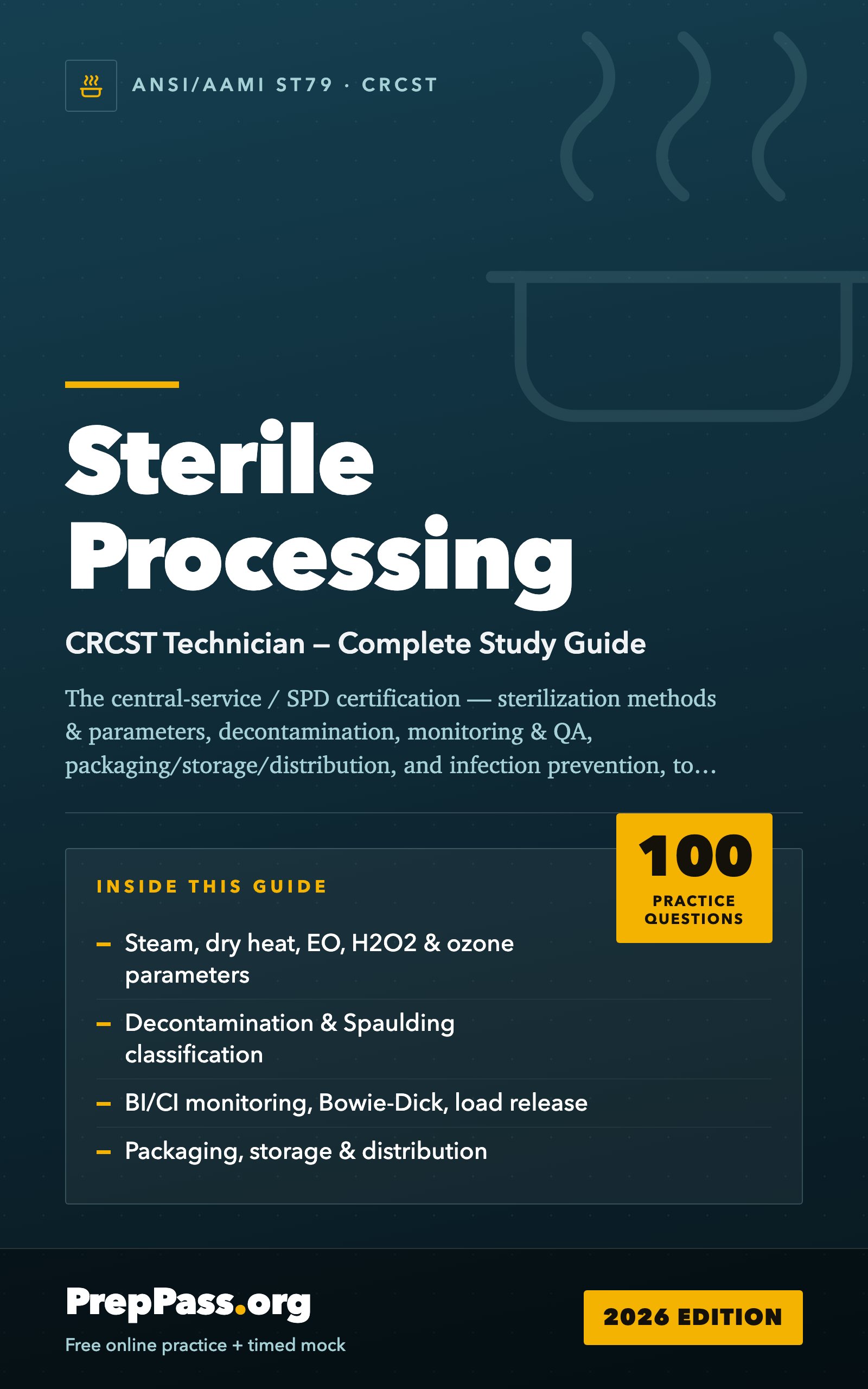
Sterile Processing Technician (CRCST) · 2026 版
Sterile Processing Technician (CRCST) — Complete Study Guide (2026)
The central-service / SPD certification — one chapter per HSPA content area: departmental considerations; decontamination; preparation & packaging; sterilization; sterile storage & transport; patient care equipment; professional practice.
- HSPA CRCST 的七个考区合成一本,PDF + EPUB 永久保存 —— 含旧版根本没有章节的那两个考区
- 七章每章收尾都有必背数字表、点名的陷阱清单和一道情景例题详解
- 书末附一整套完整模拟卷,按七个考区的权重配题,每道题都写清答案背后的推理
包含什么,不包含什么
包含
- One chapter per HSPA content area — all seven, including departmental considerations and patient care equipment
- Sterilization methods & parameters (steam, dry heat, EO, H2O2, ozone)
- Decontamination, cleaning, and the Spaulding classification
- Monitoring & QA: biological/chemical indicators, Bowie-Dick, load release
- Sterile storage, transport, inventory, and distribution
- A 70-question practice exam weighted to the seven areas, with a written explanation for every answer
- An appendix naming every exam figure this book will not state, and where HSPA publishes it
- PDF (print & tab it) + EPUB (phone / e-reader)
不包含
- 不寄送纸质书 —— 这是一份你下载后可自行打印的文件
- 购书不含视频课程、讲师或一对一辅导 —— 站上的免费视频是另一回事
- 不含考试报名费与考点费用,这些仍需向官方机构缴纳
免费读完整一章
完整的一章,与电子书正文一字不差。直接在此窗口滚动阅读;无需下载,无需邮箱。
在本页直接阅读第 6 章
我们没有拿轻松的绪论充数 —— 免费章节直接翻到书里最见功力的部分,让你在考试真正难的地方检验这本书讲得好不好。
HSPA Section 6 — published weight 5%.
Sterile processing does not only process instruments. In most facilities the department also cleans, tracks, stages, and distributes the reusable patient care equipment the rest of the hospital runs on: IV poles and infusion pumps, stretchers and wheelchairs, suction regulators, sequential compression device (SCD) controllers, feeding pumps, blood pressure cuffs, specialty carts, and the case carts that carry a surgical case to the operating room.
This is the smallest section on the exam and the fastest to learn, because most of it follows from one classification decision you already know. Do not skip it — five percent of a scored exam is real, and this material is concrete.
6.1 Classification and Cleaning
Almost all reusable patient care equipment is noncritical: it contacts intact skin only, or no patient tissue at all. The required minimum is therefore cleaning followed by low-level disinfection with an EPA-registered hospital disinfectant used exactly per its label — under federal pesticide law, label instructions are not advisory. High-level disinfectants and liquid chemical sterilants are never used on noncritical items.
Two qualifications matter. Use changes the category: a blood pressure cuff placed over nonintact skin or a wound is no longer a noncritical use, and items with brief nonintact-skin contact such as bed side rails are commonly handled with intermediate-level disinfection. Contact precautions raise the bar: absent dedicated or disposable equipment, an item used on a patient under contact precautions is disinfected before use on another patient, not at the end of the shift.
The variable that decides whether disinfection actually happened is contact time, which runs from application until the surface has dried. The surface must therefore stay visibly wet for the full labeled time. If a wipe dries in twenty seconds on a warm pump housing and the label calls for two minutes, that surface was cleaned, not disinfected, and the disinfectant is reapplied. This single idea produces more correct answers in this section than any other.
The rest of the routine follows the shape of the item. Remove and discard all single-use components first — disposable tubing, suction liners, SCD sleeves, probe covers, feeding-pump sets, disposable batteries — into the correct waste stream. Clean before you disinfect, since visible soil blocks a disinfectant exactly as it blocks a sterilant. Do not immerse electrical equipment: powered devices are wiped, and the model's own IFU is the authority. The Kendall SCD controller illustrates why — its manual states that the system cannot be sterilized by liquid immersion, autoclaving, or ethylene oxide without irreparable damage, and publishes its own list of acceptable cleaning agents. Approved-chemical lists are model-specific, so the durable rule is "check that model's IFU." Finally, label the finished item with a clean tag, sticker, or cover, so the next person can tell a processed item from one awaiting cleaning.
Two specific cases recur. Case carts are cleaned after each use, mechanically in a cart washer where one exists; a cart washer cleans and provides low- to intermediate-level thermal disinfection, and like any mechanical cleaning equipment it is tested on installation, on each day of use, and after major repairs. Carts are received on the decontamination side and return to the clean side for restocking. Suction splits cleanly: the liner is a single-use disposable, never emptied and reused, while the rigid outer canister and the wall regulator are reusable noncritical equipment. A liner whose contents would release blood or other potentially infectious material in a liquid or semi-liquid state is regulated medical waste and goes into a closable, leak-proof, labeled container.
6.2 Inspection, PM Tags, and Electrical Safety
Every item is inspected before distribution, and HSPA names the triad: cleanliness, frayed cords, and damage.
Electrical safety carries real regulatory teeth. OSHA requires portable cord- and plug-connected equipment to be visually inspected before use on any shift for external defects and evidence of internal damage, and states that if a defect or damage might expose an employee to injury, the item shall be removed from service until repairs and tests have made it safe. A frayed cord therefore comes out of service immediately, is tagged, is not distributed, and goes to Biomedical Engineering. It is never taped and never sent out "just for a short case."
Preventive maintenance (PM) tags are the second checkpoint, and what is actually required here is commonly overstated. Accreditation standards require a medical equipment inventory, written inspection, testing and maintenance frequencies based on the manufacturer's recommendations and risk, safety and functional checks before initial use, and documentation of all of it. No standard requires a physical sticker — but the sticker is the near-universal, surveyor-expected evidence that the program was carried out. The technician's rule is what HSPA tests: equipment with a missing or expired PM label does not go out. It is pulled from ready stock, tagged, and routed to Biomedical Engineering, which owns the PM program.
6.3 Tracking, Rentals, and Distribution
Tracking systems run from manual logs through computerized databases, barcode scanning, RFID, and hybrid combinations. What they buy is answers to four questions: where is that pump now, how much of the fleet is in use, what is due for PM, and — when a manufacturer issues a recall — exactly which units are affected and where they are.
Rental and loaned equipment adds two events. On receipt, equipment from outside the facility is treated as contaminated regardless of what the supplier says, then cleaned, inspected, and tested per its IFU before distribution. Before return, it is decontaminated again — and this one is federal law. OSHA's Bloodborne Pathogens standard requires equipment that may have become contaminated to be examined prior to servicing or shipping and decontaminated as necessary; where decontaminating a portion is not feasible, a readily observable label must state which portions remain contaminated, and that must be communicated to affected employees, the servicing representative, and the manufacturer before anyone handles or ships it. Returning a rental pump to a vendor is shipping.
Clean equipment is stored dry, clean, and secure, separated from equipment awaiting cleaning, with adequate charging stations; the department's one-way flow applies here exactly as it does to instruments. Batteries matter enough that flawed battery charging practices made ECRI's Top 10 Health Technology Hazards for 2019: keep chargeable equipment plugged in while in stock, check the charge indicator before distribution, and replace batteries on the manufacturer's schedule through Biomedical Engineering. Finally, equipment is assembled with the disposables it needs, tested per the manufacturer's IFU before it leaves the department, transported clean and protected to the requesting unit — HSPA names the operating room, the emergency department, and labor and delivery — and its delivery is recorded.
Key Numbers & Facts — Chapter 6 (memorize cold)
| Item | Value / rule |
|---|---|
| Patient care equipment | Noncritical → clean + low-level disinfection |
| Nonintact skin contact | Raises the category — no longer a noncritical use |
| Contact precautions | Disinfect between patients if not dedicated or disposable |
| Never on noncritical items | High-level disinfectants / liquid chemical sterilants |
| Disinfectant | EPA-registered hospital disinfectant, used per its label |
| Contact time | Surface must stay visibly wet the entire labeled time — reapply if it dries |
| First step | Remove and discard all consumables and single-use components |
| Electrical equipment | Do not immerse; wipe per the model's own IFU |
| SCD | Sleeves are single-patient-use; controller is wiped, never immersed or autoclaved |
| Suction | Liner single-use — never emptied and reused; canister and regulator reusable |
| Regulated waste | Liquid or semi-liquid blood/OPIM → closable, leak-proof, labeled container |
| Case carts | Cleaned after each use; cart washer = low-to-intermediate thermal disinfection |
| Cart washer testing | Installation, each day of use, after major repairs |
| Inspection triad | Cleanliness, frayed cords, damage |
| Frayed cord | Out of service, tagged, to Biomedical Engineering — OSHA, not preference |
| Cord inspection | Visually before use on any shift |
| PM label missing/expired | Do not distribute → tag → Biomedical Engineering |
| What's actually required | A documented PM program; the sticker is the expected evidence |
| Tracking systems | Manual, computer, RFID, hybrid |
| Rental/loaned on receipt | Treated as contaminated regardless of supplier assurances |
| Rental/loaned before return | Decontaminate before shipping — OSHA Bloodborne Pathogens |
| Clean equipment storage | Dry, clean, secure, separated from soiled, status visible |
| Batteries | Keep charged in stock; check the indicator before distribution |
| Before it leaves | Test per the IFU |
| Delivered to | OR, ED, Labor and Delivery — and the delivery is recorded |
Worked Scenario — The Pump on the Ready Rack
The emergency department calls for an infusion pump. The technician pulls one from the clean equipment rack and finds three things: the PM sticker expired last month, there is a shallow nick in the outer jacket of the power cord, and the housing has a dried streak of something near the handle. The charge nurse says the department is desperate, the pump "worked fine last week," and asks that it be sent now and let Biomed sort it out afterward.
Reason it through. All three findings independently disqualify the pump, which is what makes this scenario useful — a technician who fixes only the obvious one still sends out an unsafe device.
The damaged cord is the most serious and the least negotiable, because it is backed by federal law rather than professional guidance: a defect that might expose an employee to injury means the item shall be removed from service until repaired and tested. "Worked fine last week" is neither a repair nor a test, and tape is not an insulator. The expired PM label means the facility can no longer demonstrate that required inspection, testing, and maintenance were performed on this unit; the label is not itself the requirement, but it is the visible evidence that the program has lapsed here. The dried streak means the pump never completed cleaning, or reached the clean rack without being processed — which raises a question about everything else on that rack. It goes back to be cleaned and then disinfected, kept visibly wet for the full labeled contact time.
The right response to the charge nurse is the one from Chapter 7: acknowledge the real problem, decline the unsafe action, offer an alternative, and escalate. Find another pump, say how long that will take, tag this one, notify Biomed, and tell the supervisor the ED is short. Sending it and letting Biomed sort it out afterward inverts the entire purpose of an inspection step.
Exam Traps — Chapter 6
- The one-swipe trap. A surface that dries before the labeled contact time elapses was cleaned, not disinfected — reapply.
- The high-level-disinfectant trap. Noncritical equipment gets low-level disinfection; high-level disinfectants and liquid chemical sterilants are wrong for it.
- The immersion trap. Powered patient care equipment is wiped, not immersed, autoclaved, or gas sterilized — and the model's IFU is the authority.
- The reusable-liner trap. A suction liner is never emptied and reused; only the outer canister and the regulator are reusable.
- The "tape the cord" trap. A damaged cord is removed from service and repaired — under OSHA, not as a matter of preference.
- The "Biomed can check it later" trap. Equipment failing inspection does not go out first and get resolved afterward.
- The PM-sticker trap. The sticker itself is not what a standard requires — the documented PM program is — but equipment with a missing or expired label still does not get distributed.
- The vendor-assurance trap. Rental and loaned equipment is processed on receipt regardless of what the supplier says, and decontaminated again before it is shipped back.
购买前
- 怎么拿到?
- 付款后下载入口立即出现在本页,链接同时发到你的邮箱。无需注册账号。
- 不合适怎么办?
- 14 天内发邮件即可全额退款,无需理由。
- 免费练习会取消吗?
- 不会。站上的每一道练习题、计时模考和免费章节都继续免费。这本书是「学」的那一半,不是把免费部分围起来的门。
- 能在手机上看吗?
- 可以 —— EPUB 适合手机和电子书阅读器,PDF 适合打印和贴标签,两种都给你。
详细信息
The central-service / SPD certification — one chapter per HSPA content area: departmental considerations; decontamination; preparation & packaging; sterilization; sterile storage & transport; patient care equipment; professional practice.
- Format: PDF + EPUB download · 137 pages
- 70 practice questions in the book, with a full answer key
- 400 free practice questions for this exam on PrepPass, included at no cost
- $14.99 one-time — no subscription
- 14-day money-back guarantee · refund policy
- Cross-referenced against: ANSI/AAMI ST79 / ANSI/ASHRAE/ASHE 170 / CDC sterilization guidelines / OSHA / device IFUs
- Last updated: September 2026
- 官方来源核验(ANSI/AAMI ST79 / ANSI/ASHRAE/ASHE 170 / CDC sterilization guidelines / OSHA / device IFUs)
- 400 道免费练习题
- 即时下载,永久拥有
关于这场考试本身
| 主管机构 | Healthcare Sterile Processing Association (HSPA), formerly IAHCSMM —— 考试由 Prometric 承办 来源: HSPA — Certification Handbook (PDF, revised January 2026) |
|---|---|
| 题目数量 | 150 道题 (125 道计分,25 道不计分预试题) 来源: HSPA — Certification Handbook (PDF, revised January 2026) |
| 考试时限 | 180 分钟 来源: HSPA — Certification Handbook (PDF, revised January 2026) |
| 及格标准 | HSPA 未公布 我们查阅但未找到该数据的来源: HSPA — Certification Handbook (PDF, revised January 2026) |
| 费用 |
来源: HSPA — Certification Handbook (PDF, revised January 2026) |
| 考试语言 | 英语 来源: HSPA — Certification Handbook (PDF, revised January 2026) |
练习免费,为什么还要买书?
我们的练习题和计时模考一直免费 —— 网站上的东西不会因为这本书而收起来。这本 $14.99 的书是「学」的那一半:知识本身,按顺序讲清楚,存成一份属于你的文件。
- 系统讲解 —— 每个考试部分按章节从头讲到尾,不只是题目
- 可打印可贴标签 —— 一份适合打印的 PDF,能划重点、做批注、带到书桌前
- 随处离线学 —— EPUB 放手机或电子书阅读器;不用 wifi,不用一堆浏览器标签
- 全在一处 —— 章节、每章速记卡、练习题都在同一份文件里
- 永久归你 —— 一次 $14.99,即时下载,无订阅
而且零风险:14 天退款保证 —— 不满意?发邮件即可全额退款,无需理由。 详见退款政策。
14 天退款保证 · 全额退款,无需理由。
一次购买,永久下载访问。此电子书是完整的 Sterile Processing Technician (CRCST) 学习指南,含 PDF 与 EPUB。仅为教育性摘要,非专业或法律意见 —— 请始终以官方来源核实当前规定。最后更新:September 2026。