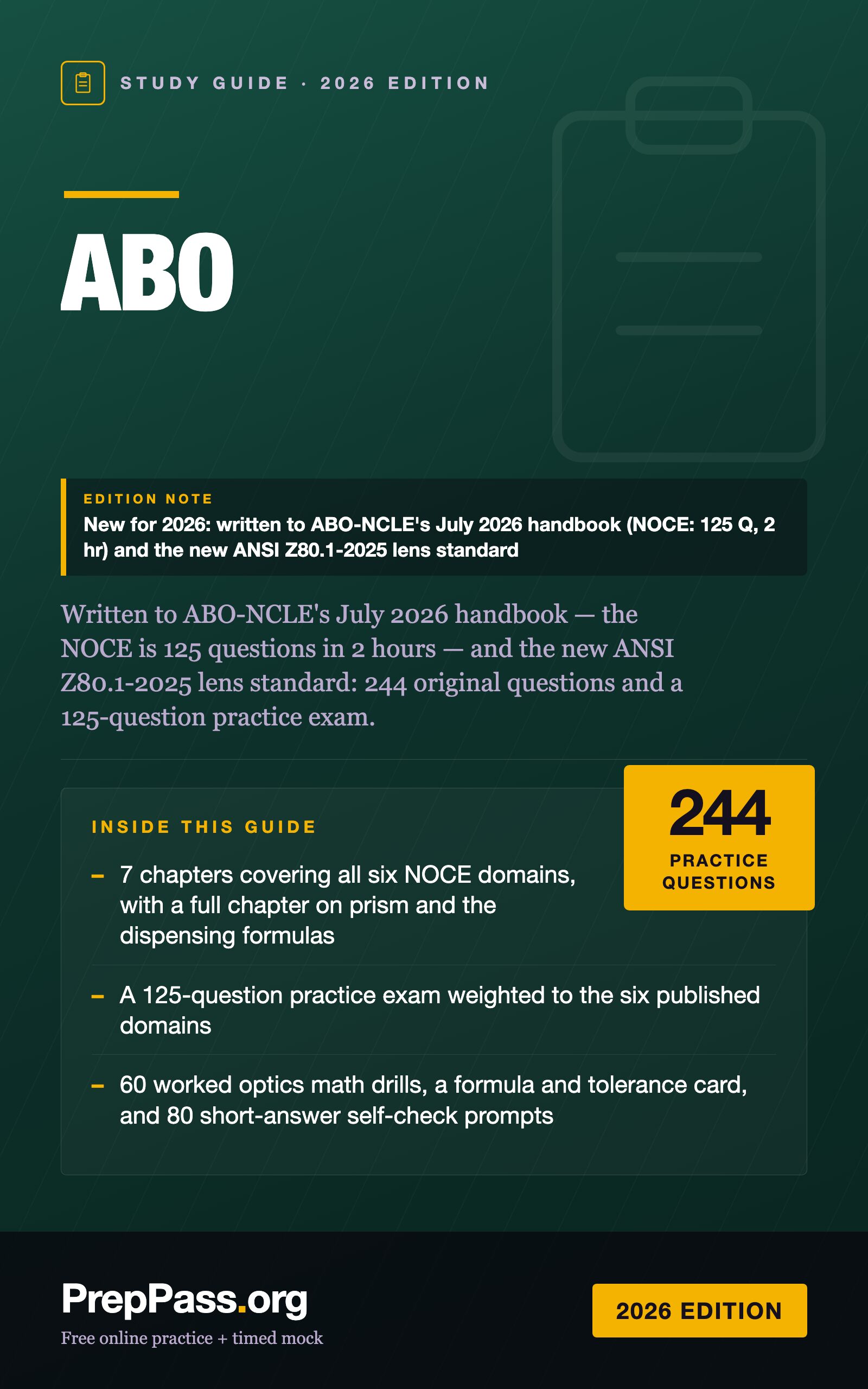
ABO NOCE (American Board of Opticianry National Opticianry Competency Examination) · 2026 Edition
ABO Study Guide — 2026 Edition
Edition noteNew for 2026: written to ABO-NCLE's July 2026 handbook (NOCE: 125 Q, 2 hr) and the new ANSI Z80.1-2025 lens standard
Written to ABO-NCLE's July 2026 handbook — the NOCE is 125 questions in 2 hours — and the new ANSI Z80.1-2025 lens standard: 244 original questions and a 125-question practice exam.
- 244 original ABO NOCE practice questions, each with a worked explanation, in one PDF + EPUB you keep
PDF + EPUB · English · 224 pages · $19.99 one-time
This book is written in English.
Instant download after payment — no account needed, no subscription.
14-day money-back guarantee: not satisfied for any reason? Email support@preppass.org within 14 days of purchase for a full refund. Refund policy
Try 10 questions first — free
Answer all 10, then see every answer explained — with the section of this guide that teaches it. About 5 minutes, no sign-up.
Start 10 free questionsLook inside the book
Three real pages, rendered straight from the PDF you download — a reference page, a teaching page, and a worked question, always in that order. Nothing here was redrawn to look better.
- Quick referenceChapter 3 — Ocular Anatomy, Physiology, Pathology, and Refraction (Domain II) · PDF page 73
A page you can turn back to: the numbers, deadlines or terms gathered in one place.
- How it's taughtChapter 5 — Instrumentation and Lens Verification (Domain IV) · PDF page 99
An explanation page: the material taught in prose, in the order the exam tests it.
- How it's taughtChapter 7 — Laws, Regulations, and Standards (Domain VI) · PDF page 141
An explanation page: the material taught in prose, in the order the exam tests it.
Questions buyers ask
- What has changed on the ABO NOCE (American Board of Opticianry National Opticianry Competency Examination) exam?
- New for 2026: written to ABO-NCLE's July 2026 handbook (NOCE: 125 Q, 2 hr) and the new ANSI Z80.1-2025 lens standard.
- Is a study guide enough for the ABO NOCE (American Board of Opticianry National Opticianry Competency Examination) exam, or do I need a course?
- A book is exam review: it does not replace any education, training or experience your licensing body requires before you may sit the exam, so check those requirements first. For the exam content itself, this 224-page guide teaches the material chapter by chapter with 244 practice questions and explanations inside, and 100 more practice questions are free on PrepPass. A prep course adds live instruction and a set schedule; whether you need one beyond any required education is your call.
- What is the cheapest way to prepare for the ABO NOCE (American Board of Opticianry National Opticianry Competency Examination) exam?
- Start with what costs nothing: 100 practice questions on PrepPass, with explanations and no signup. If you want it taught in one file you keep, the full study guide is $19.99 once. No subscription on any of them.
- Does the ABO NOCE (American Board of Opticianry National Opticianry Competency Examination) study guide come as a PDF?
- Yes — ABO Study Guide — 2026 Edition downloads as PDF and EPUB, 224 pages. The download link is emailed the moment payment clears and does not expire.
- How much does the ABO NOCE (American Board of Opticianry National Opticianry Competency Examination) study guide cost?
- $19.99, once. There is no subscription and no account to create; the PDF and EPUB files are yours to keep.
- Are there free ABO NOCE (American Board of Opticianry National Opticianry Competency Examination) practice questions?
- Yes — 100 of them, free to use with no signup and an explanation on every one. They are separate from this study guide, which is what you are buying here.
- Can I read part of the ABO NOCE (American Board of Opticianry National Opticianry Competency Examination) study guide before buying?
- Yes. A full chapter is free to read on this page — not a summary of one, the chapter itself.
- Is this the official ABO NOCE (American Board of Opticianry National Opticianry Competency Examination) study guide?
- No. This is an independent study guide and is not affiliated with or endorsed by the exam's awarding body. It is written from ABO-NCLE Basic Exam Handbook (July 2026) and ABO-NCLE exam pages, read September 24, 2026. Always confirm current requirements with the body that issues your licence.
What's included — and what isn't
Included
- 7 chapters covering all six NOCE domains, with a full chapter on prism and the dispensing formulas
- A 125-question practice exam weighted to the six published domains
- 60 worked optics math drills, a formula and tolerance card, and 80 short-answer self-check prompts
- What changed: the July 2026 handbook and the ANSI Z80.1-2025 lens standard
- 244 original questions, each with a worked explanation citing its source
- PDF + EPUB you keep
Not included
- No printed copy is shipped — this is a file you download and can print yourself
- No video course, instructor or tutoring comes with the book — the free videos on the site are separate
- Not your exam registration or the testing centre's fee, which you still pay to the official body
Contents
See 29 sections and the page each one starts on
- Chapter 1 — Ophthalmic Optics: Light, Lenses and the Prescription (Domain I, sections 1–7 and 9–13)p. 12
- Chapter 2 — Ophthalmic Optics: Prism and the Dispensing Formulas (Domain I, sections 8 and 14)p. 37
- Chapter 3 — Ocular Anatomy, Physiology, Pathology, and Refraction (Domain II)p. 62
- Chapter 4 — Ophthalmic Products (Domain III)p. 78
- Chapter 5 — Instrumentation and Lens Verification (Domain IV)p. 96
- Chapter 6 — Dispensing Procedures (Domain V)p. 113
- Chapter 7 — Laws, Regulations, and Standards (Domain VI)p. 132
- Section I — Ophthalmic Optics (31 questions)p. 147
- Section II — Ocular Anatomy, Physiology, Pathology, and Refraction (13 questions)p. 154
- Section III — Ophthalmic Products (25 questions)p. 156
- Section IV — Instrumentation (19 questions)p. 161
- Section V — Dispensing Procedures (25 questions)p. 165
- Section VI — Laws, Regulations, and Standards (12 questions)p. 171
- Appendix A — The exam at a glance, in one tablep. 188
- Appendix B — Terms the exam expects you to use preciselyp. 189
- Appendix C — Formula and tolerance card Formulasp. 192
- Appendix D — Optics math drill set (60 worked problems)p. 194
- Appendix E — Forty traps the exam likesp. 200
- Appendix F — One-page review sheetsp. 204
- Appendix G — Short-answer self- check (80 prompts)p. 207
- Chapter 1 — Light, lenses, prescriptions Prompt Answerp. 208
- Chapter 2 — Prism and formulas Prompt Answerp. 209
- Appendix H — Practice-exam review mapp. 212
- Section I — Ophthalmic Optics Question Topic Rereadp. 213
- Section II — Anatomy, Physiology, Pathology, Refraction Question Topic Rereadp. 214
- Section III — Ophthalmic Products Question Topic Rereadp. 215
- Section IV — Instrumentation Question Topic Rereadp. 216
- Section V — Dispensing Procedures Question Topic Rereadp. 217
- Section VI — Laws, Regulations, and Standards Question Topic Rereadp. 218
Taken from the PDF you download, with the page each one starts on — not typed here.
Read a chapter free, in full
One complete chapter, exactly as it ships in the eBook. Scroll the window to read it right here; no download, no email.
Read chapter 2 here, without leaving the page
We didn't give you the easy intro — the free chapter opens on one of the hardest-working parts of the book, so you can judge the teaching where the exam gets difficult.
This is the chapter candidates fear, and the one that separates a pass from a near miss. The outline lists "calculating prismatic effects" and eight ophthalmic formulas by name: Prentice's rule, vertical imbalance, vertex compensation, centration, power in oblique meridians, magnification, anisometropia and aniseikonia[1]. Every one of them is arithmetic you can do on the exam's on-screen scientific calculator[1].
The method for every problem in this chapter is the same:
- Write down what you are given, with units.
- Convert millimeters to centimeters (Prentice) or to meters (power and focal length).
- Find the power in the meridian that matters — horizontal for in/out prism, vertical for up/down prism.
- Calculate, then name the direction (base up, down, in or out; stronger or weaker).
- Sanity-check: does a bigger lens power or a bigger error give a bigger answer?
Work every example below with a pencil before reading the solution.
I.8 Calculating prismatic effects
What a prism does
A prism is a transparent wedge with an apex and a base. Light passing through it bends toward the base, but the image appears displaced toward the apex[2]. Prism power is measured in prism diopters (Δ): one prism diopter deviates a ray 1 cm, measured on a plane 1 m away[2]. A prism does not focus light; it only displaces it[3].
Two consequences you must hold onto:
- A lens is a stack of prisms. A plus lens has its bases toward the middle and its apexes at the edge; a minus lens has its apexes in the middle and bases at the edge[4].
- The optical center is the only point with no prism. Look through any other point and you are looking through prism[4].
Which way is the base?
From the stacked-prism picture you can work out the base direction for any point on a lens:
- Plus lens: the base points toward the optical center.
- Minus lens: the base points away from the optical center.
NAO's statements match: looking through the top of a minus lens or the bottom of a plus lens gives base-up prism; looking through the top of a plus lens or the bottom of a minus lens gives base-down prism[5].
For horizontal prism, "in" means toward the nose and "out" means toward the temple, for either eye[5]. When the lenses' optical centers are set wider than the patient's PD and the lenses are minus, the patient looks through base-in prism; with plus lenses the same error gives base-out prism[4].
| Where the eye looks relative to the OC | Plus lens | Minus lens |
|---|---|---|
| Below the OC | Base up | Base down |
| Above the OC | Base down | Base up |
| Nasal to the OC (OCs set too wide) | Base out | Base in |
| Temporal to the OC (OCs set too narrow) | Base in | Base out |
I.14.1 Prentice's rule
Prentice's rule: the prismatic effect at a point on a lens equals the distance from the optical center, in centimeters, multiplied by the lens power in diopters in that meridian[4].
P = c × F — P in prism diopters, c in centimeters, F in diopters. Because decentration is measured in millimeters, the working form is P = (mm × F) ÷ 10[4].
Worked example 1 (NAO's PD error). Rx −4.00 DS OU. Patient PD 62 mm; the finished glasses measure 66 mm. How much prism, and which direction[4]?
- Each lens is off by 2 mm (half of 66 − 62).
- P = 0.2 cm × 4.00 = 0.8Δ per eye[4].
- Direction: centers too wide, minus lens → base in.
- Total horizontal prism for the pair: 0.8 + 0.8 = 1.6Δ base in. Both eyes see base-in prism, and the two effects add (next section).
Worked example 2 (NAO's vertical point). Find the prismatic effect 4 mm below the optical center of a +2.50 DS lens. P = 0.4 × 2.50 = 1.00Δ base up, because the eye is below the center of a plus lens[4].
Worked example 3 (the same error, two powers). A frame is made with each OC 3 mm too far out.
- For +1.00 DS OU: 0.3 × 1.00 = 0.3Δ base out per eye.
- For +6.00 DS OU: 0.3 × 6.00 = 1.8Δ base out per eye.
This is why NAO warns never to accept or reject a job on the millimeters alone: the same PD error that is harmless in a weak lens is a real problem in a strong one[6].
Worked example 4 (sphero-cylinder). OD −2.00 −2.00 × 180, OC 3 mm too far in. Horizontal decentration needs the power in the horizontal (180) meridian. The axis is 180, so the 180 meridian carries the sphere alone: −2.00. P = 0.3 × 2.00 = 0.6Δ. OCs too narrow with a minus lens → base out. The trap is to use −4.00 (the total in the vertical meridian) for a horizontal problem.
Rearranging Prentice's rule
The rule works backward as easily as forward[4]:
- How far to decenter? c (mm) = P ÷ F × 10. To get 1.6Δ from a 4.00 D lens: 1.6 ÷ 4.00 × 10 = 4 mm.
- What power produces it? F = P ÷ c (mm) × 10. If 4 mm of decentration gives 1.6Δ, the lens is 1.6 ÷ 4 × 10 = 4.00 D.
Decentration can produce prescribed prism only if the lens has enough power; a plano lens has no power to decenter, so its prism has to be ground[4].
Compounding and cancelling between the two eyes
When both eyes look through prism, the effects either add (compound) or subtract (cancel), depending on the directions[5]:
| Right eye | Left eye | Net effect on the pair |
|---|---|---|
| Base in | Base out | Cancel (subtract) |
| Base in | Base in | Compound (add) |
| Base out | Base out | Compound (add) |
| Base up | Base up | Cancel (subtract) |
| Base down | Base down | Cancel (subtract) |
| Base up | Base down | Compound (add) |
Horizontal: same named direction in both eyes adds. Vertical: same direction in both eyes cancels, opposite directions add. The vertical rule surprises people, so think of it physically: if both images move up by the same amount, the eyes simply look up a little together; only a difference between the eyes forces them apart.
Prism notation and resultant prism
Prescribed prism is written with a base direction (BU, BD, BI, BO) or as an amount at a base meridian on the 360° protractor[5]. When you face the patient or read the glasses in a lensmeter with the temples away from you, 0° is always on the right side of each lens[5]. So for the right eye, base in is toward 0° and base out toward 180°; for the left eye, base in is toward 180° and base out toward 0°.
When a lens carries both a vertical and a horizontal component, they combine into one resultant prism:
R = √(V² + H²), and the base meridian angle from the horizontal is a = tan⁻¹(V ÷ H)[5].
Worked example (NAO's numbers). OD 1.5Δ BU and 2Δ BI[5].
- R = √(1.5² + 2²) = √(2.25 + 4) = √6.25 = 2.5Δ[5].
- Angle: tan⁻¹(1.5 ÷ 2) = tan⁻¹(0.75) ≈ 36.9°, about 37°.
- The right eye's base-in direction is the 0° side and base up is 90°, so the base lies at about 037: 2.5Δ base 037. NAO writes the right eye as "Pl 2.5 @ 037" and the matching left-eye prescription, base down and in, as "@ 217"[5].
Splitting prescribed prism
A prescriber sometimes orders all the prism in one eye, which makes that lens much thicker and heavier. With the prescriber's agreement, the dispenser can split it: half in each eye, keeping the original direction in the prescribed eye and putting the other half in the compounding direction in the fellow eye[5].
- Vertical: OD 10Δ BU, OS none → OD 5Δ BU, OS 5Δ BD[5]. (Up and down in opposite eyes compound, so the total is still 10.)
- Horizontal: OS 4Δ BI, OD none → 2Δ BI in each eye[5]. (Base in plus base in compounds.)
The trap: splitting a vertical prism as "5 BU and 5 BU" — those cancel, leaving the patient with no vertical correction at all.
Prism and eye deviations
Prism moves the image toward its apex, so the eye turns toward the apex[2]. To help an eye that deviates, the prism's apex points the way the eye already turns — which puts the base on the opposite side. For an "eso" deviation (eye turned in), the base is placed out; for an "exo" deviation, the base goes in[5]. Yoked prism is the opposite idea: prism whose bases point the same way in space before both eyes (for example, base in before one eye and base out before the other), so the effects cancel between the eyes and both images shift together. It is used for purposes such as prism thinning and patients who misperceive their position in space, and it is always ordered in both lenses[5].
I.14.2 Vertical imbalance
Why the reading level matters
When a bifocal wearer reads, the eyes drop below the distance optical centers; NAO puts the normal reading excursion at about 8 to 10 mm[4]. If the two lenses have different powers in the vertical (90°) meridian, each eye meets a different amount of vertical prism. The difference is vertical imbalance, and it depends on two things: the vertical-meridian powers and the distance from the optical center to the reading level[4]. Because the eyes tolerate vertical differences poorly, even a modest imbalance can cause vertical diplopia[4]; ANSI Z80.1's vertical imbalance tolerance is tighter than the horizontal one (Chapter 5)[7].
Worked example (NAO's average-math problem)
OD −1.00 DS, OS +1.75 DS, add +2.00, reading depth 12 mm[6].
- OD: 1.2 cm × 1.00 = 1.2Δ base down (below the center of a minus lens)[6].
- OS: 1.2 cm × 1.75 = 2.1Δ base up (below the center of a plus lens)[6].
- Base down in one eye and base up in the other compound: 1.2 + 2.1 = 3.3Δ of vertical imbalance at the reading level[6].
Worked example with cylinder (NAO's reading-level problem)
OD −0.25 +3.00 × 180, OS −1.00 +1.00 × 090, add +1.50 OU, reading level 10 mm[4].
- OD, vertical meridian: the axis is 180, so the full cylinder is in the 90 meridian: −0.25 + 3.00 = +2.75.
- OS, vertical meridian: the axis is 090, so the 90 meridian carries the sphere only: −1.00.
- Distance powers alone: OD 1.0 × 2.75 = 2.75Δ BU; OS 1.0 × 1.00 = 1.00Δ BD. Up and down compound: 3.75Δ.
- NAO works the same problem by adding the +1.50 add to both lenses first (+4.25 and +0.50, both base up), which gives 4.25 − 0.50 = 3.75Δ[4]. The answer is the same because an equal add in both lenses adds equal prism to both eyes, which cancels. What creates imbalance is the difference in the vertical-meridian powers.
Shortcut. Imbalance at the reading level = (difference in vertical-meridian distance powers) × (reading depth in cm). In the example: (+2.75 − (−1.00)) × 1.0 = 3.75Δ.
What to do about it
NAO lists the options[4]:
| Method | What it is | NAO's working range |
|---|---|---|
| Separate single-vision reading glasses | OCs placed where the patient reads | Can handle imbalances over 5Δ, but inconvenient |
| Fresnel press-on prism | Temporary prism on the segment | A useful trial before slab-off |
| Prism segments | Prism ground into the segment | Rarely used; slow to process |
| Compensated ("R") segments | Segment OCs placed 4–10 mm below the seg top | About 1.5Δ or less |
| Dissimilar segments | Different seg styles or sizes in each eye | About 1.5Δ |
| Bicentric grinding (slab-off) | Prism added to the lower part of one lens | Most common; up to 5Δ |
Which lens gets the slab-off? Reason it out from the base-direction table. Looking down through the reading level, the more minus (or less plus) lens produces the relatively greater base-down effect — in the first example above, the −1.00 lens gave 1.2Δ base down against the +1.75 lens's 2.1Δ base up. To cancel the difference, the slab-off adds prism that opposes it: base-up prism in the reading area of the more minus (least plus) lens in the vertical meridian.
Imbalance is only worth correcting when both eyes see well enough to fuse. NAO's example: a patient correctable to 20/25 in one eye but only 20/200 in the other gains nothing from a slab-off[4].
Sources cited in this excerpt
- ABO-NCLE Basic Exam Handbook July 2026 (Candidate Handbook, NOCE and CLRE). American Board of Opticianry & National Contact Lens Examiners (ABO-NCLE), 2026-07. https://drive.google.com/file/d/1EjE8GtE_jfLiGeA2x3zAPOroAOtF-T3a/view?usp=sharing
- Prisms (StatPearls; PubMed abstract, PMID 35593813). StatPearls Publishing, via PubMed (National Library of Medicine), 2023 Jun 11. https://pubmed.ncbi.nlm.nih.gov/35593813/
- Optical Dilemmas and Solutions (continuing education course). National Academy of Opticianry, 2018. https://www.nao.org/wp-content/uploads/2020/04/Optical-Dilemmas-and-Solutions.pdf
- How to Use Prentice's Rule and Finding the Power of a Lens in Any Meridian (continuing education course). National Academy of Opticianry, 2025. https://www.nao.org/wp-content/uploads/2026/02/How-to-Use-Prentices-Rule-and-Finding-the-Power-of-a-Lens-in-Any-Meridian.pdf
- Not Your Basic Prism: Splitting Prism, Compounding Prism, Prism Notation, Resulting and Resolving Prism (continuing education course). National Academy of Opticianry, 2025. https://www.nao.org/wp-content/uploads/2025/10/Not-Your-Basic-Prism-Online.pdf
- Average Math for the Above Average Dispenser (continuing education course). National Academy of Opticianry, 2008. http://www.nao.org/wp-content/uploads/2013/12/Average-Math-for-the-Above-Average-Dispenser-pdf.pdf
- Quick Reference Guide - ANSI Z80.1-2015 (tolerance summary). The Vision Council (Secretariat, Accredited Standards Committee Z80), 2016-01-25. https://thevisioncouncil.org/sites/default/files/ANSI%20Z80%201-2015_Quick%20Reference%20v2.pdf
Before you buy
- How do I get it?
- Pay, and the download appears on this page straight away. The links are also emailed to you. No account is required.
- What if it isn't for me?
- Email us within 14 days for a full refund, no questions asked.
- Is the free practice going away?
- No. Every practice question, the timed mock and the free chapters on this site stay free. This book is the studying half, not a gate around the free half.
- Can I read it on my phone?
- Yes — the EPUB is for phones and e-readers, the PDF is for printing and tabbing. You get both.
The details
Written to ABO-NCLE's July 2026 handbook — the NOCE is 125 questions in 2 hours — and the new ANSI Z80.1-2025 lens standard: 244 original questions and a 125-question practice exam.
- Format: PDF + EPUB download · 224 pages
- 244 practice questions in the book, with a full answer key
- 100 free practice questions for this exam on PrepPass, included at no cost
- $19.99 one-time — no subscription
- 14-day money-back guarantee · refund policy
- Cross-referenced against: ABO-NCLE Basic Exam Handbook (July 2026) and ABO-NCLE exam pages, read September 24, 2026
- Verified from the official source(ABO-NCLE Basic Exam Handbook (July 2026) and ABO-NCLE exam pages, read September 24, 2026)
- 100 free practice questions
- Instant download, yours for life
Why buy the book when the practice is free?
Our practice questions and timed mock stay free — nothing on the site moves behind this book. The $19.99 book is the studying half: the material itself, taught in order, in a file you own.
- Systematic teaching — every exam section explained chapter by chapter, start to finish, not just questions
- Print it & tab it — a paper-ready PDF you can highlight, mark up, and bring to your study table
- Study anywhere, offline — EPUB on your phone or e-reader; no wifi, no browser tabs
- Everything in one place — the chapters and the practice questions in one file
- Yours for life — one-time $19.99, instant download, no subscription
And it's risk-free: 14-day money-back guarantee — not satisfied? Email us for a full refund, no questions asked. See the refund policy.
14-day money-back guarantee · full refund, no questions asked.
One-time purchase, lifetime access to the download. The eBook is the full ABO NOCE (American Board of Opticianry National Opticianry Competency Examination) study guide in PDF and EPUB. Educational summary, not professional or legal advice — always confirm the current rules with the official source.