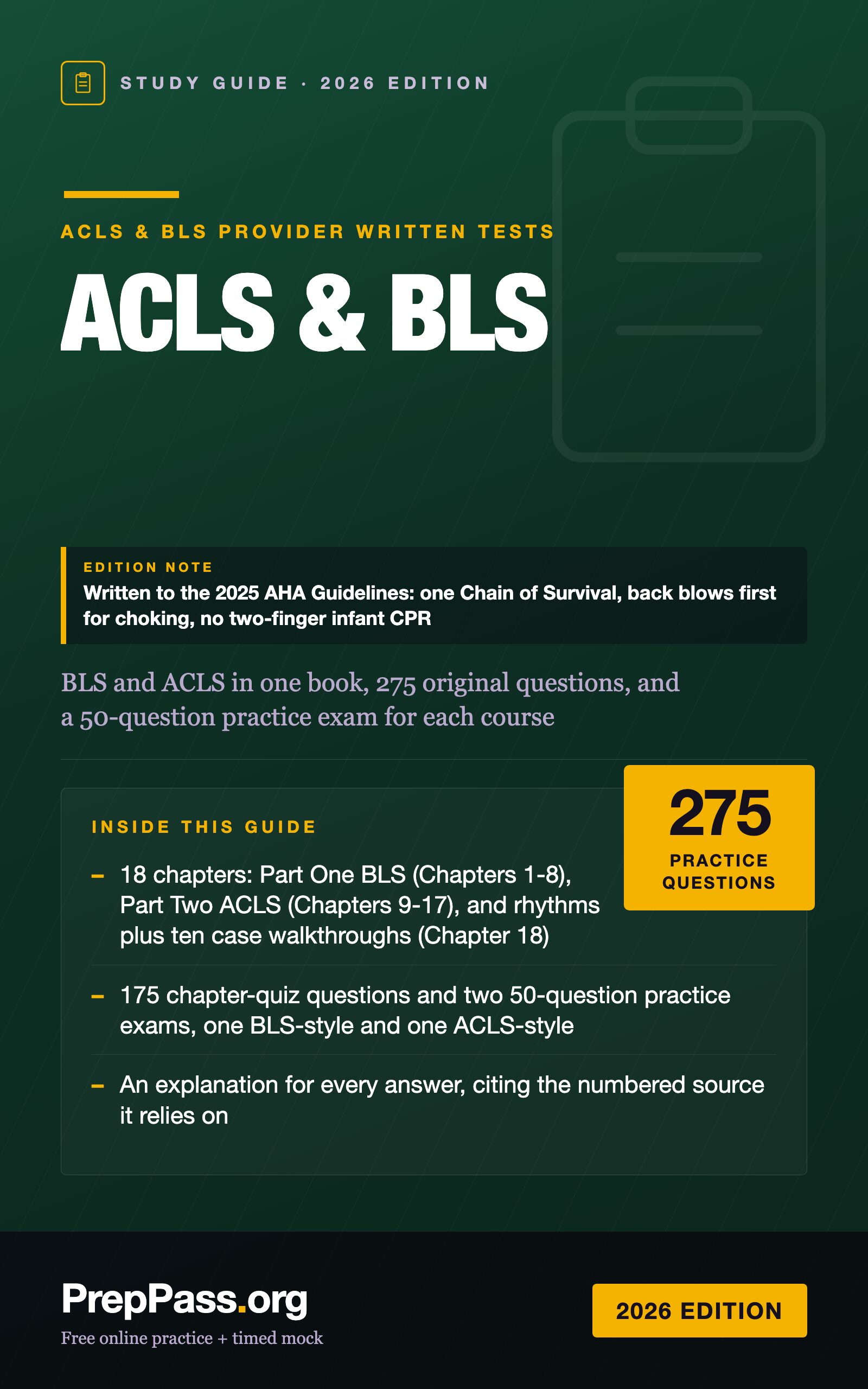
ACLS & BLS Provider Written Tests · 2026 Edition
ACLS & BLS Study Guide — 2026 Edition
Edition noteWritten to the 2025 AHA Guidelines: one Chain of Survival, back blows first for choking, no two-finger infant CPR
BLS and ACLS in one book, 275 original questions, and a 50-question practice exam for each course
- 275 original ACLS and BLS practice questions, each with a worked explanation, in one PDF + EPUB you keep
PDF + EPUB · English · 251 pages · $24.99 one-time
This book is written in English.
Instant download after payment — no account needed, no subscription.
14-day money-back guarantee: not satisfied for any reason? Email support@preppass.org within 14 days of purchase for a full refund. Refund policy
Try 10 questions first — free
Answer all 10, then see every answer explained — with the section of this guide that teaches it. About 5 minutes, no sign-up.
Start 10 free questionsLook inside the book
Three real pages, rendered straight from the PDF you download — a reference page, a teaching page, and a worked question, always in that order. Nothing here was redrawn to look better.
- Quick referenceChapter 4 — Airway, Breaths and Ventilation · PDF page 48
A page you can turn back to: the numbers, deadlines or terms gathered in one place.
- How it's taughtChapter 4 — Airway, Breaths and Ventilation · PDF page 55
An explanation page: the material taught in prose, in the order the exam tests it.
- A question, workedChapter 10 — Cardiac Arrest With a Shockable Rhythm: VF and Pulseless VT · PDF page 112
A practice question with its answer and the reasoning behind it — not just a key.
Questions buyers ask
- What has changed on the ACLS & BLS Provider Written Tests exam?
- Written to the 2025 AHA Guidelines: one Chain of Survival, back blows first for choking, no two-finger infant CPR.
- Is a study guide enough for the ACLS & BLS Provider Written Tests exam, or do I need a course?
- A book is exam review: it does not replace any education, training or experience your licensing body requires before you may sit the exam, so check those requirements first. For the exam content itself, this 251-page guide teaches the material chapter by chapter with 275 practice questions and explanations inside, and 124 more practice questions are free on PrepPass. A prep course adds live instruction and a set schedule; whether you need one beyond any required education is your call.
- What is the cheapest way to prepare for the ACLS & BLS Provider Written Tests exam?
- Start with what costs nothing: 124 practice questions on PrepPass, with explanations and no signup. If you want it taught in one file you keep, the full study guide is $24.99 once. No subscription on any of them.
- Does the ACLS & BLS Provider Written Tests study guide come as a PDF?
- Yes — ACLS & BLS Study Guide — 2026 Edition downloads as PDF and EPUB, 251 pages. The download link is emailed the moment payment clears and does not expire.
- How much does the ACLS & BLS Provider Written Tests study guide cost?
- $24.99, once. There is no subscription and no account to create; the PDF and EPUB files are yours to keep.
- Are there free ACLS & BLS Provider Written Tests practice questions?
- Yes — 124 of them, free to use with no signup and an explanation on every one. They are separate from this study guide, which is what you are buying here.
- Can I read part of the ACLS & BLS Provider Written Tests study guide before buying?
- Yes. A full chapter is free to read on this page — not a summary of one, the chapter itself.
- Is this the official ACLS & BLS Provider Written Tests study guide?
- No. This is an independent study guide and is not affiliated with or endorsed by the exam's awarding body. It is written from 2025 AHA Guidelines for CPR and ECC (Circulation, Oct 22, 2025); 2025 ACC/AHA acute coronary syndromes guideline; 2026 AHA/ASA acute ischemic stroke guideline (summary); MedlinePlus, CDC, NHLBI and FDA drug labels; read September 2026. Always confirm current requirements with the body that issues your licence.
What's included — and what isn't
Included
- 18 chapters: Part One BLS (Chapters 1-8), Part Two ACLS (Chapters 9-17), and rhythms plus ten case walkthroughs (Chapter 18)
- 175 chapter-quiz questions and two 50-question practice exams, one BLS-style and one ACLS-style
- An explanation for every answer, citing the numbered source it relies on
- What changed in the 2025 Guidelines, from the single Chain of Survival to back blows first for choking
- Key numbers and named traps in every chapter
- A one-page quick reference and a final-week review of sixty sourced facts
- PDF + EPUB you keep
Not included
- No printed copy is shipped — this is a file you download and can print yourself
- No video course, instructor or tutoring comes with the book — the free videos on the site are separate
- Not your exam registration or the testing centre's fee, which you still pay to the official body
Contents
See 25 sections and the page each one starts on
- Chapter 1 — Recognizing Cardiac Arrest and the 2025 Chain of Survivalp. 12
- Chapter 2 — High-Quality Adult CPRp. 24
- Chapter 3 — Defibrillation and the AEDp. 35
- Chapter 4 — Airway, Breaths and Ventilationp. 46
- Chapter 5 — Infant and Child BLSp. 57
- Chapter 6 — Choking: Adults, Children and Infantsp. 68
- Chapter 7 — Special Situations for BLS Providers: Opioids, Drowning, Pregnancy and Morep. 77
- Chapter 8 — Resuscitation Teams, Communication and Debriefingp. 87
- Chapter 9 — The ACLS Toolkit: Assessment, Access, Airways and Monitoringp. 97
- Chapter 10 — Cardiac Arrest With a Shockable Rhythm: VF and Pulseless VTp. 107
- Chapter 11 — Asystole, PEA, Reversible Causes and Ending Resuscitationp. 120
- Chapter 12 — Bradycardia With a Pulsep. 132
- Chapter 13 — Tachycardia With a Pulsep. 141
- Chapter 14 — Acute Coronary Syndromesp. 153
- Chapter 15 — Acute Strokep. 163
- Chapter 16 — Post–Cardiac Arrest Carep. 171
- Chapter 17 — Special Circumstances for ACLS Providersp. 181
- Chapter 18 — Putting It Together: Rhythms and Case Walkthroughsp. 191
- Part 1: The rhythms in this book, in wordsp. 191
- Part 2: Ten case walkthroughsp. 192
- Appendix A — The courses at a glancep. 235
- Appendix B — Terms to use preciselyp. 236
- Appendix C — One-page quick referencep. 238
- Appendix D — What changed in 2025, in the Guidelines’ own wordsp. 240
- Appendix F — Study plansp. 247
Taken from the PDF you download, with the page each one starts on — not typed here.
Read a chapter free, in full
One complete chapter, exactly as it ships in the eBook. Scroll the window to read it right here; no download, no email.
Read chapter 2 here, without leaving the page
We didn't give you the easy intro — the free chapter opens on one of the hardest-working parts of the book, so you can judge the teaching where the exam gets difficult.
Part One: BLS. The components of high-quality compressions, how the 2025 Guidelines define and measure them, and the positioning details that were new or strengthened in 2025.
"High-quality CPR" appears in almost every BLS and ACLS question, often as the unstated right answer. When a stem asks what matters most during a resuscitation, when it asks what to fix, or when it offers a clever intervention against plain good compressions, the answer usually protects compression quality. This chapter teaches the components one by one, then the ways real resuscitations fail.
The five components
The 2025 Adult BLS chapter lists the key components: "minimizing interruptions, compressing at an optimal rate and depth, providing adequate chest recoil, and avoiding excessive ventilation."[1] The Pediatric BLS chapter numbers the same five for children — depth, rate, minimizing interruptions, complete recoil, and avoiding excessive ventilation.[2] Learn them as a checklist, because exam items often describe a resuscitation and ask which component is being violated.
1. Rate: 100 to 120 per minute
Compress at 100 to 120 compressions per minute. MedlinePlus, the National Library of Medicine's consumer reference, gives the same figure for adult CPR: "Do 100 to 120 compressions per minute."[3] The Guidelines' supporting evidence explains why the range is not open-ended. A 2020 ILCOR review found three studies of more than 13,700 patients suggesting "improved survival to hospital discharge with compression rates of 100 to 119/min, compared with lower or higher rates."[1] One trial of faster rates improved return of spontaneous circulation but not survival, and the writing group "placed higher value on survival compared with ROSC."[1]
Too slow moves too little blood. Too fast shortens the time the heart has to refill between compressions, and depth tends to suffer. The test answer for a compressor at 140 per minute is to slow down, not to praise the effort.
2. Depth: at least 5 cm, but not excessive
For an average adult, compress at least 5 cm (about 2 inches). The 2020 ILCOR review behind the 2025 Guidelines found "improved survival to hospital discharge when compression depth was at least 5 cm, compared to less than 4 cm," while "Observational research has suggested reduced survival with chest compressions of excessive depth (>6 cm)."[1] MedlinePlus states the adult depth as "about 2 inches (5 centimeters)."[3] In inches, 6 cm is about 2.4 inches — the upper bound you will see on course materials.
On the test, "as deep as possible" is always wrong. So is "about 1 inch." The target is a floor (at least 5 cm) with a ceiling (avoid more than 6 cm).
3. Full chest recoil
Recoil is the release phase: the chest must come all the way back up after each compression. The Pediatric BLS chapter explains the physiology in one line: "Allowing complete chest re-expansion improves the flow of blood returning to the heart, and therefore by increasing preload, increases blood flow to the body during CPR."[2] The Adult chapter notes animal data showing "decreased coronary perfusion with rescuers leaning on the chest."[1]
Leaning — resting weight on the chest between compressions — is the classic recoil error. It usually appears as a tired compressor late in a resuscitation.
4. Minimize interruptions: the chest compression fraction
Blood flow during arrest depends on compressions, and it collapses quickly when they stop. The Guidelines explain that pauses cause "an almost immediate drop in coronary perfusion pressure, which is associated with reduced likelihood of ROSC."[1] The measure of hands-on time is the chest compression fraction (CCF): "The chest compression fraction (CCF) refers to the proportion of time a patient is receiving chest compressions during a resuscitation."[1]
The target is at least 60%: "While a CCF of 60% is considered a minimum target, high performance teams may achieve higher levels (eg, >80%)."[1] Pauses happen for rhythm checks, pulse checks, breaths and shocks — and the Guidelines note that pulse checks in practice "can be prolonged greater than 10 seconds, further reducing the CCF."[1] MedlinePlus puts the practical limit simply: pauses for breaths "should be less than 10 seconds."[3]
5. Avoid excessive ventilation
Breaths matter (Chapter 4), but too many or too forceful breaths do harm: "Excessive ventilation can cause gastric inflation, regurgitation, aspiration, and decreased cardiac output."[1] The Guidelines also say "Too little ventilation also is harmful."[1] The test theme is balance: enough volume to see the chest rise, no more.
Rotate compressors every 2 minutes
Compressors tire before they notice it. The Guidelines report that "Chest compression depth begins to decrease after 90 to 120 seconds of CPR,"[1] and that rotating every 2 minutes "is sensible because this approach maintains chest compression quality and takes advantage of when CPR would ordinarily be paused for rhythm analysis."[1] MedlinePlus gives the same rule: switch compressors "every 2 minutes or after about 5 cycles of 30 compressions and 2 breaths to prevent rescuer fatigue."[3]
The switch should happen at a planned pause (the rhythm check) so it does not add a new interruption. On the test, "switch only when the compressor says they are tired" is wrong: fatigue shows in the depth before the rescuer feels it.
Position: patient, surface, rescuer and hands
The 2025 Guidelines strengthened recommendations on positioning. The executive summary lists positioning among the significant new and updated adult BLS recommendations.[4]
Firm surface. "Whenever possible, CPR should be performed on a firm surface."[4] In hospitals, the Guidelines note that a backboard, a deflated dynamic mattress, or a bed's manufacturer "CPR mode" can improve compression depth.[1] The floor works well outside the hospital.
Rescuer height: the knee rule. New in the 2025 top-ten list: "In adult cardiac arrest, rescuers should perform chest compressions with the patient's torso at approximately the level of the rescuer's knees."[1] The executive summary describes aligning the rescuer's knee with the patient's torso "either by kneeling next to the patient or using a step stool for improved chest compression quality."[4] A nurse standing beside a high hospital bed should lower the bed or use a step stool.
Hands. Place the heel of the hand on the lower half of the sternum. The Guidelines' review found better physiological measurements when compressions were over the lower third of the sternum than the middle, with a caution that hands placed too low may press over the xiphoid.[1] The Guidelines also note evidence that placing the dominant hand against the sternum may improve compression quality.[1]
Supine is preferred; prone is possible. "While the supine position is preferred, rescuers can consider providing CPR in the prone position if the supine position is not possible or would lead to significant delays in initiation of compressions."[4]
Special adult situations
Obesity. The 2025 top-ten list says: "CPR for adult cardiac arrest patients with obesity should be provided by using the same techniques as for the average weight patient."[1] Rescuers may need more force to reach the target depth, and fatigue comes faster, so plan more frequent switches.[1]
Confined spaces. Over-the-head compressions (kneeling at the patient's head) are described for confined spaces and special circumstances, but standard two-rescuer CPR with a compressor at the side produced better compression quality in studies.[1]
Tools: feedback devices yes, routine mechanical CPR no
Real-time feedback devices. "Based on additional studies, the use of real-time feedback devices during CPR is recommended to improve manual CPR performance."[4] These devices report rate, depth and recoil so the team can correct in the moment.
Mechanical CPR devices. Tested repeatedly, they have not beaten good manual CPR: "At present, the routine use of mechanical CPR devices is not recommended."[4] They may be considered where high-quality manual CPR cannot be maintained or for rescuer safety, such as during transport. On the test, a mechanical device is not a routine upgrade.
CPR quality and the rest of the resuscitation
The Guidelines tie compression quality to everything that follows. Before defibrillation, "High-quality CPR is the single most critical intervention for a patient in cardiac arrest."[1] After a shock, compressions restart immediately: "Immediate resumption of chest compressions after a shock results in a shorter perishock pause and improves the overall hands-on time (CCF) during resuscitation."[1]
In ACLS terms, this is why the team leader's job includes watching the compressor: medications and airways support resuscitation, but perfusion comes from compressions.
How the written test asks it
CPR-quality items often give you numbers from a feedback device or a debrief — a rate, a depth, a compression fraction — and ask what to correct. Check each number against its target in turn: rate 100–120, depth at least 5 cm but not more than 6 cm, compression fraction at least 60%. Only one of them is usually wrong, and the correct answer fixes that one without breaking another. Other items describe a situation — a high bed, a soft mattress, a tired rescuer, a patient in a tight space — and ask for the best adjustment. The answers that win protect depth, recoil and hands-on time: lower the bed, use a firm surface, switch compressors at the planned pause, and start where the patient lies. Be suspicious of answers that add equipment or delay; a mechanical device or a transfer rarely beats good compressions now. The figures mentioned here are sourced in the sections above.
Worked examples
Example 1 — The fast compressor. A feedback device shows a rate of 138 per minute and depth of 4 cm. Analysis: two components are off. Slow to 100–120 and push to at least 5 cm. Faster compressions do not compensate for shallow depth.
Example 2 — The high bed. A short nurse is compressing on a patient in a bed raised to waist height; depth keeps falling below target. Analysis: the 2025 guidance places the patient's torso at about the rescuer's knee level — lower the bed, use CPR mode, or stand on a step stool — and confirm a firm surface.
Example 3 — Minute three. A healthy young rescuer has compressed for 3 minutes and says she feels fine. The feedback device shows depth drifting to 4 cm. Analysis: switch at the next rhythm check. Depth declines after 90–120 seconds whether or not the rescuer feels tired.
Key numbers
| Figure | What it means | Source |
|---|---|---|
| 100–120 per minute | Adult compression rate | [1, 3] |
| At least 5 cm (about 2 in) | Adult compression depth floor | [1, 3] |
| More than 6 cm (about 2.4 in) | Excessive depth, associated with reduced survival | [1] |
| At least 60% | Minimum chest compression fraction; high-performing teams may exceed 80% | [1] |
| Under 10 seconds | Practical limit for pauses | [3] |
| Every 2 minutes | Rotate compressors; depth falls after 90–120 seconds | [1] |
Named traps
- "Deeper is better." The ceiling is real: more than 6 cm is associated with reduced survival.
- "Faster is better." Above 120 per minute, filling time and depth suffer.
- The leaning compressor. Incomplete recoil reduces blood returning to the heart.
- The tired-feeling rule. Rotate on the clock (every 2 minutes), not on how the compressor feels.
- The gadget answer. Routine mechanical CPR is not recommended; feedback devices are.
Key takeaways
- Rate 100–120, depth at least 5 cm but not more than 6 cm, full recoil, minimal pauses (CCF at least 60%), and no excessive ventilation.
- Compress on a firm surface with the patient's torso at about the rescuer's knee level — a 2025 emphasis.
- Change compressors every 2 minutes at a planned pause.
- Obesity does not change the technique; it changes the force and the fatigue.
- Nothing replaces compressions; resume them immediately after every shock.
Chapter 2 quiz — 10 questions
Answer each question, then check the key that follows.
1. A CPR feedback device shows an adult compressor working at 135 compressions per minute with a depth of 5.5 cm. What correction should the team leader give?
- A. Slow the rate to 100–120 per minute
- B. Keep the rate and push deeper
- C. Speed up to improve blood flow further
- D. Stop and switch to breaths only
2. Which compression depth is the target for an average adult in cardiac arrest?
- A. About 4 cm, to limit fatigue
- B. As deep as the chest allows
- C. About 2.5 cm, to protect the ribs
- D. At least 5 cm (2 in) but not over 6 cm
3. During a code, a respiratory therapist notices the compressor is resting his weight on the patient's chest between compressions. Which CPR component is being compromised?
- A. Chest compression fraction
- B. Ventilation volume
- C. Compression rate
- D. Complete chest recoil
4. A debrief shows that compressions were being delivered during 52% of a 20-minute resuscitation. How should this be interpreted?
- A. The fraction should ideally be under 50%
- B. The fraction is excellent for a long resuscitation
- C. The fraction is below the 60% minimum target
- D. Only compression depth, not fraction, is measured
5. A strong, experienced rescuer has been compressing for 4 minutes and says she is not tired. What should the team do?
- A. Let her continue as long as she feels fine
- B. Switch only if the rate drops below 100
- C. Switch every 10 minutes to limit pauses
- D. Switch compressors at the next rhythm check
6. A nurse compresses on a patient whose bed is raised to the level of her waist, and her depth keeps falling short. What 2025 guidance best addresses this?
- A. Patient's torso at about the rescuer's knee level
- B. Compress faster to make up for the depth
- C. Move the patient to a softer mattress
- D. Raise the bed higher for more leverage
7. An adult with severe obesity is in cardiac arrest. How should compression technique change?
- A. Use the over-the-head position as standard
- B. Same technique, more force if needed
- C. Use only mechanical CPR for obese patients
- D. Compress at half the usual depth to avoid injury
8. A hospital committee proposes buying mechanical CPR devices to use on every in-hospital cardiac arrest. What does the 2025 guidance say?
- A. Mechanical CPR is not recommended routinely
- B. Mechanical devices are recommended for all arrests
- C. Mechanical devices are required once an airway is placed
- D. Mechanical devices replace the need for rotation
9. Just after a shock is delivered to an adult in VF, a team member reaches to check the carotid pulse. What should happen instead?
- A. Reanalyze the rhythm before touching the chest
- B. Resume compressions right away
- C. Give two breaths, then check the pulse
- D. Check the pulse for 10 seconds first
10. A woman collapses in a narrow restaurant bathroom and is found face down. Turning her onto her back would take several minutes because of the tight space. What does the 2025 guidance allow?
- A. Delay CPR until a mechanical device arrives
- B. Give breaths only until she is turned
- C. Consider CPR in the prone position
- D. Wait until she can be moved to the floor
Chapter 2 answer key & explanations
1. A. Survival evidence behind the Guidelines favors a rate of about 100 to 120 per minute, and the writing group chose survival over the short-term ROSC gains seen at faster rates. The depth here is already within target, so pushing deeper would risk exceeding 6 cm; the problem is only the rate.[1, 3]
2. D. The evidence summarized in the 2025 Guidelines links survival with a depth of at least 5 cm and reduced survival with excessive depth above 6 cm. "As deep as possible" ignores that ceiling, and 4 cm falls in the range associated with worse survival than 5 cm.[1, 3]
3. D. Leaning prevents full chest re-expansion; complete recoil increases blood returning to the heart and therefore blood flow during CPR, and animal data show reduced coronary perfusion with leaning. The rate and pauses may be perfectly acceptable while recoil still fails.[1, 2]
4. C. The chest compression fraction is the proportion of resuscitation time with compressions in progress, and the Guidelines describe 60% as a minimum target, with high-performing teams exceeding 80%. A fraction of 52% means pauses took too much of the resuscitation.[1]
5. D. Compression depth begins to decline after 90 to 120 seconds, and the Guidelines call rotating every 2 minutes sensible because it keeps quality up and uses the pause already planned for rhythm analysis. How the rescuer feels is not a reliable guide, since depth falls before fatigue is noticed.[1]
6. A. The 2025 Adult BLS top-ten list says compressions should be done with the patient's torso at approximately the level of the rescuer's knees, by kneeling alongside or using a step stool. Raising the bed makes the problem worse, and a softer surface absorbs compression force.[1, 4]
7. B. The 2025 Guidelines state that CPR for adults with obesity should use the same techniques as for the average-weight patient; rescuers may need more force to reach adequate depth. Reducing depth or requiring a device is not supported, and over-the-head compressions are reserved for special circumstances.[1]
8. A. Studies have shown mechanical CPR is no better than manual CPR for survival, and the 2025 Guidelines state routine use is not recommended, while allowing use where high-quality manual CPR cannot be maintained or for rescuer safety. Real-time feedback devices, by contrast, are recommended to improve manual CPR.[4]
9. B. Immediate resumption of compressions after a shock shortens the perishock pause and improves the chest compression fraction; pausing to check a pulse or reanalyze adds interruption when compressions are what restore perfusion. The rhythm is checked at the end of the next 2-minute cycle.[1, 2]
Sources cited in this excerpt
- Part 7: Adult Basic Life Support: 2025 American Heart Association Guidelines for CPR and ECC (Circulation 2025;152(suppl 2):S448-S478). 2025-10-22. https://www.ahajournals.org/doi/10.1161/CIR.0000000000001369
- Part 6: Pediatric Basic Life Support: 2025 American Heart Association and American Academy of Pediatrics Guidelines for CPR and ECC (Circulation 2025;152(suppl 2)). 2025-10-22. https://www.ahajournals.org/doi/10.1161/CIR.0000000000001370
- CPR - adult and child after onset of puberty (Medical Encyclopedia, review date 2/10/2026). MedlinePlus, U.S. National Library of Medicine, 2026-02-10. https://medlineplus.gov/ency/article/000013.htm
- Part 1: Executive Summary: 2025 American Heart Association Guidelines for Cardiopulmonary Resuscitation and Emergency Cardiovascular Care (Circulation 2025;152(suppl 2)). 2025-10-22. https://www.ahajournals.org/doi/10.1161/CIR.0000000000001372
Before you buy
- How do I get it?
- Pay, and the download appears on this page straight away. The links are also emailed to you. No account is required.
- What if it isn't for me?
- Email us within 14 days for a full refund, no questions asked.
- Is the free practice going away?
- No. Every practice question, the timed mock and the free chapters on this site stay free. This book is the studying half, not a gate around the free half.
- Can I read it on my phone?
- Yes — the EPUB is for phones and e-readers, the PDF is for printing and tabbing. You get both.
The details
BLS and ACLS in one book, 275 original questions, and a 50-question practice exam for each course
- Format: PDF + EPUB download · 251 pages
- 275 practice questions in the book, with a full answer key
- 129 free practice questions for this exam on PrepPass, included at no cost
- $24.99 one-time — no subscription
- 14-day money-back guarantee · refund policy
- Cross-referenced against: 2025 AHA Guidelines for CPR and ECC (Circulation, Oct 22, 2025); 2025 ACC/AHA acute coronary syndromes guideline; 2026 AHA/ASA acute ischemic stroke guideline (summary); MedlinePlus, CDC, NHLBI and FDA drug labels; read September 2026
- Verified from the official source(2025 AHA Guidelines for CPR and ECC (Circulation, Oct 22, 2025); 2025 ACC/AHA acute coronary syndromes guideline; 2026 AHA/ASA acute ischemic stroke guideline (summary); MedlinePlus, CDC, NHLBI and FDA drug labels; read September 2026)
- 124 free practice questions
- Instant download, yours for life
Why buy the book when the practice is free?
Our practice questions and timed mock stay free — nothing on the site moves behind this book. The $24.99 book is the studying half: the material itself, taught in order, in a file you own.
- Systematic teaching — every exam section explained chapter by chapter, start to finish, not just questions
- Print it & tab it — a paper-ready PDF you can highlight, mark up, and bring to your study table
- Study anywhere, offline — EPUB on your phone or e-reader; no wifi, no browser tabs
- Everything in one place — the chapters and the practice questions in one file
- Yours for life — one-time $24.99, instant download, no subscription
And it's risk-free: 14-day money-back guarantee — not satisfied? Email us for a full refund, no questions asked. See the refund policy.
14-day money-back guarantee · full refund, no questions asked.
One-time purchase, lifetime access to the download. The eBook is the full ACLS & BLS Provider Written Tests study guide in PDF and EPUB. Educational summary, not professional or legal advice — always confirm the current rules with the official source.