Free practice + study guide

BLS — Basic Life Support

PrepPass also publishes a complete study guide for this exam as a downloadable book (251 pages, 275 practice questions inside, $24.99).

Start 10 questions — about 5 min Free · No signup · Every answer explained
01

Test what you know · free, all of it

Five ways to practise.

The same 124 questions, dealt five ways. Pick the one that fits the time you have.

02

Learn what the questions test

Practice finds the gaps. Reading closes them. The six chapters below are free to read online. The study guide book is a separate download, sold on its own page.

Practice · free
124
questions, each explained — finds what you don't know yet
Learn · the guide
251
pages in the study guide book, section by section

The six sections, as chapters

free to read online
  1. 1High-Quality CPR (Adult, Child, Infant)High-Quality CPR (adult/child/infant) · 17% of the exam — the largest sectionRead free →
  2. 2AED Use17% — the largest sectionRead free →
  3. 3Team Dynamics16%Read free →
  4. 4Rescue Breathing & VentilationRescue Breathing/Ventilation · 17% — the largest sectionRead free →
  5. 5Relief of Choking17% — the largest sectionRead free →
  6. 6Chain of Survival16%Read free →
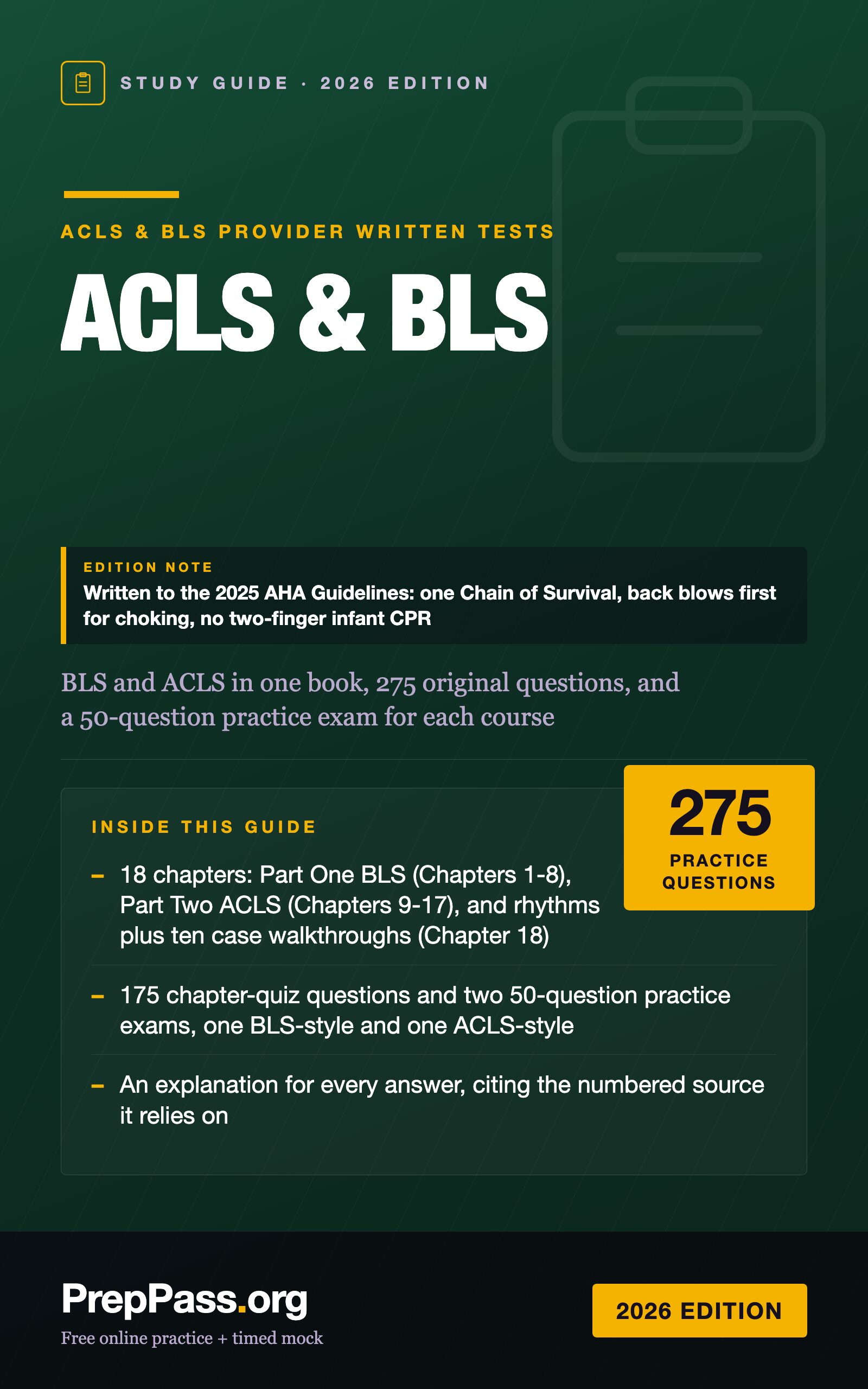
Cover: ACLS & BLS Study Guide — 2026 Edition
Study guide · PDF + EPUB
ACLS & BLS Study Guide — 2026 Edition
251 pages · 275 practice questions inside
$24.99 one-time · yours to keep
  • 275 original ACLS and BLS practice questions, each with a worked explanation, in one PDF + EPUB you keep
03

Before you sit

Know the exam you're walking into.

04

See the questions first

Two from the bank, answered.

Real items, with the answer marked and the reason written out — the same format as all 124.

AED Use

An AED arrives while you are performing CPR on an adult in cardiac arrest. What should you do?

  1. ATurn it on and follow its promptsCorrect
  2. BWait for a physician to authorize it
  3. CFinish 5 more minutes of CPR first
  4. DCheck a pulse for a full minute first

Why: The AED is used as soon as it arrives, with compressions continuing until the pads are on and pausing only for analysis and the shock.

High-Quality CPR (adult/child/infant)

At what rate should chest compressions be delivered to an adult in cardiac arrest?

  1. A60 to 80 compressions per minute
  2. BAt least 140 compressions per minute
  3. C80 to 100 compressions per minute
  4. D100 to 120 compressions per minuteCorrect

Why: Current AHA guidelines specify a compression rate of 100 to 120 per minute for all ages. Slower than 100 does not generate adequate perfusion, while faster than 120 shortens the recoil phase so the heart cannot refill, which paradoxically lowers the blood delivered per compression.

Read all 124 questions with answers →

06

The exam itself

BLS — Basic Life Support, by the numbers.

SectionsHigh-Quality CPR (adult/child/infant) · AED Use · Team Dynamics · Rescue Breathing/Ventilation · Relief of Choking · Chain of Survival
Our bank124 questions · updated August 2026Written from American Heart Association
LanguagesEnglish
SourceAmerican Heart Association

Studying for the ACLS & BLS Provider Written Tests in order? ACLS & BLS Study Guide — 2026 Edition — PDF + EPUB, $24.99 · 14-day refund →

09

Questions

Asked before starting.

Is the practice really free, or does it stop after a few questions?

All 124 questions, the timed mock and the report are free with no sign-up. A free account only adds saving your progress. The study guide book is sold separately, $24.99 one-time; nothing in the practice requires it.

Is there a study guide for the BLS — Basic Life Support?

Yes. PrepPass sells ACLS & BLS Study Guide — 2026 Edition, a PDF + EPUB download, $24.99 one-time; the practice on this page stays free without it. See the study guide →

Practice questions are AI-assisted study material written from American Heart Association and reviewed by PrepPass — for practice only, not official exam questions. Bank updated August 2026. PrepPass is an independent study resource and is not affiliated with, endorsed by, or approved by American Heart Association. Always confirm current exam details with American Heart Association.
Report