Study guide · 2026 Edition
AWS Certified AI Practitioner (AIF-C01) — Complete Study Guide (2026)
PrepPass's independent 2026 study guide for the AWS Certified AI Practitioner exam is 67 pages including 55 practice questions with a full answer key, PDF + EPUB, $14.99 one-time; it is not affiliated with the exam provider.
- Length
- 67 pages
- Practice questions in the book
- 55
- Exam facts last checked
- September 2026
- File last updated
- October 2026
- Delivery
- PDF + EPUB · English · instant download
What is in the AWS Certified AI Practitioner (AIF-C01) study guide?
The real exam: AWS Certified AI Practitioner (AIF-C01) — 65 questions (50 scored, 15 unscored pretest) · 90 minutes · Passing score: Scaled score of 700 on a 100–1,000 scale.
All five official AIF-C01 domains — AI/ML fundamentals, generative AI, foundation models (Amazon Bedrock), responsible AI, and security & governance — with original practice questions. Not affiliated with AWS.
Exam fee: $100 per attempt, paid to AWS. A retake pays it again. This guide: $14.99, one time.
Exam facts, who it suits and what changed
About the exam itself
| Administering body | Amazon Web Services (AWS Certification) — exam delivered by Pearson VUE Source: AWS Certification — AWS Certified AI Practitioner (Exam overview) |
|---|---|
| Questions | 65 questions (50 scored, 15 unscored pretest) Source: AWS — AWS Certified AI Practitioner (AIF-C01) Exam Guide |
| Time limit | 90 minutes Source: AWS Certification — AWS Certified AI Practitioner (Exam overview) |
| Passing score | Scaled score of 700 on a 100–1,000 scale Source: AWS — AWS Certified AI Practitioner (AIF-C01) Exam Guide |
| Fees |
Source: AWS Certification — AWS Certified AI Practitioner (Exam overview) |
| Languages offered | Arabic · English · French (France) · German · Italian · Japanese · Korean · Portuguese (Brazil) · Spanish (Latin America) · Spanish (Spain) · Simplified Chinese · Traditional Chinese Source: AWS Certification — AWS Certified AI Practitioner (Exam overview) |
Look inside the book
Three real pages, rendered straight from the PDF you download — a reference page, a teaching page, and a worked question, always in that order. Nothing here was redrawn to look better.
- Quick referenceChapter 1 — Fundamentals of AI and ML · PDF page 13
A page you can turn back to: the numbers, deadlines or terms gathered in one place.
- How it's taughtChapter 1 — Fundamentals of AI and ML · PDF page 12
An explanation page: the material taught in prose, in the order the exam tests it.
- A question, workedPractice Exam — 55 Questions · PDF page 49
A practice question with its answer and the reasoning behind it — not just a key.
Exam inside two weeks?
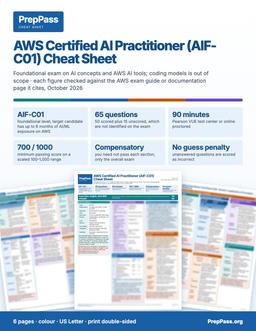
This guide is the teaching, read over weeks. If your exam is inside two weeks, the printable colour cheat sheet is the other product: the figures the exam turns on, laid out by section.
See the AWS Certified AI Practitioner cheat sheet PDF — $9.99 →
6 pages · US Letter · printable PDF · yours to keep
What's included — and what isn't
Included
- All 5 official AIF-C01 domains at their real exam weights
- Generative AI: foundation models, tokens, embeddings, prompting, RAG, fine-tuning
Not included
- No printed copy is shipped — this is a file you download and can print yourself
- No video course, instructor or tutoring comes with the book — the free videos on the site are separate
Everything included, and everything that isn't
Included
- Amazon Bedrock, SageMaker AI, Amazon Q, and the AWS AI service catalog
- Responsible AI + security/governance (Guardrails, Clarify, IAM, Macie)
- 55 original practice questions with answer explanations
- PDF (print & tab it) + EPUB (phone / e-reader)
Not included
- Not your exam registration or the testing centre's fee, which you still pay to the official body
Contents
See 7 sections and the page each one starts on
- Chapter 1 — Fundamentals of AI and MLp. 8
- Chapter 2 — Fundamentals of Generative AIp. 15
- Chapter 3 — Applications of Foundation Modelsp. 22
- Chapter 4 — Guidelines for Responsible AIp. 30
- Chapter 5 — Security, Compliance, and Governance for AI Solutionsp. 36
- Practice Exam — 55 Questionsp. 41
- Answer Key with Explanationsp. 60
Taken from the PDF you download, with the page each one starts on — not typed here.
Read a chapter free, in full
One complete chapter, exactly as it ships in the eBook. Scroll the window to read it right here; no download, no email.
Read chapter 1 here, without leaving the page
This domain builds the vocabulary the rest of the exam depends on. Before you can reason about generative AI, foundation models, or responsible AI, you need to know what "AI," "machine learning," and "deep learning" actually mean, how they nest inside one another, how a model is trained and then used, and where the core AWS machine-learning services fit. None of it is hard, but the exam is precise, and a single loose definition is enough to turn an easy question into a wrong answer. Master this chapter and you will move faster through every chapter that follows, because the same terms reappear constantly.
1.1 AI, Machine Learning, and Deep Learning
Start with the three-ring nesting, because the exam tests it directly and uses it as a trap in later questions.
Artificial intelligence (AI) is the broadest idea: the goal of getting computers to perform tasks that normally require human intelligence — understanding language, recognizing images, making decisions, solving problems. AI is the outer ring. It is a field and an aspiration, not a single technique. A hand-written rule-based "expert system" that plays chess is AI even though it contains no learning at all.
Machine learning (ML) is a subset of AI. In machine learning, a system is not explicitly programmed with the rules for a task; instead it learns the patterns directly from data. You show it many examples, and it infers a model that maps inputs to outputs. This is the middle ring. The defining shift is from "a human writes the rules" to "the system derives the rules from examples."
Deep learning is a further subset of ML — the inner ring. Deep learning uses multi-layer neural networks, loosely inspired by the interconnected neurons of the brain, to model very complex patterns. "Deep" refers to the many layers stacked between input and output. Deep learning is what powers modern image recognition, speech, and the large language models behind generative AI. Every deep-learning system is machine learning, and every machine-learning system is AI — but not the reverse.
Memory hook: Deep learning ⊂ Machine learning ⊂ Artificial intelligence. Three nested rings, smallest inside largest. The classic wrong answer flips the order (claims deep learning is the umbrella that "contains" AI). If you can draw the three rings, you will get this family of questions right every time.
1.2 The Main Types of Machine Learning
Machine learning is usually divided into three paradigms, and the exam constantly asks you to match a described business scenario to the correct one. Learn the one-line trigger for each.
Supervised learning trains on labeled data: every training example is a pair of an input and its known, correct output (the label). The model learns the mapping so it can predict the label for new, unlabeled inputs. The trigger word is labeled. Supervised learning splits into two sub-types by the kind of output:
- Classification predicts a discrete category — spam vs. not spam, fraud vs. legitimate, which of ten animal species is in a photo. The output is a class.
- Regression predicts a continuous number — a house price, tomorrow's temperature, an expected sales figure. The output is a quantity on a scale.
Telling classification from regression is a favorite exam distinction: if the answer is a category, it is classification; if the answer is a number on a continuum, it is regression.
Unsupervised learning works on unlabeled data to find hidden structure that no one specified in advance. The signature task is clustering — grouping similar records together, such as segmenting customers into natural groups when you do not know the groups ahead of time. The trigger is no labels / discover groups. Because nobody told the model what the "right" groups are, unsupervised learning is used for discovery, segmentation, and anomaly detection rather than prediction of a known target.
Reinforcement learning (RL) trains an agent to take actions in an environment so as to maximize a reward signal over time. There are no labeled input-output pairs; instead the agent tries actions, receives rewards or penalties, and learns a policy that earns the most reward. The triggers are agent, action, reward. Think of a system learning to play a game, control a robot, or optimize a process through trial and feedback.
A fourth term worth recognizing is transfer learning — reusing a model trained on one task as the starting point for a related task, which is conceptually how foundation models get adapted. It is a legitimate concept but a common distractor when the real answer is plain supervised learning.
1.3 The ML Lifecycle: Training, Evaluation, and Inference
A machine-learning model has two big phases in its life, and the exam wants you to keep them straight.
Training is where the model is built. You feed it training data, and the model adjusts its internal parameters (called weights) to reduce the error between its predictions and the known answers. Training is compute-intensive and happens before deployment. Adjusting weights is the essence of training — remember that phrase, because "adjusting the model's internal weights" is the tell for training on the exam.
Evaluation measures how good the trained model is. The crucial practice is to hold out a separate test set — data the model did not see during training — and measure performance on it. Why? Because a model can look great on data it has already memorized while being useless on anything new. Evaluating on unseen data estimates real-world performance and exposes overfitting.
Two failure modes anchor a whole family of questions:
- Overfitting — the model learns the training data too well, memorizing its noise and quirks, and then performs poorly on new data. The classic symptom is a large gap: near-perfect on training data, much worse on the test set. The model is "too complex" or "over-trained" for the signal that is really there.
- Underfitting — the opposite. The model is too simple to capture the underlying pattern and performs poorly even on the training data. Neither training nor test accuracy is good.
Inference is the payoff phase: taking a finished, trained model and using it to generate predictions on brand-new inputs in production. No weights change during inference; the model is fixed and simply produces outputs. Every time a deployed spam filter classifies a new email, that is inference. Keep the pair straight: training adjusts weights; inference uses the fixed model to predict.
1.4 Features, Labels, and Why Data Quality Rules Everything
Two more terms complete the core vocabulary.
A feature is an input variable the model reads — a column of data such as a customer's age, a house's square footage, or the words in an email. Features are what the model looks at.
A label is the target value the model learns to predict — the "right answer" attached to each training example. In a spam model, the words are features and "spam / not spam" is the label. In a house-price model, square footage and location are features and the sale price is the label. In supervised learning, every training example pairs features with a known label; unsupervised learning has features but no labels.
The single most important practical truth in this chapter: the quality, quantity, and representativeness of the data largely determine how good a model can be. This is why data preparation — collecting, cleaning, labeling, and balancing data — typically consumes the majority of a real ML project's effort. And it sets up a theme that dominates Chapters 4 and 5: poor or biased data produces poor or biased models. "Garbage in, garbage out" is not a slogan on this exam; it is the correct answer to a surprising number of questions about why a model failed or behaved unfairly.
1.5 When to Use AI/ML — and Where AWS Fits
Not every problem needs machine learning, and the exam rewards the judgment to know the difference.
Use ML when the patterns are complex, changing, or hard to write down as explicit rules, and when you have enough representative data to learn from. Recognizing thousands of objects across millions of images, detecting subtle fraud patterns that shift over time, understanding natural language — these resist hand-written rules and are ideal for ML.
Prefer a traditional rule-based system when the logic is well understood, stable, and can be written as clear deterministic rules. A rule-based approach is simpler, cheaper, more transparent, and easier to audit. Calculating sales tax or enforcing a fixed business policy does not need a neural network. The exam likes to offer ML as the "sophisticated" answer to a problem that is really just a set of known rules — resist it.
Where AWS fits is the other half of this domain, and it maps cleanly onto the "build vs. buy" choice:
- Amazon SageMaker AI is the managed platform for the end-to-end ML lifecycle — preparing data, building, training, tuning, and deploying your own custom models at scale. Reach for SageMaker AI when you need to build a model, not just call one. (SageMaker AI is covered in depth in Chapters 3 and 4.)
- Pre-built AI services — Amazon Rekognition (images and video), Amazon Comprehend (text analysis), Amazon Textract (document extraction), and their siblings — provide ready-made AI capabilities through a simple API, so a team can add intelligence without training any model at all. Reach for these when a common capability already exists as a service. (These are covered in Chapter 3.)
That build-versus-buy axis — custom model on SageMaker AI versus a managed AI service you simply call — is one of the most heavily tested ideas on the entire exam, so fix it now: if the scenario needs a common, general capability with no training, pick the managed service; if it needs a bespoke model trained on your own data, pick SageMaker AI.
Key Facts — Chapter 1 (memorize cold)
- Nesting: Deep Learning ⊂ Machine Learning ⊂ Artificial Intelligence (smallest inside largest).
- Supervised = labeled data. Classification → discrete category; Regression → continuous number.
- Unsupervised = unlabeled data; clustering groups similar records (customer segmentation).
- Reinforcement learning = agent + actions + reward, maximized over time.
- Feature = input variable; label = target being predicted.
- Training adjusts the model's weights; inference uses the fixed, trained model to predict on new data.
- Overfitting = great on training, poor on new data (memorized noise). Underfitting = too simple, poor even on training data.
- Split into train/test; evaluate on the held-out test set to estimate real-world performance.
- Data quality, quantity, and representativeness cap how good a model can be. Bad data → bad/biased model.
- Rule-based beats ML when logic is known, stable, and writable as clear rules.
- Amazon SageMaker AI = build/train/deploy custom models. Pre-built AI services (Rekognition, Comprehend, Textract…) = ready capability via API, no training.
Worked Scenario — Choosing the Paradigm
A logistics company has three projects. (a) It has two years of delivery records labeled "late" or "on-time" and wants to predict whether a new shipment will be late. (b) It wants to group its 50,000 customers into natural segments for marketing, with no predefined groups. (c) It wants a system that learns, through trial and reward, the best sequence of warehouse-robot moves to minimize travel time. Which ML paradigm fits each?
Work it by the trigger words. Project (a) has labeled examples and predicts a category (late / on-time) — that is supervised classification. Project (b) has no labels and wants to discover groups — that is unsupervised learning, specifically clustering. Project (c) has an agent taking actions to maximize a reward over time — that is reinforcement learning. Notice that all three are "learning," but the data (labeled? unlabeled? reward-driven?) decides the paradigm. That is exactly how the exam frames these questions: read for whether labels exist and what the output is.
Exam Traps — Chapter 1
- Flipping the nesting. Any answer that says deep learning "contains" ML or AI is wrong. AI is the biggest ring.
- Classification vs. regression by output type. If the target is a number on a continuum → regression. If it is a category → classification. "Predict the price" is regression; "predict which class" is classification.
- Calling clustering "supervised." Clustering is unsupervised — there are no labels. If the scenario says "no predefined categories/groups," it is unsupervised.
- Training vs. inference. "Adjusting weights to reduce error" = training. "Using the trained model on new inputs" = inference. Do not swap them.
- Overfitting vs. underfitting. Great-on-training-but-bad-on-new = overfitting. Bad-on-everything (too simple) = underfitting. "Convergence" and "regularization" are distractors, not names for this gap.
- Reaching for ML when rules suffice. If experts can write the logic down and it is stable, the rule-based system is the better, cheaper, more transparent answer.
- Confusing SageMaker AI with a pre-built service. SageMaker AI is a platform to build your own model; Rekognition/Comprehend/Textract are finished capabilities you call. CloudWatch and Route 53 are not ML services at all — pure distractors.
Questions buyers ask
How do I get it?
Pay, and the download appears on this page straight away. The links are also emailed to you. No account is required.
What if it isn't for me?
Email us within 14 days for a full refund, no questions asked.
Is the free practice going away?
No. Every practice question, the timed mock and the free chapters on this site stay free. This book is the studying half, not a gate around the free half.
More questions (15)
Can I read it on my phone?
Yes — the EPUB is for phones and e-readers, the PDF is for printing and tabbing. You get both.
Is a study guide enough for the AWS Certified AI Practitioner (AIF-C01) exam, or do I need a course?
A book is exam review: it does not replace any education, training or experience Amazon Web Services (AWS Certification) requires before you may sit the exam, so check those requirements first. For the exam content itself, this 67-page guide teaches the material chapter by chapter with 55 practice questions and explanations inside, and 150 more practice questions are free on PrepPass. A prep course adds live instruction and a set schedule; whether you need one beyond any required education is your call.
What is the cheapest way to prepare for the AWS Certified AI Practitioner (AIF-C01) exam?
Start with what costs nothing: 150 practice questions on PrepPass, with explanations and no signup. If you want it taught in one file you keep, the full study guide is $14.99 once; the printable cheat sheet for the last days is $9.99. No subscription on any of them.
Who administers the AWS Certified AI Practitioner (AIF-C01)?
Amazon Web Services (AWS Certification) — exam delivered by Pearson VUE. Taken at a Pearson VUE testing center or as an online proctored exam. Content Domain 1: Fundamentals of AI and ML 20%; Domain 2: Fundamentals of GenAI 24%; Domain 3: Applications of Foundation Models 28%; Domain 4: Guidelines for Responsible AI 14%; Domain 5: Security, Compliance, and Governance for AI Solutions 14% (of scored content).
How many questions are on the AWS Certified AI Practitioner (AIF-C01)?
65 questions (50 scored, 15 unscored pretest). Question types: multiple choice, multiple response, ordering and matching. The 15 unscored questions are not identified on the exam, and unanswered questions count as incorrect.
How long is the AWS Certified AI Practitioner (AIF-C01)?
90 minutes
What is the passing score for the AWS Certified AI Practitioner (AIF-C01)?
Scaled score of 700 on a 100–1,000 scale. AWS uses a compensatory scoring model: you need to pass the exam as a whole, not each section.
How much does the AWS Certified AI Practitioner (AIF-C01) cost?
$100 — Exam fee (AWS, per attempt). AWS points to its Exam pricing page for foreign-exchange rates and other costs.
What languages is the AWS Certified AI Practitioner (AIF-C01) offered in?
Arabic · English · French (France) · German · Italian · Japanese · Korean · Portuguese (Brazil) · Spanish (Latin America) · Spanish (Spain) · Simplified Chinese · Traditional Chinese. AWS says the Italian and German versions of this exam will be retired after October 15, 2026.
Does the AWS Certified AI Practitioner (AIF-C01) study guide come as a PDF?
Yes — AWS Certified AI Practitioner (AIF-C01) — Complete Study Guide (2026) downloads as PDF and EPUB, 67 pages. The download link is emailed the moment payment clears and does not expire.
How much does the AWS Certified AI Practitioner (AIF-C01) study guide cost?
$14.99, once. There is no subscription and no account to create; the PDF and EPUB files are yours to keep.
Are there free AWS Certified AI Practitioner (AIF-C01) practice questions?
Yes — 150 of them, free to use with no signup and an explanation on every one. They are separate from this study guide, which is what you are buying here. The same free, no-account system also has practice modes (adaptive, new questions, spaced review of misses, weak-topic focus, saved, my mistakes); a timed mock exam (50 questions, 90 minutes) with a score report by topic; a 10-question readiness check (about 5 minutes); 5 study chapters. None of it needs this study guide.
Can I read part of the AWS Certified AI Practitioner (AIF-C01) study guide before buying?
Yes. A full chapter is free to read on this page — not a summary of one, the chapter itself.
What is the difference between the AWS Certified AI Practitioner (AIF-C01) study guide and the cheat sheet?
The study guide ($14.99) teaches the material chapter by chapter and is meant to be read over weeks. The cheat sheet ($9.99, 6 pages) drops the teaching and keeps the figures: every number on the exam grouped by value so the confusable ones sit together, each reference page paired with a recall page that blanks the answers, and four routes by days left — 14, 7, 3, or tonight. They are separate purchases; neither replaces the other.
Is this the official AWS Certified AI Practitioner (AIF-C01) study guide?
No. This is an independent study guide and is not affiliated with or endorsed by the exam's awarding body. It is written from official AWS AIF-C01 exam guide / current AWS documentation. Always confirm current requirements with the body that issues your licence.
Why buy the book when the practice is free?
Our practice questions and timed mock stay free — nothing on the site moves behind this book. The $14.99 book is the studying half: the material itself, taught in order, in a file you own.
- Systematic teaching — every exam section explained chapter by chapter, start to finish, not just questions
- Print it & tab it — a paper-ready PDF you can highlight, mark up, and bring to your study table
- Study anywhere, offline — EPUB on your phone or e-reader; no wifi, no browser tabs
- Everything in one place — the chapters and the practice questions in one file
- Yours for life — one-time $14.99, instant download, no subscription
The details
- Verified from the official source(official AWS AIF-C01 exam guide / current AWS documentation)
- 150 free practice questions
An AWS certification course runs $100–$800. This book teaches the same exam — same rules, verified to current standards — for a one-time $14.99 you keep for life.
Also free on PrepPass for AWS Certified AI Practitioner (AIF-C01)
Beside this guide, PrepPass has a free study system for the same exam. It needs no account, and buying the guide does not unlock or change it: 150 practice questions with explanations; practice modes (adaptive, new questions, spaced review of misses, weak-topic focus, saved, my mistakes); a timed mock exam (50 questions, 90 minutes) with a score report by topic; a 10-question readiness check (about 5 minutes); 5 study chapters.
Progress is saved in your browser; a free account keeps it across devices. The readiness gauge reflects your own practice, not a prediction of the real exam result. How the practice works
One-time purchase, lifetime access to the download. The eBook is the full AWS Certified AI Practitioner (AIF-C01) study guide in PDF and EPUB. Educational summary, not professional or legal advice — always confirm the current rules with the official source. Last updated: October 2026.