Study guide · 2026 Edition
AWS Certified Cloud Practitioner (CLF-C02) — Complete Study Guide (2026)
PrepPass's independent 2026 study guide for the AWS Certified Cloud Practitioner exam is 80 pages including 20 practice questions with a full answer key, PDF + EPUB, $14.99 one-time; it is not affiliated with the exam provider. The book does not include PrepPass's separate online timed mock for this exam (65 questions, 90 minutes).
- Length
- 80 pages
- Practice questions in the book
- 20
- PrepPass online timed mock
- 65 questions · 90 min
- Exam facts last checked
- September 2026
- File last updated
- October 2026
- Delivery
- PDF + EPUB · English · instant download
What is in the AWS Certified Cloud Practitioner (CLF-C02) study guide?
Exam facts last checked September 2026 against the exam body's published sources.
The real exam: AWS Certified Cloud Practitioner (CLF-C02) — 65 questions (50 scored, 15 unscored pretest) · 90 minutes · Passing score: Scaled score of 700 on a 100–1,000 scale.
The whole CLF-C02 blueprint — cloud concepts & the Well-Architected Framework, security & the shared responsibility model, core AWS services, and billing & pricing — taught plainly, with a service cheat-sheet so you can name each service by its one job.
Exam fee: $100 per attempt, paid to AWS. A retake pays it again. This guide: $14.99, one time.
Exam facts, who it suits and what changed
To prepare for the AWS Certified Cloud Practitioner (CLF-C02) exam, cover every topic on the exam body's current content outline and practise with timed questions. The exam itself (AWS Certified Cloud Practitioner (CLF-C02)): 65 questions (50 scored, 15 unscored pretest), 90 minutes, scaled score of 700 on a 100–1,000 scale to pass.
About the exam itself
| Administering body | Amazon Web Services (AWS Certification) — exam delivered by Pearson VUE Source: AWS Certification — AWS Certified Cloud Practitioner (Exam overview) |
|---|---|
| Questions | 65 questions (50 scored, 15 unscored pretest) Source: AWS — AWS Certified Cloud Practitioner (CLF-C02) Exam Guide |
| Time limit | 90 minutes Source: AWS Certification — AWS Certified Cloud Practitioner (Exam overview) |
| Passing score | Scaled score of 700 on a 100–1,000 scale Source: AWS — AWS Certified Cloud Practitioner (CLF-C02) Exam Guide |
| Fees |
Source: AWS Certification — AWS Certified Cloud Practitioner (Exam overview) |
| Languages offered | Arabic · English · French (France) · German · Italian · Japanese · Korean · Portuguese (Brazil) · Spanish (Latin America) · Spanish (Spain) · Simplified Chinese · Traditional Chinese Source: AWS Certification — AWS Certified Cloud Practitioner (Exam overview) |
Look inside the book
Three real pages, rendered straight from the PDF you download — a reference page, a teaching page, and a worked question, always in that order. Nothing here was redrawn to look better.
- Quick referenceGlossary of AWS terms (~30) · PDF page 77
A page you can turn back to: the numbers, deadlines or terms gathered in one place.
- How it's taughtCHAPTER 2 — SECURITY AND COMPLIANCE · PDF page 25
An explanation page: the material taught in prose, in the order the exam tests it.
- A question, workedCHAPTER 2 — SECURITY AND COMPLIANCE · PDF page 38
A practice question with its answer and the reasoning behind it — not just a key.
Exam inside two weeks?
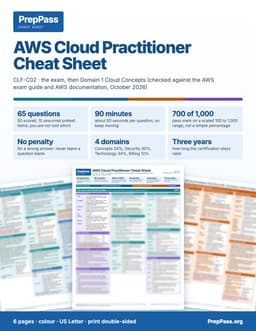
This guide is the teaching, read over weeks. If your exam is inside two weeks, the printable colour cheat sheet is the other product: the figures the exam turns on, laid out by section.
See the AWS Certified Cloud Practitioner cheat sheet PDF — $9.99 →
6 pages · US Letter · printable PDF · yours to keep
What's included — and what isn't
Included
- All 4 domains at real weight, version-locked to CLF-C02
- The shared responsibility model made concrete (who secures what)
Not included
- No printed copy is shipped — this is a file you download and can print yourself
- No video course, instructor or tutoring comes with the book — the free videos on the site are separate
Everything included, and everything that isn't
Included
- A 40+ service cheat-sheet — each service by its single job
- Well-Architected's six pillars + the Cloud Adoption Framework
- 20 practice questions printed in the book, with explanations (400+ more free on the site)
- A ~30-term glossary + a 7-day study plan — PDF + EPUB
Not included
- Not your exam registration or the testing centre's fee, which you still pay to the official body
Contents
See 5 sections and the page each one starts on
- CHAPTER 1 — CLOUD CONCEPTSp. 8
- CHAPTER 2 — SECURITY AND COMPLIANCEp. 23
- CHAPTER 3 — CLOUD TECHNOLOGY AND SERVICESp. 39
- CHAPTER 4 — BILLING, PRICING, AND SUPPORTp. 60
- Glossary of AWS terms (~30)p. 77
Taken from the PDF you download, with the page each one starts on — not typed here.
Read a chapter free, in full
One complete chapter, exactly as it ships in the eBook. Scroll the window to read it right here; no download, no email.
Read chapter 3 here, without leaving the page
We didn't give you the easy intro — the free chapter opens on one of the hardest-working parts of the book, so you can judge the teaching where the exam gets difficult.
This is the biggest domain, and it is mostly recognition: given a need described in a sentence, name the AWS service (or infrastructure concept) that meets it. You will not be asked to configure anything, but you must know, on sight, that a fully managed NoSQL database is DynamoDB, that object storage is S3, that a virtual server is EC2, and that a content delivery network is CloudFront. This chapter is organized the way AWS organizes its services — global infrastructure, ways to interact, then compute, storage, databases, networking, and the integration/management tools that tie them together. Learn each service by the one job it is famous for.
Teach the concept: AWS global infrastructure
AWS runs on a global infrastructure with three layers you must understand to reason about availability and latency.
Regions. A Region is a separate geographic area (for example, N. Virginia, Ireland, Tokyo, São Paulo). Each Region is fully isolated from the others, which supports fault tolerance and data residency. You choose a Region based on four factors the exam tests directly:
- Compliance / data governance — laws may require data to stay in a particular country.
- Proximity to users (latency) — closer Regions mean faster response.
- Service and feature availability — not every service is in every Region.
- Pricing — costs differ from Region to Region.
Availability Zones (AZs). Within each Region are multiple Availability Zones, each one or more discrete data centers with independent power, cooling, and networking. AZs are physically separated (miles apart) but linked by high-speed, low-latency connections. Deploying across at least two AZs is the standard way to build high availability: if one AZ fails, an application spread across several keeps running. A Region always has multiple AZs — this multi-AZ design is what makes AWS resilient.
Edge locations. Separate from Regions and AZs, AWS operates a large global network of edge locations — sites used by content delivery (Amazon CloudFront) and DNS (Amazon Route 53) to cache content and answer requests close to users, reducing latency. There are many more edge locations than Regions.
Two extras worth recognizing:
- AWS Local Zones place compute and storage close to a specific metro area for very low latency there.
- AWS Outposts bring AWS infrastructure and services into the customer's own on-premises data center for hybrid, low-latency, or data-residency needs.
Concrete examples
- "A German company must keep customer data inside Germany." Choose a Region located in Germany (compliance/data-governance driver).
- "How do we survive the loss of a single data center?" Deploy across multiple Availability Zones in the Region (high availability).
- "Users worldwide complain that a website loads slowly." Serve content from edge locations via CloudFront to cut latency.
Teach the concept: ways to interact with AWS
There are three primary ways to reach AWS services, plus infrastructure-as-code on top.
- AWS Management Console — a web-based graphical interface; best for learning, exploration, and one-off tasks.
- AWS Command Line Interface (CLI) — control services with typed commands and scripts; ideal for automation and repeatable operations from a terminal.
- AWS SDKs (Software Development Kits) — call AWS services programmatically from application code in languages such as Python, Java, JavaScript, .NET, and Go.
For repeatable provisioning, infrastructure as code (IaC) tools such as AWS CloudFormation define resources in templates so an entire environment can be created, updated, and torn down consistently — no clicking required.
Teach the concept: compute services
Compute is where your code and applications actually run. Learn the four main options and when each fits.
Amazon EC2 (Elastic Compute Cloud) — resizable virtual servers (instances) where you control the operating system, installed software, and configuration. It is the flexible, general-purpose choice and the classic IaaS example. Because you manage the instance, you patch the OS and scale capacity. EC2 offers instance families tuned for different workloads:
- General purpose — balanced CPU/memory (web servers, small databases).
- Compute optimized — high CPU (batch processing, gaming servers).
- Memory optimized — lots of RAM (in-memory databases, analytics).
- Storage optimized — high, fast local disk (data warehouses, big data).
- Accelerated computing — GPUs/specialized hardware (machine learning, graphics).
To make EC2 elastic and resilient:
- Amazon EC2 Auto Scaling adds and removes instances automatically to match demand.
- Elastic Load Balancing (ELB) distributes incoming traffic across healthy instances so none is overwhelmed and failures are bypassed. (Types include Application Load Balancer for HTTP/HTTPS, Network Load Balancer for high-performance TCP/UDP, and Gateway Load Balancer.)
AWS Lambda — serverless compute: you upload a function, and Lambda runs it in response to events, automatically scaling and charging only for the compute time consumed (measured in milliseconds), with no charge when the code is not running and no servers to manage. Ideal for short, event-driven tasks (process a file uploaded to S3, respond to an API call). Lambda is the exam's favorite illustration of both serverless and pay only for what you use.
Containers — package an application with its dependencies so it runs consistently anywhere.
- Amazon ECS (Elastic Container Service) — AWS's own container orchestration.
- Amazon EKS (Elastic Kubernetes Service) — managed Kubernetes.
- AWS Fargate — serverless compute for containers, so you run containers without managing the underlying EC2 hosts.
- Amazon ECR (Elastic Container Registry) — stores container images.
AWS Elastic Beanstalk — a PaaS that deploys and manages web applications for you: you upload code and Beanstalk handles capacity provisioning, load balancing, scaling, and health monitoring, while you keep control of the underlying resources. Great when you want to run an app without managing the platform yourself.
Other compute worth recognizing: AWS Batch (large-scale batch jobs), Amazon Lightsail (simple virtual private servers with predictable pricing for small apps and websites).
Concrete examples
- "We need full control of the OS to run a legacy application." → Amazon EC2.
- "Run a small piece of code whenever a file lands in S3, and pay nothing when idle." → AWS Lambda.
- "Run Docker containers but not manage any servers." → AWS Fargate.
- "Just upload our web app and let AWS handle deployment, scaling, and load balancing." → AWS Elastic Beanstalk.
Key-service callout — Compute - EC2 = virtual servers, you control the OS (IaaS). Auto Scaling = elastic instance count. ELB = distribute traffic across healthy targets. - Lambda = serverless functions, event-driven, pay per millisecond, no servers. - ECS/EKS = container orchestration; Fargate = serverless containers; ECR = image registry. - Elastic Beanstalk = PaaS, deploy an app without managing the platform. Lightsail = simple, low-cost VPS.
Teach the concept: storage services
AWS storage comes in three shapes — object, block, and file — plus archival. Matching the shape to the need is the core skill.
Amazon S3 (Simple Storage Service) — object storage: data is stored as objects in buckets, accessed over the internet via a URL/API, with essentially unlimited capacity and eleven 9s (99.999999999%) of durability. S3 is ideal for backups, static website hosting, data lakes, media, logs — any large collection of files. It is not a drive you mount to a server; it is accessed over HTTP. S3 offers storage classes to balance cost against access frequency:
- S3 Standard — frequent access; highest storage cost, lowest access cost.
- S3 Intelligent-Tiering — automatically moves objects between tiers based on usage; good when access patterns are unknown.
- S3 Standard-Infrequent Access (Standard-IA) and One Zone-IA — cheaper storage for less-frequently-accessed data (One Zone-IA keeps a single AZ copy).
- S3 Glacier Instant Retrieval / Flexible Retrieval / Deep Archive — very low-cost archival; retrieval ranges from instant to hours (Deep Archive is cheapest, slowest).
Lifecycle policies transition objects to cheaper classes automatically as they age.
Amazon EBS (Elastic Block Store) — block storage volumes that attach to a single EC2 instance, behaving like a virtual hard disk. Used for operating systems, databases, and any workload needing persistent, low-latency block storage. An EBS volume lives in one Availability Zone; you back it up with snapshots stored in S3. Volume types include SSD-backed (gp3, io2) and HDD-backed for throughput.
Amazon EFS (Elastic File System) — a shared file system that many Linux EC2 instances can mount at the same time, scaling elastically as files are added and removed. Suits shared content and workloads needing a common file store across instances. (For Windows or high-performance computing, Amazon FSx provides managed file systems, including FSx for Windows File Server and FSx for Lustre.)
Moving data into AWS:
- AWS Snow Family (e.g., Snowball) — physical devices shipped to you for offline transfer of large data volumes when networks are too slow.
- AWS Storage Gateway — connects on-premises applications to AWS storage.
- AWS DataSync — automates online data transfer to AWS.
The one-line contrast to memorize: S3 = object storage over the internet; EBS = block storage for one instance; EFS = shared file storage for many instances; Glacier = cheap archival.
Concrete examples
- "Store millions of images for a website, accessed over the web, with near-infinite scale." → Amazon S3.
- "A persistent disk for the operating system and database of a single EC2 instance." → Amazon EBS.
- "A shared file system mounted by twenty Linux instances at once." → Amazon EFS.
- "Archive compliance records for seven years at the lowest possible cost; retrieval in hours is fine." → S3 Glacier Deep Archive.
- "Move 80 TB to AWS but the internet link would take months." → AWS Snowball.
Key-service callout — Storage - S3 = object storage, buckets, over the internet, 11 nines durability; classes from Standard to Glacier Deep Archive; Intelligent-Tiering auto-moves data. - EBS = block storage, one EC2 instance, single AZ, snapshots to S3. - EFS = shared file storage, many Linux instances. FSx = managed Windows/Lustre file systems. - Snow Family = offline bulk transfer devices. Storage Gateway / DataSync = on-prem-to-cloud transfer.
Teach the concept: database services
AWS offers managed databases so you avoid installing, patching, backing up, and scaling engines yourself. Match each to its data model.
Amazon RDS (Relational Database Service) — managed relational databases supporting engines MySQL, PostgreSQL, MariaDB, Oracle, SQL Server, and Amazon Aurora. AWS handles provisioning, patching, backups, and failover. Multi-AZ deployments keep a standby replica in another AZ for high availability; read replicas offload read traffic. Use RDS for structured data with schemas and transactions — orders, accounting, inventory.
Amazon Aurora — a MySQL- and PostgreSQL-compatible relational database built for the cloud, offering higher performance and durability than the standard engines, storing six copies of data across three AZs. Aurora Serverless scales capacity automatically.
Amazon DynamoDB — a fully managed, serverless NoSQL key-value and document database delivering single-digit-millisecond performance at any scale, with no servers to manage and automatic scaling. Ideal for high-traffic web/mobile apps, gaming, IoT, and workloads with flexible or rapidly changing data. When a question says "fully managed NoSQL database that scales to any size," the answer is almost always DynamoDB.
Amazon ElastiCache — managed in-memory caching (Redis or Memcached) that accelerates read-heavy applications by keeping frequently accessed data in memory, reducing load on the primary database.
Amazon Redshift — a managed data warehouse optimized for analytics (OLAP) — complex queries over very large datasets for business intelligence and reporting, not day-to-day transactions.
Purpose-built databases to recognize:
- Amazon Neptune — graph database (relationships, social networks, fraud graphs).
- Amazon DocumentDB — document database (MongoDB-compatible).
- Amazon Keyspaces — Apache Cassandra-compatible.
- Amazon MemoryDB — durable in-memory database.
- Amazon Timestream — time-series data (IoT/metrics).
Migrating databases: AWS Database Migration Service (DMS) moves databases into AWS with minimal downtime; the Schema Conversion Tool helps convert between engines.
Concrete examples
- "A managed PostgreSQL database with automatic backups and a standby in another AZ." → Amazon RDS (Multi-AZ).
- "A serverless NoSQL store for a mobile game with millions of players and millisecond reads." → Amazon DynamoDB.
- "Speed up a read-heavy site by caching results in memory." → Amazon ElastiCache.
- "Run complex analytical reports over billions of rows." → Amazon Redshift.
Key-service callout — Databases - RDS = managed relational (MySQL, PostgreSQL, etc.); Multi-AZ = HA standby; read replicas = scale reads. - Aurora = cloud-built relational, MySQL/PostgreSQL-compatible, high performance. - DynamoDB = fully managed NoSQL, serverless, any scale, single-digit-ms. - ElastiCache = in-memory caching (Redis/Memcached). Redshift = data warehouse (analytics). - DMS = database migration with minimal downtime.
Questions buyers ask
How do I get it?
Pay, and the download appears on this page straight away. The links are also emailed to you. No account is required.
What if it isn't for me?
Email us within 14 days for a full refund, no questions asked.
Is the free practice going away?
No. Every practice question, the timed mock and the free chapters on this site stay free. This book is the studying half, not a gate around the free half.
More questions (15)
Can I read it on my phone?
Yes — the EPUB is for phones and e-readers, the PDF is for printing and tabbing. You get both.
Is a study guide enough for the AWS Certified Cloud Practitioner (CLF-C02) exam, or do I need a course?
A book is exam review: it does not replace any education, training or experience Amazon Web Services (AWS Certification) requires before you may sit the exam, so check those requirements first. For the exam content itself, this 80-page guide teaches the material chapter by chapter with 20 practice questions and explanations inside, and 420 more practice questions are free on PrepPass. A prep course adds live instruction and a set schedule; whether you need one beyond any required education is your call.
What is the cheapest way to prepare for the AWS Certified Cloud Practitioner (CLF-C02) exam?
Start with what costs nothing: 420 practice questions on PrepPass, with explanations and no signup. If you want it taught in one file you keep, the full study guide is $14.99 once; the printable cheat sheet for the last days is $9.99. No subscription on any of them.
Who administers the AWS Certified Cloud Practitioner (CLF-C02)?
Amazon Web Services (AWS Certification) — exam delivered by Pearson VUE. Taken at a Pearson VUE testing center or as an online proctored exam. Content Domain 1: Cloud Concepts 24%; Domain 2: Security and Compliance 30%; Domain 3: Cloud Technology and Services 34%; Domain 4: Billing, Pricing, and Support 12% (of scored content).
How many questions are on the AWS Certified Cloud Practitioner (CLF-C02)?
65 questions (50 scored, 15 unscored pretest). Multiple choice or multiple response. The 15 unscored questions are not identified on the exam, and unanswered questions count as incorrect.
How long is the AWS Certified Cloud Practitioner (CLF-C02)?
90 minutes
What is the passing score for the AWS Certified Cloud Practitioner (CLF-C02)?
Scaled score of 700 on a 100–1,000 scale. AWS uses a compensatory scoring model: you need to pass the exam as a whole, not each section.
How much does the AWS Certified Cloud Practitioner (CLF-C02) cost?
$100 — Exam fee (AWS, per attempt). AWS points to its Exam pricing page for foreign-exchange rates and other costs.
What languages is the AWS Certified Cloud Practitioner (CLF-C02) offered in?
Arabic · English · French (France) · German · Italian · Japanese · Korean · Portuguese (Brazil) · Spanish (Latin America) · Spanish (Spain) · Simplified Chinese · Traditional Chinese. AWS says the Italian and German versions of this exam will be retired after December 31, 2026.
Does the AWS Certified Cloud Practitioner (CLF-C02) study guide come as a PDF?
Yes — AWS Certified Cloud Practitioner (CLF-C02) — Complete Study Guide (2026) downloads as PDF and EPUB, 80 pages. The download link is emailed the moment payment clears and does not expire.
How much does the AWS Certified Cloud Practitioner (CLF-C02) study guide cost?
$14.99, once. There is no subscription and no account to create; the PDF and EPUB files are yours to keep.
Are there free AWS Certified Cloud Practitioner (CLF-C02) practice questions?
Yes — 420 of them, free to use with no signup and an explanation on every one. They are separate from this study guide, which is what you are buying here. The same free, no-account system also has practice modes (adaptive, new questions, spaced review of misses, weak-topic focus, saved, my mistakes); a timed mock exam (65 questions, 90 minutes) with a score report by topic; a 10-question readiness check (about 5 minutes); 4 study chapters. None of it needs this study guide.
Can I read part of the AWS Certified Cloud Practitioner (CLF-C02) study guide before buying?
Yes. A full chapter is free to read on this page — not a summary of one, the chapter itself.
What is the difference between the AWS Certified Cloud Practitioner (CLF-C02) study guide and the cheat sheet?
The study guide ($14.99) teaches the material chapter by chapter and is meant to be read over weeks. The cheat sheet ($9.99, 6 pages) drops the teaching and keeps the figures: every number on the exam grouped by value so the confusable ones sit together, each reference page paired with a recall page that blanks the answers, and four routes by days left — 14, 7, 3, or tonight. They are separate purchases; neither replaces the other.
Is this the official AWS Certified Cloud Practitioner (CLF-C02) study guide?
No. This is an independent study guide and is not affiliated with or endorsed by the exam's awarding body. It is written from the public AWS CLF-C02 exam guide. Always confirm current requirements with the body that issues your licence.
Why buy the book when the practice is free?
Our practice questions and timed mock stay free — nothing on the site moves behind this book. The $14.99 book is the studying half: the material itself, taught in order, in a file you own.
- Systematic teaching — every exam section explained chapter by chapter, start to finish, not just questions
- Print it & tab it — a paper-ready PDF you can highlight, mark up, and bring to your study table
- Study anywhere, offline — EPUB on your phone or e-reader; no wifi, no browser tabs
- Everything in one place — the chapters and the practice questions in one file
- Yours for life — one-time $14.99, instant download, no subscription
The details
- Verified from the official source(the public AWS CLF-C02 exam guide)
- 420 free practice questions
An AWS Cloud Practitioner bootcamp/course runs $300–$1,200. This book teaches the same exam — same rules, verified to current standards — for a one-time $14.99 you keep for life.
Also free on PrepPass for AWS Certified Cloud Practitioner (CLF-C02)
Beside this guide, PrepPass has a free study system for the same exam. It needs no account, and buying the guide does not unlock or change it: 420 practice questions with explanations; practice modes (adaptive, new questions, spaced review of misses, weak-topic focus, saved, my mistakes); a timed mock exam (65 questions, 90 minutes) with a score report by topic; a 10-question readiness check (about 5 minutes); 4 study chapters.
Progress is saved in your browser; a free account keeps it across devices. The readiness gauge reflects your own practice, not a prediction of the real exam result. How the practice works
One-time purchase, lifetime access to the download. The eBook is the full AWS Certified Cloud Practitioner (CLF-C02) study guide in PDF and EPUB. Educational summary, not professional or legal advice — always confirm the current rules with the official source. Last updated: October 2026.